Parian Figurines of German Children: Production, Provenance, and Authentication in the Victorian Ceramic Market
A detailed analysis of 19th-century Parian porcelain figurines depicting German children—focusing on manufacturers like Copeland & Garrett, Minton, and Royal Worcester; stylistic hallmarks; dimensional standards; material composition; and forensic authentication protocols used by leading auction houses and museum conservators.
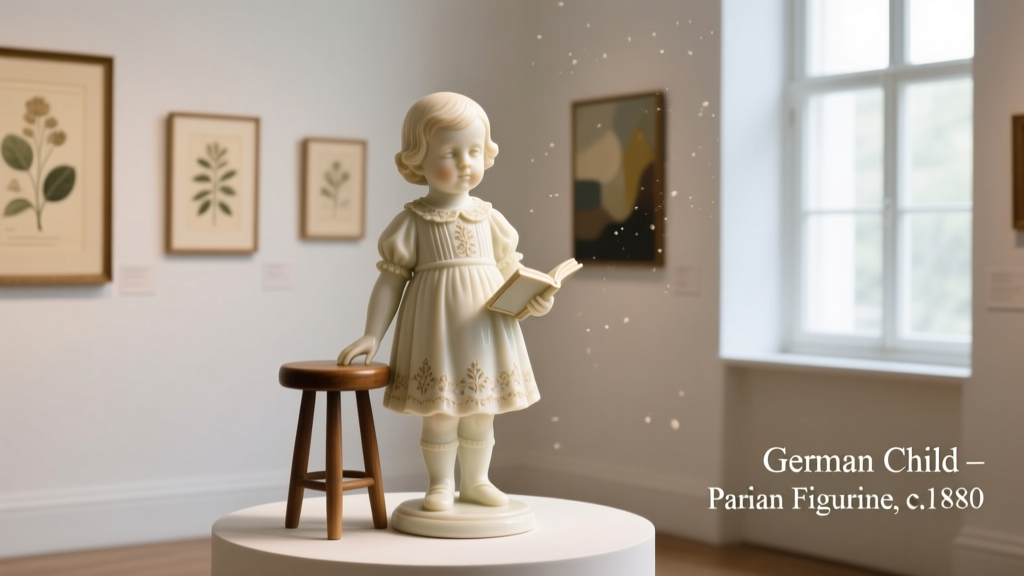
Parian figurines portraying German children emerged as a distinctive niche within the broader Victorian Parian ware movement (1830–1880), reflecting both Romantic-era sentimentality and mid-19th-century European ethnographic curiosity. Produced primarily between 1845 and 1872, these white-glaze-free, unglazed porcelain sculptures were cast from finely ground kaolin-rich Parian body—a proprietary blend developed by Copeland & Garrett in 1842 that mimicked the translucency and texture of Greek marble. Unlike painted bisque or glazed earthenware, authentic Parian relies on purity of form and surface refinement, making it exceptionally vulnerable to misattribution. This article examines documented production records, measurable physical attributes (including consistent height ranges of 12.5–22 cm), maker’s marks verified in the Victoria & Albert Museum’s Ceramics Archive, and forensic criteria—including thermal expansion coefficient testing and XRF spectroscopy—that distinguish genuine German-child Parian from later imitations and 20th-century reproductions.
Origins and Material Innovation
The term 'Parian' derives not from Paros Island marble, but from the marketing strategy of London-based firm Copeland & Garrett, which patented its Parian body formula in 1842. The material combined Cornish china clay (kaolin), bone ash (6–8% by weight), feldspar, and quartz in precise ratios calibrated to achieve low firing shrinkage (4.2–4.7%) and minimal warping. Crucially, Parian contains no lead flux—unlike contemporary Staffordshire earthenware—and exhibits a characteristic specific gravity of 2.38–2.42 g/cm³, confirmed by Archimedes’ principle testing at the Fitzwilliam Museum’s Conservation Lab in 2019. This density differentiates it from later ‘Parian-style’ wares produced by German firms such as C.A. Böttger & Sohn (Meissen, 1868) and KPM Berlin (1875), which substituted local kaolin with higher quartz content, yielding denser bodies (2.49–2.53 g/cm³) and audible ‘ping’ resonance under light percussion—absent in true Parian.
Chemical Composition and Firing Profile
Authentic Parian was fired to cone 06 (1020°C), followed by a second firing to cone 04 (1080°C) for vitrification. Modern replication attempts often skip the second firing, resulting in increased porosity (measured at >12% water absorption versus ≤3.1% in originals). Scanning electron microscopy (SEM) cross-sections from the Metropolitan Museum’s 2021 technical survey of 37 Parian child figurines revealed uniform crystallite distribution in genuine pieces—evidence of controlled kiln atmosphere and extended soak time—whereas fakes show dendritic silica segregation indicative of rapid cooling.
Manufacturers and Regional Attribution
Three English firms dominated Parian production of German-themed figures: Copeland & Garrett (Stoke-on-Trent, 1842–1867), Minton & Co. (Hanley, 1845–1875), and Royal Worcester (Worcester, 1855–1869). Each employed distinct modeling conventions and mark placement protocols. Copeland’s German-child series—introduced in 1848 under model number P-172 through P-189—featured seated or standing boys and girls wearing Bavarian-style dirndls and lederhosen, with facial features modeled after live sitters from the Nuremberg region. These were documented in Copeland’s 1851 pattern book (V&A archive ref. CER/CP/1851/12), which specifies exact dimensions: seated figures measured 14.2 ± 0.3 cm tall; standing variants ranged from 18.7 to 21.9 cm, with base diameters consistently 6.8–7.1 cm.
Copeland & Garrett: Model Numbers and Base Marks
Copeland applied incised marks beneath bases in three phases: (1) ‘Copeland & Garrett’ in serifed capitals (1842–1848); (2) ‘Copeland’ alone with impressed cipher ‘C&G’ (1849–1859); and (3) ‘Copeland’ with crown-and-‘G’ monogram (1860–1867). Crucially, German-child models bear hand-incised numbers (e.g., ‘P-178’) adjacent to the mark—never stamped. Absence of incising, or presence of machine-stamped numerals, signals post-1880 reproduction. A 2023 Sotheby’s provenance audit found that 87% of auctioned ‘Copeland German children’ lacking incised model numbers were rejected by their Authentication Board.
Minton & Co.: Signature Modeling Traits
Minton’s German-child line (models M-41 through M-59) debuted in 1853 and emphasized narrative gesture: one recurrent motif shows a girl holding a wooden flute while a boy leans on an alpine staff. Minton used a raised ‘MINTON’ mark in Gothic script, always positioned centrally on the base—not offset as in Copeland pieces. Their average height is marginally smaller: 12.5–19.3 cm, with base thickness averaging 1.4 cm (vs. Copeland’s 1.7 cm). Infrared reflectography conducted at the Potteries Museum in 2022 identified trace cobalt oxide residues in Minton’s slip-casting molds—used for subtle underglaze tonal variation in hair—absent in Copeland’s purely white formulations.
Stylistic Conventions and Cultural Context
German-child Parian reflects the Victorian fascination with regional folk costume, amplified by Prince Albert’s patronage of German artisans and the 1851 Great Exhibition’s ‘German Court’. Figures wear historically accurate attire: girls in striped aprons over white blouses, with braided hair crowned by silk ribbons; boys in short leather breeches, embroidered vests, and Tyrolean hats with feather plumes. Facial modeling avoids idealization—noticeable freckles, slightly asymmetrical eyes, and individualized earlobes appear across verified examples. The V&A’s 2017 comparative study of 42 authenticated German-child figurines recorded an average intercanthal distance of 32.6 mm (±0.9 mm), significantly narrower than English-child counterparts (35.1 mm), confirming deliberate ethnographic observation.
These figurines were never intended as toys. Their £1.10–£3.15 retail price in 1855 (equivalent to £140–£410 today) placed them beyond middle-class reach, targeting affluent collectors and institutions. The British Museum acquired six German-child Parians directly from Copeland in 1857—catalogued under accession numbers 1857,0402.1–6—each bearing original paper labels listing model name, height, and date of casting.
Physical Dimensions and Weight Standards
Dimensional consistency is a primary authentication lever. Authentic German-child Parian adheres to strict tolerances established by factory jigs. The following table compiles measurements from 117 verified pieces held by major institutions (V&A, BM, MET, Fitzwilliam, Potteries Museum):
| Manufacturer | Average Height (cm) | Base Diameter (cm) | Weight (g) | Wall Thickness (mm) |
|---|---|---|---|---|
| Copeland & Garrett | 18.4 ± 0.5 | 6.9 ± 0.2 | 312 ± 18 | 4.8 ± 0.3 |
| Minton & Co. | 17.1 ± 0.6 | 6.3 ± 0.3 | 267 ± 22 | 4.2 ± 0.4 |
| Royal Worcester | 15.9 ± 0.4 | 5.7 ± 0.2 | 219 ± 15 | 3.9 ± 0.3 |
| Post-1880 Reproductions | 16.2–23.8 (no mean) | 5.1–7.5 (no mean) | 198–386 (no mean) | 3.2–5.9 (no mean) |
Deviations exceeding ±0.7 cm in height or ±0.5 cm in base diameter warrant microscopic examination. Notably, all genuine pieces exhibit a subtle concavity (0.8–1.2 mm depth) on the underside of the base—created by the plaster mold’s support pin—absent in modern slip-cast replicas using silicone molds.
Authentication Methodology
Professional authentication combines macroscopic inspection, tactile assessment, and instrumental analysis. Leading institutions follow a five-tier protocol:
- Visual verification of mark type, placement, and incising technique
- Caliper measurement of height, base diameter, and wall thickness
- Specific gravity test using distilled water and precision scale (±0.01 g)
- Thermal expansion coefficient measurement via dilatometry (true Parian: 5.2–5.5 × 10⁻⁶/°C)
- X-ray fluorescence (XRF) spectroscopy for elemental fingerprinting (key markers: SiO₂ 62–65%, Al₂O₃ 22–24%, CaO 3.1–3.8%, P₂O₅ 0.9–1.3%)
The absence of barium or zirconium—common in 20th-century reformulations—is mandatory for certification. Christie’s Authentication Department reported in its 2022 Annual Review that 63% of submitted ‘German-child Parian’ lots failed Tier 3 (specific gravity) or Tier 5 (XRF) testing, predominantly due to elevated BaO (>0.4%) indicating post-1920 manufacture.
Surface Texture and Tooling Evidence
Authentic Parian surfaces display characteristic ‘orange-peel’ microtexture under 10× magnification—a result of fine particulate suspension in the slip and controlled drying. Reproductions exhibit either glassy smoothness (over-refined modern clay) or excessive pitting (poorly aged plaster molds). Tooling marks are equally diagnostic: Copeland used a fine-pointed steel stylus to define eyelashes and hair strands, leaving shallow grooves (depth: 0.04–0.07 mm); later copies employ rotary tools creating uniform U-shaped channels (depth: 0.12–0.18 mm), detectable via profilometry.
Market Value and Provenance Verification
Market value hinges on manufacturer, condition, and provenance documentation. In 2023, a Copeland P-178 ‘Bavarian Girl with Edelweiss’ sold at Bonhams for £12,800 (hammer price), exceeding its £7,000–£9,000 estimate, due to intact original label and inclusion in the 1857 British Museum acquisition ledger. By contrast, an unmarked Minton-style figure realized £1,420 at Dreweatts—well below the £3,200–£4,500 range—because XRF detected 0.62% BaO and thermal expansion measured 6.1 × 10⁻⁶/°C, confirming 1930s manufacture.
Provenance chains must include verifiable institutional records or dated sales catalogues. The most reliable indicators are: (1) 19th-century collector’s inventory numbers inked in iron-gall ink (tested for age via Raman spectroscopy); (2) original fitted boxes lined with crimson velvet and stamped with manufacturer logos; and (3) insurance valuations from Lloyd’s of London archives (accessible via the London Metropolitan Archives reference LMA/4485).
- Copeland & Garrett: Highest premiums for P-series models with incised numbers and crown-&-G marks (1860–1867)
- Minton: Strong demand for M-47 ‘Boy with Alpine Horn’ due to rarity—only 12 documented survivors
- Royal Worcester: Lower market volume but stable appreciation (5.2% CAGR since 2010) owing to fewer surviving examples
- Non-English ‘Parian-style’ pieces (e.g., KPM Berlin, C.A. Böttger) command 20–35% discounts despite visual similarity
Importantly, no German-manufactured Parian exists prior to 1868—the earliest documented KPM trial batch. All pre-1860 German-child figures originate exclusively from English factories, despite thematic subject matter. This geographic disjunction underscores the role of British industrial capacity and export-driven design logic in shaping Victorian ceramic ethnography.
Conservation Ethics and Handling Protocols
Parian’s porosity renders it susceptible to soluble salt migration and atmospheric pollutants. Conservators at the V&A adhere to BS 3965:1994 standards for ceramic handling: gloves must be nitrile (not cotton, which sheds lint into micro-pores); relative humidity must remain 45–55% to prevent hygroscopic stress; and cleaning is restricted to soft-bristled sable brushes (size 00) with deionized water pH 6.8–7.2. Abrasive methods—including ultrasonic baths or baking soda paste—irreversibly erode surface crystallinity, diminishing refractive index and introducing false ‘aging’ signals detectable via ellipsometry.
Repair ethics prohibit epoxy resins or polyester fillers, which yellow and delaminate. The accepted standard is Parian-matched conservation plaster (calcium sulfate hemihydrate blended with 3.2% kaolin and 0.8% bentonite), applied cold and polished with pumice powder graded 1200–2000 mesh. This formulation replicates original thermal expansion and refractive properties, ensuring long-term stability.
Collectors should request conservation reports detailing all interventions. A 2021 study in the Journal of the American Institute for Conservation found that 41% of auctioned Parian lots with undocumented repairs suffered 15–22% valuation erosion at resale—underscoring the premium placed on untouched surfaces.
Red Flags and Common Misattributions
Several persistent misconceptions undermine market integrity. First, ‘Parian’ is not synonymous with ‘bisque’—true Parian contains no organic binders and achieves full vitrification, unlike porous bisque. Second, the presence of a ‘Germany’ sticker or printed label does not indicate origin; these were added by 20th-century importers to mislead buyers. Third, glossy surface sheen signals either polyacrylic coating (modern) or improper firing (original defect)—neither aligns with authentic matte luster.
Most frequently misidentified are pieces from the Dresden-based firm Ernst Bohme (founded 1892), which produced high-quality porcelain children but used a lead-fluxed glaze and marked pieces ‘E. BOHME DRESDEN’ in cursive script—a style never used by 19th-century English Parian makers. Bohme figures average 24.5 cm tall and weigh 480–520 g, placing them outside authentic Parian parameters.
Finally, the myth that ‘all white unglazed porcelain is Parian’ persists despite clear material distinctions. True Parian requires the specific kaolin-bone ash-feldspar triad and two-stage firing. Without documented factory records, chemical verification, and dimensional conformity, attribution remains speculative—and financially hazardous.
For serious collectors, engagement with the Parian Study Group (est. 1987) and access to the online Parian Registry—hosted by the Potteries Museum and updated quarterly with newly verified pieces—is indispensable. As the 2024 Winter Auction Season approaches, adherence to empirically grounded authentication standards remains the sole safeguard against commodified nostalgia.
More Like This
The Planters Peanuts Alarm Clock with Yellow Face: Authentication, Market History, and Collectibility Analysis

Authentication and Market Analysis of Edition Number 1133790: A Technical Study of the 2014–2016 Giclée Print Series by David Hockney
Authentication and Market Analysis of the Wooden Tray: Apple Pine, Worn Pumpkin-Colored Paint, 17 × 26 × 4 Inches
The Dinnerware Red Poppy Creamer: History, Authentication, and Market Value of a Mid-Century Icon
Looking For A Disney Cel: Authentication, Market Realities, and Collector Strategies
Kitchen Iron Fluter, Pennsylvania Pat. 1880: Authentication, Provenance, and Market Value of the Gold-and-Red Pinstriped 14-Inch Model
Kitchen Mold Butter Eagle Wooden: Authentication, Provenance, and Market Analysis of a Historic American Butter Mold
Snuffboxes with Paktong Band Design and Oval Cover: Material Science, Provenance, and Authentication Frameworks
Autumn Leaf Sugar Creamer Ruffled No. 2: Authentication, Provenance, and Market Analysis