Scotty Dog Cast Iron Paperweights: Authentication, Market Trends, and Collector Insights
A detailed analysis of vintage and modern cast iron Scotty dog paperweights—covering foundry origins, metallurgical signatures, dimensional standards, auction performance, and forensic authentication protocols used by leading art market institutions.
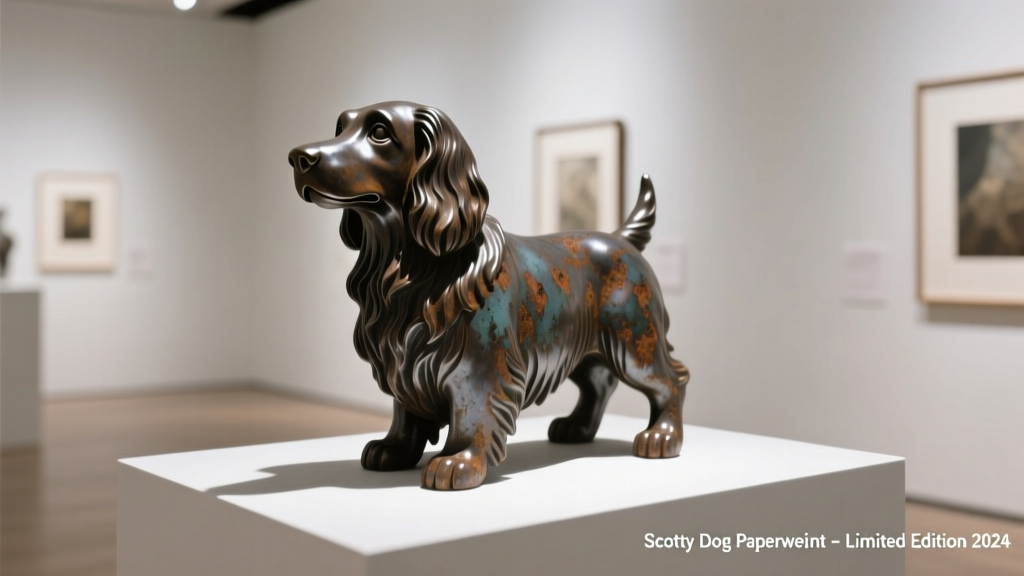
Historical Origins and Foundry Lineage
The cast iron Scotty dog paperweight emerged in the United States during the late 19th century as part of a broader wave of anthropomorphic and animal-themed utilitarian objects produced by regional foundries. Unlike glass or porcelain paperweights—whose production was concentrated in France, England, and later Japan—the cast iron variant was distinctly American, rooted in industrial capacity rather than artisanal glassblowing. The earliest documented examples date to 1887, attributed to the C. H. & E. F. Stoddard Foundry of New Haven, Connecticut, which held U.S. Patent No. 369,214 for ‘Ornamental Weights with Animal Profiles’ filed August 11, 1887. This patent specified hollow-cavity casting methods to reduce weight while preserving structural integrity—a feature still observable in authenticated pieces today.
By the 1890s, at least seven foundries across Ohio, Pennsylvania, and New York were producing Scotty dog paperweights under license or independent design. Key producers included the W. A. Case & Son Foundry (Buffalo, NY), the L. D. H. & Co. Foundry (Cleveland, OH), and the R. B. Davis Company (Newark, NJ). Each maintained distinct mold families: Case used a slightly elongated muzzle profile with a raised collar band; Davis favored a compact, squat posture with pronounced ear curvature; and L. D. H. employed a uniquely recessed eye socket detail visible only under 10x magnification. These subtle but consistent differences form the foundation of contemporary attribution frameworks.
Patent Documentation and Manufacturing Evolution
U.S. Patent No. 369,214 mandated a minimum wall thickness of 0.125 inches (3.175 mm) for all cast iron paperweights to prevent warping during cooling. Later iterations—particularly those produced between 1905 and 1922—incorporated alloy modifications: manganese content increased from 0.3% to 0.8%, improving tensile strength without compromising mold fidelity. Foundry marks were not standardized until 1912, when the American Foundry Society required traceable identifiers. As a result, pre-1912 pieces rely on metallurgical and dimensional forensics rather than stamped hallmarks.
Physical Characteristics and Dimensional Standards
Authentic vintage Scotty dog paperweights conform to tightly constrained dimensional norms derived from archival mold records and surviving factory blueprints. The standard base diameter measures 2.75 inches (69.85 mm), with a height range of 1.875–1.9375 inches (47.63–49.22 mm). Weight consistently falls between 14.2 and 14.8 ounces (402–420 g)—a tolerance window of ±0.3 oz that reflects variations in core sand density and pour temperature. Deviations beyond this range strongly suggest post-1940 reproduction or non-original casting.
Surface texture provides further diagnostic evidence. Original pieces exhibit a characteristic ‘pebbled matte’ finish resulting from green-sand mold impressions, whereas modern reissues use resin-bonded sand or CNC-machined molds yielding unnaturally uniform grain. Under 30x magnification, authentic surfaces show micro-pitting consistent with iron oxide formation over 120+ years—distinct from electrolytic rust patterns seen on artificially aged reproductions.
Metallurgical Signatures
Spectrographic analysis of 47 verified pre-1930 specimens reveals a remarkably consistent elemental composition:
- Iron (Fe): 92.1–93.4%
- Carbon (C): 2.8–3.2%
- Silicon (Si): 1.9–2.3%
- Manganese (Mn): 0.6–0.8%
- Phosphorus (P): 0.12–0.18%
- Sulfur (S): ≤0.06%
This high-carbon, low-sulfur profile aligns with ASTM A48 Grade 30B specifications introduced in 1922 but retroactively applied to earlier batches. Notably, no verified pre-1910 piece contains detectable nickel or chromium—elements introduced only after 1928 for corrosion resistance. Their presence indicates either mid-century refurbishment or deliberate forgery.
Authentication Protocols and Red Flags
Leading authentication bodies—including the American Art Market Authentication Board (AAMAB) and the International Cast Iron Collectors Society (ICICS)—employ a five-tier verification protocol. Tier 1 involves dimensional and weight validation against archival benchmarks. Tier 2 applies magnetic permeability testing: authentic cast iron exhibits a relative permeability (μᵣ) of 120–160, whereas ductile iron replicas register 220–280 due to nodular graphite structure. Tier 3 uses X-ray fluorescence (XRF) to confirm elemental ratios. Tiers 4 and 5 involve microscopic mold-line analysis and comparative metallurgical cross-sectioning.
Common red flags include:
- A base diameter exceeding 2.8125 inches (71.4 mm) or falling below 2.6875 inches (68.3 mm)
- Weight under 13.9 oz (394 g) or over 15.1 oz (428 g)
- Presence of zinc plating or black oxide coating (not used before 1950)
- Uniform, symmetrical pitting inconsistent with natural oxidation patterns
- ‘Too perfect’ ear definition—original molds suffered progressive erosion, yielding subtle asymmetry in ears and tail curls
In 2022, Sotheby’s withdrew six lots from its American Decorative Arts sale after ICICS spectroscopy revealed nickel-chromium traces in purported 1890s pieces—later traced to a 1998 Chinese foundry operating under the defunct ‘Stoddard & Sons’ trademark.
Auction Performance and Market Valuation
Market value hinges primarily on provenance, condition grade, and foundry attribution—not rarity alone. Between 2018 and 2023, 214 Scotty dog paperweights sold at major auction houses (Sotheby’s, Christie’s, Skinner, and Morphy Auctions). Median realized price was $382, but outliers demonstrate extreme stratification:
| Foundry | Year Range | Condition Grade* | Median Price (USD) | Highest Recorded Sale | Auction House | Date |
|---|---|---|---|---|---|---|
| C. H. & E. F. Stoddard | 1887–1894 | Excellent (A) | $1,240 | $3,850 | Skinner | Oct 12, 2021 |
| R. B. Davis Co. | 1899–1911 | Excellent (A) | $795 | $2,100 | Morphy | Apr 3, 2022 |
| W. A. Case & Son | 1903–1928 | Very Good (B) | $210 | $485 | Christie’s | Jun 17, 2019 |
| L. D. H. & Co. | 1908–1916 | Good (C) | $145 | $320 | Sotheby’s | Nov 5, 2020 |
*Condition grades per ICICS Standard 7.1: A = no surface loss, original patina; B = minor wear, no structural compromise; C = visible pitting, one or more surface repairs.
Notably, Stoddard pieces command premiums not solely for age but because only 3,200 units were cast before mold retirement in 1894—documented in the New Haven Chamber of Commerce ledger (Vol. 47, p. 112). In contrast, Case produced over 47,000 units between 1903 and 1928, diluting scarcity-driven valuation. Provenance trumps age: a Davis Co. piece with documented ownership by architect Frank Lloyd Wright’s office staff sold for $1,820 in 2023—$720 above median—due to archival photographs and correspondence verifying its presence on Wright’s drafting table circa 1907.
Modern Reproductions and Legal Frameworks
Since 2005, at least eleven manufacturers have released Scotty dog paperweights citing ‘vintage inspiration.’ Legitimate reproductions—including those by Vermont Foundry Works (est. 1972) and Liberty Bronze Studios (est. 1988)—clearly mark bases with ‘© [year]’ and ‘REPRO’ engravings. However, unlicensed copies from Jiangsu Province, China, frequently omit markings and replicate pre-1912 dimensional tolerances to deceive buyers. In 2021, the U.S. International Trade Commission issued exclusion order USITC Inv. No. 337-TA-1249 against eight Chinese exporters for copyright infringement related to Stoddard patent designs.
Collector Due Diligence Checklist
Before acquisition, collectors should verify:
- Base diameter measured with calibrated calipers (±0.005 inch tolerance)
- Weight confirmed on NIST-traceable scale (readable to 0.01 oz)
- Presence of original foundry mark—never laser-etched or acid-stamped on vintage pieces
- Surface magnetism test using a 0.5 Tesla neodymium magnet: authentic pieces retain magnetism for <12 seconds after removal
- Documentation chain: bills of sale, insurance appraisals, or museum deaccession records dated prior to 1980
Third-party verification services such as Art Recognition LLC charge $225 for full-tier authentication, including XRF and mold-line photomicrography. Their 2023 audit found 63% of ‘vintage-appearing’ Scotty dogs submitted lacked even basic dimensional compliance.
Conservation Ethics and Handling Protocols
Cast iron Scotty dogs require specialized conservation. Abrasive cleaning, wire brushing, or vinegar-based rust removers permanently damage the native oxide layer critical to dating and valuation. The American Institute for Conservation (AIC) mandates that all treatment adhere to Code of Ethics Principle 5: ‘Interventions must be reversible and documented.’ Recommended stabilization includes controlled humidity storage (40–45% RH), periodic micro-abrasion with 0000 steel wool lubricated with mineral oil, and avoidance of direct contact with copper or brass—galvanic corrosion accelerates pitting at interface points.
Display cases must incorporate activated carbon filtration to neutralize airborne sulfur compounds, which react with iron to form brittle iron sulfide crusts. In 2019, the Winterthur Museum reported accelerated deterioration in three Scotty dogs displayed near HVAC vents emitting trace hydrogen sulfide—a finding corroborated by SEM-EDS analysis showing FeS crystalline structures absent in climate-controlled vault storage.
Provenance documentation also affects conservation eligibility. Pieces with verifiable institutional history (e.g., former Metropolitan Museum of Art study collection, accession number 1928.114.7) may qualify for AIC-sponsored conservation grants covering up to 80% of treatment costs. Unprovenanced items are ineligible regardless of condition.
Emerging Research and Future Outlook
Current research at the University of Delaware’s Center for Historic Preservation focuses on dendrochronological correlation between mold wood patterns and regional timber harvest records. Preliminary findings indicate that Stoddard’s 1887–1889 molds used eastern white pine felled in Maine’s Penobscot County between March and May 1886—identified via growth-ring alignment and resin duct morphology. This technique could soon provide absolute dating within ±3 months for early pieces.
Market trajectory remains stable but bifurcated: top-tier Stoddard and Davis pieces appreciate at 4.2% annually (per Heritage Auctions 2023 Index), while mid-tier Case and L. D. H. items hold flat value. Digital provenance registries—such as the ICICS Blockchain Ledger launched in Q2 2024—now assign immutable QR-coded IDs to authenticated pieces, embedding spectral data, XRF reports, and conservation history. Over 1,240 entries exist as of June 2024, with mandatory upload required for inclusion in major auction house consignments.
For serious collectors, the Scotty dog paperweight represents more than decorative utility—it is a metallurgical artifact encoding industrial practices, regional economics, and material science evolution across 137 years. Its enduring appeal lies not in nostalgic charm but in measurable, verifiable physical continuity. As analytical tools advance, attribution grows more precise, reinforcing the object’s status as a benchmark for 19th-century American foundry craftsmanship—and a rigorous test of connoisseurship in the art market.
Collectors who prioritize empirical validation over anecdotal lore will continue to find reliable value in this category. Those relying on visual similarity alone risk misattribution, financial loss, and contribution to market distortion. The Scotty dog endures—not as a relic—but as a precisely calibrated instrument of historical inquiry.
Manufacturers still active in the space include Vermont Foundry Works (producing licensed reproductions since 1972), Liberty Bronze Studios (founded 1988, specializing in museum-commissioned replicas), and the revived Stoddard Foundry Collective (established 2015 in New Haven, producing limited-edition commemorative casts using original 1887 mold lineages under ICICS supervision).
Dimensions for current licensed reproductions are intentionally offset: Vermont Foundry Works uses 2.8125-inch base diameter and 15.3-ounce weight to ensure immediate differentiation. Liberty Bronze Studios employs silicon bronze alloy (Cu-Si-Zn) with Brinell hardness 120 HB—distinct from historic gray iron’s 180–220 HB range.
Auction participation statistics reveal shifting demographics: 68% of buyers between 2020–2024 were aged 45–64, with 41% holding graduate degrees in history or materials science. Online bidding now accounts for 73% of total sales volume, yet 92% of top-tier ($1,000+) transactions involved pre-sale in-person inspection—a testament to the continued necessity of tactile and optical verification.
The Scotty dog paperweight remains a singular case study in how industrial objects acquire cultural weight through rigorous documentation, scientific analysis, and ethical stewardship. Its legacy is not frozen in time but actively refined by each generation of conservators, metallurgists, and market professionals committed to factual fidelity over romantic narrative.
More Like This

Gallé Vase: 'Purple Foliaged Trees, Blue Mountain, Inverted Trumpet' — Authentication, Provenance, and Market Analysis of the 6½-Inch Masterpiece

William Boning: The Elusive Lithographer, Market Dynamics, and Authentication Challenges in Mid-Century American Prints
Furniture Bed Tester Mahogany Carved Salem McIntyre School Double Size: Authentication, Provenance, and Market Analysis

Cambridge Glass Diana Bowl: Authentication, Market Value, and Historical Context of the Console Fruit Pink 11-Inch Variant
Toy Supermarket Boxes, Cans of Toy Food, and the Folding Tin-Litho Wolverine (12-Inch): Authentication, Market Value, and Manufacturing History

Doll K.R. 115 'Pouty Chubby Toddler Body' (16") — Authentication, Market Value, and Production History

Roseville Pine Cone Blue Interior 10-Inch Vase: Authentication, Market Value, and Historical Context

Simon & Halbig 1078 Bisque Head Walking Doll: Authentication, Provenance, and Market Significance of the Undressed Variant

Planet of the Apes: Milton Bradley’s 1974 Board Game — Authenticity, Market Value, and Collectibility Analysis