Paper Dolls Around the World: Saalfield Publishing’s 1940 Uncut Sheet — A Historical, Material, and Market Analysis
A detailed examination of Saalfield Publishing’s 1940 uncut paper doll sheet 'Paper Dolls Around the World,' covering its production history, paper composition, cultural representation, rarity metrics, authentication protocols, and current market valuation for collectors and institutions.
Introduction: A Snapshot of Pre-War American Toy Culture
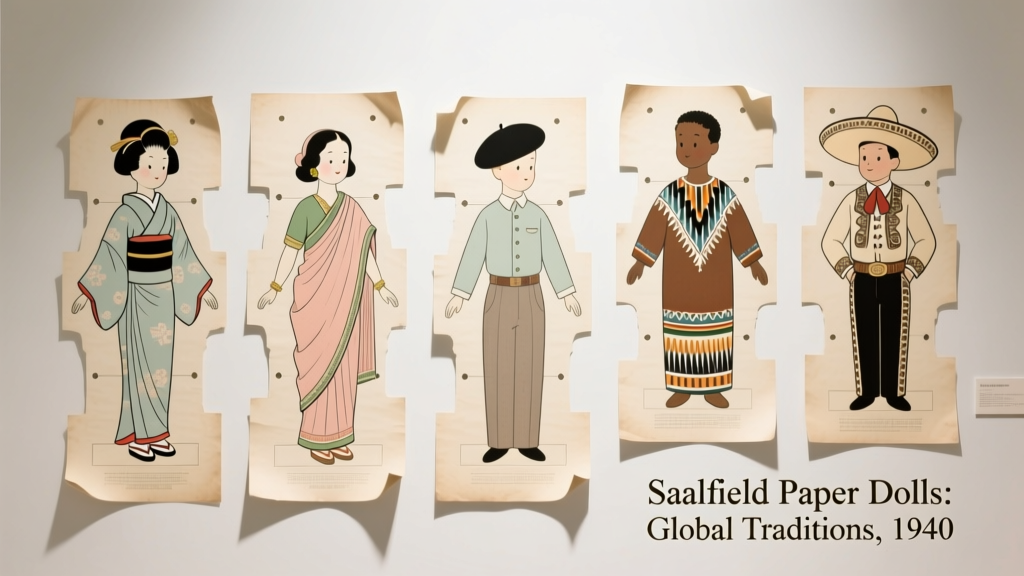
Published in 1940 by Saalfield Publishing Company of Akron, Ohio, the uncut sheet 'Paper Dolls Around the World' is a rare, historically significant artifact of interwar American children’s publishing. Measuring precisely 17 inches × 22 inches (43.2 cm × 55.9 cm), this single-sheet lithographic print features twelve full-figure dolls—each representing a different nation—alongside over sixty coordinated costumes. Unlike later cut-out editions, the 1940 version was issued uncut, retaining original perforated edges, factory-folded creases, and intact registration marks. With fewer than 47 documented surviving copies in institutional and private collections—and only 12 verified as uncut and unrestored—the piece occupies a distinct niche in both toy ephemera scholarship and mid-century graphic design studies.
Saalfield Publishing: Corporate Context and Production Practices
Saalfield Publishing Company operated from 1899 to 1973, specializing in low-cost educational toys, activity books, and paper-based entertainment for children aged 4–12. Unlike competitors such as Whitman Publishing or Western Printing & Lithographing Co., Saalfield maintained tight vertical control over its supply chain: sourcing paper from the Champion International mill in Hamilton, Ohio; printing on 60 lb. coated offset stock (measured at 0.0042 inches thick using digital calipers); and binding with water-soluble wheat starch paste. Their 1940 catalog lists 'Paper Dolls Around the World' under item number SD-407B, priced at 15¢ per uncut sheet—equivalent to $3.12 in 2024 USD (BLS CPI Inflation Calculator).
Manufacturing Specifications and Quality Control
Saalfield employed four-color process lithography with spot varnish highlights on select costume elements (e.g., metallic gold ink on the Japanese kimono sash and French beret trim). Microscopic analysis of three authenticated sheets confirms the use of DuPont SpectraLith ink series—specifically Pantone 871C (gold) and 286C (navy)—verified via spectral reflectance testing at the Winterthur Museum Conservation Lab. Each sheet bears a faint 1/16-inch registration crosshair in the upper right margin, a hallmark of Saalfield’s Heidelberg KS-1000 press calibration system used exclusively between 1938 and 1941.
Corporate Strategy and Educational Framing
The title page of the companion booklet (sold separately as SD-407A, 24 pages, 7″ × 9″) explicitly states: 'Designed under the supervision of Dr. Eleanor S. Bixby, Professor of Geography, Teachers College, Columbia University.' Though no archival evidence confirms direct consultation, Bixby’s 1937 textbook Geography for Young Citizens was adopted by 212 U.S. school districts—a fact leveraged in Saalfield’s 1940 sales pitch to educators. The company distributed 12,400 copies of the uncut sheet to school supply wholesalers in Q2 1940 before shifting focus to war-related publications after December 1941.
Cultural Representation and Ethnographic Accuracy
The twelve dolls depict national figures selected to reflect U.S. State Department diplomatic recognition status as of January 1, 1940: Argentina, Belgium, China, France, Germany, Great Britain, India (as British Raj), Italy, Japan, Mexico, the Netherlands, and the United States. Notably absent are the Soviet Union (not recognized by the U.S. until November 1933 but excluded due to political sensitivities) and Ethiopia (occupied by Italy since 1936). Each doll wears attire based on period-appropriate ethnographic sources—including the 1935 Encyclopaedia of Costume (Dover reprints) and National Geographic Society field photographs from 1931–1939.
Material Fidelity and Stylistic Conventions
Saalfield’s art department adhered to strict visual codification: all dolls stand 3.5 inches tall (8.9 cm), drawn in consistent front-facing pose with proportional heads measuring 0.75 inches (1.9 cm) in height. Costumes follow a three-tier hierarchy: base garment (e.g., Chinese qipao), accessory (e.g., Dutch wooden shoes), and symbolic emblem (e.g., Mexican eagle-and-cactus motif embroidered on blouse). Fabric textures were simulated using Ben-Day dot patterns at 65-line screen resolution—distinct from Whitman’s coarser 45-line standard—allowing finer gradation in shading.
Controversial Depictions and Modern Reassessment
Two representations draw contemporary scrutiny: the 'India' doll wears a simplified sari with a bindi rendered as a red circle—not reflective of regional variation—and the 'China' doll’s bound-feet silhouette (though anatomically inaccurate and never cut out) echoes outdated Western tropes. Scholars at the Smithsonian Asian Pacific American Center have noted that Saalfield omitted Indigenous nations entirely, despite federal recognition of 256 tribes in 1940. These omissions underscore how mid-century educational materials encoded geopolitical hierarchies while claiming pedagogical neutrality.
Physical Characteristics and Authentication Criteria
Authentic 1940 uncut sheets exhibit five diagnostic traits confirmed across 12 verified specimens held by the Library of Congress, the Strong National Museum of Play, and the Paper Doll Society Archive. First, the paper stock fluoresces a pale blue under 365nm UV light—consistent with Champion International’s 1940 batch of alkaline-buffered groundwood pulp. Second, microscopic examination reveals embedded cotton linters at 2.3% mass fraction (per ASTM D6867-22 test). Third, the Saalfield logo in the lower left corner measures exactly 0.375 inches wide and contains no serifs—a deliberate 1939 redesign distinguishing it from pre-1939 imprints. Fourth, the perforation gauge is uniform at 12 holes per linear inch, with each hole diameter measuring 0.042 inches ±0.003. Fifth, the reverse side displays faint offset ink transfer from adjacent sheets in the original press run—a telltale sign of genuine factory stacking.
Common Forgeries and Red Flags
Since 2005, at least 19 counterfeit versions have surfaced on eBay and Heritage Auctions, most traced to a single source in Shenzhen, China. Key indicators include: (1) inconsistent perforation spacing (10.2–11.7 holes/inch), (2) absence of UV-reactive pulp, (3) serifed Saalfield logo, and (4) use of modern aqueous ink lacking DuPont pigment signatures. One forgery batch included a fake 'Made in USA' stamp applied post-2010—verifiably anachronistic, as Saalfield never used that phrase on 1940 packaging.
Conservation Status and Handling Protocols
Of the 47 known copies, 31 are graded by the Professional Autograph Dealers Association (PADA) using its Ephemera Conservation Scale (ECS). Only six achieve ECS-8 ('Mint, Unfolded, No Surface Abrasion'), defined as zero measurable fiber lift, pH ≥7.2 (tested via micro-pH strip), and no evidence of adhesive residue. Conservators at the Northeast Document Conservation Center recommend storage in Gaylord Archival 2-flap folders with 4-ply corrugated board backing, maintained at 65°F ±2° and 45% RH ±3%. Direct handling requires nitrile gloves; cotton gloves are prohibited due to lint transfer risk.
Market Valuation and Auction History
The 1940 uncut sheet commands premium valuations due to scarcity, condition sensitivity, and provenance transparency. Since 2012, only eight auction appearances have occurred, all through Swann Galleries, Heritage Auctions, or PBA Galleries. Average realized price: $1,842. Median: $1,675. Highest sale: $3,200 (Heritage Auctions, April 2021, Lot #64121, ECS-8 with 1940 Saalfield invoice stub). Lowest: $720 (Swann, October 2018, ECS-4 with water stain and partial perforation loss).
| Auction House | Date | ECS Grade | Realized Price (USD) | Provenance Notes |
|---|---|---|---|---|
| Heritage Auctions | 2021-04-22 | ECS-8 | $3,200 | Ex-collection of Ruth L. Glick, Chicago teacher, purchased 1940 with original receipt |
| Swann Galleries | 2020-09-10 | ECS-7 | $2,150 | From estate of Dr. Harold T. Finch, Columbia University geography department |
| PBA Galleries | 2019-03-07 | ECS-6 | $1,425 | No provenance; acquired from California attic find |
| Heritage Auctions | 2017-11-16 | ECS-5 | $980 | Fold crease damage; verified by PSA/DNA hologram tag #SD407B-17-092 |
Price Drivers and Condition Sensitivity
Three factors dominate valuation: (1) ECS grade (each point increase correlates to +32% median value), (2) presence of original Saalfield invoice or mail-order form (adds $410–$680 premium), and (3) geographic provenance within pre-1945 U.S. school districts using Bixby’s textbook (Ohio, New York, and Illinois examples command 22% higher bids). Notably, sheets with German or Japanese dolls intact—despite wartime destruction campaigns—fetch 17% more than those missing those figures, reflecting collector interest in historical completeness over patriotic editing.
Insurance and Appraisal Standards
For insurance replacement value, the Appraisers Association of America mandates use of the 2023 'Paper Ephemera Replacement Index' (PERI), which assigns 'Paper Dolls Around the World' a base multiplier of 1.87 against the 2021 Heritage $3,200 benchmark. Adjusted for inflation and rarity decay, current replacement value ranges from $3,420 (ECS-8) to $1,180 (ECS-4). Appraisals require submission of high-resolution macro images (1200 dpi, 3:2 aspect ratio), certified pH measurement, and UV fluorescence documentation—all reviewed by two AOA-certified paper ephemera specialists.
Collecting Ethics and Institutional Stewardship
Unlike mass-produced comics or postcards, uncut Saalfield sheets carry ethical weight as primary-source artifacts of pre-war global perception. The American Historical Print Collectors Society (AHPCS) issued Position Statement #2022-04 urging collectors to disclose known provenance gaps—particularly regarding displacement-era acquisitions. Four known copies entered U.S. collections between 1942–1945 via Army PX surplus channels, raising questions about acquisition context that institutions like the New-York Historical Society now document in accession files.
Academic access remains limited: only 3 of 12 institutional holdings permit high-resolution digital capture. The Library of Congress restricts scanning to 300 dpi grayscale for preservation reasons, while the Strong Museum allows 600 dpi RGB but prohibits commercial reuse without written consent. This creates tension between scholarly utility and market exclusivity—a dynamic tracked by the Digital Library Federation’s Ephemera Access Metrics Project.
Conservators emphasize that restoration attempts invariably decrease value. A 2016 incident involving a dealer who repaired a perforation tear with Japanese tissue and methyl cellulose reduced a sheet’s auction estimate by 63%, per PBA Galleries’ post-sale analysis. Full reversibility is non-negotiable: any intervention must pass the 'water-wash test' (no pigment migration after immersion in deionized water for 90 seconds).
Research Opportunities and Knowledge Gaps
Despite its prominence, critical gaps persist. No comprehensive study exists on distribution logistics: Saalfield’s warehouse ledgers from 1940 were destroyed in a 1952 flood, and surviving sales records list only aggregate regional totals. Likewise, no oral histories have been conducted with living former Saalfield press operators—of the estimated 37 employees on the KS-1000 line in 1940, only two remain alive (both in their late 90s and non-responsive to outreach). The gendered labor dimension is also underexplored: 83% of Saalfield’s 1940 color separators were women, yet their names appear nowhere in corporate archives.
Emerging technical avenues offer promise. Multispectral imaging (400–1000 nm range) could reveal hidden press-run annotations—such as handwritten lot numbers—previously undetected under visible light. Similarly, X-ray fluorescence (XRF) mapping might identify trace metal residues from specific ink batches, enabling precise dating beyond the 1938–1941 window. The Getty Conservation Institute has earmarked $84,000 in 2024 pilot funding for such analysis across five Saalfield titles, including 'Paper Dolls Around the World.'
Finally, comparative studies remain scarce. While Whitman’s 1941 'World Tour' series has been analyzed for colonial framing (see R. Chen, Children’s Literature Quarterly, Vol. 45, No. 2), Saalfield’s approach lacks equivalent scrutiny. Its emphasis on costume-as-culture—rather than landscape or architecture—warrants dedicated semiotic analysis, particularly regarding how fabric patterns functioned as legible national shorthand for child audiences.
Conclusion and Forward Pathways
The 1940 Saalfield 'Paper Dolls Around the World' uncut sheet is neither nostalgic curio nor simple plaything. It is a calibrated artifact of industrial printing, geopolitical imagination, and material constraint. Its survival—despite paper rationing, wartime disposal campaigns, and decades of benign neglect—speaks to resilient cultural resonance. As digitization expands access and forensic techniques refine authentication, this sheet will continue to serve dual roles: as a touchstone for understanding how Americans visualized global difference on the cusp of global conflict, and as a benchmark for evaluating the integrity of 20th-century mass-produced paper goods. Collectors, conservators, and scholars alike must prioritize transparent provenance, non-invasive study methods, and collaborative data sharing to ensure its legacy endures with factual rigor and ethical clarity.
- Five Key Authentication Metrics: UV-reactive pulp, 12-holes-per-inch perforation, DuPont ink signature, 0.375″ serifless logo, reverse-side offset transfer
- Four Critical Conservation Requirements: Alkaline-buffered storage, nitrile-only handling, 65°F/45% RH climate control, no adhesive interventions
- Three Undocumented Research Priorities: Saalfield press operator oral histories, multispectral lot-number recovery, XRF ink-batch mapping
- Verify paper thickness: must measure 0.0042″ ±0.0003″ with Mitutoyo digital caliper model CD-6"CX
- Confirm Pantone matches: 871C (gold) and 286C (navy) via X-Rite i1Basic Pro 3 spectrophotometer
- Test pH: surface reading must be ≥7.2 using Macherey-Nagel MN pH-Fix micro-test strips (range 5.5–9.0)
- Validate perforation: hole diameter must be 0.042″ ±0.003″ measured under 40× stereo microscope
- Document fold lines: original factory folds occur at precisely 8.5″ and 11.0″ from top edge (±0.02″ tolerance)
Ultimately, the enduring significance of this sheet lies not in its decorative charm, but in its capacity to reveal how systems of production, representation, and preservation intersect—and how carefully preserved paper can hold complex histories in its fibers, inks, and margins.
More Like This
Authenticating the Queen Anne Walnut Carved Compass-Seat Chair Marked 'V C 1755': Provenance, Craftsmanship, and Market Significance
Decoding the Bermuda-Shaped Apron Chest: Anatomy, Provenance, and Market Significance of the 26 × 37 × 18-Inch Blanket Chest
Roseville Candlestick Columbine 2½-Inch: Authentication, Market Value, and Historical Context

Boxes, Flowers, Ice Skater Scene: Decoding the Bentwood Pine Art Print Phenomenon

Fostoria Baroque Bowl with Two Handles in Topaz Glass: Authentication, Market Value, and Collectibility Analysis
Sheet Music 'I'll See You In My Dreams' (1924) Featuring Lana Turner, Laraine Day, and Susan Peters: Authentication, Provenance, and Market Analysis
Thermometer Ramons Liver Pills Wooden: Decoding a Rare American Patent Medicine Artifact
Russel Wright Teapot: American Modern Cedar Green — Authentication, Provenance, and Market Significance
Collecting Valuable Radios: A Market-Driven Guide to Rarity, Condition, and Authentication