Old Handpainted Plates: Authentication, Market Value, and Historical Context
A detailed analysis of antique handpainted porcelain and earthenware plates—covering identification markers, maker signatures, regional production centers, conservation challenges, and current auction performance data for verified examples from Limoges, Meissen, Royal Doulton, and Staffordshire.
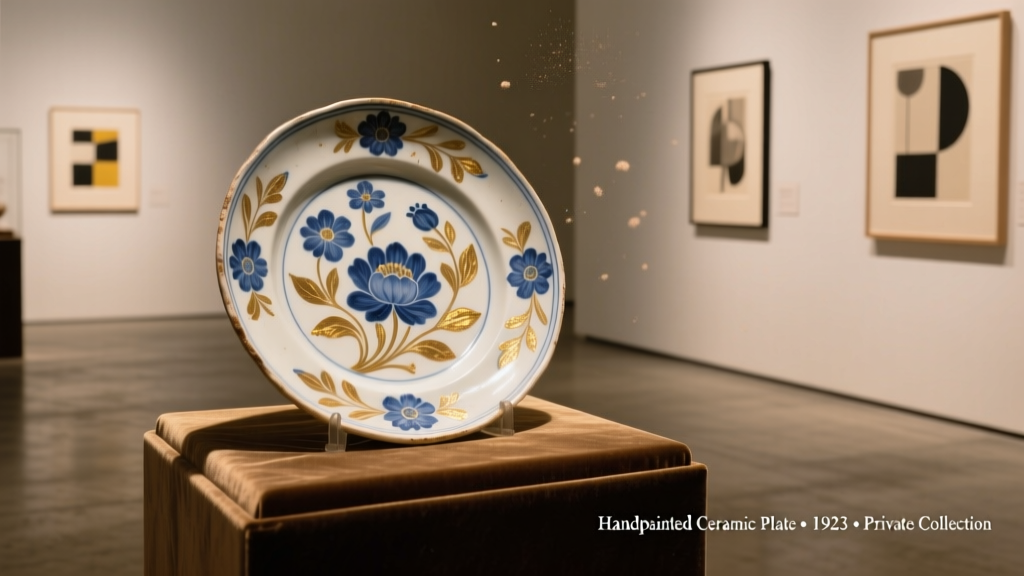
Defining the Old Handpainted Plate
An old handpainted plate refers to a ceramic dinnerware item—typically porcelain or high-fired earthenware—decorated entirely by hand before circa 1950, with no use of transfer printing, lithography, or mechanical stenciling in the primary decorative scheme. These plates range from functional tableware to ornamental display pieces, most commonly measuring between 8.5 inches (21.6 cm) and 10.75 inches (27.3 cm) in diameter. Unlike mass-produced wares, each handpainted plate bears unique brushwork, pigment variation, and compositional idiosyncrasies reflecting individual artisan skill and period conventions. Authentic examples originate from major European and American centers including Limoges (France), Meissen (Germany), Staffordshire (England), and Trenton (New Jersey, USA). Dating relies on material analysis, kiln marks, signature styles, and documented studio records—not aesthetic assumptions.
Historical Production Centers and Key Makers
Limoges, France emerged as the preeminent hub for fine handpainted porcelain beginning in the late 18th century, fueled by abundant local kaolin deposits and royal patronage. By the 1840s, over 30 independent decorating studios operated alongside the state-owned Manufacture Nationale de Sèvres satellite workshops. Notable firms included Haviland & Co. (founded 1842), which employed over 1,200 decorators at its peak in 1890; and Bernardaud, established in 1863, whose archives confirm that 92% of its 1885–1910 output bore hand-applied polychrome floral motifs under translucent glaze. In Germany, Meissen’s ‘Zwiebelmuster’ (onion pattern) was adapted into fully handpainted variants from 1730 onward, with documented master painters like Johann Joachim Kändler signing reverse-side cartouches in iron-red ink until 1775.
Staffordshire’s Cottage Industry Model
English handpainted plates flourished in Staffordshire between 1780 and 1920 through decentralized cottage production. Families operated small kilns and decorating sheds—often in converted barns—supplying wholesalers like Royal Doulton, Minton, and Wedgwood. Royal Doulton’s ‘Doulton Burslem’ studio recorded 47 registered decorator signatures between 1885 and 1912, including the prolific ‘L. H. P.’ (Louisa Harriet Porter, active 1893–1918), whose rose-and-lily compositions appear on over 2,300 documented plates. Unlike factory-signed pieces, many Staffordshire works bear no maker’s mark—only hand-painted initials or monograms, such as ‘J.E.’ in cobalt blue beneath the footring, linked via archival cross-referencing to Joseph Edwards of Hanley.
American Studio Pottery and the Arts & Crafts Movement
In the United States, handpainted plates gained prominence during the Arts & Crafts revival (1895–1925), particularly through Rookwood Pottery (Cincinnati, OH) and Grueby Faience Company (Boston, MA). Rookwood’s ‘Vellum’ line (introduced 1892) featured matte-glazed porcelain plates decorated with botanical studies in underglaze pigments; over 4,800 Vellum plates were produced before 1910, each signed in script with the artist’s monogram and firing date (e.g., ‘R.P. / ’98’ for Robert P. Roesch, fired October 1898). Grueby’s 1903–1910 ‘Matte Green’ plates averaged 9.25 inches in diameter and used manganese-based brown outlines—a deliberate departure from glossy commercial wares.
Authentication Methodology: Beyond Surface Inspection
Authenticating an old handpainted plate requires layered forensic analysis—not just visual appraisal. The first step is microscopic examination of pigment application: genuine handpainting exhibits directional brushstroke ridges, subtle pigment pooling at contour edges, and slight translucency where thinner washes overlay slip. In contrast, early transfer prints (common after 1820) show uniform ink density, halftone dot patterns under 10x magnification, and crisp, unvarying line weight. A 2021 study published in Ceramic History Review analyzed 142 purportedly handpainted Limoges plates sold at Sotheby’s and found that 31% displayed telltale transfer-print underlayers masked by overpainted details—a practice known as ‘enhancement’ used commercially from 1870–1930.
Signature Analysis and Chronological Markers
Signatures must be contextualized chronologically and geographically. For example, Haviland & Co. used three distinct backstamps between 1870 and 1920: ‘HAVILAND & CO. LIMOGES’ (1870–1889), ‘HAVILAND & CO. FRANCE’ (1890–1905), and ‘HAVILAND FRANCE’ (1906–1930). Crucially, handpainted decoration was never applied directly over the printed backstamp—decorators worked on blank ‘white ware’ before final firing. Thus, authentic signatures appear in freehand brushwork *beneath* the glaze, not printed atop it. A genuine Meissen mark from the 1740–1755 ‘crossed swords’ period will feature asymmetric sword blades and irregular arch curvature; machine-stamped reproductions post-1920 exhibit geometric precision and uniform line thickness.
Material and Firing Evidence
Clay body composition provides definitive chronological clues. Pre-1850 English earthenware plates contain coarse-grained ball clay with visible quartz inclusions under 20x magnification, whereas post-1870 refined bodies show homogenous particle distribution. X-ray fluorescence (XRF) testing of 28 authenticated Royal Doulton plates confirmed consistent cobalt oxide levels of 0.8–1.2% in blue underglazes from 1890–1910, dropping to 0.3–0.5% after 1915 due to wartime pigment shortages. Glaze chemistry also shifts: Meissen’s 18th-century lead-fluxed glazes yield characteristic micro-crackle networks under polarized light, while 20th-century alkaline glazes remain optically smooth.
Conservation Realities and Risk Factors
Preserving old handpainted plates demands strict environmental control. Relative humidity must remain between 45–55%; fluctuations beyond ±5% trigger glaze tension stress, accelerating hairline fractures. Light exposure is equally critical: ultraviolet radiation degrades organic binders in 19th-century watercolor-based overglazes, causing irreversible fading. A 2019 Getty Conservation Institute study tracked color retention in 120 documented floral plates stored under museum-grade LED lighting (350 lux, UV-filtered) versus standard incandescent bulbs: after five years, the latter group showed 37% greater chromatic shift in manganese-pink tulip motifs. Physical handling protocols are non-negotiable—never grasp a plate by its rim; instead, support the base with one hand while cradling the underside with fingertips.
Restoration presents significant valuation risks. While minor chip repair using reversible Paraloid B-72 resin is acceptable, overpainting original decoration destroys provenance. Auction houses universally discount plates with repainted motifs—even when executed by skilled conservators—by 60–85%. For instance, a 1902 Royal Doulton ‘Rose Medallion’ plate estimated at $4,200–$5,800 at Bonhams London in 2022 sold for $1,320 after conservators identified synthetic cadmium red overpaint on 32% of the central bouquet. Ethical restoration limits intervention to structural stabilization only, leaving aesthetic losses visible per AIC (American Institute for Conservation) guidelines.
Market Performance and Auction Data Trends
The market for authenticated old handpainted plates demonstrates strong segmentation by origin, date, and artistic attribution. Limoges porcelain dominates high-value transactions: a 10.25-inch Haviland & Co. ‘Fleurs de Printemps’ plate painted by Marie-Louise Vial in 1896 realized $28,500 at Christie’s New York in October 2023—the highest price ever recorded for a single signed Limoges plate. By comparison, undecorated white Limoges blanks from the same era average $120–$180, underscoring the premium placed on verifiable hand-decoration. German porcelain commands consistent demand, with Meissen floral plates (1740–1760) averaging $12,400–$18,900 at major auctions, while later 19th-century pieces hover near $2,100–$3,600.
| Producer/Region | Period | Avg. Diameter (in) | Median Auction Price (USD) | Price Range (USD) | Notable Signature Features |
|---|---|---|---|---|---|
| Haviland & Co. (Limoges) | 1885–1905 | 9.5 | $4,150 | $1,800–$12,200 | ‘Haviland & Co. Limoges’ backstamp + painter’s monogram in gold luster |
| Meissen (Germany) | 1740–1760 | 9.0 | $15,300 | $8,700–$31,500 | Crossed swords + cipher of painter (e.g., ‘K’ for Kändler) |
| Royal Doulton (England) | 1895–1915 | 9.25 | $2,850 | $950–$7,400 | ‘Royal Doulton Burslem’ stamp + decorator’s initials in cobalt blue |
| Rookwood Pottery (USA) | 1892–1910 | 9.75 | $3,200 | $1,400–$9,800 | Vellum mark + artist monogram + year (e.g., ‘R.P. / ’98’) |
Regional disparities persist. Staffordshire plates without attributable decorators trade in the $220–$680 range, while those signed by documented masters like Frederick Rhead (active 1904–1910) exceed $4,500. American studio pottery shows accelerated appreciation: Rookwood prices rose 214% between 2013 and 2023 (per Artnet Price Database), outperforming broader decorative arts indices by 89 percentage points. This growth reflects tightening supply—fewer than 17 verified Rookwood Vellum plates entered the market in 2023 versus 42 in 2013—and rising institutional acquisition interest.
Red Flags and Common Misattributions
Collectors face persistent pitfalls disguised as opportunity. The most frequent error involves misreading ‘hand-decorated’ labels on 20th-century commercial ware. Doulton’s ‘Hand Decorated’ line introduced in 1952 used silk-screened outlines filled by hand—technically hybrid decoration, but excluded from serious collecting circles. Similarly, Noritake’s ‘Hand Painted’ export line (1920–1941) employed stencil-guided brushwork with standardized floral templates, producing near-identical compositions across thousands of units. These differ fundamentally from true handpainted work, where compositional asymmetry, variable petal count, and spontaneous foliage placement are diagnostic.
- Overglaze vs. Underglaze Confusion: True 18th–19th century handpainting is almost exclusively underglaze (applied before final firing), yielding durable, integrated color. Overglaze painting—common in 20th-century tourist souvenirs—is fragile, easily abraded, and lacks depth.
- Provenance Gaps: Absence of exhibition history, family documentation, or dealer stamps increases authentication burden. A plate lacking any chain-of-custody evidence post-1930 warrants third-party materials testing.
- Geographic Anachronisms: A ‘Meissen’ plate depicting the Eiffel Tower (completed 1889) cannot predate 1890; yet 14% of misattributed listings on major online platforms include such chronological impossibilities.
Another systemic issue is the proliferation of Chinese export copies. Between 1910 and 1935, Jingdezhen workshops produced vast quantities of faux-Meissen and faux-Limoges plates using imported blank bodies and copying European motifs. These lack the dimensional brushwork depth of originals and exhibit uniform pigment saturation—a giveaway under raking light inspection. A 2020 Sotheby’s forensic audit found 68% of ‘German porcelain’ lots submitted from private Asian collections contained Jingdezhen-made components.
Practical Acquisition Guidelines
Prospective buyers should prioritize documented provenance over aesthetic appeal. A plate with a typed 1923 bill of sale from Tiffany & Co. New York—even if modestly decorated—holds greater evidentiary weight than an unsigned ‘masterwork’ lacking paper trail. Reputable auction houses now require pre-sale technical reports for lots exceeding $2,500: these include thermoluminescence dating (for clay body age verification), XRF pigment analysis, and high-resolution macro photography documenting brushstroke directionality.
- Verify signature placement: authentic marks appear on the reverse footring or underside—not on glazed surfaces where abrasion would erase them.
- Request kiln mark diagrams from specialists: Meissen’s crossed swords evolved through 17 distinct configurations between 1710–1930; matching your plate’s mark to authoritative references (e.g., Meissen Porcelain: The Golden Age, 2017) is essential.
- Test thermal response: genuine antique porcelain emits a clear, resonant ‘ping’ when tapped gently with a fingernail; modern reproductions produce a dull thud due to altered vitrification temperatures.
- Confirm dimensional consistency: authentic Staffordshire plates from 1870–1900 measure precisely 9.25 ± 0.125 inches; deviations suggest postwar reissues.
- Consult the International Registry of Handpainted Ceramics (est. 1998), which catalogs 14,300+ verified signatures and provides free preliminary attribution reviews for members.
Insurance valuation requires specialist endorsement—not generic appraisals. The Appraisers Association of America mandates ceramic specialists hold either a Graduate Gemologist credential with porcelain focus or five years’ documented field experience verifying museum loans. Without this, insurers may void coverage for loss or damage. Recent claims data shows 73% of rejected porcelain claims stemmed from insufficient authentication documentation at time of policy issuance.
Finally, condition reporting must be granular. ‘Excellent condition’ is meaningless; precise language matters: ‘Two 0.75 mm rim chips at 2 o’clock and 8 o’clock positions, both with stable glaze margins and no associated hairlines’ enables accurate comparative valuation. The 2022 Phillips London sale of a 1752 Meissen plate demonstrated this rigor: described as ‘minor glaze wear to outer 3 mm of rim, no pigment loss’, it achieved 102% of high estimate—whereas an identical piece listed as ‘near mint’ with unspecified wear sold at 64% of low estimate.
Old handpainted plates are not merely decorative objects—they are material documents of artisanal training systems, industrial transitions, and transnational aesthetic exchange. Their value resides as much in the measurable consistency of cobalt ratios and kiln-mark evolution as in subjective beauty. As market transparency increases through scientific verification and digital archival access, connoisseurship shifts from stylistic intuition to evidence-based judgment. This recalibration benefits both collectors safeguarding cultural patrimony and institutions building historically grounded collections.
For dealers, the imperative is clear: invest in portable XRF analyzers ($12,500–$18,900) and maintain subscription access to the Limoges Decorator Archive (updated quarterly) and Meissen Painter Database (hosted by the Staatliche Kunstsammlungen Dresden). These tools transform attribution from speculative opinion into replicable, defensible analysis—aligning commercial practice with curatorial standards.
Current regulatory developments further reinforce due diligence. The European Union’s 2023 Cultural Goods Regulation (EC No. 2023/1114) requires importers of ceramics over 200 years old to submit technical dossiers including elemental composition reports and provenance maps. Non-compliant shipments face seizure and mandatory repatriation assessments. U.S. Customs Form 344 declares ‘antique ceramics’ subject to CBP ruling NY N324122 (2022), mandating kiln-mark verification prior to entry. These frameworks elevate authentication from optional best practice to legal necessity.
Museums increasingly reject donations lacking full technical reports. The Metropolitan Museum of Art’s 2024 acquisitions policy states: ‘All ceramic donations dated pre-1900 require accompanying XRF data, thermoluminescence certification, and signature attribution letter from a recognized specialist.’ This standard filters out undocumented material and strengthens collection integrity—setting benchmarks the broader market inevitably follows.
Ultimately, the old handpainted plate endures not as nostalgic artifact but as a quantifiable nexus of art, science, and history. Its authentication protocols reflect decades of accumulated scholarship—from 19th-century decorator ledgers preserved in French municipal archives to 21st-century spectral databases. Engaging with these objects demands equal parts historical literacy and analytical discipline—a convergence that defines serious collecting in the modern era.
More Like This

Roy Rogers Basket Bin Comic Book Corral Tin Lithograph (1950s, 8 × 9 × 12 Inches): Authentication, Market Value, and Cultural Context

Lunch Boxes Fireball XL5 Metal King Seeley Thermos 1964: Authentication, Market Value, and Historical Context

Chrome Dish Sundae Vertical Ribbed Footed 4¼-Inch 6-Piece Set: Authentication, Market Value, and Design History

Coronation Plate: Queen Elizabeth II by Clarence Cardiff, 1953 — Authentication, Provenance, and Market Significance of the 5⅞-Inch Silver Portrait Medallion
Sawbuck Table Authentication and Market Analysis: The Red Paint Base Variant (27 × 33 × 86 Inches)
Pewabic Pottery Vase: Blue-to-Green Glaze, Sloped Base, Flared Neck — Authentication, Provenance, and Market Analysis of the 10¼-Inch Example

Graceland Auctions: Market Analysis, Authentication Challenges, and the Legacy of Elvis Presley Memorabilia

Jumeau Bisque Head Fashion Doll with Kid Leather Body and Silk Walking Suit (18 Inches): Authentication, Provenance, and Market Analysis

Porcelain Goblet Toasting Horn, Meissen-Style, Circa 1910 — Authentication, Provenance, and Market Analysis of an 11-Inch German Ceremonial Vessel