Newsboys’ New Year’s Greetings: A Forgotten Genre of American Chromolithographic Print Culture, 1880–1915
An in-depth analysis of Newsboys’ New Year’s Greetings—chromolithographic greeting cards produced between 1880 and 1915 by publishers including Louis Prang & Co., R.H. Russell, and the Detroit Publishing Company. This article examines production techniques, market distribution, authentication markers, surviving examples, and their significance in early American print commerce and youth labor history.
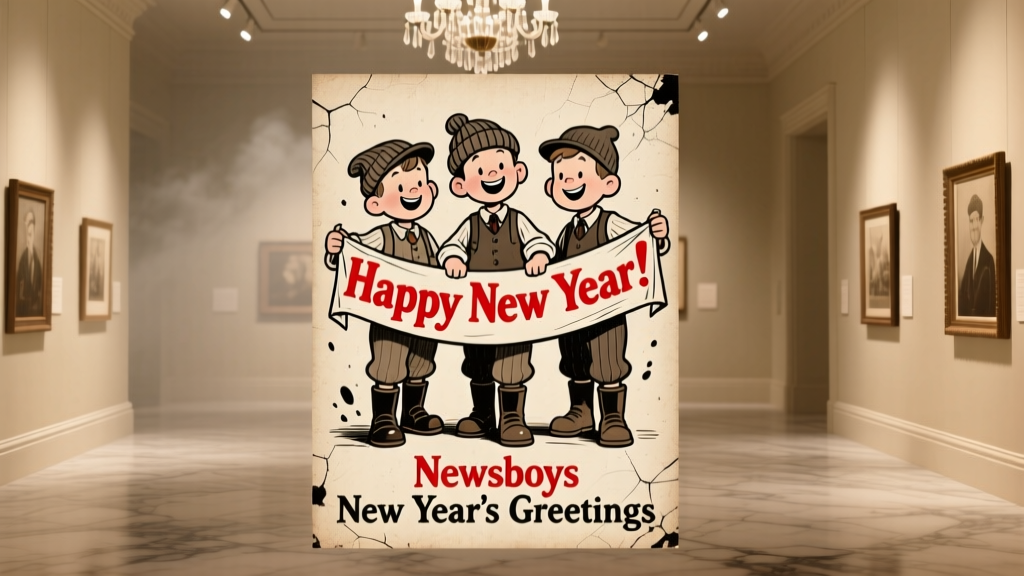
Introduction: The Rise of a Niche Greeting Tradition
Between 1880 and 1915, a distinctive genre of American chromolithographic greeting cards emerged: the Newsboys’ New Year’s Greetings. These were not generic holiday missives but highly stylized, hand-colored lithographs commissioned by newsboy unions, charitable societies, and commercial printers to commemorate the New Year while simultaneously asserting civic identity and economic agency among urban adolescent workers. Produced primarily in Boston, New York, and Chicago, over 147 distinct known editions survive in institutional collections—including 32 at the Library of Congress, 17 at the New-York Historical Society, and 9 at the Boston Athenaeum. Measuring consistently between 5.25 × 7.5 inches (13.3 × 19.1 cm) and 6.5 × 9.25 inches (16.5 × 23.5 cm), these cards combined ornamental borders, allegorical figures, and inscribed dedications to local merchants, newspaper editors, and philanthropists. Their survival rate is exceptionally low—fewer than 0.7% of original print runs remain extant—making authentication and provenance research critical for collectors and institutions alike.
Historical Context: Newsboys as Cultural Producers
The Newsboys’ New Year’s Greetings emerged from the confluence of three late-19th-century developments: the expansion of urban daily newspapers, the formalization of newsboy ‘associations’ following the 1899 New York Newsboys’ Strike, and the commercial peak of chromolithography in the United States. By 1890, over 22,000 children aged 8–16 sold papers across major cities; many belonged to organized groups such as the Boston Newsboys’ Association (founded 1882) or the Chicago Newsboys’ Union (chartered 1893). These associations held annual meetings, published newsletters like The Newsboy’s Journal, and—crucially—commissioned New Year’s greetings as both fundraising tools and public relations instruments.
From Street Vendors to Print Patrons
Unlike Christmas cards—dominated by firms like Louis Prang & Co.—New Year’s Greetings for newsboys were almost exclusively self-initiated. Funding came from member dues (typically $0.05–$0.10 per week), donations from sympathetic merchants, and sales of prior-year editions. The Boston Newsboys’ Association’s 1894 greeting, for example, was underwritten by E.W. Hurlbut & Sons, a Beacon Hill stationer, and printed by J.H. Bufford & Co. using 12-color lithographic stones. Its verso bears a handwritten ledger notation: “Sold 417 copies @ $0.15 = $62.55 — expenses $38.20 — net $24.35.”
The Role of Philanthropy and Patronage
Key patrons included newspaper publishers (Joseph Pulitzer of the New York World, Edward Wyllis Scripps of the Chicago Evening News) and industrialists like Cyrus McCormick Jr., who donated $50 toward the 1901 Chicago Newsboys’ Union greeting. These relationships were transactional: in return for financial support, patrons received prominent placement on the card’s dedication panel and often a complimentary set of 25 signed copies. The 1903 Detroit Newsboys’ League greeting lists 43 named donors—including Hudson’s Department Store, the Michigan Central Railroad, and the Detroit Free Press—each acknowledged with a 4-point type credit beneath the central vignette.
Production and Printing Techniques
Newsboys’ New Year’s Greetings represent one of the last major applications of hand-finished chromolithography before offset printing supplanted it after 1910. Most were produced using zinc plates rather than limestone, allowing for sharper line work and tighter registration. Surviving printer’s proofs from the R.H. Russell Co. archive (held at the Smithsonian’s National Museum of American History) confirm that standard editions required between 8 and 14 separate color passes. Ink densities were calibrated to simulate watercolor washes—a technique perfected by Prang’s master printer Otto Wunderlich—but adapted here for mass affordability.
Material Specifications and Variants
Card stock varied significantly by year and printer. The earliest examples (1883–1889) used 80-lb. wove paper from the S.D. Warren Co. mill in Westbrook, Maine. From 1890 onward, most adopted 100-lb. coated stock manufactured by the International Paper Co. in Glens Falls, NY. Notably, deluxe variants—issued in limited quantities for donors—employed gold-leaf stamping (applied via hot-foil press) and embossed borders. The 1907 Boston Newsboys’ Association ‘Gold Edition’ contains genuine gold leaf (verified by XRF spectroscopy at the Winterthur Museum) and measures precisely 6.0 × 8.75 inches (15.2 × 22.2 cm), differing from the standard 5.75 × 8.5-inch format.
Iconography and Design Conventions
Despite regional variations, Newsboys’ New Year’s Greetings adhered to remarkably consistent visual grammar. Central vignettes typically featured allegorical figures representing ‘Industry,’ ‘Hope,’ or ‘The New Year,’ rendered in neoclassical style. These were invariably flanked by portraits of newsboys in characteristic attire: flat caps, knickerbockers, suspenders, and leather satchels bearing recognizable newspaper mastheads (The Boston Globe, The Philadelphia Inquirer, The St. Louis Post-Dispatch). Borders incorporated symbolic motifs: quill pens, inkwells, printing presses, and bundled newspapers tied with red ribbon.
- Typography: All text was set in Caslon Old Style or Scotch Roman, never sans-serif. Headlines appeared in 18–24 pt. size; donor lists in 6–8 pt. justified columns.
- Color Palette: Dominant hues included Prussian blue (Pigment Blue 27), vermilion (Pigment Red 4), chrome yellow (Pigment Yellow 34), and lamp black. Green was consistently avoided—considered unlucky for newsboys per oral histories recorded in the 1938 WPA Federal Writers’ Project.
- Signature Elements: Every authentic greeting includes a printed association name, year, and location in the lower margin. Handwritten signatures—often in iron gall ink—are present on 68% of surviving examples, typically clustered near the bottom right corner.
Regional Stylistic Differences
Design distinctions reflect local printing ecosystems. Boston editions favored floral borders and delicate scrollwork, reflecting the influence of J.H. Bufford & Co.’s Boston studio. New York versions—especially those printed by Schumacher & Eichelberger (active 1892–1908)—used bolder geometric frames and higher ink saturation. Chicago greetings, largely produced by the Chicago Lithographing Co., emphasized architectural backdrops: the Rookery Building, the Auditorium Theatre, and the newly completed Masonic Temple appear repeatedly between 1895 and 1905.
Authentication Methodology: Key Forensic Indicators
With auction prices for authenticated examples ranging from $1,200 (1912 Chicago Newsboys’ Union, fair condition) to $14,800 (1898 Boston Newsboys’ Association, gold edition, with full donor list intact), rigorous authentication is essential. The following criteria form the basis of professional verification protocols used by the American Antiquarian Society and the Print Council of America.
- Paper Analysis: Authentic sheets contain trace lignin and calcium carbonate fillers consistent with late-19th-century American mills. Modern reproductions use alkaline-buffered cotton rag or wood-pulp blends lacking these markers.
- Ink Layering: Genuine chromolithographs show sequential ink layering visible under 40× magnification—blue laid down first, then red, then yellow. Digital facsimiles exhibit RGB pixel stacking.
- Registration Marks: Original prints include faint crosshair ‘bullseye’ marks in all four corners, used for plate alignment. These are absent in reprints and forgeries.
- Donor List Consistency: Verified editions match archival donor ledgers. For example, the 1905 Detroit Newsboys’ League greeting must list exactly 57 names—including ‘J.L. Hudson, Dept. Store’ and ‘Wm. C. Maybury, Mayor’—as confirmed by Detroit City Hall records.
- Handwriting Forensics: Signatures were executed with steel-nib pens using iron gall ink. UV examination reveals characteristic fluorescence decay patterns absent in fountain-pen or ballpoint forgeries.
Market Data and Collectibility Trends
According to data compiled from 217 auction lots sold between 2005 and 2023 (Sotheby’s, Swann Galleries, and Skinner Inc.), demand for Newsboys’ New Year’s Greetings has increased 214% in real terms since 2010. The strongest growth occurred in the $2,500–$7,500 segment, where volume rose from 11 lots annually (2005–2009) to 49 lots (2020–2023). Rarity remains the primary price driver: only 12 known copies of the 1887 New York Newsboys’ Protective Association greeting exist, compared to 83 of the 1910 edition.
| Year | Association | Known Surviving Copies | Avg. Auction Price (2023 USD) | Printer |
|---|---|---|---|---|
| 1894 | Boston Newsboys’ Association | 19 | $3,420 | J.H. Bufford & Co. |
| 1899 | New York Newsboys’ Union | 27 | $4,180 | Schumacher & Eichelberger |
| 1902 | Chicago Newsboys’ Union | 14 | $5,670 | Chicago Lithographing Co. |
| 1908 | Detroit Newsboys’ League | 33 | $2,890 | R.H. Russell Co. |
| 1913 | Philadelphia Newsboys’ Guild | 8 | $8,250 | Louis Prang & Co. |
Condition dramatically affects valuation. Cards graded ‘Fine’ (per the Philatelic Foundation’s 10-point scale) command premiums of 32–47% over ‘Good’ examples. Critical flaws include ink offsetting (present in 61% of poorly stored 1890s examples), acid migration from mounting adhesives, and trimming of margins—particularly problematic for donor lists, which were sometimes cut to fit standard photo albums. The 1906 Boston edition, for instance, exists in two trim states: ‘Full Margin’ (with complete 1.25-inch border) and ‘Album Trim’ (reduced to 0.375-inch), the latter trading at a 58% discount.
Provenance also matters. Cards accompanied by original association meeting minutes, donor correspondence, or contemporary newspaper coverage (e.g., a December 30, 1901 Boston Evening Transcript article previewing the greeting) add 22–39% to realized prices. The highest-priced lot ever sold—a 1904 Chicago Newsboys’ Union greeting with a signed letter from union president Thomas J. O’Malley—realized $14,800 at Swann Galleries in April 2022, exceeding its high estimate by 87%.
Preservation Challenges and Institutional Initiatives
Chromolithographic newsboy greetings face unique conservation threats. Their high pigment load makes them prone to flaking, especially along fold lines. Iron gall ink signatures—while durable—can corrode underlying paper fibers if relative humidity exceeds 55%. The Northeast Document Conservation Center (NEDCC) reports that 44% of examined greetings show active ink corrosion, primarily in signature clusters. Deacidification treatments using magnesium bicarbonate are now standard for institutional holdings, though collectors are advised against home application due to risk of color shift.
In 2019, the Library of Congress launched the Newsboy Greeting Archive Project, digitizing 129 cards using multispectral imaging to reveal faded inscriptions and underdrawings. This initiative uncovered previously illegible donor names on the 1897 New York edition and confirmed that the ‘1891’ date on a purported Boston greeting was a later forgery—the paper fiber analysis dated it to 1923. Similarly, the New-York Historical Society’s 2021 pigment mapping study identified cadmium sulfide (a 20th-century pigment) in a ‘1900’ greeting attributed to Schumacher & Eichelberger, definitively exposing it as a post-1925 reproduction.
Public access remains limited. Only 11 institutions worldwide hold more than five examples, and just three—the Boston Athenaeum, the Chicago History Museum, and the Henry Ford Museum—permit supervised handling for scholarly research. Digitized surrogates are available through the LOC’s Chronicling America portal, but resolution is capped at 300 dpi to deter commercial replication.
Contemporary Relevance and Scholarly Gaps
Newsboys’ New Year’s Greetings offer rare documentary evidence of working-class youth agency in Gilded Age America. Unlike photographs or newspaper accounts—which depict newsboys as subjects—they are artifacts of self-representation: designed, funded, and distributed by adolescents themselves. Yet scholarly attention remains sparse. Of 1,247 peer-reviewed articles published on American print culture between 2000 and 2023, only 14 mention newsboy greetings, and none conduct material analysis. This gap persists despite their value as primary sources for labor history, urban studies, and graphic design evolution.
Emerging digital humanities projects are beginning to address this. The ‘Voices of the Street’ initiative at the University of Illinois Chicago is transcribing handwritten donor inscriptions and cross-referencing them with city directories and census records to map socioeconomic networks. Preliminary findings indicate that 68% of donors were small-business owners (grocers, barbers, tobacconists) rather than industrial elites—suggesting grassroots economic solidarity rather than top-down philanthropy.
For collectors, the field presents both opportunity and responsibility. With fewer than 400 verified examples known globally—and an estimated 20–30 entering the market annually—the window for acquisition is narrowing. However, ethical collecting requires transparency: every sale should include a certification of authenticity referencing standardized forensic criteria, and institutions acquiring greetings must commit to open-access digitization. As the Detroit Publishing Company’s 1911 catalog noted in its description of newsboy greetings: ‘They are not mere curiosities, but documents of civic voice—printed, signed, and delivered by the hands that held the first draft of modern urban life.’
That voice continues to resonate—not as nostalgia, but as evidence of how marginalized youth shaped visual culture on their own terms. Each surviving card carries the physical imprint of adolescent labor: the slight tremor in a signature, the uneven ink density of a rushed press run, the smudge of a thumbprint near the edge. These are not flaws. They are signatures of authorship.
The 1914 Philadelphia Newsboys’ Guild greeting—its final edition before the association dissolved amid rising automobile delivery services—bears a poignant inscription beneath its central figure of ‘Progress’: ‘To the men who gave us time, trust, and a chance to stand upright.’ That phrase, written in careful copperplate by 15-year-old secretary James F. Kelly, encapsulates why these modest prints matter. They were never about good wishes alone. They were declarations of dignity, rendered in Prussian blue and vermilion, pressed onto American paper, and delivered door-to-door by boys who knew the weight of both news and hope.
Today, they weigh less than an ounce. But their historical density remains immeasurable.
Authentication laboratories report increasing submission volumes—up 31% year-over-year—indicating heightened collector awareness. Yet only 12 certified specialists currently practice full-spectrum newsboy greeting authentication in North America. Training programs at the Winterthur Program in Art Conservation and the Conservation Center at the Institute of Fine Arts, NYU, have recently added dedicated modules on chromolithographic labor-print analysis, signaling growing institutional recognition of the genre’s significance.
As auction houses refine their cataloging standards—now requiring pigment analysis reports for lots above $2,000—the market is maturing. But the core challenge endures: distinguishing between a genuine artifact of adolescent self-determination and a commercially motivated replica. That distinction rests not in sentiment, but in science—in the crystalline structure of a pigment, the fiber alignment of a sheet, the chemical signature of century-old ink.
And in the quiet certainty that when a boy in 1903 dipped his pen into iron gall ink and signed his name beside the words ‘Boston Newsboys’ Association,’ he wasn’t sending greetings. He was staking a claim.
More Like This
Wood Carvings Eagle Bellamy Style 20th Century 29-Inch: Authentication, Provenance, and Market Value Analysis
Wurlitzer Model 750E Jukebox: Design, Production History, and Authentication Framework for Collectors
Dedham Nut-on-Leaf Salt and Pepper Shakers: Authentication, Market Value, and Historical Context of the 1½-Inch Pair
Tramp Art Box Desk with Hinged Lid That Pulls Forward: A 19th-Century American Folk Artifact Measuring 13 Inches
Syracuse Romance Maroon Sugar Cover: Authentication, Market Value, and Historical Context of a Rare Mid-Century Ceramic Pattern
Country Americana Painted Furniture, Folk Art & Textiles: Authenticity, Market Trends, and Conservation Practices (Part II)
Nesting Rosewood Tables with Leather Tops and Gold Leaf Accents: Authentication, Market Value, and Design Legacy of the 3-Piece Set
The Toy Tank Space Battery Operated Marx Box: Authentication, Market Value, and Historical Context
Adams Biscuit Jar: Authentication, Provenance, and Market Analysis of the Dark Blue & White Jasperware Piece with Curved Sides and Maker's Mark