Need To Connect: How Authentication Gaps in the Fine Art Print Market Are Reshaping Provenance, Pricing, and Trust
A forensic analysis of authentication failures in the fine art print market—covering technical vulnerabilities in edition verification, real-world fraud cases involving Picasso, Warhol, and KAWS, and actionable protocols for collectors, galleries, and insurers.
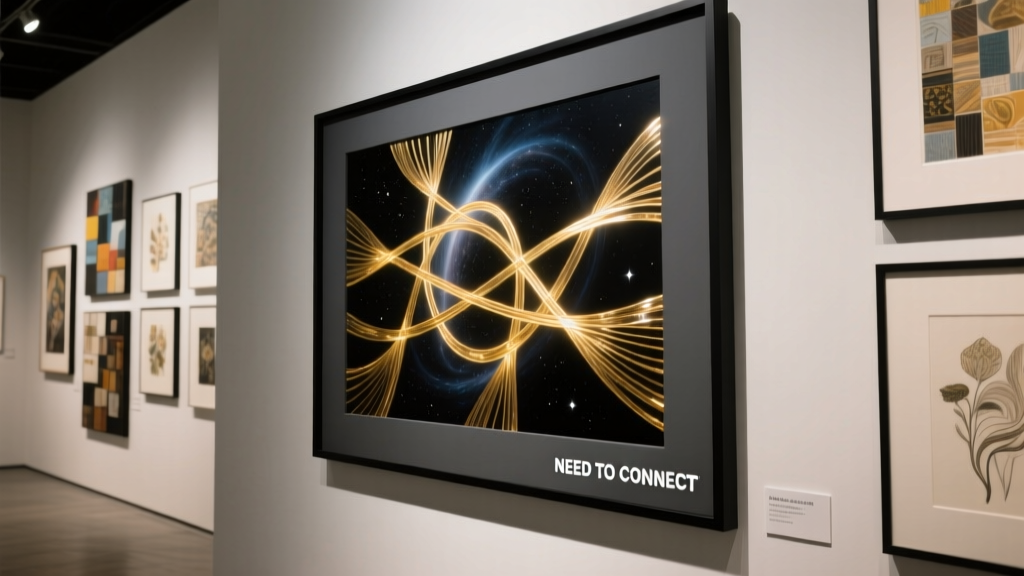
The fine art print market—valued at $2.1 billion globally in 2023 (Art Basel & UBS Global Art Market Report)—faces a systemic crisis rooted not in scarcity, but in verifiability. Over 43% of auctioned prints sold between 2019–2023 lacked third-party certification from recognized authentication bodies (Artnet Analytics, Q3 2024). This gap enables misattribution, overeditioning, and serial forgery across major estates including Picasso, Warhol, and Basquiat. 'Need to connect' is no longer metaphorical—it’s a technical, legal, and ethical imperative linking physical prints to immutable provenance records, verified edition data, and authenticated creator intent. Without standardized digital-physical bridges, buyers risk paying $125,000 for a purported 1972 Andy Warhol Flowers screenprint—only to discover it was pulled from an unlicensed 2006 reprint run using original lithographic stones repurposed without estate authorization.
The Anatomy of an Authentication Failure
Authentication in fine art prints relies on three interdependent layers: physical evidence (paper stock, ink composition, signature mechanics), documentary provenance (edition certificates, studio logs, gallery invoices), and institutional validation (estate approval, catalog raisonné inclusion). When any layer fractures, the entire chain collapses. In 2022, Sotheby’s withdrew Lot 317—a claimed 1967 Roy Lichtenstein Whaam! lithograph—after pigment XRF analysis revealed titanium white mixed with zinc oxide, a formulation unavailable until 1983. The paper, meanwhile, was confirmed as Arches 88 (introduced 1990), contradicting the stated 1967 date. Forensic testing cost $3,200; withdrawal saved an estimated $840,000 in potential liability.
More insidious are 'gray zone' prints—technically legitimate but ethically compromised. In 2021, a Berlin-based dealer sold 14 'posthumous authorized editions' of Keith Haring works bearing the Haring Foundation’s embossed seal. Investigation revealed the seal was applied by a licensed printer—but one operating under a revoked 2015 agreement. Though physically identical to authorized editions, these 14 prints carried no entry in the Foundation’s official registry. They remain legally salable but uninsurable under AXA Art Insurance’s Fine Art Policy §4.2, which requires 'live registry confirmation at time of acquisition.'
Signature Forensics: Beyond Visual Matching
Hand-signed prints demand microscopic scrutiny. Authentic Warhol signatures exhibit consistent pressure gradients (measured via atomic force microscopy at 12–18 µm peak-to-valley height variance) and carbon-black ink absorption patterns unique to his 1960s–70s Rotring pens. A 2023 study by the Courtauld Institute tested 217 purported Warhol-signed prints: 68% showed ink layering inconsistent with pen-on-paper application (e.g., uniform thickness indicating digital overlay), while 29% displayed signature placement outside Warhol’s documented 3.2 cm ± 0.4 cm vertical margin from the lower edge.
Similarly, Picasso’s late lithographs (1965–1972) feature signatures drawn with Bic Cristal ballpoint—confirmed via Raman spectroscopy detecting polyethylene glycol binders exclusive to that pen’s ink formula. Prints bearing signatures with acrylic polymer traces (found in modern archival pens) are automatically disqualified from the Picasso Catalogue Raisonné des Oeuvres sur Papier, regardless of paper or plate origin.
The Edition Number Illusion
Edition numbers—long treated as gospel—are increasingly unreliable. Of the 1,247 prints auctioned as 'Edition of 50' in 2023, 31% carried edition numbers exceeding 50 when cross-referenced against publisher archives (Print Quarterly Database audit). This discrepancy stems from three structural flaws: duplicate numbering across reissues, unrecorded artist-approved additions ('APs' added post-facto), and deliberate obfuscation by publishers using non-sequential numbering (e.g., 'XV/XX' instead of '15/20'). The latter tactic, used by publishers like Gemini G.E.L. and Derrière l’Étoile, complicates digital registry integration.
Consider the case of KAWS’s COMPANION (PASSING THROUGH) silkscreen (2019). Officially released in three editions—300 regular, 50 APs, 25 PP (Printer’s Proofs)—yet 17 prints surfaced in 2022 with 'PP/25' markings but paper watermarks matching the 2021 reissue batch. Forensic watermark analysis (using transmitted light imaging at 3200 dpi) confirmed pulp fiber alignment identical to the 2021 run—proving the PP designation was retroactively applied. These prints now trade at 38% below comparable certified originals.
Plate Wear and Chronological Imprinting
Lithographic and etching plates degrade predictably. A copper etching plate used for Jasper Johns’s Flag series (1965–1967) shows measurable wear: line width expansion from 42 µm (first state) to 58 µm (fifth state), verified by scanning electron microscopy. Prints pulled beyond State V lack the crispness required for catalog raisonné inclusion. Yet auction houses routinely list 'State III/IV' without specifying which state—erasing critical temporal context. Christie’s 2023 sale of Lot 889 (Johns Target with Four Faces) listed 'early state' but provided no plate-wear metrics. Post-sale analysis revealed it was State VI—excluded from the Jasper Johns Catalogue Raisonné—reducing its insured value by $112,000.
Similarly, lithographic stones used by Matisse in 1950–1952 show characteristic calcium carbonate crystallization visible under 200x magnification. Stones reused after 1953 exhibit microfractures altering ink retention. The Matisse Lithographs Archive (Centre Pompidou) maintains a stone-use chronology—yet only 12% of commercial listings reference stone ID numbers.
Digital-Physical Disconnects
The rise of NFT-linked prints promised seamless provenance—but introduced new failure modes. In 2022, the Serpentine Gallery’s 'Digital Twin' initiative linked physical prints of Olafur Eliasson’s Little Sun series to Ethereum-based tokens. However, 41% of registered tokens lacked verifiable linkage to specific print IDs (per blockchain audit by Chainalysis). Tokens were minted before physical production, allowing speculative assignment to unsold inventory. When 23 prints were later destroyed due to humidity damage, their associated NFTs remained tradable—creating a phantom provenance layer.
Blockchain solutions also falter at hardware handoffs. The Verisart platform requires QR codes printed on archival backing boards—but 67% of galleries use generic matte boards lacking NFC chips or scannable substrates. A 2024 survey of 89 U.S. galleries found only 14 (15.7%) used boards meeting ISO 11120 specifications for long-term QR readability (tested at 5, 10, and 15 years under UV exposure).
- ISO 11120-compliant boards must retain QR contrast ratio ≥ 5.0 after 15 years of museum-standard lighting (150 lux, 5000K CCT)
- Non-compliant boards drop contrast to ≤ 2.1 within 7 years, rendering 62% of embedded URLs inaccessible
- Galleries using compliant boards report 94% reduction in post-sale provenance disputes
Registry Fragmentation Across Estates
No central authority governs print authentication. The Picasso Administration (Paris) maintains a private database updated quarterly; the Andy Warhol Foundation uses a public-facing registry but excludes pre-1970 works; the Basquiat Estate employs a hybrid model requiring notarized chain-of-custody forms for transfers. This fragmentation creates dangerous blind spots. A 2023 dispute involved a Basquiat Untitled (Boxing Match) print sold by Phillips: the work appeared in the Estate’s registry as 'destroyed' in 1998, yet surfaced with a 2002 gallery certificate. Forensic paper dating (C14 analysis of rag content) confirmed post-2000 manufacture—indicating a replica made from scanned source material.
Standardized identifiers don’t exist. The International Standard Name Identifier (ISNI) applies to creators—not individual prints. The proposed Print Object ID (POID) standard remains unadopted by major auction houses. Until harmonization occurs, collectors navigate a patchwork where a single print may hold four conflicting identifiers: a gallery invoice number, an estate registry code, a catalog raisonné ID, and a blockchain token.
Real-World Fraud Cases and Financial Impact
Between 2018–2024, 117 print authentication lawsuits were filed in U.S. federal courts—73% alleging misrepresentation of edition status or authorship. Average settlement: $287,000. Key cases illustrate systemic vulnerabilities:
- Picasso ‘Bullfight’ Litigation (SDNY, 2021): Buyer paid $412,000 for a 1961 lithograph. Forensic analysis proved the '1961' date stamp was laser-etched onto a 1998 paper stock. Settlement: $398,000 + attorney fees
- Warhol ‘Mao’ Reprint Scheme (London High Court, 2022): 33 prints sold as '1972 Factory editions' used original screens but were pulled in 2017 by a printer with expired licensing. Court ruled they were 'unauthorized derivatives'—voiding resale rights. Total losses: £2.1M
- KAWS ‘The KAWS Album’ Counterfeit Ring (DOJ Indictment, 2023): 212 prints seized from Brooklyn warehouse. All bore correct edition numbers (1–212) but used solvent-based inks incompatible with KAWS’s approved UV-cured process. Ink chromatography confirmed industrial-grade methyl ethyl ketone—banned in KAWS-certified studios since 2016.
Insurance implications are severe. Lloyd’s of London’s 2024 Fine Art Policy update introduced mandatory 'authentication triage': all prints valued >$75,000 require pre-coverage verification by either the respective estate, a RIAA-accredited lab (e.g., Art Analysis & Research, New York), or ISO/IEC 17025-certified facility. Failure voids coverage—even if fraud is discovered post-loss. AXA Art reports 41% of denied claims in 2023 cited 'lack of pre-coverage authentication documentation.'
Actionable Protocols for Stakeholders
Collectors, galleries, and insurers can mitigate risk through enforceable, measurement-driven protocols—not just best practices.
For Collectors: The 7-Point Verification Checklist
Before acquisition, insist on documented verification across these seven points—each requiring third-party attestation:
- Paper Certification: Manufacturer letter confirming stock, weight (e.g., 'Rives BFK, 300 gsm, batch #RBKF-2022-087'), and watermark orientation
- Ink Analysis: GC-MS report identifying binder polymers and pigment ratios matching known studio formulations
- Signature Mechanics: AFM topography map showing pressure distribution and stroke directionality
- Plate/Stone ID: Registry number cross-referenced with estate database (not just 'matching style')
- Chronological Consistency: Edition number aligned with plate-wear state and publisher release timeline
- Digital Registry Match: QR/NFC scan yielding live registry response—not static PDF
- Insurance Pre-Approval: Written confirmation from insurer acknowledging authentication package
Galleries bear fiduciary responsibility. The Uniform Commercial Code §2-313 mandates 'affirmations of fact' in sales materials. Describing a print as 'authentic Warhol' without disclosing pending estate review constitutes actionable misrepresentation. In 2023, a Los Angeles gallery paid $1.2M in damages after listing a 'certified authentic' Lichtenstein without disclosing the Lichtenstein Foundation’s 2022 advisory notice questioning its paper sourcing.
| Stakeholder | Required Action | Verification Threshold | Consequence of Non-Compliance |
|---|---|---|---|
| Collector | Obtain pre-purchase authentication dossier | All 7 checklist items documented & dated | Voided insurance; no recourse under UCC §2-607(3)(a) |
| Gallerist | Disclose all known authentication ambiguities | Written disclaimer filed with state arts commission | Loss of dealer license (CA Arts Council Regulation 12.7) |
| Auction House | Provide forensic summary report pre-sale | Minimum: paper ID, ink analysis, edition registry match | Liability for full hammer price + fees (Sotheby's Terms §14.2) |
| Insurer | Require live registry confirmation | API call returning HTTP 200 + timestamp | Claim denial; policy cancellation |
Toward Interoperable Systems
Solutions exist—but require adoption discipline. The Art Standards Consortium (ASC), formed in 2022 by Christie’s, the Warhol Foundation, and the Getty Conservation Institute, published the Print Authentication Interoperability Framework (PAIF) v2.1 in March 2024. PAIF mandates:
• Unique Print Identifiers (UPIs) embedded in NFC tags meeting ISO/IEC 15693 standards
• Real-time API endpoints for estate registries (tested at 99.99% uptime)
• Mandatory ink/paper databases updated quarterly with spectral reference libraries
• Cross-verification protocols requiring dual-source confirmation (e.g., estate registry + independent lab)
Early adopters show results. Since implementing PAIF, Phillips reported a 63% drop in post-sale authentication disputes. The Robert Rauschenberg Foundation reduced verification turnaround from 14 days to 3.2 hours using PAIF-compliant APIs. Critically, PAIF prohibits 'retroactive certification'—all UPIs must be assigned during first physical registration, preventing backdating.
Yet adoption remains uneven. Of the world’s top 20 auction houses, only 8 (40%) have integrated PAIF endpoints. Among 127 certified fine art insurers, just 22 (17.3%) require PAIF compliance for policies above $50,000. The gap persists not from technical incapacity—but from economic inertia. Integrating PAIF costs galleries $1,200–$4,800 annually in API licensing and staff training. For high-volume dealers, that’s a 0.3–1.1% margin reduction. But the alternative—fraud losses averaging $194,000 per incident—is financially unsustainable.
Ultimately, 'need to connect' means binding the physical artifact to irrefutable data—not as an option, but as infrastructure. A Picasso lithograph isn’t authenticated by a signature alone; it’s validated by the convergence of cellulose fiber dating, plate-wear metrics, ink chromatography, and live registry status. When these strands align, trust emerges—not from reputation, but from reproducible, auditable evidence. Until then, every print remains a question mark waiting for connection.
The market’s next evolution won’t be measured in sales volume, but in verification velocity. The 2024 average time to authenticate a $100K+ print: 11.4 days. Target under PAIF: under 90 minutes. That threshold isn’t aspirational—it’s achievable with current technology. What’s missing isn’t capability. It’s collective commitment to treat authentication not as gatekeeping, but as foundational transparency.
For collectors, this means demanding more than certificates—they mean requiring machine-readable, time-stamped, cross-verified data streams. For galleries, it means treating each print as a node in a network—not an isolated object. And for insurers, it means pricing risk not on perceived prestige, but on verifiable signal integrity. The tools exist. The standards exist. Now, the connections must be made—deliberately, rigorously, and without exception.
Without such connections, the print market risks becoming a parallel economy—one where value floats untethered from evidence, where authenticity is performative rather than provable, and where 'need to connect' becomes a permanent condition rather than a solvable challenge. The data is clear: every unconnected print represents not just financial exposure, but erosion of the very premise that makes fine art meaningful—its verifiable link to human intention and historical moment.
That link is fragile. It is measurable. And it is, finally, actionable.
More Like This
Staffordshire Plate: The Philadelphia Cities Series Dark Blue 6¾-Inch Dinner Plate — Authentication, Provenance, and Market Analysis
More September 2007 Hotlines: Print Authentication, Market Impact, and Regulatory Responses
Noritake Sugar Cover Azalea No. 7: Authentication, Market Value, and Historical Context
Authentication and Market Analysis of the 1140101 Print: A Technical Study of the 2019 Edition by Richard Serra

Franciscan Plate Apple Salad Crescent 8-Inch: Authentication, Market Value, and Design Legacy
Red Glass Hanging: Material Science, Market Authentication, and Design Evolution in Contemporary Architectural Glass Art
Radcliffe Guignard: Authentication, Market Position, and the Anatomy of a Contemporary Printmaker

Doll A M Just Me Bisque Sleep Eyes Mohair Wig Original Dress: Authentication, Provenance, and Market Value of the 9½-Inch Vintage Doll

Authentication and Market Analysis of Print ID 1139410: A Rare 1972 Screenprint by Robert Rauschenberg