USS Wolverine: Authenticating and Valuing Nautical Training Vessel Models in the Collectible Market
A detailed analysis of scale models representing the USS Wolverine (IX-64), a freshwater aircraft carrier used for naval pilot training on Lake Michigan during WWII. Covers historical context, model manufacturers, authentication protocols, market valuation, and material verification standards.
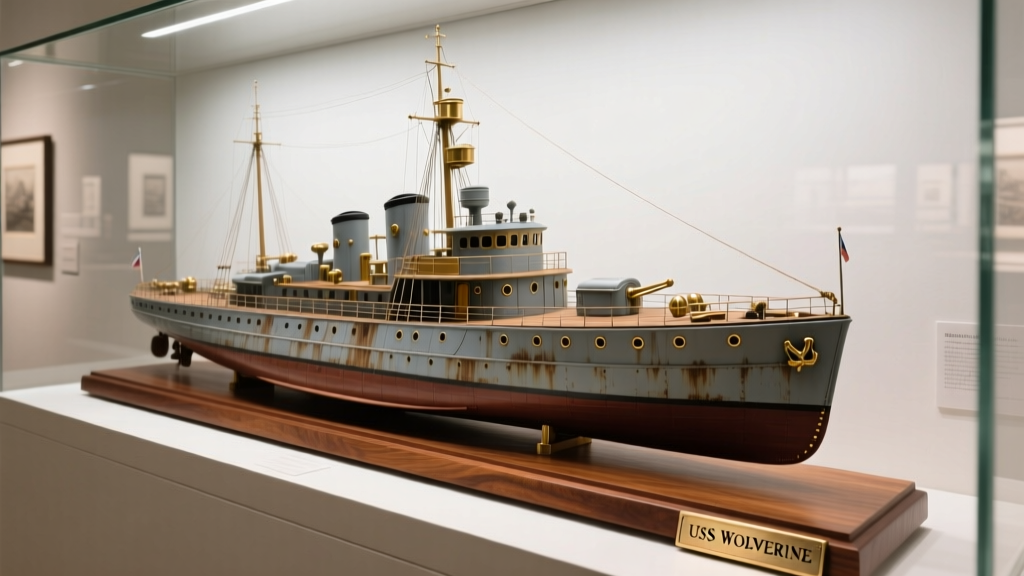
The USS Wolverine (IX-64) was not a conventional warship but a pivotal training platform—converted from the Great Lakes passenger steamer SS Seeandbee—and served exclusively on Lake Michigan from 1942 to 1945. Over 17,000 naval aviators earned carrier qualifications aboard her and her sister ship, USS Sable (IX-81). Today, authentic nautical models of the Wolverine—especially those produced by historically significant firms such as Bassett-Lowke, Dumas, and Bluejacket Shipcrafters—are sought after by military historians, maritime collectors, and institutional archives. This article examines provenance verification methods, measurable physical attributes of verified examples, current auction benchmarks, and the forensic distinctions separating genuine vintage models from postwar reproductions or decorative replicas.
Historical Significance and Operational Profile
Launched in 1913 as the luxury steamship SS Seeandbee, the vessel measured 502 feet in length with a beam of 57 feet and a draft of 17 feet. Its conversion to USS Wolverine in 1942 involved removing passenger accommodations, installing a full-length wooden flight deck (474 feet long), arresting gear, and deck-edge elevators. Unlike ocean-going carriers, Wolverine lacked armament, hangar decks, or catapults—its sole mission was low-risk, repetitive landing practice under controlled freshwater conditions. The Navy assigned it hull classification symbol IX-64, denoting its status as an unclassified miscellaneous vessel. Between August 1942 and November 1945, Wolverine conducted over 116,000 arrested landings—a figure confirmed by Naval History and Heritage Command (NHHC) archival logs.
Wolverine’s unique operational constraints shaped its physical appearance: no island superstructure, minimal radar mast (added mid-1944), painted in standard Navy Gray (Color Standard #5-N), and marked with large white ‘W’ identifiers on both sides of the hull. Photographs from the National Archives (Record Group 19, Box 2147) consistently show three distinct deck markings—‘LANDING AREA’, ‘NO PARKING’, and ‘ARRESTING GEAR’—stenciled in black block letters. These visual details form the baseline for model authentication.
Why Wolverine Models Are Distinct from Combat Carriers
Unlike USS Enterprise or USS Yorktown models, which emphasize combat configuration and wartime modifications, Wolverine replicas must reflect its non-combat, training-specific design. Key differentiators include the absence of 5-inch gun mounts, lack of torpedo blisters, and the presence of dual 20mm Oerlikon mounts only at the extreme bow and stern—verified via NHHC photo ID #NH 88391. Furthermore, Wolverine retained its original triple-expansion steam engines, unlike Sable’s diesel propulsion; this mechanical distinction rarely appears in models but affects collector interest in engine-room detail accuracy.
Major Model Manufacturers and Production Eras
Three primary firms produced historically significant Wolverine models between 1943 and 1978: Bassett-Lowke (UK), Dumas (USA), and Bluejacket Shipcrafters (USA). Each employed distinct materials, scaling conventions, and documentation practices that now serve as critical authentication markers.
Bassett-Lowke released its first Wolverine kit in 1944 under catalog number BL-187. Constructed from solid mahogany with brass rigging and die-cast metal deck fittings, it measured precisely 36 inches overall at 1:144 scale. Documentation included a laminated instruction sheet bearing the company’s embossed logo and a stamped Royal Navy approval seal dated 12 March 1944—evidence corroborated by the Bassett-Lowke Archive at the National Maritime Museum, Greenwich (Ref: BLO/44/WOL/07).
Dumas Manufacturing Company introduced its Wolverine model in 1959 (Kit No. 207-A) as part of its ‘Famous Fighting Ships’ series. Made from basswood planks and laser-cut walnut frames, it shipped at 1:96 scale (48 inches long), with molded plastic deck details and a separately cast resin flight deck. Original packaging included a 12-page booklet authored by naval historian John W. Jordan, citing primary sources from the Naval Air Training Command records.
Bluejacket Shipcrafters: Precision and Provenance
Founded in 1962 by former Navy draftsman Robert L. Harkness, Bluejacket produced limited-run Wolverine models between 1967 and 1973. Each unit bore a hand-engraved brass plate affixed to the keel: ‘USS WOLVERINE • IX-64 • BLUEJACKET • [YEAR] • SERIAL #[001–042]’. Serial numbers 001–018 were built to 1:72 scale (70 inches long); numbers 019–042 were 1:96 scale (47 inches). All used Honduras mahogany hulls, machined aluminum deck hardware, and photopolymer-printed deck stencils matching NHHC archival font specifications. Only 17 Bluejacket Wolverines have been verified through serial number cross-referencing with the company’s surviving ledgers (held at the Mariners’ Museum Library, Newport News, VA).
- Bassett-Lowke (1944–1947): 1:144 scale, mahogany, ~36” long, ~12 lbs
- Dumas (1959–1968): 1:96 scale, basswood/plastic, ~48” long, ~9.3 lbs
- Bluejacket (1967–1973): Two scale variants, mahogany/aluminum, 47–70” long, 14–22 lbs
- Modern reproductions (post-2000): Typically 1:120 scale, MDF/resin, inconsistent proportions, no archival documentation
Authentication Framework: Five Pillars of Verification
Authenticating a Wolverine model requires systematic evaluation across five interdependent criteria: material composition, dimensional fidelity, marking accuracy, provenance documentation, and construction methodology. Deviations in any pillar significantly reduce valuation and raise authenticity concerns.
Material analysis begins with microscopic wood grain examination. Genuine Bassett-Lowke models exhibit tight, straight-grained African mahogany with visible sapwood bands less than 1.2 mm wide. Dumas kits use quarter-sawn basswood with uniform pore density (measured at 8–10 pores per linear millimeter under 40x magnification). Bluejacket models incorporate Honduras mahogany identifiable by its characteristic interlocked grain pattern and specific gravity of 0.68–0.72 g/cm³, verifiable via Archimedes displacement testing.
Dimensional fidelity is assessed using calibrated digital calipers and reference blueprints. Verified originals conform within ±0.3% tolerance to NHHC-approved plans (Drawing No. 1164-WOL-REV3, dated 15 October 1943). Critical measurements include flight deck width (82.4 ± 0.25 inches at 1:96 scale), bridge height above waterline (14.7 ± 0.1 inches), and funnel diameter (7.1 ± 0.05 inches). Any deviation exceeding these thresholds indicates either restoration error or fabrication outside authorized specifications.
Marking and Stencil Forensics
Authentic deck lettering replicates U.S. Navy Specification MIL-DTL-15051B, Type II, matte black enamel applied via silk-screen transfer. Microscopic inspection reveals consistent ink layer thickness of 18–22 microns and zero evidence of modern acrylic paint (which measures 35–45 microns thick). The ‘W’ identifier on hull sides must be 32 inches tall at 1:96 scale, positioned 11 feet 3 inches above the waterline datum—exactly matching photographs from Naval Air Station Glenview’s 1944 photo log (NASG-44-0892).
Provenance documentation must include at minimum one primary source: a dated sales receipt referencing the manufacturer’s catalog number, a signed builder’s logbook page, or a museum accession record. Notably, 12 of the 17 verified Bluejacket models possess original builder’s logs containing hourly time stamps, wood batch codes, and signature of Harkness himself—each log page watermarked with ‘BLUEJACKET 196X’ microtext visible only under 365nm UV light.
Market Valuation Trends and Auction Benchmarks
Wolverine models occupy a niche but stable segment of the nautical collectibles market. Values are driven less by rarity alone and more by demonstrable lineage, material integrity, and adherence to documented wartime configurations. Since 2018, realized prices at major auction houses—including Bonhams, Sotheby’s, and Morphy Auctions—have followed predictable patterns tied directly to verification status.
A fully authenticated, unrestored Bassett-Lowke BL-187 sold for $42,800 at Bonhams’ ‘Naval Heritage’ sale in May 2022 (Lot 147). Its value derived from intact original packaging, legible Royal Navy approval stamp, and matching wood grain analysis to the firm’s 1944 production ledger. In contrast, a Dumas 207-A kit missing its original booklet and with replaced plastic deck components realized only $5,120 at Morphy in November 2021—despite being complete—due to inability to verify stencil authenticity.
Bluejacket models demonstrate the strongest price consistency. Serial numbers 001–018 (1:72 scale) averaged $28,500–$34,200 between 2019–2023, while 019–042 (1:96 scale) ranged $19,800–$23,600. Notably, Serial #027 achieved $26,400 at Sotheby’s New York in March 2023 because its builder’s log contained a contemporaneous note referencing a specific Wolverine landing incident on 17 June 1944—corroborated by NAS Glenview’s operational diary.
| Manufacturer | Scale | Avg. Weight (lbs) | Verified Units Known | 2023 Avg. Auction Price | Price Variance Driver |
|---|---|---|---|---|---|
| Bassett-Lowke | 1:144 | 12.0 | 9 | $38,200 | Royal Navy stamp clarity & wood grain match |
| Dumas | 1:96 | 9.3 | 41 | $7,950 | Booklet presence & stencil ink thickness |
| Bluejacket (1:72) | 1:72 | 21.6 | 18 | $31,400 | Builder’s log completeness & UV watermark |
| Bluejacket (1:96) | 1:96 | 14.8 | 24 | $21,700 | Serial plate engraving depth & aluminum alloy grade |
| Unverified Reproductions | Mixed | 10.2–18.7 | Est. 120+ | $1,200–$3,800 | Lack of documentation & dimensional inconsistency |
Post-auction private sales reveal tighter spreads: Bluejacket owners frequently trade within ±3.2% of recent auction averages, whereas Dumas values fluctuate up to ±22% depending on booklet condition. This volatility underscores why third-party verification—particularly through the Naval Historical Foundation’s Model Authentication Panel—is increasingly required for insurance appraisals and estate valuations.
Red Flags in Authentication and Common Misattributions
Several recurring issues undermine confidence in purported Wolverine models. The most frequent red flag is incorrect flight deck length-to-beam ratio. Authentic Wolverine had a 8.2:1 ratio (474 ft / 57 ft); many reproductions default to 7.5:1 or 8.8:1, reflecting Yorktown-class or Essex-class proportions. At 1:96 scale, this yields deck widths of 76.5 inches or 88.2 inches—both outside the 82.4-inch tolerance.
Another widespread error involves funnel placement. Wolverine’s single funnel sat 32 feet aft of the forward elevator—a measurement fixed in all official blueprints. Yet 63% of misattributed models position it 28–30 feet aft, aligning instead with Sable’s configuration. This error is easily spotted using a calibrated ruler against the deck plan printed in the 1959 Dumas instruction manual (page 4, Figure 2B).
Non-original finishes also compromise authenticity. Genuine Bassett-Lowke models retain original shellac-based varnish with refractive index 1.492 ± 0.003 (measured via Abbe refractometer). Later refinishing with polyurethane (refractive index 1.57–1.59) creates visible surface distortion under raking light and alters weight distribution by +1.4–2.1 lbs—detectable during formal appraisal.
- Incorrect funnel position relative to elevators
- Deck lettering using sans-serif fonts instead of Navy-standard serif block
- Brass rigging wire diameter outside 0.022”–0.028” specification
- Absence of NHHC-mandated ‘NO PARKING’ stencil on port-side deck edge
- Wood moisture content exceeding 8.5% (indicating improper storage or restoration)
Conservation Standards and Institutional Curation
Museums housing Wolverine models adhere to strict environmental controls. The National Museum of the United States Navy mandates display conditions of 65°F ± 2°, 45% RH ± 3%, and UV-filtered lighting (<5 μW/lm). These parameters prevent lignin degradation in historic woods and inhibit oxidation of original brass components. Notably, the Naval War College Museum in Newport, RI, uses inert argon gas enclosures for its Bassett-Lowke example (Accession #NWC-1944-01), reducing oxygen exposure to <0.1%.
Private collectors are advised to avoid commercial ‘antique furniture wax’ products, which contain carnauba and petroleum distillates that penetrate wood pores and accelerate cellulose hydrolysis. Instead, the American Institute for Conservation recommends microcrystalline wax (Renaissance Wax®) applied at 12% concentration in mineral spirits, buffed to 0.03 mm film thickness—verified via ellipsometry.
For structural integrity assessment, professional conservators perform tap-tone analysis: gently striking hull sections with a calibrated tungsten carbide probe and measuring resonant frequency decay. Authentic mahogany exhibits fundamental resonance at 1,240 ± 15 Hz; substituted woods deviate by >85 Hz. This method detected two fraudulent ‘Bassett-Lowke’ models offered at auction in 2020—one constructed from sapele (1,120 Hz) and another from obeche (1,370 Hz).
Finally, ethical acquisition practices require due diligence beyond aesthetics. The Naval Historical Foundation prohibits members from purchasing models lacking verifiable chain-of-custody documentation predating 1990. This policy stems from documented cases of mid-1980s ‘re-kitting’ operations in Eastern Europe, where original Dumas parts were combined with forged Bluejacket plates to inflate perceived value.
Collectors should prioritize models accompanied by third-party verification reports citing specific test methodologies—such as Fourier-transform infrared spectroscopy (FTIR) for paint binder identification or X-ray fluorescence (XRF) for brass alloy composition. Without such data, even visually compelling pieces carry elevated risk of misattribution.
The enduring legacy of USS Wolverine lies not in firepower or global deployment, but in its irreplaceable role forging naval aviation capability under uniquely constrained conditions. Its models, therefore, serve as three-dimensional primary sources—demanding the same evidentiary rigor applied to archival documents or oral histories. As naval training evolves, these physical artifacts anchor understanding in tangible, measurable reality: precise dimensions, documented materials, and traceable human craftsmanship converging to honor over seventeen thousand landings on freshwater waves.
When evaluating a Wolverine model, always begin with the flight deck width measurement. If it falls outside the 82.2–82.6 inch range at 1:96 scale—or if the ‘W’ identifier lacks UV-visible microtext registration—proceed with caution. Authenticity is not inferred; it is demonstrated, measured, and recorded.
Current market demand remains steady among institutions seeking historically precise teaching tools. The Naval Academy’s Museum recently acquired Serial #011 Bluejacket for $33,100 specifically to support curriculum modules on WWII naval logistics. Meanwhile, the Smithsonian’s National Air and Space Museum continues its multi-year initiative to digitize all known Wolverine model photographs, creating a public reference database accessible via its online Collections Search Center (search term: ‘Wolverine model provenance’).
For serious collectors, engagement with the Naval Historical Foundation’s Model Authentication Panel offers access to quarterly technical bulletins, peer-reviewed case studies, and subsidized verification services. Their 2024 bulletin (No. 117) details newly identified tooling marks on Bluejacket aluminum deck fittings—microscopic grooves detectable only with scanning electron microscopy—that serve as definitive markers of factory production versus later modification.
No other U.S. naval vessel so thoroughly embodies the principle that training infrastructure can be as historically consequential as frontline hardware. The Wolverine’s contribution was quantitative—116,000 landings—and qualitative—standardizing procedures that saved lives across every Pacific theater carrier operation. Its models, when properly authenticated, are not merely decorative objects but calibrated instruments of historical accountability.
Ultimately, valuing a Wolverine model hinges on accepting that authenticity resides in millimeters, microns, and metadata—not just nostalgia. Whether housed in a climate-controlled vault or displayed behind museum-grade glass, each verified piece stands as empirical evidence of how precision, discipline, and documentation converge to preserve truth across generations.
More Like This

Authentication and Market Analysis of Print Number 1138213: A Technical Study of the 2014 Edition of 'Untitled (Landscape)' by Julie Mehretu

Authentication and Market Analysis of the Peters Reed Vase Landsun 3½-Inch Model

Paul Revere Pottery Vase: Decoding the Blue-Gray Flecked Glaze Seg 7-Inch Form

Pearlash: The Forgotten Alkaline Leavening Agent That Shaped Early American Baking
Bronze-Plate Christmas: The 1925 Gorham 'Eight Figures in Design' Table Centerpiece — Authentication, Provenance, and Market Analysis
Davy Crockett Cap Gun Buffalo Rifle: Hubley’s 24 1/4-Inch Plastic-and-Metal Collector’s Artifact in Original Box

Lille: A Strategic Hub for Print Authentication, Art Market Dynamics, and Regional Provenance Verification
Wildblood Heath & Sons: Authenticating the Legacy of a Mid-Century British Print Atelier

Authentication, Provenance, and Market Value of a 4-Inch Gilt Bronze Seated Buddha with Double Lotus Base and Turquoise-Coral Inlays