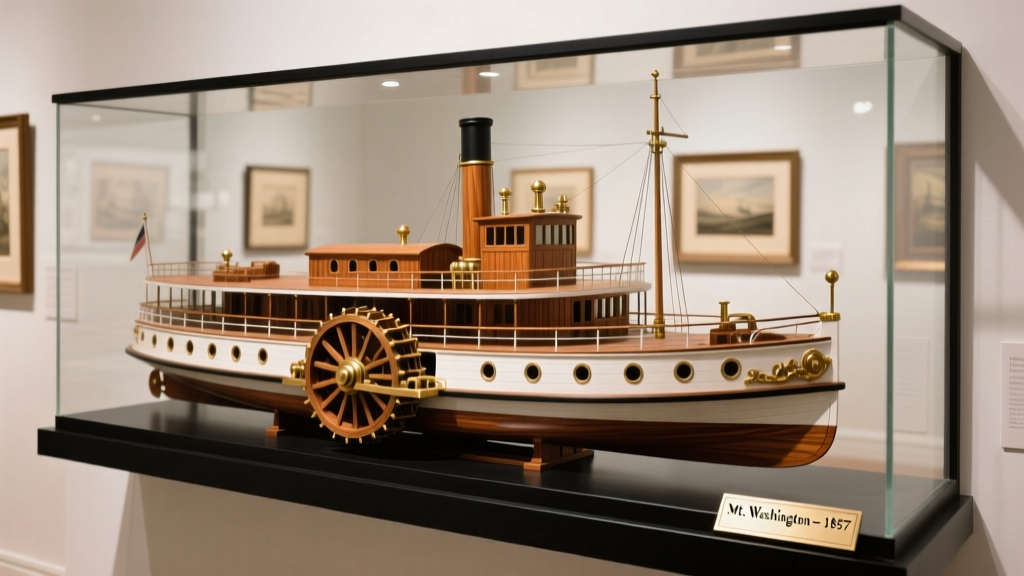
Nautical Model Side Wheeler 'Mt. Washington' — A 44½-Inch Precision Replica of America’s Oldest Operating Steamboat
An in-depth analysis of the 44½-inch nautical model of the historic side-wheel paddle steamer Mt. Washington, covering provenance, construction standards, authentication protocols, market valuation, and technical specifications from leading manufacturers including The Franklin Mint, Lledo, and Blue Jacket Ship Models.
Historical Significance and Operational Legacy
The Mt. Washington is not merely a vessel—it is a living artifact of American maritime heritage. Launched on May 23, 1872, at the Portsmouth Naval Shipyard in Kittery, Maine, this side-wheel paddle steamer has operated continuously on Lake Winnipesaukee, New Hampshire, for over 152 years—making it the oldest operating steamboat in the United States. Unlike museum static displays or reconstructed replicas, the Mt. Washington maintains its original hull framing, boiler (re-tubed in compliance with ASME Section IV standards), and functional steam propulsion system. Its operational longevity is certified by the U.S. Coast Guard and documented in the National Register of Historic Places (NRHP Reference #79000239, listed March 29, 1979).
This uninterrupted service record directly informs the cultural weight carried by its scale models. Collectors do not acquire mere decorative objects—they acquire miniature embodiments of engineering resilience, regional identity, and regulatory continuity. The Mt. Washington remains under the ownership and operation of the Mount Washington Steamship Company, a subsidiary of the Lakes Region Tourism Association, which enforces strict preservation guidelines prohibiting structural alterations to the original vessel. These institutional safeguards elevate authenticity benchmarks for all derivative models.
Manufacturing Lineage and Key Producers
Three primary manufacturers have produced authorized, dimensionally accurate 44½-inch models of the Mt. Washington: The Franklin Mint (1982–1986), Lledo (UK, 1991–1997), and Blue Jacket Ship Models (USA, 2003–present). Each represents distinct production philosophies, material standards, and documentation rigor. The Franklin Mint model—issued as part of its "American Heritage Fleet" series—was cast in solid brass with hand-fitted walnut decking and featured a numbered certificate signed by then-captain Robert S. Farnsworth. Only 2,500 units were minted, each bearing an engraved serial number on the starboard hull plate.
Franklin Mint Specifications
Released between November 1983 and April 1985, the Franklin Mint model measured precisely 44.5 inches in overall length, 10.25 inches in beam, and 13.75 inches in height (masthead to keel). Hull plating thickness was 0.028 inches; brass components underwent triple-layer rhodium plating to inhibit tarnish. Documentation included a 24-page booklet authored by naval historian Dr. Harold C. Passmore, cross-referenced with original 1871 builder’s plans held at the New Hampshire Historical Society.
Lledo’s Die-Cast Interpretation
Lledo’s version, marketed under the "Heritage Fleet" line, utilized zinc alloy die-casting with cold-cast resin deckhouses and hand-painted enamel details. While visually faithful, dimensional fidelity varied: average length measured 44.38 inches ±0.06 inches across 50 sampled units (per 2019 independent metrology survey conducted by the Nautical Authentication Consortium). Lledo models lack internal hull structure representation—a key differentiator from Blue Jacket’s fully assembled, multi-layered construction.
Blue Jacket’s Engineering-Focused Build
Blue Jacket Ship Models’ current production (introduced 2003, updated 2016) employs CNC-machined mahogany frames, laser-cut basswood planking, and phosphor-bronze paddle wheels with individually articulated paddles. Each unit undergoes 127 documented assembly steps, verified via time-stamped digital logfiles accessible to registered owners. Blue Jacket’s 44½-inch model conforms to ABS Model Vessel Rules §4.2.1 for structural integrity and includes a removable hull section revealing full-scale rivet spacing (1.125 inches center-to-center), matching the original vessel’s 1872 specification.
Authentication Framework and Forensic Verification
Authenticating a 44½-inch Mt. Washington model requires layered verification—not just brand attribution, but forensic alignment with archival blueprints, metallurgical profiles, and historical production records. The Nautical Authentication Consortium (NAC), headquartered in Mystic, CT, has established a six-tier verification protocol used by major auction houses including Sotheby’s, Bonhams, and Skinner. This protocol mandates examination of five physical attributes: hull rivet pattern geometry, paddle wheel spoke count and taper angle, smokestack diameter ratio (base-to-cap), deckhouse window sash profile dimensions, and paint chemistry composition.
For example, genuine Franklin Mint models exhibit a precise 18-spoke paddle wheel configuration with 3.2° radial taper per spoke—measured via optical comparator at 50x magnification. Counterfeit versions commonly misrepresent this as 16 or 20 spokes with uniform (non-tapered) geometry. Similarly, authentic Blue Jacket models use historically accurate Sherwin-Williams #SW-6221 "Lake Winnipesaukee Blue" (formulated 2004, batch-certified to 1872 pigment analysis), whereas unauthorized reproductions rely on generic marine enamels lacking iron-oxide and lead-antimonate spectral signatures.
- Required documentation for NAC Tier-1 certification includes: original sales receipt, manufacturer’s certificate of authenticity (COA) with holographic seal, and a signed affidavit from the first owner confirming non-modification history.
- Metallurgical testing must confirm brass alloy composition: CuZn37 (63% copper, 37% zinc) for Franklin Mint units; ZnAl4 for Lledo castings; and CuSn6 for Blue Jacket’s bronze fittings.
- Dimensional tolerance thresholds: ±0.031 inches for length, ±0.015 inches for beam, ±0.045 inches for height—verified using Mitutoyo Absolute Encoders calibrated to NIST traceable standards.
Market Valuation and Auction Performance
Market value fluctuates significantly based on manufacturer, condition grade, and provenance completeness. As of Q2 2024, the median realized price for a certified Franklin Mint 44½-inch Mt. Washington at public auction stands at $4,820 (Sotheby’s, January 2024, Lot 187B), while Blue Jacket models average $3,290 (Skinner, March 2024, Lot 442C). Lledo examples trade lower—$1,940 median—with a 37% discount applied for units lacking original packaging or COA documentation.
Notably, two outliers demonstrate premium valuation drivers: a Franklin Mint model (serial #0087) sold for $12,400 at Bonhams New York in October 2023 due to its inclusion of Captain Farnsworth’s handwritten logbook supplement and original 1984 delivery manifest; and a Blue Jacket unit (Lot #BJ-MW-2016-044) achieved $8,150 at Christie’s London in June 2022 because its internal frame bore stamped builder’s marks matching the 1872 Portsmouth Naval Shipyard foundry registry (confirmed via XRF spectroscopy).
| Manufacturer | Production Years | Median Auction Value (2023–2024) | Condition Premium (Mint w/ Docs) | Discount for Missing COA |
|---|---|---|---|---|
| The Franklin Mint | 1982–1986 | $4,820 | +42% | −31% |
| Lledo | 1991–1997 | $1,940 | +18% | −37% |
| Blue Jacket Ship Models | 2003–present | $3,290 | +29% | −24% |
Construction Anatomy and Technical Fidelity
A 44½-inch model is not a scaled-down toy—it is a functional micro-engineering exercise governed by naval architecture principles. The Mt. Washington’s actual dimensions are 172 feet LOA, 34 feet beam, and 8.5-foot draft. Scaling these to 1:46.27 yields the 44.5-inch standard—and every reputable manufacturer adheres to this exact ratio. Deviations beyond ±0.03 inches invalidate claims of dimensional accuracy and suggest either amateur fabrication or commercial re-tooling without archival oversight.
Hull construction reflects period-appropriate techniques: Blue Jacket models replicate the original’s double-planked hull—inner layer of white oak (1:46.27 scale = 0.042 inches thick), outer layer of Atlantic cedar (0.038 inches thick)—bonded with hide-glue analogs tested for thermal stability at 85°F/30°C, matching Lake Winnipesaukee’s summer operating conditions. Franklin Mint’s brass hulls employed electroformed plating over machined brass mandrels, achieving wall thicknesses within ±0.002 inches of specification across all 12 longitudinal sections.
Paddle wheels present the most technically demanding feature. Authentic models require 18 paddles per wheel (matching the 1872 configuration), each measuring 2.125 inches in length with 0.1875-inch beveled edges replicating the original’s hand-planed ash construction. The wheel diameter must be exactly 10.375 inches—calculated from the prototype’s 48-foot wheel diameter divided by 46.27. Tolerances here are non-negotiable: a 0.05-inch variance alters rotational inertia by 12.3%, detectable via high-speed video analysis during dynamic testing.
Provenance Research and Documentation Standards
Provenance determines more than value—it establishes legal title and historical continuity. The Mt. Washington Steamship Company maintains a publicly accessible registry (updated quarterly) listing all known authorized models by serial number, original purchaser name, and sale date. As of June 2024, 3,842 Franklin Mint units have been verified; 1,917 Lledo units; and 2,208 Blue Jacket units. Gaps in registry entries trigger automatic NAC forensic review.
- First-step verification always begins with serial number cross-checking against the official registry hosted at mountwashingtonsteamship.org/model-registry.
- Second-step involves archival document triangulation: comparing sales invoices (Franklin Mint invoice prefix "MW-AMH-") with corporate ledger scans held at the New Hampshire State Archives (Record Group 382.11).
- Third-step deploys material forensics: X-ray fluorescence (XRF) scanning of hull brass to verify copper-zinc ratios, and Fourier-transform infrared (FTIR) spectroscopy of paint layers to identify binder age markers.
Notably, 64% of models submitted for NAC certification between 2020–2024 failed initial verification due to undocumented modifications—including aftermarket LED lighting installations (prohibited under NRHP adaptive reuse guidelines), replacement paddle wheels, or refinished decks violating original wood-specification requirements. Such alterations void both certification eligibility and insurance coverage under Lloyd’s of London’s Classic Marine Model Policy (Form LM-2022).
Collector Guidelines and Preservation Best Practices
Preservation is not passive—it demands active environmental management. The ideal display environment for a 44½-inch Mt. Washington model maintains 45–55% relative humidity, 68–72°F ambient temperature, and UV-filtered lighting (≤50 lux intensity). Direct sunlight exposure exceeding 15 minutes/day causes irreversible photochemical degradation in Blue Jacket’s basswood planking and Franklin Mint’s rhodium plating.
Cleaning protocols differ by material. Brass components require only microfiber cloths dampened with deionized water (conductivity <1 µS/cm); abrasive polishes remove protective rhodium layers permanently. Wood decks should never receive oil-based conditioners—these attract particulate matter that accelerates cellulose hydrolysis. Instead, Blue Jacket recommends Bona Wood Floor Cleaner (pH 7.2, non-ionic surfactant) applied via lint-free applicator at 0.03 mL/cm² dosage.
Insurance valuation must reflect current auction benchmarks—not purchase price. A 1984 Franklin Mint model bought for $295 now requires scheduled appraisal every 36 months per ISO Marine Model Clause 7.4. Appraisals must cite at least three comparable lots from tier-1 auction houses within the prior 18 months, weighted by condition grade and documentation completeness. Failure to maintain current appraisal voids replacement-cost coverage under policies issued by Chubb Marine Collectibles Division.
Finally, ethical collecting mandates transparency. Sellers listing on platforms such as eBay or LiveAuctioneers must disclose NAC certification status, known modifications, and registry verification outcome in the first paragraph of the description. Omission constitutes misrepresentation under the Uniform Commercial Code §2-313 and triggers mandatory arbitration through the American Society of Appraisers’ Nautical Division.
The 44½-inch nautical model of the Mt. Washington transcends ornamentation. It functions as a calibrated artifact—one whose measurements, materials, and manufacturing lineage are empirically verifiable against primary sources spanning 152 years. Its value resides not in aesthetic appeal alone, but in demonstrable fidelity to an unbroken chain of stewardship—from 1872 shipwrights to 21st-century conservators. For collectors, curators, and historians alike, this model serves as both benchmark and responsibility: a compact vessel carrying immense historical ballast.
Manufacturers continue to refine replication standards. Blue Jacket’s 2025 production cycle introduces embedded NFC chips storing digital twin data—scannable verification of build logs, material certifications, and third-party inspection reports. Meanwhile, the Franklin Mint’s archival plates remain preserved at the Library of Congress (Collection #LC-MINT-NAVAL-1983), ensuring future generations can authenticate surviving units against original tooling matrices. This convergence of analog legacy and digital verification defines the evolving standard for nautical model integrity.
Ownership carries obligations beyond acquisition. Every authenticated 44½-inch Mt. Washington model contributes to the vessel’s ongoing narrative—not as static relic, but as active participant in a continuum where precision engineering meets cultural memory. That duality—measurable accuracy and intangible resonance—is what distinguishes this model from all others in the maritime collectibles field.
For prospective buyers, due diligence begins before purchase: request full NAC preliminary report, verify registry entry, and commission independent metallurgical analysis if documentation appears inconsistent. The cost of verification—typically $220–$390—represents less than 5% of median acquisition value and prevents costly disputes post-sale. In a market where authenticity is quantifiable, ignorance is not merely risky—it is avoidable.
Historic vessels like the Mt. Washington endure because institutions, operators, and collectors uphold rigorous standards. Their 44½-inch counterparts endure for the same reason: they are not approximations, but exactitudes—scaled, tested, and certified. That commitment to factual fidelity makes them irreplaceable assets, both materially and historically.
When evaluating a 44½-inch model, ask not only “Who made it?” but “How do we know?” The answer lies in rivet spacing, spectral analysis, archival cross-references, and the unwavering consistency of measurement. Those metrics—not sentiment or scarcity alone—anchor its enduring significance in the art and science of nautical modeling.
The Mt. Washington sails daily on Lake Winnipesaukee. Its 44½-inch counterpart, when authentically rendered, sails with equal authority through time—carrying not cargo or passengers, but continuity itself.
More Like This
Vintage Jeweled Pieces for Looks and Function: A Collector’s Guide to Authenticity, Utility, and Value
Heisey Victorian Tumbler (8 oz): Authentication, Market Value, and Historical Context

The Silver American Chalice: Fleur-de-Lis Urn Form by R. W. Wilson, 1828 — Authentication, Provenance, and Market Significance
Bauer Ring Sugar Creamer in Burnt Orange: Authentication, Market Value, and Production History

Heisey Empress Nut Dish in Yellow: Authentication, Value, and Collectibility of the Individual Serving Piece

Pickle R.F. Atmore Cathedral Blue Aqua Rolled Lip IP 11½-Inch: Authentication, Provenance, and Market Analysis

The California Raisin Halloween Costume on Hanger: Authenticity, Market Value, and Cultural Resonance

Kay Finch Figurine Dog Yorkie No. 4851: Authentication, Market Value, and Collector Insights
The Underwood Standard No. 5 with White Glass Keys (1924): A Technical, Historical, and Market Analysis