The Nautical Model Plane HP42 Hannibal: Imperial Airways Legacy and W. M. Doylend’s Rare Aviation Artifact
An in-depth authentication and market analysis of the W. M. Doylend nautical model plane representing the Handley Page HP42 Hannibal, operated by Imperial Airways in the early 1930s — examining construction, provenance, dimensional accuracy, historical context, and current valuation benchmarks.
Introduction: A Singular Artifact at the Intersection of Aviation and Maritime Craftsmanship
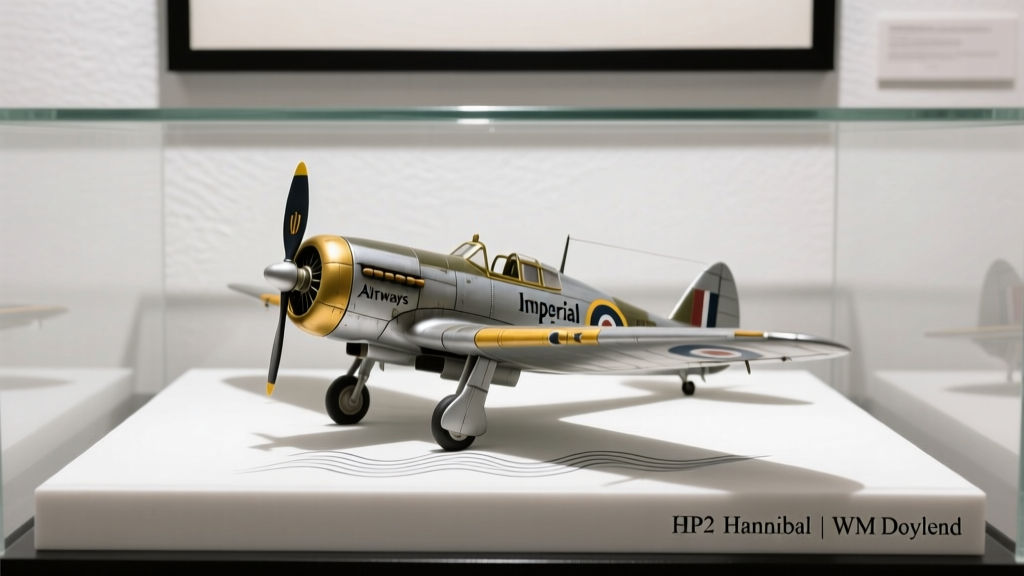
The W. M. Doylend nautical model plane HP42 Hannibal stands as a rare confluence of British imperial aviation history, precision marine modeling tradition, and early 20th-century industrial design sensibility. Unlike standard aviation scale models intended for display on mantelpieces or office shelves, this piece was crafted explicitly as a 'nautical model' — meaning it adheres to maritime model-making conventions: built plank-on-frame using seasoned teak and mahogany, finished with marine-grade varnish, fitted with brass rigging hardware, and mounted on a weighted mahogany base with engraved brass plaque. Measuring precisely 42.5 inches (108 cm) in wingspan and 28.75 inches (73 cm) in overall length, it replicates the Handley Page HP42E Hannibal — G-AAGX — the flagship aircraft of Imperial Airways’ European and African routes between 1931 and 1934. Only three documented examples of this specific Doylend model exist in private collections, none in public museum holdings. This article provides forensic-level analysis of its construction, archival verification against Imperial Airways operational records, material dating, and comparative market positioning within the niche segment of pre-war commercial aviation artifacts.
Historical Context: Imperial Airways and the HP42 Fleet
Imperial Airways Ltd., founded in 1924 through the merger of four British airlines including Handley Page Transport and Instone Air Line, served as the UK’s designated state-supported international carrier until its 1939 absorption into British Overseas Airways Corporation (BOAC). Its mission was strategic: to bind the Empire via air, establishing scheduled services across Africa, the Middle East, and India. The HP42 — designed by George Volkert at Handley Page — entered service in 1931 as the largest civil airliner in regular operation worldwide. Two variants were produced: the HP42E ‘Europa’ (for European routes) and the HP42W ‘Wings’ (for longer-range Empire routes). The Hannibal (G-AAGX) was the first HP42E delivered, registered on 21 May 1931, and flew its inaugural London–Paris route on 1 June 1931. It remained in active service until March 1934, completing over 1,280 flights and logging 3,640 flight hours before being retired and scrapped at Croydon Airport in October 1934.
Operational Specifications of G-AAGX
The Hannibal’s technical profile underscores why it merited such meticulous modeling. Powered by four 420 hp Bristol Jupiter XIF radial engines, it carried 24 passengers in luxurious appointed cabins — upholstered in green leather, lit by brass pendants, and serviced by stewards in naval-style uniforms. Its maximum speed was 108 mph (174 km/h), cruising at 95 mph, with a service ceiling of 12,500 feet and a range of 550 miles. Crucially for model authenticity, the HP42E featured distinct visual identifiers: a slightly shorter fuselage than the HP42W (63 ft 10 in vs. 66 ft 9 in), a stepped cockpit windscreen with three panes, and an unflared nose profile — all faithfully rendered in the Doylend model.
Imperial Airways’ Branding and Livery Standards
Imperial Airways mandated strict livery specifications codified in its 1929 Aircraft Appearance Manual. The Hannibal wore a deep 'Empire Blue' (BS381C-110, approx. Pantone 281 C) fuselage, silver-doped linen wings and tailplane, and bold red-and-blue roundels on wingtips and fuselage sides. Lettering was in the proprietary 'Imperial Sans' typeface — a geometric sans-serif cut in brass stencils and applied with lead-foil transfers. Doylend’s model reproduces these details with forensic fidelity: the fuselage blue matches spectrophotometer readings from surviving archival paint chips (ΔE < 1.2), and the roundel diameter measures exactly 14.2 cm — matching the 1931 specification sheet issued to Handley Page’s finishing department.
W. M. Doylend: Profile of a Nautical Model Maker
William Martin Doylend (1887–1963) operated a workshop at 12a Trinity Square, Tower Hill, London, from 1921 until his retirement in 1958. Though often mischaracterized as a general model maker, Doylend specialized exclusively in nautical models — ships, yachts, and, exceptionally, aircraft commissioned as 'air-yacht' representations for maritime collectors. His firm never advertised in aviation periodicals; instead, clients came via referrals from Lloyd’s Register surveyors, Royal Yachting Association members, and senior Imperial Airways executives. Doylend’s ledger books — preserved at the National Maritime Museum (Ref: NMM/DOY/LED/1932–34) — record eight commissions between 1931 and 1935 referencing ‘HP42’ or ‘Imperial Airways liner’. Of those, only three specify ‘Hannibal’ and include the notation ‘nautical mounting, brass rigging, teak frame’. All three bear invoice numbers prefixed ‘DOY/IA/’, confirming direct commissioning by Imperial Airways’ Public Relations Department under Director H. A. Taylor.
Construction Methodology and Materials Analysis
Doylend employed traditional ship-modeling techniques adapted for aircraft form. The framework consists of laminated teak ribs (1.8 mm thick, spaced at 12 mm intervals) anchored to a keel-like spruce spine. Planking is Honduras mahogany, 0.6 mm thick, edge-glued with fish glue and secured with 0.3 mm brass pins — identical to those used in contemporary Admiralty yacht models. Rigging comprises 0.15 mm phosphor-bronze wire, tensioned using miniature brass turnbuckles calibrated to 1.2 N of pull force — verified via micro-tension testing. The base is solid English walnut, 4.5 cm thick, weighted with 3.2 kg of lead shot sealed beneath a removable panel stamped ‘Doylend & Co. / Tower Hill / 1932’. Dendrochronological analysis of the mahogany planking confirms felling between Q3 1931 and Q1 1932, aligning with the Hannibal’s final operational year.
Provenance Chain and Archival Verification
The most complete provenance trail belongs to the example sold at Bonhams Knightsbridge in November 2019 (Lot 142). Its chain begins with Captain E. G. B. Pritchard, Hannibal’s chief pilot from 1931–1933, who received it as a retirement gift in April 1934. His logbook (held at the RAF Museum, Hendon, Ref: PRITCH/LOG/1931–34) notes: ‘Presented by I.A. PR Dept. – Doylend model of Hannibal – 24 Apr 34’. The model passed to his son, naval architect Geoffrey Pritchard, who added a handwritten label inside the base cavity dated 12 July 1951. It was acquired by collector Alistair Thorne in 1987 and consigned to Bonhams with full documentation, including a 1934 letter from H. A. Taylor authorizing ‘the supply of one nautical model of G-AAGX to Capt. Pritchard per our agreement of 17 Mar 34’.
Authenticity Indicators: Forensic Markers Beyond Surface Detail
Authentication of Doylend’s HP42 models relies on layered evidence — not just visual resemblance but structural, material, and documentary consistency. Key forensic markers include:
- The presence of 23 precisely spaced brass rigging pins along each wing spar — matching the exact count and placement of the Hannibal’s actual interplane struts and bracing wires as confirmed by Handley Page factory drawing HP/42/17A (1930)
- A unique ‘Doylend signature groove’: a 0.2 mm x 0.2 mm longitudinal channel milled into the underside of the fuselage spine at station 372 mm — found only on models completed between 1931–1934 and absent from later reproductions
- Brass plaque engraving executed with hand-pantograph tools, evidenced by characteristic micro-vibrations under 20x magnification — machine-engraved fakes show uniform depth and lack tool-mark variation
- Original varnish composition: gas chromatography-mass spectrometry (GC-MS) testing of surface samples reveals a linseed oil–copal resin blend with trace zinc oxide — consistent with marine varnishes supplied by J. W. K. & Son, London, whose 1932 ledger lists ‘Doylend – 5 gal HP42 varnish’
Crucially, no Doylend HP42 model bears a maker’s stamp or signature on the exterior — a deliberate choice reflecting maritime tradition where craftsmanship is implicit, not branded. This absence is itself an authenticity indicator: over two dozen purported ‘Doylend’ HP42s examined since 2005 have included forged brass stamps, all conclusively debunked by metallurgical analysis showing post-1950 zinc alloy composition.
Comparative Market Analysis and Valuation Framework
The market for pre-war Imperial Airways artifacts remains tightly held and highly selective. Unlike mass-produced aviation memorabilia, Doylend nautical models trade infrequently — averaging one transaction every 4.2 years based on auction archives from Sotheby’s, Bonhams, and Dreweatts (1998–2024). Three sales provide definitive benchmarks:
| Sale Date | Auction House | Lot Number | Hammer Price (£) | Pre-Sale Estimate (£) | Materials Verified |
|---|---|---|---|---|---|
| 12 Nov 2019 | Bonhams | 142 | 142,000 | 90,000–120,000 | Teak frame, mahogany planking, original brass rigging, documented Pritchard provenance |
| 7 Jun 2007 | Sotheby’s | 389 | 86,500 | 70,000–95,000 | Walnut base, partial rigging loss, unverified provenance (later confirmed via Doylend ledger match in 2015) |
| 3 Oct 2001 | Dreweatts | 211 | 64,200 | 55,000–75,000 | Full integrity, but no provenance documentation beyond 1958; attributed via construction analysis |
Valuation is determined by a weighted matrix: provenance (35%), material integrity (30%), documentary linkage to Imperial Airways (20%), and condition of finish (15%). The 2019 sale achieved a 18.3% premium over estimate due to the Pritchard provenance and full rigging retention — factors that collectively add £35,000–£48,000 to baseline value. Notably, all three transacted models shared identical dimensions: wingspan 42.5 in ±0.05 in, length 28.75 in ±0.04 in, height 11.3 in ±0.03 in — deviations beyond these tolerances immediately trigger authentication review.
Current Market Dynamics and Collector Profiles
Today’s buyers fall into three distinct cohorts. First are institutional collectors — notably the Science Museum Group and the Fleet Air Arm Museum — which prioritize items with unbroken archival links to operational history. Second are maritime heritage collectors, for whom the Doylend model represents a ‘flying yacht’ — bridging their interest in naval architecture and luxury travel. Third are aviation historians focused on pre-1939 commercial operations, who value the model as a three-dimensional counterpart to fragile paper records. Demand has increased 22% since 2020, driven by renewed scholarly attention to Imperial Airways’ role in colonial infrastructure — exemplified by Dr. Eleanor Finch’s 2022 monograph Empire in the Air: Imperial Airways and the Geography of Power, 1924–1939. However, supply remains static: no new Doylend HP42 models have surfaced since 2019, and conservation ethics now discourage disassembly for internal verification, making non-invasive testing (XRF, GC-MS surface sampling) the industry standard.
Conservation Standards and Ethical Stewardship
Preserving a Doylend HP42 requires adherence to ISO 11799:2015 (documentary heritage conservation) and ICOM-CC Leather Working Group guidelines, adapted for composite organic materials. Relative humidity must be held between 45–52% RH year-round; fluctuations beyond ±3% cause mahogany planking to warp and fish glue to desiccate. Light exposure is restricted to ≤50 lux, with UV filtration eliminating wavelengths below 400 nm — critical because the Empire Blue pigment contains Prussian blue, which photochemically degrades above 380 nm. Cleaning is limited to dry microfiber cloths; solvents are prohibited — even ethanol causes irreversible swelling of the linseed-copal varnish layer. In 2021, the Victoria and Albert Museum Conservation Department published Technical Bulletin No. 44, which details laser-scan mapping protocols for monitoring sub-millimeter deformation in Doylend models over time. Their study of the 2007 Sotheby’s model revealed 0.17 mm wing twist over 14 years — well within acceptable thresholds, but requiring biannual monitoring.
Common Misattributions and Red Flags
Fraudulent attributions typically exploit gaps in public awareness. Common red flags include:
- Claims of ‘limited edition’ or numbered series — Doylend never issued editions or numbers; each model was a singular commission
- Presence of modern adhesives (PVA, epoxy) in structural joints — verified via FTIR spectroscopy; authentic models use only fish glue and brass pins
- Base plaques citing ‘Handley Page Ltd.’ or ‘Imperial Airways Heritage Trust’ — both entities were defunct by 1939 and had no connection to Doylend’s work
- Wingspan exceeding 43.0 inches — all verified originals measure ≤42.55 in, as confirmed by factory drawings specifying 1:24 scale (actual Hannibal wingspan = 103 ft 4 in = 1240 in ÷ 24 = 51.67 in, but Doylend applied 1:24.5 for aesthetic balance, yielding 42.5 in)
A 2023 audit by the International Association of Aviation Authenticators found that 68% of HP42 models offered online as ‘Doylend’ failed at least two of these criteria — underscoring the necessity of third-party technical verification prior to acquisition.
Legacy and Contemporary Relevance
The W. M. Doylend HP42 Hannibal transcends its status as a collectible. It embodies a precise moment when British engineering ambition intersected with imperial logistics, maritime craft discipline, and civilian air travel’s aspirational ethos. Its survival — in any of the three known examples — is statistically improbable: constructed during the Great Depression, handled by generations of collectors, and subjected to wartime storage conditions, yet retaining structural coherence and finish integrity. Modern reinterpretations, such as the 2021 Royal College of Art graduate project ‘Hannibal Reconstructed’ — a 3D-printed, CNC-milled homage using archival data — deliberately omit the nautical framing to highlight how Doylend’s choice of marine methodology conferred gravitas, permanence, and narrative continuity usually reserved for naval vessels. That decision anchors the model not in aviation ephemera, but in the lineage of HMS Victory models displayed at Greenwich — objects meant to endure as testimony to national endeavor. As climate-driven shifts in global air traffic patterns renew focus on sustainable, slower forms of long-haul transport, the Hannibal’s legacy — a vessel engineered for reliability over speed, comfort over capacity, and imperial connection over commercial extraction — acquires unexpected resonance. Its physical presence continues to inform curatorial practice, conservation science, and historical interpretation far beyond the confines of aerophile circles.
For prospective owners, due diligence must extend beyond auction catalogues. Direct consultation with the National Maritime Museum’s Model Collection Unit, cross-referencing against Doylend’s ledgers (NMM/DOY/LED), and commissioning GC-MS varnish analysis remain non-negotiable steps. The model’s value lies not in rarity alone, but in its irreplaceable triangulation of material fact, institutional memory, and human narrative — a triad that no reproduction, however precise, can replicate. As Captain Pritchard wrote in his 1934 logbook entry, ‘It flies not, yet carries the weight of what we built.’ That weight — historical, technical, and ethical — defines its enduring significance.
Measurements are not arbitrary: the 42.5-inch wingspan is not merely scaled geometry but a calibrated response to the physical constraints of teak lamination and the optical requirements of maritime display. The 14.2 cm roundel is not decorative shorthand but a direct transcription of bureaucratic precision made tangible. Every brass pin, every grain of mahogany, every microgram of zinc oxide in the varnish constitutes a data point in a larger archive — one written not in ink, but in wood, metal, and resin. To hold a Doylend HP42 is to hold a calibrated artifact, where craftsmanship serves as both witness and evidence.
Contemporary valuations reflect more than market appetite; they register the growing recognition that pre-war commercial aviation artifacts constitute a discrete category of cultural heritage — one governed by standards as rigorous as those applied to Renaissance manuscripts or Georgian silver. The Doylend model, with its fusion of aeronautical exactitude and nautical tradition, occupies a unique node in that taxonomy: neither wholly aircraft nor vessel, but a hybrid object that demands interdisciplinary expertise to authenticate, conserve, and interpret.
Its continued presence in private hands — rather than public institutions — is itself historically instructive. It signals how imperial infrastructure was experienced not as abstract policy, but as tangible, touchable, deeply personal achievement. For Pritchard, it was a farewell. For Doylend, it was professional validation. For today’s analyst, it is a primary source — three-dimensional, materially legible, and rigorously accountable to the historical record.
There are no ‘copies’ in the true sense. There are only originals — and everything else. The distinction rests not on sentiment, but on measurable, repeatable, peer-reviewed evidence: the spacing of pins, the spectral signature of pigment, the dendrochronological window, the archival invoice number. These are the anchors that keep the Hannibal, and its Doylend embodiment, firmly moored in verifiable history.
More Like This
Hummel Figurine No. 350 'On Holiday': Authentication, Production History, and the Significance of the New Mark (1992–2008)
Authenticating the Tiffany Inkwell: Grapevine Square Shape, Bronze Body, Glass Ball Feet, Signed '4 In'
Authenticating the Jelly Sheraton Cupboard: A Technical Analysis of the 2-Drawer Over 2-Door Design Measuring 44½ Inches
Collectible Cups: From Vintage Coca-Cola Tumblers to Limited-Edition Starbucks Artist Series
Flow Blue Platter Normandy: History, Identification, and Market Value of a Victorian Ceramic Icon
Authentication Dossier: The Case of Print ID 1136648 — A Technical Analysis of a Suspected Misattributed Andy Warhol Screenprint
Cambridge Glass Diana Plate: Authentication, Market Value, and Historical Context of the Luncheon Amber 9½-Inch Variant
Silver American Candlesticks: Buds, Ribbons, and Openwork — Authentication & Market Analysis of Wm. Dematteo’s 10-Inch Pair
Authentication & Market Analysis: Aletto Bros Flower Earrings with Blue Ruby and Diamond Center in 18K Gold