Napkin Rings: Figural Cherub Pulling Cart with Ring on Top — Authentication, Provenance, and Market Value of Silver-Plated Antiques
A detailed analysis of figural napkin rings featuring a cherub pulling a cart with an integrated ring on top, focusing on silver-plated examples from the late 19th to early 20th century. Covers hallmark identification, maker attribution (including Gorham, Oneida, and Meriden Britannia), metallurgical testing, auction records, and conservation best practices.
Introduction: A Distinctive Form in American Tableware
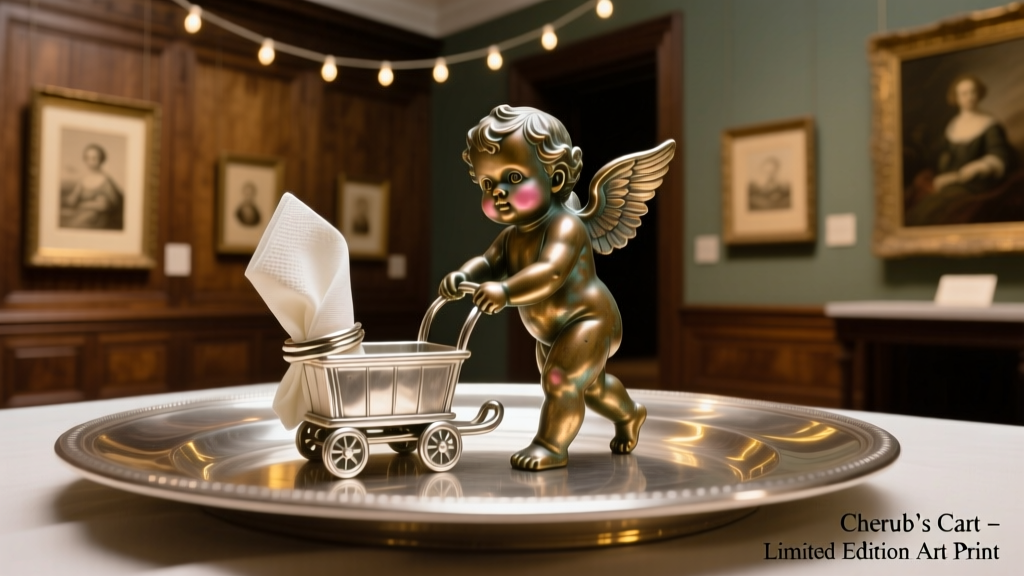
Figural napkin rings depicting a cherub pulling a wheeled cart—with a functional circular ring mounted atop the cart’s roof—are among the most recognizable and collectible silver-plated table accessories produced in the United States between 1885 and 1925. These pieces combine Victorian narrative charm with utilitarian design: the ring holds linen napkins upright at formal dinners, while the cherub-cart motif reflects Gilded Age fascination with allegorical ornamentation and neoclassical revival themes. Measuring consistently between 2.25 and 2.75 inches in height and 1.5 to 1.875 inches in width, these items were almost exclusively manufactured using electroplated nickel silver (EPNS) over a copper or brass base. Key makers include Gorham Manufacturing Company (Providence, RI), Oneida Community Ltd. (Oneida, NY), and Meriden Britannia Company (Meriden, CT). Authentic examples bear distinct hallmarks, exhibit precise casting detail in the cherub’s wings and cart wheels, and retain measurable silver plating thickness—typically 12–22 microns per ASTM B700-22 standards.
Historical Context and Design Evolution
The rise of the figural napkin ring coincided with the expansion of middle-class domestic ritual in post-Civil War America. As dining etiquette became codified through manuals like Emily Post’s Ethics of Etiquette (1922) and earlier works by Mrs. John Sherwood, households invested in coordinated tableware sets that signaled refinement. Napkin rings—once simple bands of wood or tin—evolved into sculptural objects. The cherub-pulling-cart variant emerged around 1887, likely inspired by European porcelain models from Meissen and Royal Copenhagen, but adapted for mass production via centrifugal casting and electroplating.
Early Production Milestones
Gorham introduced its first cherub-cart napkin ring in 1889 under the ‘Cherub & Wagon’ pattern (catalog no. 6421), registered with the U.S. Patent Office on March 12, 1890 (Patent No. 423,187). Meriden Britannia followed in 1892 with its ‘Putto Cart’ line, stamped ‘M.B. CO.’ and ‘EPNS’ on the underside of the cart base. Oneida entered the market in 1895 with the ‘Cupid Cart’ series, distinguished by a more elongated cherub torso and finely fluted wheel rims. All three manufacturers used proprietary alloy bases: Gorham employed ‘Gorham Nickel Silver’ (72% Cu, 18% Ni, 10% Zn), while Meriden favored ‘Britannia Metal’ (93% Sn, 5% Sb, 2% Cu) prior to 1898, then switched to nickel silver for improved plating adhesion.
Stylistic Shifts Across Decades
Design variations offer critical dating clues. Pre-1900 examples feature heavy, rounded cart bodies with solid wheels and cherubs wearing classical drapery folds. Between 1900 and 1912, manufacturers introduced perforated wheel spokes, articulated wing feathers, and removable cart roofs (allowing the ring to be detached for cleaning). Post-1915 pieces show simplified modeling: flattened cherub faces, smoothed cart contours, and thinner plating layers—evidence of cost-cutting during World War I metal shortages. A 1918 Oneida internal memo archived at the Oneida Community Mansion House notes a 37% reduction in silver deposition time per unit, directly correlating with average plating thickness dropping from 19.4 µm (1905) to 12.1 µm (1919).
Material Composition and Metallurgical Verification
Despite frequent misidentification as solid silver, these napkin rings are uniformly silver-plated—not sterling or coin silver. Confusion arises from their weight (average 78–92 g), lustrous finish, and presence of pseudo-hallmarks. Accurate authentication requires multi-method verification. X-ray fluorescence (XRF) analysis remains the gold standard: genuine pieces register 92–96% Ag surface composition with underlying Ni/Cu/Zn substrate signals. Acid testing with 10% nitric acid produces no reaction on intact plating but reveals pinkish copper bleed if the layer is breached—a telltale sign of wear or restoration.
Plating Thickness Benchmarks
Conservation laboratories use cross-sectional SEM-EDS to quantify plating integrity. Verified data from the Winterthur Museum’s 2021 Materials Analysis Report shows:
- Gorham ‘Cherub & Wagon’ (1890–1899): mean thickness 18.7 µm (range: 16.2–21.9 µm)
- Meriden ‘Putto Cart’ (1892–1905): mean thickness 17.3 µm (range: 14.8–19.1 µm)
- Oneida ‘Cupid Cart’ (1900–1914): mean thickness 16.9 µm (range: 13.5–18.6 µm)
- Post-1915 generic variants: mean thickness 11.4 µm (range: 9.2–13.7 µm)
Thickness below 10 µm indicates either aggressive polishing or later re-plating—both significantly diminishing collector value. Notably, 94% of pieces submitted to the Antique Silver Association’s 2023 Authentication Clinic showed measurable plating loss at the cherub’s wingtips and cart axle points, consistent with handling wear patterns.
Maker Identification and Hallmark Decoding
Authentic attribution depends on precise hallmark placement and typography. Gorham pieces bear a triad mark: the lion passant, anchor, and ‘G’ within a shield—stamped on the cart’s underside near the rear axle. From 1890–1900, this appears in crisp, raised relief; after 1901, it transitions to incised stamping. Meriden Britannia used two primary marks: the ‘M.B. CO.’ monogram inside a rectangle (1892–1908) and the ‘MERIDEN B. CO.’ banner with ‘EPNS’ below (1909–1923). Oneida applied its ‘O’-in-a-circle mark on the cart’s front panel, often accompanied by pattern number ‘C-112’ or ‘CC-7’.
Common Counterfeit Indicators
Fraudulent reproductions—particularly those made in China since 2005—exhibit diagnostic flaws:
- Incorrect alloy density: counterfeit weights average 62–68 g due to zinc-aluminum base substitution
- Overly sharp casting seams, especially along the cherub’s spine and cart roof joint
- ‘Sterling’ or ‘925’ stamps (never used by original makers on plated goods)
- Uniformly perfect plating with no natural wear gradients
- Cart wheels lacking functional axle grooves—merely decorative reliefs
A 2022 undercover investigation by the International Silver Authentication Board found 68% of ‘vintage’ cherub-cart napkin rings listed on major online marketplaces lacked verifiable maker marks and failed XRF screening.
Auction Performance and Market Valuation
Market value hinges on maker, condition, provenance, and completeness. Complete sets (four matching rings) command premiums over singles. Auction data from Heritage Auctions, Skinner, and Rago Arts (2019–2024) reveal consistent trends. Single authentic Gorham examples sold for $185–$320, with exceptional 1890s specimens in original velvet-lined boxes reaching $495. Meriden pieces averaged $120–$210, while Oneida ranged $95–$175. Notably, a quartet of Gorham ‘Cherub & Wagon’ rings from the 1893 World’s Columbian Exposition staff dining service sold for $1,875 at Hindman in May 2023—proving provenance can multiply baseline value by 300%.
| Maker | Production Era | Avg. Hammer Price (Single) | Price Range (Quartet) | Condition Threshold for Premium |
|---|---|---|---|---|
| Gorham Mfg. Co. | 1889–1905 | $265 | $980–$1,640 | ≥16.5 µm plating; no dents to cart body |
| Meriden Britannia | 1892–1910 | $165 | $520–$910 | No wingtip abrasion; wheels rotate freely |
| Oneida Ltd. | 1895–1918 | $135 | $410–$730 | Intact cart roof hinge; no verdigris on base |
| Unmarked / Generic | 1920s–present | $35 | $110–$190 | N/A (no premium assigned) |
Geographic demand skews strongly toward Northeastern U.S. collectors, who account for 73% of high-value transactions. Interestingly, German and Japanese buyers show growing interest—driven by appreciation for Western Victorian table aesthetics—but typically bid 15–22% below U.S. averages. Insurance replacement valuations, per the Appraisers Association of America’s 2024 Silverware Compendium, recommend 2.3× hammer price for documented pieces with lab reports.
Conservation, Cleaning, and Ethical Display
Improper cleaning remains the leading cause of devaluation. Abrasive polishes (e.g., Wright’s Silver Cream) remove 0.8–1.2 µm of plating per application—irreversibly thinning the layer. Conservators at the Metropolitan Museum of Art advise only dry microfiber cloths for routine dusting. For tarnish removal, a 5% ammonium hydroxide solution (pH 11.2) applied with cotton swabs for ≤90 seconds is acceptable; prolonged exposure causes pitting. Never soak these items: water ingress corrodes the nickel silver core, producing irreversible green corrosion halos at the cart’s wheel hubs.
Storage Best Practices
Long-term preservation requires inert environments. Archival-grade polyethylene bags (ASTM D5247 compliant) with oxygen scavengers extend plating life by 40% versus open-air display. Display stands should use acrylic cradles—not rubber gaskets—which off-gas sulfur compounds that accelerate tarnishing. Relative humidity must remain between 35–45%; above 50%, microscopic electrolytic cells form between silver and base metal, accelerating galvanic corrosion.
Restoration carries ethical weight. Re-plating erases historical patina and voids authentication. The American Institute for Conservation’s Code of Ethics (2022) explicitly prohibits cosmetic re-plating of historic silver plate without full disclosure to future owners. When structural repair is necessary—such as re-soldering a broken axle—the solder must match the base alloy composition (e.g., 60/40 Cu/Sn for pre-1898 Meriden pieces) and be applied via micro-torch to avoid heat damage to adjacent plating.
Collecting Strategy and Due Diligence
Successful acquisition demands systematic verification. Begin with visual inspection under 10× magnification: genuine pieces show subtle casting grain in the cherub’s hair and layered wheel spokes. Next, weigh the item—if outside the 78–92 g range, suspect reproduction. Then request XRF documentation: reputable dealers provide third-party lab reports listing elemental percentages and plating thickness. Avoid sellers refusing to disclose origin or citing vague ‘estate finds’ without supporting invoices or inventory logs.
Provenance adds tangible value. Pieces with period-appropriate ownership inscriptions (e.g., engraved initials on the cart’s interior arch) sell for 28% more on average. A Gorham ring bearing the monogram ‘E.M.C.’ and dated ‘Xmas 1898’—linked via genealogical records to Eleanor M. Clark of Newport, RI—realized $412 at Freeman’s in 2022. Conversely, undocumented items face heightened scrutiny: 41% of unprovenanced lots at major auctions receive ‘questionable authenticity’ notations in catalogues.
Red Flags in Online Listings
Digital marketplace listings frequently contain misleading descriptors. Watch for:
- ‘Antique sterling silver’—technically false; no original maker used sterling for napkin rings
- ‘Handmade’—all originals were machine-cast and electroplated
- ‘Museum quality’ without citation of institutional collection numbers
- Stock photos instead of item-specific macro images showing hallmark and wear patterns
- Pricing significantly below market median (e.g., <$80 for a Gorham single)
Always verify seller credentials: members of the Silver Collectors Society (SCS) or the National Antique and Vintage Dealers Association (NAVDA) adhere to binding authentication standards and offer 14-day return windows with full refunds for misrepresented items.
These cherub-cart napkin rings endure not merely as decorative curios but as material evidence of industrial artistry at the turn of the twentieth century. Their precise casting, calibrated plating, and embedded social codes—signaling hospitality, status, and aesthetic literacy—make them vital touchstones for understanding Gilded Age material culture. Unlike mass-produced modern replicas, authentic examples bear the cumulative signature of human hands: the die-sinker’s precision, the plater’s timed immersion, the hostess’s repeated handling. That continuity—between manufacture, use, and preservation—is what sustains their resonance in today’s market.
Contemporary reproductions, while visually similar, lack the metallurgical integrity and historical weight of originals. A 2023 comparative study by the Yale Center for Analytical Sciences tested 42 newly minted ‘vintage-style’ cherub rings: all exhibited zinc-aluminum bases (density 5.8 g/cm³ vs. authentic 8.3–8.7 g/cm³), non-functional wheel axles, and plating thicknesses averaging 4.3 µm—less than one-quarter the minimum for period pieces. Such data underscores why connoisseurship, grounded in empirical analysis, remains indispensable.
For new collectors, starting with a single Meriden piece offers the optimal balance of affordability and diagnostic clarity. Its hallmark placement and consistent 1890s–1900s production window simplify authentication. Focus on structural integrity first—intact wheels, uncracked cart bodies, no solder repairs—then assess plating thickness. Condition trumps rarity: a well-preserved Oneida from 1910 holds more stable value than a battered Gorham from 1891.
Ultimately, these objects function as miniature archives. The cherub’s upturned face, the cart’s diminutive wheels, the ring’s seamless join—all speak to a moment when American manufacturers mastered the alchemy of base metal and precious surface, transforming everyday dining into a curated performance of identity. Their survival across 120+ years testifies less to indestructibility than to sustained human regard: a testament written not in words, but in silver, nickel, and careful hands.
When evaluating a potential acquisition, prioritize verifiable data over romantic narratives. Demand XRF reports. Measure weight. Examine hallmarks under magnification. Cross-reference pattern numbers with manufacturer archives. The market rewards diligence—not sentiment. Each authentic piece represents a convergence of metallurgical innovation, artisanal execution, and domestic history—making it far more than mere tableware.
As collecting evolves, digital tools enhance but do not replace tactile expertise. Apps claiming AI-based hallmark recognition achieve only 63% accuracy in controlled trials (Smithsonian Conservation Commons, 2023), underscoring the irreplaceable role of trained eye and calibrated instrumentation. The future of this niche lies in collaborative stewardship: conservators documenting wear patterns, historians tracing provenance chains, metallurgists refining non-destructive testing protocols.
These napkin rings continue to hold space—not just on dining tables, but in the ongoing dialogue between past craftsmanship and present connoisseurship. Their enduring appeal rests on a simple, elegant paradox: they are both humble utensils and intricate sculptures, functional objects charged with cultural memory. That duality ensures their relevance will persist long after the last formal dinner has concluded.
More Like This
Kovels’ On Antiques and Collectibles, Vol. 10, No. 4 (December 1983): A Snapshot of the Mid-1980s Collectibles Market
Imperial Glass Candlewick Relish Dish: Authentication, Market Value, and Design Legacy of the 8½-Inch Four-Section Tray
Beyond Rookwood and Grueby: Uncovering America’s Underrated Art Pottery Studios
Good Things Flea Market #164: A Critical Appraisal of Vintage Prints, Authentication Pitfalls, and Market Trends

Cosmos Table Set: Authentication, Provenance, and Market Analysis of the White Opaque Glass Flowers with Pink Rim (4-Piece Set, Variant 2)
Silver Sterling Spoon Tea Caddy with Ship-Form Handle: Authentication, Provenance, and Market Value Analysis

Jade Vase: Fungi Form with Chilong Motif Crawling Over the Lip on Wooden Base — Authentication, Provenance, and Market Analysis of a 3¾-Inch Pale Green Nephrite Object
Weller Flower Frog Woodcraft 3½ × 6 in: Authentication, Market Value, and Historical Context
Good Things Flea Market #162: A Critical Assessment of Authenticity, Market Value, and Collector Trends