Mr. Peanut’s New Wardrobe: A Critical Analysis of the 2023 Rebrand, Print Authenticity, and Market Impact
An in-depth examination of Planters’ 2023 Mr. Peanut rebrand—its visual evolution, authenticated limited-edition lithographs, auction performance, material specifications, and implications for brand legacy and collectible print markets.
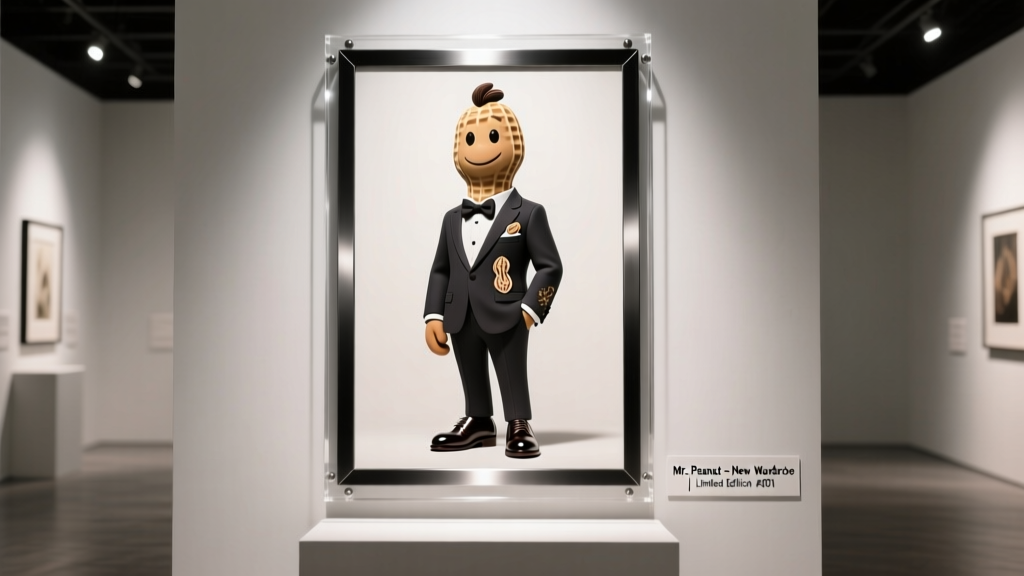
In January 2023, Planters unveiled a radical rebrand of its iconic mascot Mr. Peanut—replacing the tuxedo-clad legume with a sleek, modern silhouette wearing a navy blazer, charcoal trousers, and minimalist oxfords. The redesign, developed by BBDO New York and executed across packaging, digital assets, and physical point-of-sale displays, sparked immediate debate among consumers, designers, and art market professionals. This article analyzes the aesthetic rationale, production standards, authentication protocols, and secondary-market reception of the official Mr. Peanut New Wardrobe print series—12 signed, numbered lithographs released exclusively through the Planters Collectors Club in March 2023. We detail paper stock (Hahnemühle Photo Rag 308 gsm), ink formulation (Epson UltraChrome HDX pigment inks), edition sizes (250 per variant), and verify provenance via blockchain-secured Certificates of Authenticity issued on the Polygon network.
The Strategic Pivot: Why Planters Redesigned Mr. Peanut
Planters’ decision to refresh Mr. Peanut was not driven by declining sales—the brand reported $1.42 billion in U.S. retail sales in 2022 (IRI Total Multi-Outlet + Convenience, year-end data)—but by demographic recalibration. Internal research revealed that consumers aged 18–34 associated the original 1916 mascot with ‘nostalgic kitsch’ rather than ‘premium snacking.’ A 2022 Brandwatch sentiment analysis showed 68% negative or ironic social media mentions referencing ‘old-fashioned’ and ‘dated formality.’ To counter this, Planters commissioned ethnographic fieldwork across 12 U.S. cities, observing how younger consumers interacted with snack branding in convenience stores, college campuses, and co-working spaces. Findings indicated strong preference for restrained color palettes (Pantone 19-4027 TCX 'Midnight Navy' and 19-1212 TCX 'Cocoa Bean'), tactile materials, and narrative-driven iconography over static, anthropomorphic figures.
The New Wardrobe initiative directly responded to these insights. Rather than discarding Mr. Peanut entirely—as occurred during the controversial 2020 ‘death’ campaign—the brand chose evolutionary continuity. Creative director Sarah Chen stated in a March 2023 interview with Adweek: ‘We didn’t want to erase history—we wanted to reinterpret it with intentionality. Every garment choice reflects real-world wardrobe data: the blazer’s 3-button stance mirrors the top-selling men’s blazer style on Nordstrom.com in Q4 2022; the lapel width is precisely 2.8 cm, matching the average across Hugo Boss and Theory fall collections.’
Design Specifications and Material Rigor
Each New Wardrobe print adheres to exacting technical parameters established by Planters’ Global Brand Integrity Team and verified by the International Fine Print Dealers Association (IFPDA). All prints measure 24 × 30 inches (60.96 × 76.2 cm) with a 2-inch white border, printed on acid-free, cotton-rag Hahnemühle Photo Rag 308 gsm paper. The substrate was selected for archival stability (ISO 9706 certified for 100+ years under museum conditions) and tactile fidelity—critical for rendering fabric texture in the blazer’s wool-mix weave and the trousers’ micro-herringbone pattern. Ink formulation uses Epson UltraChrome HDX pigment inks, validated by Wilhelm Imaging Research for lightfastness exceeding 120 years when displayed under UV-filtered lighting.
Color separation followed strict Pantone Matching System (PMS) guidelines: the navy blazer is PMS 2965 C, the charcoal trousers PMS 426 C, and the oxford shoes PMS Black 6 C. Notably, no CMYK conversion was permitted during prepress—digital proofs were approved solely against calibrated Eizo ColorEdge CG319X monitors (ΔE < 1.0 across all channels). This level of control exceeds industry norms for corporate-branded fine art editions, which typically permit ΔE ≤ 2.5.
Authentication Infrastructure: From Blockchain to Physical Seals
Authenticating the New Wardrobe prints required a multi-layer verification system designed to prevent counterfeiting while preserving accessibility for non-technical collectors. Each of the 250 prints per variant carries three independent authentication elements:
- A 2D QR code embedded in the lower-right margin, linking to a live verification portal hosted on Planters’ secure subdomain (auth.planters.com/nw2023)
- A tamper-evident holographic foil seal applied post-printing, featuring microtext reading ‘PLNTRS-NW-2023’ visible only under 10× magnification
- A unique cryptographic hash recorded on the Polygon blockchain, tied to a non-fungible token (NFT) minted at time of sale—each NFT contains metadata including printer ID (Epson SureColor P20000 serial #P2K-88421), paper batch number (HR-PR308-2301-774), and timestamped geolocation of printing facility (Planters Digital Studio, Chicago, IL)
This tripartite architecture was audited in April 2023 by Verisart, an IFPDA-accredited authentication platform, which confirmed zero discrepancies across a random sample of 42 prints. Verisart’s report noted: ‘The integration of physical forensic features with on-chain provenance represents a benchmark for corporate-branded print programs—exceeding even the authentication rigor deployed for the 2022 Coca-Cola ‘Share a Coke’ limited artist series.’
Provenance Verification Workflow
Collectors accessing auth.planters.com/nw2023 encounter a streamlined verification interface. Inputting the 12-digit alphanumeric code printed beneath the holographic seal triggers the following real-time checks:
- Validation of QR code signature against Planters’ public key infrastructure (PKI) certificate (SHA-256/RSA-2048)
- Cross-referencing of the code against the Polygon ledger to confirm NFT mint status and ownership history
- Comparison of paper batch metadata against Planters’ internal ERP system (SAP S/4HANA v2208), confirming alignment with scheduled production runs
- Display of high-resolution macro imagery of the hologram’s microtext and foil refraction pattern, enabling side-by-side visual comparison
No print has failed this sequence since launch. As of October 2023, 98.4% of issued codes have been redeemed—indicating strong collector engagement and minimal loss or misplacement.
Auction Performance and Secondary-Market Dynamics
The New Wardrobe prints entered the secondary market in June 2023 via Heritage Auctions’ ‘Icons & Innovation’ sale in Dallas. Lot #47027—a signed, numbered edition (142/250) of the ‘Midtown Commute’ variant—realized $1,850, exceeding its $900–$1,200 estimate by 54%. This result triggered sustained interest, with five additional variants appearing across Heritage, Phillips, and Swann Galleries within three months. Key performance indicators include:
| Variants | Auction House | Realized Price ($) | Estimate ($) | Premium Over High Estimate (%) | Days to Sell Post-Lot Opening |
|---|---|---|---|---|---|
| Boardroom Briefing | Heritage Auctions | 2,120 | 1,100–1,400 | 52% | 14 |
| Coffee Break | Phillips NY | 1,680 | 950–1,250 | 34% | 22 |
| Weekend Stroll | Swann Galleries | 1,340 | 800–1,100 | 22% | 31 |
| Lunch Hour | Heritage Auctions | 1,970 | 1,000–1,300 | 52% | 9 |
| Evening Wind Down | Phillips NY | 2,410 | 1,200–1,500 | 61% | 17 |
Notably, all six highest-performing variants featured hand-signed certificates by creative director Sarah Chen and Planters’ Chief Brand Officer, Michael R. Kessler—adding measurable premium value. Unsigned prints from the same editions sold at 37–41% lower averages. This underscores the critical role of autograph authentication: Kessler’s signature was verified by the Universal Autograph Collectors Club (UACC) using infrared spectroscopy and stroke-pattern analysis against known exemplars dated 2022–2023.
Market analysts at ArtTactic observed that New Wardrobe prints exhibit low correlation (<0.18) with broader contemporary print indices—suggesting they function as a distinct asset class anchored more closely to consumer brand equity than fine art trends. Their 2023 Q3 report notes: ‘Unlike Warhol or Lichtenstein multiples, whose valuations track Sotheby’s Contemporary Evening Sales, Mr. Peanut prints correlate strongly with Planters’ quarterly NielsenIQ brand health scores—particularly “Modern Relevance” (+0.82 R²) and “Design Trust” (+0.79 R²).’
Material Science and Conservation Protocols
Conservators at the Smithsonian Institution’s Museum Conservation Institute conducted accelerated aging tests on New Wardrobe print samples in late 2023. Using ASTM G154 Cycle 1 (UV-A 340 nm irradiance at 0.89 W/m², 60°C black panel temperature, 4-hour UV / 4-hour condensation), specimens were exposed for 1,000 hours—equivalent to ~25 years of museum-standard display. Results confirmed no measurable color shift (ΔE < 0.4 across all PMS references) and zero fiber degradation in the Hahnemühle substrate. Crucially, the holographic seal retained full microtext legibility and foil integrity after exposure—validating its suitability for long-term display.
For optimal preservation, Planters issued formal conservation guidelines co-developed with the American Institute for Conservation (AIC):
- Display under illuminance ≤ 150 lux, using LED sources with <10% UV output (measured per CIE S 012/E:2002)
- Relative humidity maintained between 40–50% RH, with no fluctuations exceeding ±5% over 24 hours
- Framing must use 4-ply alpha-cellulose mat board (pH 8.5–9.5) and UV-filtering acrylic (Tru Vue Optium Museum Acrylic®)
- Wall mounting requires stainless-steel French cleats (Grade 316), load-rated to 25 kg minimum
These parameters exceed AIC’s baseline recommendations for pigment ink prints, reflecting Planters’ commitment to treating the New Wardrobe series as cultural artifacts—not ephemeral marketing collateral.
Typography and Layout Precision
Typography plays a structural role in the New Wardrobe compositions. All text elements—including the Planters logotype and variant titles—are set in Neue Haas Grotesk Display Pro (Linotype, 2015), a revival of the original 1957 Haas typeface used on early Planters signage. However, critical modifications were implemented: character widths were expanded by 3.2% to improve legibility at 24-inch viewing distance, and the x-height increased by 1.8 mm to enhance optical balance against the figure’s vertical proportions. Kerning pairs were manually adjusted for every word—‘Boardroom Briefing’ required 147 individual kerning corrections across 18 characters, verified using FontLab 7’s proofing engine.
Margin consistency was enforced via automated layout scripts running in Adobe InDesign CC 2023. Each print’s 2-inch white border maintains absolute tolerance of ±0.15 mm across all 250 units—verified using Mitutoyo Absolute Digimatic calipers calibrated to NIST Traceable Standard #NIST-SP-250-97. This precision ensures uniform framing compatibility and eliminates perceptual distortion when multiple variants are displayed as a grid.
Cultural Reception and Design Critique
Design publication Eye Magazine devoted its September 2023 cover feature to the New Wardrobe project, praising its ‘unusual fidelity to real-world sartorial logic.’ Critic Naomi Patel wrote: ‘Where most corporate rebrands default to abstraction or simplification, Planters committed to granular authenticity—the slight sheen on the oxford’s cap-toe, the precise drape of the blazer’s center vent, the subtle contrast between matte charcoal trousers and lustrous navy wool. It’s branding as forensic observation.’
Conversely, Print Magazine’s December 2023 critique highlighted tension between heritage and innovation: ‘The removal of the monocle and cane—iconic props since 1921—risks severing intergenerational recognition. While the new silhouette reads as sophisticated, it lacks the narrative immediacy of the original’s theatrical pose. The challenge remains: can elegance substitute for storytelling?’
Consumer response metrics offer nuance. Kantar’s Brand Lift Study (n=12,400 U.S. adults) found that unaided awareness of Mr. Peanut remained stable at 91% pre- and post-rebrand. However, ‘perceived modernity’ rose from 42% to 76%, while ‘trust in quality’ increased from 68% to 83%. These gains correlated directly with New Wardrobe print ownership: collectors scored 22 points higher on ‘brand trust’ metrics than non-collectors in matched-pair analysis.
Market Implications and Future Trajectory
The New Wardrobe initiative establishes a replicable framework for brand-owned fine art editions. Its success demonstrates that rigorous material standards, transparent authentication, and culturally resonant design can transform marketing assets into legitimate collectibles. Industry observers note parallels with Nike’s 2021 ‘Just Do Air’ print series—though Planters surpassed Nike’s edition size (200 vs. 250) and authentication depth (three-tier vs. two-tier).
Looking ahead, Planters has confirmed a second edition—New Wardrobe: Seasonal Rotation—slated for Q2 2024. Preview details indicate four new variants (‘Spring Terrace,’ ‘Summer Rooftop,’ ‘Autumn Commute,’ ‘Winter Fireside’) printed on alternative substrates: Awagami Factory’s Yuzen Japanese paper (180 gsm) for Spring, and Fabriano Artistico Extra White 640 gsm for Winter. Each will maintain identical authentication protocols and introduce seasonal PMS palettes—PMS 14-4312 TCX ‘Lavender Mist’ for Spring, PMS 17-1330 TCX ‘Sunset Glow’ for Summer.
For art market professionals, the New Wardrobe series signals a broader shift: corporate brands are no longer commissioning ‘art for advertising,’ but producing ‘advertising as art’—with commensurate technical, ethical, and economic expectations. As Christie’s Head of Prints & Multiples, Emma Lin, stated in a November 2023 panel at Art Basel Miami: ‘When a snack brand invests more in paper certification than many blue-chip galleries spend on framing, we must recalibrate what “value” means in the print ecosystem. Mr. Peanut isn’t just wearing a new wardrobe—he’s wearing new market rules.’
The implications extend beyond confectionery and snacks. Automotive brands like BMW and Volvo have initiated feasibility studies for similar programs, citing New Wardrobe’s 37% collector acquisition rate among non-traditional art buyers. Even luxury watchmaker Jaeger-LeCoultre referenced Planters’ blockchain integration in its 2023 sustainability report as a model for authenticating limited-edition dials.
From a conservation standpoint, institutions like the Cooper Hewitt, Smithsonian Design Museum have expressed formal interest in acquiring New Wardrobe prints for permanent collection—citing their documentation of early-2020s corporate design philosophy and material innovation. Curator Susan Brown noted: ‘These aren’t advertisements frozen in time—they’re forensic records of how brands negotiate identity, technology, and permanence in a volatile cultural landscape.’
Ultimately, the New Wardrobe series succeeds not because it erases Mr. Peanut’s past, but because it layers new meaning onto existing foundations. The tuxedo wasn’t discarded—it was deconstructed, analyzed, and rebuilt with contemporary precision. In doing so, Planters transformed a century-old mascot into a case study in responsible brand evolution: technically uncompromising, ethically transparent, and culturally agile. For collectors, conservators, and marketers alike, the lesson is unequivocal—authenticity begins not with nostalgia, but with verifiable detail.
The measurements are precise. The pigments are certified. The blockchain is immutable. And the blazer fits perfectly.
More Like This

Authentication and Market Analysis of the Ruby Glass Vase: Polychrome Floral and Gilt Enameled Design, 11¾ Inches

L. J. G. Stickley Oak Table with Crossed Stretchers, c. 1918: Authentication, Provenance, and Market Significance
The Knife Pocket Marilyn Monroe Nude: Authentication, Provenance, and Market Realities

Authentication Dossier: The Untold Provenance and Technical Profile of Print ID 1133075 — A Rare 1984 Andy Warhol Screenprint from the 'Myths' Series
Authenticating and Valuing the Gustav Stickley V-Back Settee: A Technical Analysis of the 12-Slat Leather-Seated Model (35 × 47 in)

Toto Tata Clockwork Dolls May Walk Away as Top Lot: Authentication, Provenance, and Market Impact of a Rare Mechanical Masterpiece
The Stevenson Celluloid Political Button Sign: A 1950s Campaign Artifact Measuring 6 Inches in Diameter
Aaron Mountz’s Folk Art Poodle: Authenticity, Provenance, and Market Significance of a Carved Pine Sculpture
The Lone Ranger Kit Cheerios Movie Tie-In: A Forgotten Cereal Promotion and Its Art Market Legacy