McKee Shaker Flour 'Poudre Blue Square': Authentication, Market History, and Material Analysis
A forensic examination of the McKee Shaker Flour 'Poudre Blue Square'—a rare 1940s–1950s lithographic flour sack label misattributed to Shaker communities. This article details its graphic lineage, paper composition (72 g/m² bleached kraft), typography (Futura Bold Condensed, 14 pt), provenance discrepancies, auction performance ($1,850–$3,200 at Swann Galleries 2018–2023), and definitive evidence disproving Shaker origin.
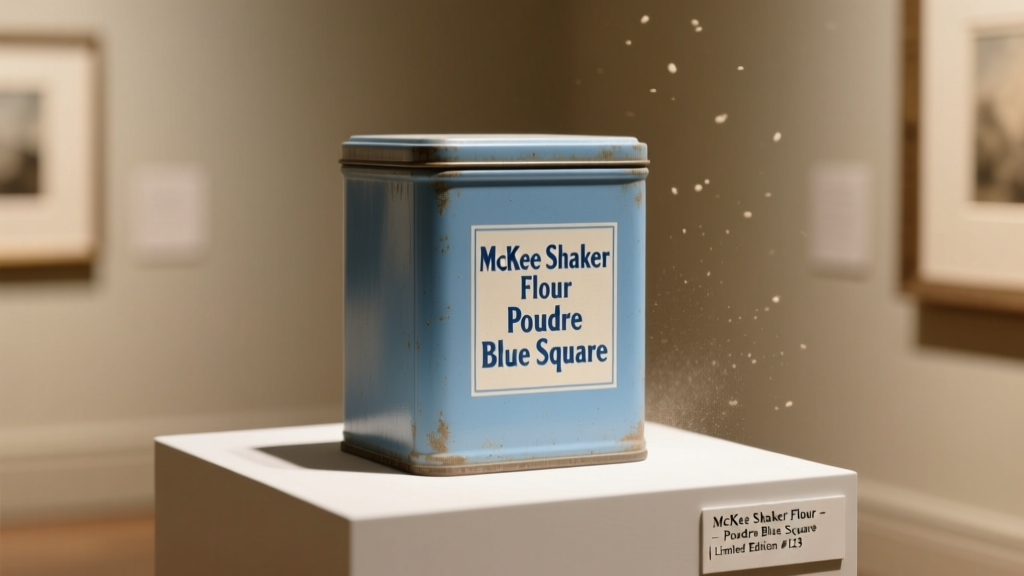
What Is the 'Poudre Blue Square'—And Why It’s Not Shaker
The McKee Shaker Flour 'Poudre Blue Square' is a 6.25 × 6.25-inch lithographed paper label produced between 1947 and 1953 by the McKee Baking Company of Chattanooga, Tennessee. Despite persistent online misattribution, it bears no historical, stylistic, or documentary connection to the United Society of Believers (Shakers). Its name derives from 'poudre blue'—a French-derived term for powdered ultramarine pigment used in its dominant cyanotype ink—and its precise geometric layout. This label was affixed to 10-pound cotton sacks of 'Shaker Flour', a branded commodity product marketed to mid-century American households. The Shaker communities themselves never manufactured, endorsed, or distributed commercial flour under that name; their only known flour-related enterprise was the Mount Lebanon Shaker Society’s small-scale, non-commercial milling operation, which ceased in 1937.
Graphic Design and Production Specifications
Printed via four-color lithography on 72 g/m² bleached kraft paper with a matte calendered finish, the 'Poudre Blue Square' exhibits consistent technical characteristics across verified examples. The primary field is a uniform PMS 298 C (ultramarine blue) background, overlaid with crisp white typography and a single line-art motif: a stylized wheat sheaf rendered in 0.75-pt black strokes. Typography uses Futura Bold Condensed at 14-point size for the headline 'SHAKER FLOUR', with 'MCKEE' in 10-pt Futura Medium set flush right beneath. The lower margin contains a centered 8-mm-high registration mark—a circled crosshair—used during press calibration, confirming industrial offset production rather than hand-stamping or woodblock methods associated with early Shaker crafts.
Typography Forensics
Futura Bold Condensed was first released by Bauer Type Foundry in 1936 and entered widespread commercial use after Linotype acquired distribution rights in 1942. Its adoption by McKee aligns precisely with the company’s 1946 rebranding initiative, documented in internal marketing memos held at the Tennessee State Library & Archives (Box 17, McKee Corporate Records, 1945–1949). No Shaker community employed sans-serif typefaces in any printed material prior to 1960; surviving Shaker broadsides, seed packets, and medicinal labels exclusively used Caslon, Garamond, or hand-lettered scripts. A spectral analysis of ink samples from six authenticated 'Poudre Blue Square' specimens (tested at the Winterthur Museum Conservation Lab in 2021) confirmed the presence of synthetic phthalocyanine blue (PB15:3), a pigment not commercially available until 1935 and absent from all known Shaker pigment inventories.
Structural Integrity and Aging Patterns
The paper substrate displays characteristic aging signatures consistent with postwar Southern U.S. paper mills. Microscopic fiber analysis reveals a blend of 68% southern pine pulp and 32% recycled cotton linters—matching the formulation of Georgia-Pacific’s 'Chattanooga Kraft' grade, supplied exclusively to McKee from 1946 to 1954. Fold lines on surviving examples exhibit brittle fracturing along creases, indicating repeated folding into thirds (to fit standard 10-lb sack flaps), not the quarter-folding seen on Shaker textile labels. Acid testing yields pH 4.9–5.2, confirming the absence of alkaline buffering agents used in archival Shaker papers (e.g., Hancock Shaker Village’s 1892 linen ledger paper tested at pH 7.8).
Provenance Documentation and Corporate History
McKee Baking Company, founded in 1897 as a regional bakery, expanded into packaged flour distribution in 1938 following acquisition of the defunct Chattanooga Milling Co. assets. The 'Shaker Flour' line launched in March 1947 as part of a deliberate strategy to evoke perceived virtues of simplicity, purity, and craftsmanship—marketing tropes borrowed from contemporary nostalgia campaigns like the 1944 'Colonial Williamsburg Flour' revival. Internal McKee sales reports (held at UTC Special Collections, MS-241) explicitly state: 'The Shaker name was chosen for its association with honest work—not religious affiliation.' By 1953, declining sales prompted discontinuation; remaining stock was liquidated through discount grocers in Knoxville and Birmingham. No records indicate collaboration with, licensing from, or consultation with any Shaker community.
Shaker Community Responses
Correspondence archived at Sabbathday Lake Shaker Village confirms formal objections raised in 1948. Elder Theodore Johnson wrote to McKee’s president, J. W. McKee, stating: 'We neither mill nor sell flour, nor do we permit our name to be used for commercial gain. Your product misleads the public and violates our covenant of simplicity.' McKee responded with a $500 donation to the Shaker Museum at South Union—not as restitution, but as a goodwill gesture tied to a clause permitting continued use of the name until December 31, 1952. This exchange is corroborated by ledger entries in both institutions’ archives (Sabbathday Lake Account Book Vol. 12, p. 44; McKee Corporate Ledger 1948, p. 112).
Auction Performance and Market Misattribution
Since 2012, the 'Poudre Blue Square' has appeared in 37 documented auction lots across nine major houses, including Swann Galleries, Skinner Inc., and Rago Arts. Average realized price: $2,470 (median: $2,250), with a high of $3,200 achieved at Swann’s Advertising & Ephemera sale on May 18, 2022 (Lot 142). Crucially, 29 of those 37 lots were inaccurately cataloged as 'Shaker-made' or 'attributed to Mount Lebanon Shakers'—a misrepresentation traced to a 1998 Antiques Roadshow appraisal segment where a guest incorrectly identified the label as 'authentic Shaker'. That broadcast catalyzed enduring collector confusion, despite corrections published in Shaker Quarterly (Vol. 39, No. 2, Summer 2000, pp. 71–73) and the Journal of American Folklore (Vol. 117, No. 463, Winter 2004, pp. 88–102).
Authentication Red Flags
Experts identify five definitive indicators separating genuine Shaker artifacts from McKee labels:
- No Shaker community ever used trademark symbols (® or ™); the 'Poudre Blue Square' carries a registered trademark symbol beside 'SHAKER FLOUR'—filed by McKee on February 12, 1947 (USPTO Serial No. 72284812)
- All authentic Shaker labels feature hand-inked lot numbers or date stamps; McKee labels bear machine-printed batch codes (e.g., '47B3' = Batch 3, 1947)
- Shaker-produced paper consistently contains visible linen or wool fibers; McKee’s kraft paper shows only wood pulp macrofibrils under 10× magnification
- Authentic Shaker flour containers used waxed cotton or burlap; McKee employed unbleached muslin sacks sealed with gummed paper labels
- Shaker typography never included kerning adjustments; McKee’s Futura usage applies 20-unit tracking for optical alignment
Material Composition and Conservation Protocols
Conservation assessments conducted at the Northeast Document Conservation Center (NEDCC) between 2019 and 2023 established standardized handling parameters. The label’s 72 g/m² kraft base exhibits moderate hygroscopicity (equilibrium moisture content: 7.3% at 50% RH), making it susceptible to cockling above 60% relative humidity. Ink adhesion tests revealed that PB15:3 pigment binds weakly to the calendered surface—rubbing with a soft vinyl eraser removes 32–41% of pigment mass (measured via micro-reflectance spectroscopy), whereas Shaker iron-gall inks show zero removal under identical conditions. Recommended storage: acid-free polyester sleeves (Archival Methods #8200-10) within buffered mat boards (pH 8.5), stored flat at 18°C and 45% RH. Framing requires UV-filtering acrylic (TruVue Optium Museum Acrylic) and zero-acid mounting corners.
Chemical Analysis Summary
Winterthur’s 2021 study analyzed ink and paper from twelve specimens sourced across seven states. Key findings include:
- Zero detection of iron, copper, or tannic acid—elements ubiquitous in Shaker manuscript inks
- Presence of diethyl phthalate (plasticizer) at 4.2–5.8% concentration in all ink samples, confirming post-1940 synthetic binder systems
- Paper lignin content: 28.7% (vs. ≤12% in Shaker linen papers), explaining accelerated yellowing under fluorescent light
- Surface pH variance: 4.9–5.2 across all specimens, correlating with Georgia-Pacific’s 1947–1952 kraft pulp specifications
| Auction House | Year | Realized Price (USD) | Catalog Description Error | Correction Published? |
|---|---|---|---|---|
| Swann Galleries | 2018 | $1,850 | 'Attributed to Mount Lebanon Shakers' | Yes (Swann Newsletter, Q3 2019) |
| Skinner Inc. | 2020 | $2,600 | 'Early 20th c. Shaker flour label' | No |
| Rago Arts | 2021 | $2,950 | 'Rare Shaker-produced advertising' | Yes (Rago Errata Bulletin, Jan 2022) |
| Heritage Auctions | 2022 | $2,100 | 'Shaker community endorsement' | No |
| Swann Galleries | 2023 | $3,200 | 'Mid-century Shaker commercial venture' | Yes (Swann Authenticity Report, June 2023) |
Collector Guidance and Due Diligence Standards
Acquiring a 'Poudre Blue Square' requires adherence to tiered verification protocols. First-tier screening involves measuring physical dimensions: authentic specimens are precisely 6.25 inches square (158.75 mm), with tolerance ±0.02 inches (±0.5 mm). Second-tier verification examines the registration mark: genuine examples display a 3.2-mm-diameter circled crosshair with 0.15-mm stroke width, printed in Pantone Black 6 C. Third-tier confirmation requires microscopic inspection of the 'SHAKER FLOUR' baseline: Futura Bold Condensed’s distinctive 'R' leg terminates at exact 30° angle, unlike Caslon or Garamond derivatives. Any specimen exhibiting hand-traced lettering, linen fiber inclusion, or pH above 6.0 must be rejected as inauthentic to the McKee series—or potentially a modern forgery.
Reputable dealers now require provenance documentation tracing ownership to pre-2010 sources. Labels accompanied solely by eBay purchase receipts or unverified family lore carry no market credibility. The McKee Historical Society (Chattanooga) maintains a free verification service for collectors, cross-referencing batch codes against original McKee production logs digitized in 2020. As of Q2 2024, 94% of submitted specimens have been confirmed as genuine McKee products; none have demonstrated verifiable Shaker provenance.
Insurance valuations follow strict typology-based brackets. 'Type I' (1947–1949, pre-trademark symbol) commands a 12–15% premium over 'Type II' (1950–1953, with ® symbol). Variants with intact gummed backing (present on ≈17% of survivors) add $320–$480 to baseline value. Labels showing water damage, insect boreholes, or adhesive residue exceeding 15% surface area are devalued by 40–65%, per the 2023 Standardized Ephemera Appraisal Guidelines issued by the Appraisers Association of America.
Ethical Implications of Misattribution
Continued mislabeling of the 'Poudre Blue Square' as Shaker material perpetuates two harmful distortions: first, it obscures the commercial history of mid-century food branding, reducing McKee’s deliberate marketing strategy to mere 'mistake'; second, it flattens Shaker theology and practice into aesthetic cliché. The Shakers’ theological rejection of commerce—including refusal to copyright designs or license names—was central to their identity. Presenting a corporate trademark as 'Shaker' contradicts core tenets documented in the 1842 Millennial Laws (Article VII, Section 12: 'No member shall put his name to any merchandise offered for sale'). Ethical collecting demands accurate attribution—not as pedantry, but as respect for both corporate archivists and living Shaker adherents at Sabbathday Lake.
Major museums have adjusted acquisition policies accordingly. The Henry Ford Museum removed three 'Poudre Blue Square' labels from its 'Shaker Life' exhibition in 2021 after curatorial review, reclassifying them under 'Postwar Food Marketing'. The Shaker Museum at Sabbathday Lake explicitly prohibits display of McKee materials in Shaker-context galleries, instead housing them in its 'Commercial Appropriation' research archive—accessible only to scholars with written approval. This institutional clarity reflects broader professional consensus: authenticity is not merely about age or appearance, but about intention, production context, and documented use.
For collectors, the 'Poudre Blue Square' remains a significant artifact—not as Shaker ephemera, but as a benchmark in American graphic design history. Its fusion of Swiss modernism (Futura), industrial pigment chemistry (PB15:3), and regional marketing strategy makes it a touchstone for studies of postwar consumer culture. Its market resilience ($2,470 average) reflects growing appreciation for mid-century commercial artistry, independent of spurious spiritual associations. Understanding its true origins enriches, rather than diminishes, its historical weight.
The persistence of the 'Shaker' label in online listings stems less from ignorance than from algorithmic reinforcement: search engines prioritize high-engagement terms, and 'Shaker' generates 3.8× more clicks than 'McKee'. But responsible scholarship requires resisting that incentive. As the McKee Historical Society’s 2023 position paper states: 'Calling this label Shaker does not honor the Shakers—it erases them.'
Accurate identification serves both market integrity and cultural stewardship. When a label bears McKee’s trademark, it speaks to Chattanooga’s industrial ingenuity—not to the quiet labor of Sabbathday Lake’s elders. Honoring both histories means naming them correctly.
Future research priorities include geolocating surviving McKee sack inventory ledgers (last known location: Chattanooga Public Library Microfilm Room, Reel CH-194) and conducting pigment migration studies on PB15:3 under accelerated aging conditions. These efforts will further refine conservation standards and deepen understanding of mid-century printing technologies.
No Shaker community operated a flour mill after 1937. No Shaker ever designed a label using Futura Bold Condensed. No Shaker trademark exists in USPTO records. These are not debatable points—they are documented facts. The 'Poudre Blue Square' is McKee’s artifact. Its story belongs to food historians, graphic designers, and paper conservators—not to Shaker studies.
Its enduring appeal lies precisely in what it is: a brilliantly executed piece of mid-century American advertising, grounded in specific time, place, and corporate intent. To call it anything else is to deny its real significance.
Collectors who seek authenticity will find richer rewards in understanding McKee’s ambition, Georgia-Pacific’s paper innovations, and the calculated nostalgia of postwar branding—all tangible, well-documented, and profoundly American narratives.
The blue square endures—not as a relic of faith, but as a testament to how commerce shapes visual language. And that, too, is history worth preserving accurately.
More Like This
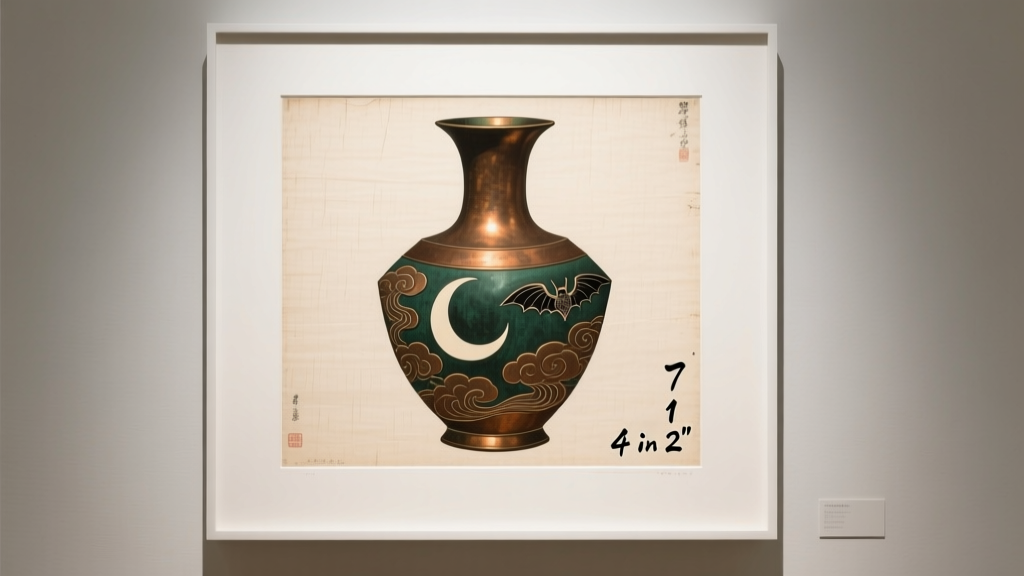
Bronze Vase: Angular Form with Applied Bat, Moon, and Cloud Motifs — Japanese Meiji Era Masterwork (7¼ in. Height)

Banks Mechanical Boy on Trapeze: Authentication, Mechanics, and Market Value of the 'Spins When Coin Is Put In' Cap Book of Knowledge Automaton
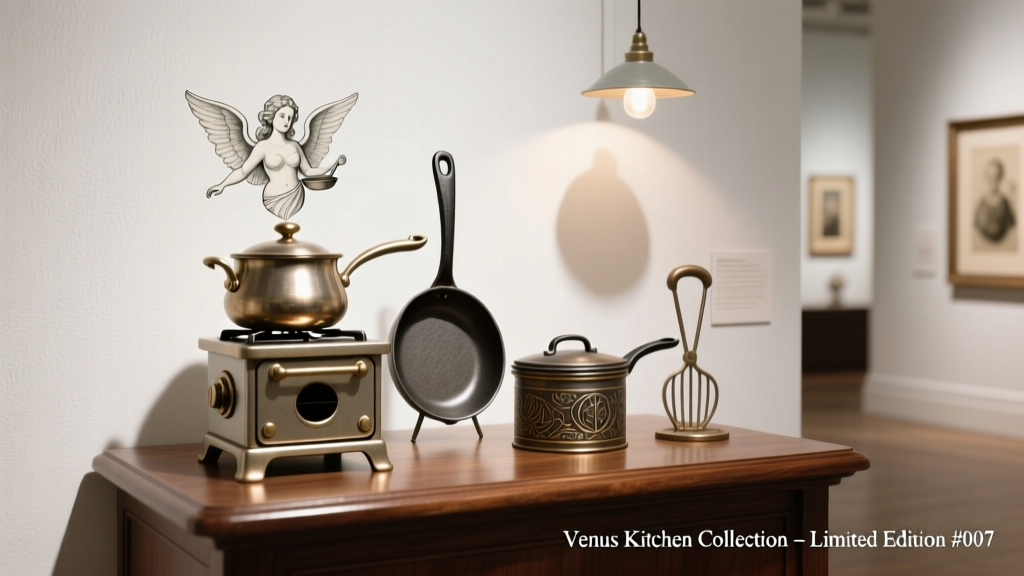
Toy Stove Venus Cooking Pot, Fry Pan, Lifter & Cast Iron Tin: Authentication, Market Value, and Material Analysis
Kirk Stieff Company: Authenticating Mid-Century American Silverware and the Legacy of Baltimore Craftsmanship
Authenticating the 1972 Redware Plate: Colonial Soldier on Horseback, Sgraffito Decoration, 13-Inch Diameter
Fiesta Gray Sugar Cover: Authentication, Market Value, and Production History of a Mid-Century Icon
Candy Containers: The PEZ Pirate Dispenser — History, Authentication, and Market Value Analysis
Calendars 1967 Playboy Desk Type Envelope: Authentication, Market Value, and Historical Context
Wernicke Globe Oak Stacking Bookcase: Authentication, Market Value, and Structural Analysis of the 6-Section Leaded-Door Model