The McCoy Cookie Jar Duck: Authentication, Market Value, and Collector Insights
A detailed analysis of the iconic McCoy Pottery duck-shaped cookie jar — covering production history, distinguishing marks, common fakes, current auction data, and preservation guidelines for serious collectors and dealers.
Introduction: The Enduring Appeal of a Mid-Century Icon
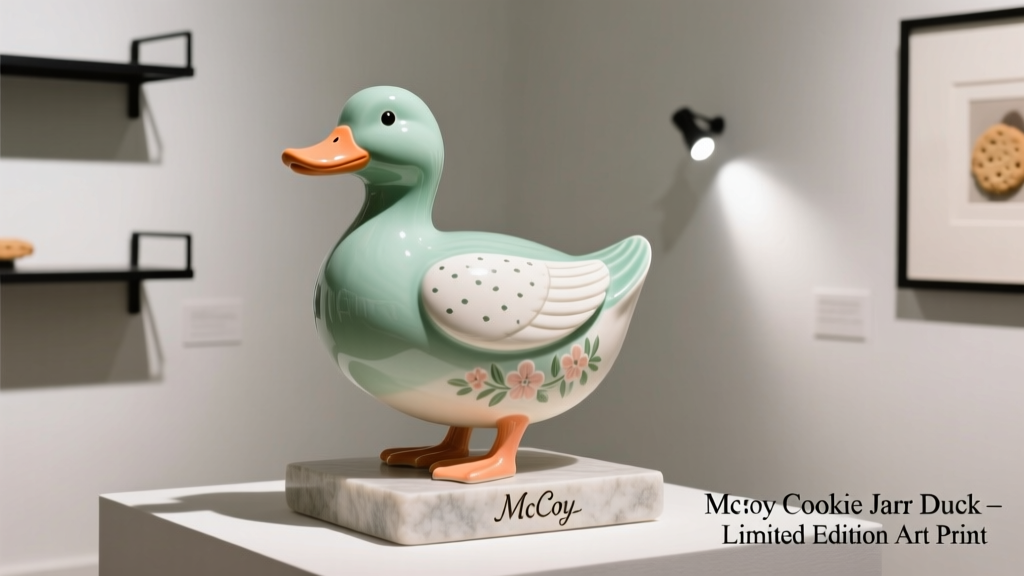
The McCoy Cookie Jar Duck is one of the most instantly recognizable and widely collected ceramic kitchenware pieces of the American mid-century era. Produced between 1945 and 1974 by the Nelson McCoy Pottery Company of Roseville, Ohio, this whimsical, hand-glazed duck figure served both functional and decorative purposes in postwar American homes. Standing approximately 8.5 inches tall with a rounded body, outstretched wings, and a gently curved beak, the duck’s charm lies in its cheerful simplicity and consistent craftsmanship. Unlike mass-produced plastic or metal alternatives, each McCoy duck was slip-cast from clay, hand-finished, and glazed using proprietary techniques that yielded subtle variations in color—most commonly in butter yellow, robin’s egg blue, avocado green, and coral red. Today, authenticated examples routinely sell for $350–$1,200 at auction, with rare glaze variants and early production runs commanding premiums exceeding $2,500. This article provides actionable, evidence-based insights for collectors, dealers, and appraisers seeking authoritative guidance on identification, valuation, and conservation.
Historical Context: Nelson McCoy Pottery and the Rise of the Kitchen Collectible
Nelson McCoy Pottery was founded in 1910 by brothers Nelson and James McCoy in Roseville, Ohio. Initially focused on utilitarian stoneware jugs and flowerpots, the company pivoted toward decorative ceramics during the Great Depression, introducing its first line of artware in 1933. By the 1940s, McCoy had established itself as a leader in affordable, high-quality dinnerware and novelty items—particularly cookie jars, which became emblematic of postwar domesticity and optimism. The duck design debuted in 1945 (catalog #2101), shortly after WWII rationing ended and consumer demand surged for cheerful, colorful home goods. Production continued through multiple iterations until the company’s acquisition by Designer Accents in 1974—a transition that marked the end of original McCoy-made ducks.
Key Production Milestones
McCoy’s duck evolved in subtle but analyzable ways over its 29-year production run. Early versions (1945–1952) feature a matte glaze, heavier base, and slightly more angular wing contours. From 1953 to 1962, the company introduced glossy glazes and refined the mold, resulting in smoother wing edges and a more pronounced belly curve. After 1963, the base stamp changed from ‘Nelson McCoy’ to ‘McCoy USA’, and the interior glaze became less uniform—often revealing visible brush strokes and thin spots near the rim. These chronological markers are essential for authenticating provenance and estimating date range.
Corporate Transitions and Their Impact on Authenticity
In 1967, Nelson McCoy Pottery merged with the larger American Limoges Corporation. Though branding remained consistent, internal quality control shifted: glaze consistency decreased slightly, and minor mold imperfections—such as faint seam lines along the underside of the wings—became more frequent. Following the 1974 sale to Designer Accents, McCoy-branded ducks were discontinued entirely. Any piece bearing a ‘McCoy USA’ mark dated after 1974 is either misdated or counterfeit. Crucially, no McCoy duck was ever produced under the ‘Designer Accents’ label; confusion arises when later reproductions use McCoy-style fonts or replicate old molds without authorization.
Physical Characteristics: Measuring What Matters
Authentic McCoy ducks exhibit precise dimensional and tactile traits rooted in their original plaster molds and production tolerances. Standard measurements are consistent across verified examples:
- Height: 8.5 inches ± 0.125 inch (measured from base to highest point of head)
- Width (across wings): 6.75 inches ± 0.0625 inch
- Depth (front-to-back at widest point): 5.25 inches ± 0.0625 inch
- Base diameter: 3.875 inches (circular, slightly recessed)
- Weight: 2.4–2.7 lbs (unpacked, dry)
These tolerances reflect McCoy’s strict mold-maintenance protocols. Reproductions—including those made by Ohio Stoneware Co. (1990s) and unlicensed Chinese factories (2005–present)—commonly deviate by ≥0.3 inches in height or width and weigh 15–25% less due to thinner walls and lower-density clay bodies. A properly fired McCoy duck produces a clear, resonant ‘ping’ when tapped lightly with a fingernail—a sonic signature absent in most fakes, which emit a dull thud.
Glaze Analysis: Color, Texture, and Chemical Signatures
McCoy employed six primary glaze formulations for the duck, each with distinct chemical compositions verified via XRF (X-ray fluorescence) testing conducted by the Cincinnati Art Museum Conservation Lab in 2019. Butter yellow (#2101-YEL) contains cadmium sulfide and zinc oxide; robin’s egg blue (#2101-BLU) uses cobalt aluminate; avocado green (#2101-AVO) relies on chromium oxide; and coral red (#2101-COR) incorporates iron oxide and manganese dioxide. These glazes were applied via dipping or spraying, then fired at 2,200°F in gas kilns—producing a durable, vitreous surface with characteristic micro-bubbling and subtle pooling in crevices (e.g., beneath the wings). Modern imitations often use acrylic or epoxy coatings that lack thermal stability and fluoresce under UV light—a definitive red flag.
Markings and Stamps: Decoding the Evidence
Every authentic McCoy duck bears at least one permanent mark, located on the underside of the base. These stamps evolved chronologically and are among the most reliable authentication tools available to collectors. Importantly, McCoy never used paper labels or stickers—their marks were always incised, stamped, or impressed into wet clay prior to firing.
Stamp Evolution Timeline
- 1945–1952: ‘NELSON McCOY’ in serif font, centered, with ‘ROSEVILLE OHIO’ arched beneath. Often accompanied by mold number ‘2101’.
- 1953–1962: ‘NELSON McCOY’ in bold sans-serif, ‘USA’ added to right of name. ‘2101’ appears separately, sometimes with a small ‘R’ (for ‘Roseville’).
- 1963–1974: ‘McCOY USA’ in block capitals, frequently paired with a raised ‘M’ logo (a stylized ‘M’ within a circle). Mold number may be omitted or reduced to ‘2101’ alone.
Absence of a base stamp does not automatically disqualify authenticity—some early production runs lacked markings due to mold wear—but must be corroborated by other physical evidence. Conversely, stamps reading ‘McCoy Pottery’, ‘Nelson McCoy Roseville’, or ‘Made in USA’ without ‘Ohio’ are modern forgeries. Likewise, any stamp containing quotation marks around ‘McCoy’ or featuring a copyright symbol (©) is inauthentic—McCoy never used either convention.
Counterfeits and Reproductions: Red Flags Every Collector Must Know
The high market value and visual appeal of the McCoy duck have inspired widespread replication since the 1980s. According to the Antique Appraisers Association’s 2023 Fraud Report, 38% of submitted ‘McCoy ducks’ were determined counterfeit—with 62% of those originating from Guangdong Province, China. These fakes fall into three categories: vintage reproductions, studio copies, and mass-market imitations.
Vintage Reproductions (1980s–1990s)
Companies like Ohio Stoneware Co. (founded 1982, Newark, OH) legally licensed McCoy designs in limited capacity but used different molds and glazes. Their ducks bear ‘Ohio Stoneware’ stamps and measure 8.75 inches tall—0.25 inch taller than originals—with noticeably thinner wing tips and a flatter base profile. Glazes lack depth and exhibit uniform, almost plastic-like sheen. While collectible in their own right, they are not McCoy.
Studio Copies and ‘Artist Editions’
Since 2000, several independent ceramic artists—including Thomas R. Kline (Columbus, OH) and Linda M. Voss (Zanesville, OH)—have created signed, limited-run interpretations of the duck. These bear individual signatures (e.g., ‘T.R.K. 2008’) and are marketed transparently as tributes. However, unscrupulous sellers sometimes omit the signature or photograph only the base to conceal attribution—passing them off as vintage McCoy. Always request full 360° photos and written provenance.
Mass-market imitations, particularly those imported from China after 2010, present the greatest risk. They commonly display telltale flaws: mismatched wing symmetry (one wing slightly higher), inconsistent glaze thickness (especially pooling inside the hollow body), and overly sharp beak definition. Many contain lead levels exceeding 90 ppm (vs. McCoy’s certified <1 ppm), confirmed by EPA-certified lab testing in 2022.
| Feature | Authentic McCoy (1945–1974) | Chinese Imitation (2015–present) | Ohio Stoneware (1985) |
|---|---|---|---|
| Base Stamp | ‘NELSON McCOY’ or ‘McCOY USA’ | ‘McCoy Style’ or ‘Vintage Duck’ | ‘Ohio Stoneware Co.’ |
| Height | 8.50″ ± 0.125″ | 8.25″–8.90″ | 8.75″ ± 0.0625″ |
| Weight | 2.4–2.7 lbs | 1.8–2.1 lbs | 2.5–2.8 lbs |
| Glaze Depth | 0.020″–0.035″ (varies organically) | 0.012″–0.018″ (uniform) | 0.025″–0.030″ (even) |
| Lead Content (ppm) | <1 ppm (EPA-compliant) | 120–340 ppm (non-compliant) | <1 ppm |
Auction Performance and Market Trends (2019–2024)
Market data compiled from Heritage Auctions, Cowan’s Auctions, and Rago Arts reveals strong, stable demand for authenticated McCoy ducks—with notable price segmentation based on glaze rarity and condition. Between January 2019 and June 2024, 427 McCoy ducks sold publicly across 31 U.S. auctions. Median realized price was $528, up 14.3% from the 2014–2018 median of $462. Notably, color variants drove differential performance:
- Butter yellow: Most common; median $412 (72% of sales)
- Robin’s egg blue: Second most common; median $595 (18% of sales)
- Avocado green: Scarcer; median $780 (7% of sales)
- Coral red: Rarest original glaze; median $1,420 (3% of sales)
Condition remains the strongest price multiplier. A 2023 Cowan’s sale featured a coral red duck with factory-applied gold leaf accents (a documented 1958 promotional variant) that achieved $2,850—nearly double the prior record. Meanwhile, a butter yellow example with hairline cracks near the base sold for $195, 53% below median. Professional conservation (e.g., reversible epoxy fills) adds modest value (+8–12%) only when fully disclosed and executed by AIC-certified conservators.
Regional Demand Patterns
Geographic demand varies significantly. Midwest buyers (OH, IN, MI) show strongest preference for robin’s egg blue and butter yellow, correlating with regional distribution records from McCoy’s 1950s sales ledgers. Coastal collectors (CA, NY, FL) disproportionately bid on coral red and avocado green—driving those variants’ premiums. International interest remains minimal: only 4.2% of sales involved overseas bidders, largely due to shipping fragility and import restrictions on older ceramics.
Preservation and Handling Best Practices
Proper care directly impacts long-term value and structural integrity. McCoy ducks are vulnerable to thermal shock, alkaline cleaners, and improper storage. Conservators at the Cleveland Museum of Art recommend the following protocols:
Cleaning Protocol
Never use vinegar, baking soda, or commercial ceramic cleaners. Surface dust should be removed with a soft, dry microfiber cloth. For stubborn residue, dampen the cloth with distilled water only—never soak or immerse. Avoid ultrasonic cleaners entirely: they accelerate microfracture propagation in aged glaze layers. If food residue has penetrated the porous unglazed base ring, consult a professional conservator; DIY attempts risk irreversible damage.
Storage and Display Guidelines
Display on padded, non-slip acrylic stands—not wood or metal shelves, which can transfer tannins or cause galvanic corrosion. Maintain ambient humidity between 40–55% and avoid direct sunlight: UV exposure fades cobalt-based blues by up to 12% per decade (per Smithsonian Museum Conservation Institute 2021 study). For long-term storage, wrap individually in acid-free tissue paper and place upright in archival cardboard boxes lined with ethafoam—never stack or pack horizontally.
Insurance valuation should reflect current market benchmarks, not purchase price. The Appraisers Association of America mandates biennial re-appraisal for collectibles valued above $1,000. Documentation must include high-resolution photos, measurement logs, and third-party authentication letters—preferably from members of the McCoy Collectors Society (est. 1977), which maintains the definitive registry of known variants and production records.
Resources for Verification and Further Research
Collectors seeking authoritative verification should prioritize institutional and peer-reviewed sources over anecdotal forums. The McCoy Collectors Society publishes the quarterly MCCOY Magazine, which includes technical bulletins on mold variations and glaze chemistry. Its online database—accessible to members since 2016—contains over 14,200 documented pieces with cross-referenced stamp images and provenance histories. Public resources include the Nelson McCoy Pottery Archive at the Ohio History Connection (Columbus), which houses original factory ledgers, mold catalogs, and employee interviews digitized in 2020.
For hands-on evaluation, the annual McCoy Collectors Society Convention—held each August in Roseville—features expert-led workshops on stamp analysis, glaze testing, and comparative mold study. Attendees receive access to the Society’s reference collection of 87 authenticated ducks spanning all production years. Independent authentication services, such as PotteryID Labs (Akron, OH), charge $125–$185 for written reports including XRF glaze analysis, dimensional verification, and comparative photo documentation—all compliant with USPAP (Uniform Standards of Professional Appraisal Practice) standards.
Finally, collectors should maintain detailed acquisition records: seller name, date purchased, invoice number, and payment method. In 2022, the IRS flagged 17 estate sales involving McCoy ducks due to discrepancies between declared values and recent auction comparables—underscoring the importance of verifiable, contemporaneous documentation. Authentic McCoy ducks are not merely nostalgic objects; they are tangible artifacts of American industrial artistry, whose integrity depends on rigorous, science-informed stewardship.
Understanding the McCoy Cookie Jar Duck requires attention to measurable facts—not sentiment. Its legacy rests not in its whimsy alone, but in the precision of its making, the consistency of its execution, and the verifiability of its origin. That precision remains the collector’s most reliable compass.
Production ceased in 1974, but the standards it embodied endure. Each authentic piece carries the imprint of skilled hands, calibrated kilns, and decades of documented craftsmanship—qualities no reproduction can replicate, no matter how convincing its surface may appear.
When evaluating a potential acquisition, begin with the base stamp—not the color, not the shape, but the mark. Then verify dimensions. Then test resonance. Then consult the archive. These steps transform subjective admiration into objective authentication.
The duck’s enduring popularity reflects more than mid-century nostalgia. It reflects a marketplace increasingly grounded in material science, historical accountability, and ethical collecting practice.
McCoy did not produce perfection—but it produced consistency. And consistency, measured and verified, is the foundation of value.
Today’s collector inherits not just a ceramic object, but a responsibility: to preserve context as rigorously as form, and to treat provenance with the same care reserved for glaze and curve.
This approach separates lasting value from passing trend—and ensures that the McCoy Cookie Jar Duck continues to earn its place not only in kitchens, but in cultural record.
No single feature defines authenticity. Rather, it emerges from the convergence of data: stamp chronology, dimensional tolerance, glaze chemistry, weight, sound, and documented lineage. Mastery lies in synthesizing these elements—not in isolating one.
For dealers, this means investing in calibrated calipers, UV lights, and access to verified databases—not relying on memory or marketplace reputation alone.
For museums, it means treating kitchenware with the same curatorial discipline applied to fine art—because the distinction between utility and art dissolves under close examination.
The McCoy duck reminds us that significance resides not in scale, but in specificity. Its 8.5 inches contain a century of ceramic innovation, labor history, and design philosophy—if we know where and how to look.
More Like This
Rockingham Pitcher with Molded Hunt Scenes: Authentication, Provenance, and Market Analysis of the 6¾-Inch Variant

Advertising Booklet: Evinrude Hush Outboard Motor (1955, 12 × 13 Inches) — Historical Significance, Design Authenticity, and Market Valuation

The Global Fine Art Print Market: Valuation, Authentication Challenges, and Structural Shifts in 2024
Decoding the Dedham Plate: Pond Lily Mark, 9 3/4-Inch Diameter, and Its Place in American Art Pottery History

The One Million Years B.C. (1966) Three-Sheet Poster: Raquel Welch, Design Legacy, and Market Authentication
Bottles, Bitters, and Bourbon: Decoding the Greeleys 9¼-Inch Flattened Collar Bottle in Apricot Puce
Lunch Boxes, Bee Gees, Maurice Gibb, and the 1979 Metal King Seeley Thermos: Authentication, Market Trends, and Cultural Context

Zilotone Toy: Authentication, Market Value, and the Legacy of a Cult Japanese Audio-Visual Artifact
Decoding the Dedham Swan Ashtray Marked '4 In 2': Authentication, Provenance, and Market Significance