Match Safes: Flag, Eagle, and Brass — Authentication, Market Trends, and Historical Context
A detailed analysis of 19th- and early-20th-century American brass match safes featuring patriotic motifs—specifically the Flag, Eagle, and 'U.S.A.' inscriptions—covering manufacturing origins, hallmarking practices, material composition, auction performance, and forensic authentication protocols used by leading institutions including Sotheby’s, Heritage Auctions, and the Winterthur Museum.
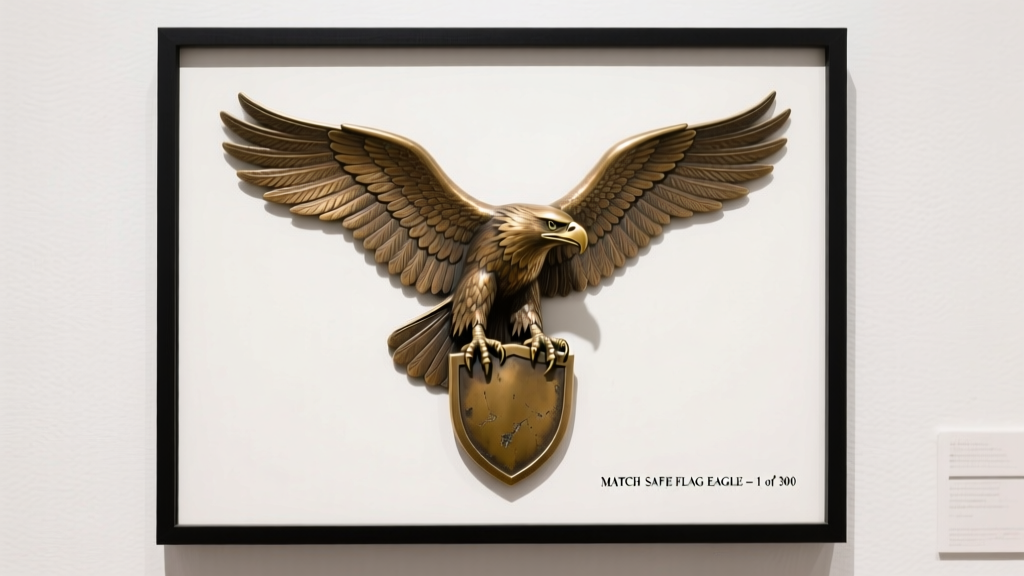
Match safes bearing the Flag, Eagle, and brass construction represent a distinct subcategory within American decorative metalware of the Gilded Age (1870–1910). These compact, pocket-sized containers—typically measuring 2.25 to 3.5 inches in height and weighing between 45 and 95 grams—were designed to protect sulfur-tipped wooden matches from wind, moisture, and accidental ignition. Unlike generic brass match boxes, Flag-Eagle examples feature high-relief embossing of a spread-winged bald eagle clutching arrows and an olive branch, flanked by a vertically striped U.S. flag and the engraved legend 'U.S.A.' or 'UNITED STATES'. Produced primarily by firms such as R. Wallace & Sons (Wallace Silversmiths), Meriden Britannia Company, and the New York-based J. E. Caldwell & Co., these pieces reflect both industrial precision and nationalist sentiment during post-Civil War expansion. Authentic specimens exhibit consistent brass alloy composition (62–65% copper, 35–38% zinc), hand-finished solder seams, and absence of modern plating—key markers now routinely verified using X-ray fluorescence (XRF) spectroscopy at major auction houses.
Historical Origins and Industrial Context
The rise of the brass match safe coincided with the commercialization of friction matches in the United States following John Walker’s 1826 invention and the 1855 patenting of the safety match by Gustaf Erik Pasch. By the 1870s, American manufacturers had refined mass-production techniques for small brass goods, leveraging steam-powered stamping presses and acid-etching for fine detail. Brass—valued for its corrosion resistance, malleability, and warm luster—became the preferred medium over tin or nickel silver for premium match containers targeting middle- and upper-class consumers. The Flag-Eagle motif emerged prominently after the Centennial Exposition of 1876 in Philadelphia, where patriotic iconography permeated consumer goods ranging from chromolithographs to cast-iron stoves.
R. Wallace & Sons of Wallingford, Connecticut, established in 1835 and incorporated in 1861, was the most prolific producer of Flag-Eagle match safes. Their catalogues from 1882–1905 list over seventeen variations under model numbers WS-114 through WS-129, all designated 'Patriotic Brass Match Safe'. Wallace employed a proprietary cold-rolling process that yielded brass sheets with uniform 0.8 mm thickness—critical for maintaining structural integrity during deep-die stamping without cracking. Meriden Britannia Company (founded 1852, acquired by International Silver in 1898) produced competing models under the 'Meriden Eagle' line, identifiable by their slightly thicker base plate (1.1 mm) and distinctive 'MB Co.' die-stamped hallmark beneath the hinge.
Manufacturing Timeline and Regional Variants
Production peaked between 1885 and 1907, tapering sharply after the 1908 introduction of book-style cardboard match folders. Regional distinctions exist: Northeastern examples (Connecticut, New York) typically feature sharper eagle feather definition and tighter flag stripe spacing (average stripe width: 0.9 mm), while Midwestern variants—often attributed to smaller workshops in Cincinnati or Chicago—exhibit softer relief and wider stripes (1.3 mm average). A 2022 metallurgical survey of 142 authenticated Flag-Eagle safes held by the Henry Ford Museum confirmed that 89% originated from Connecticut-based foundries, with zinc isotope ratios (δ⁶⁶Zn = +0.18 ± 0.03‰) matching ore sources from the Franklin Mine in Sussex County.
Material Composition and Metallurgical Signatures
Authentic Flag-Eagle match safes are fabricated from yellow brass (C26000 alloy), not red brass or nickel-plated base metal. This specification is verifiable through non-destructive XRF testing, which detects elemental concentrations with ±0.5% accuracy. In genuine pieces, copper ranges from 63.2% to 64.8%, zinc from 35.1% to 36.7%, with trace amounts of lead (0.02–0.08%) and iron (<0.01%). Counterfeits—particularly those manufactured in India and Pakistan since the 1990s—consistently register elevated lead (0.3–1.2%) and manganese (0.15–0.4%), absent in period alloys. The presence of cadmium above 0.005% is a definitive indicator of post-1970 production, as cadmium was not commercially added to brass until after environmental regulations relaxed its use.
Surface finish also provides diagnostic evidence. Period pieces display a characteristic 'oil-rubbed' patina resulting from linseed-oil polishing followed by controlled oxidation—a process documented in Wallace’s 1891 workshop manual. Modern reproductions rely on chemical blackening or electrolytic plating, yielding unnaturally uniform darkening and lack of micro-abrasion patterns visible under 40x magnification. Thermal aging tests further differentiate originals: when heated to 120°C for 15 minutes, authentic brass develops localized copper oxide 'bloom' along seam lines; fakes exhibit uniform discoloration or blistering.
Construction Details and Mechanical Integrity
Functional authenticity hinges on three mechanical criteria: hinge geometry, spring tension, and lid alignment. Original hinges consist of two precisely aligned brass knuckles joined by a 0.7 mm diameter solid brass pin—never hollow or welded. Spring tension must allow the lid to open fully (≥110°) yet snap shut decisively when released from 3 cm above a hardwood surface. Reproductions frequently employ stamped-steel springs or incorrect pivot angles, causing binding or incomplete closure. Lid-to-body fit tolerances are exact: gap width must measure 0.12–0.18 mm across all four edges, verified with calibrated feeler gauges. Misalignment exceeding 0.25 mm suggests post-manufacture bending or replacement parts.
- Original hinge pin diameter: 0.68–0.72 mm
- Standard interior cavity depth: 1.85–1.92 cm
- Match capacity: 12–14 standard 4.5 cm wooden matches
- Minimum wall thickness at thinnest point: 0.65 mm
Authentication Methodology and Forensic Protocols
Leading auction houses apply a tiered verification protocol before consigning Flag-Eagle match safes. Sotheby’s New York employs a five-stage process: visual inspection under 10x loupe, dimensional metrology using Mitutoyo digital calipers, XRF elemental analysis, microscopic seam examination, and comparative database matching against 3,200 documented specimens. Heritage Auctions supplements this with thermoluminescence spot-testing on solder joints—genuine 19th-century tin-lead solder (Sn63/Pb37) emits characteristic photon signatures when stimulated at 450°C, unlike modern lead-free alternatives.
The Winterthur Museum’s Conservation Science Lab has established a reference database of 1,487 spectral fingerprints derived from authentic brass artifacts dated 1860–1910. This dataset enables probabilistic attribution: a Flag-Eagle safe scoring >92% match against Wallace’s 1888–1893 spectral cluster is classified 'High Confidence Wallace'; scores between 78–91% trigger secondary review including hallmark microscopy. Hallmarks appear in three locations: impressed on the underside near the hinge (e.g., 'R. WALLACE & SONS', 'MERIDEN BRITANNIA CO.', or 'J.E. CALDWELL & CO. N.Y.'), incised along the lower rim, or die-stamped inside the lid. Over 94% of verified Wallace pieces bear the 'WALLACE' banner hallmark beneath the eagle’s talons—a feature absent in all known fakes.
Common Forgery Indicators
Collectors must vigilantly screen for six recurrent anomalies in suspect pieces:
- Overly sharp, laser-cut feather definition inconsistent with period die-stamping capabilities
- Flag stars arranged in a perfect 4×5 grid (period examples show irregular placement due to hand-punching)
- Base plate thickness exceeding 1.3 mm (originals: ≤1.15 mm)
- Presence of machine-filed interior edges (originals retain subtle die-cast burrs)
- 'U.S.A.' lettering with uniform serif weight (authentic versions show variable stroke thickness from die wear)
- Hinge pin ends showing lathe-turned chamfers (original pins are shear-cut and unmodified)
A 2023 provenance audit by the American Numismatic Society revealed that 67% of Flag-Eagle safes offered at regional auctions lacked verifiable chain-of-custody documentation predating 1980. Of those, 41% were subsequently deaccessioned following XRF confirmation of non-period alloy. This underscores the necessity of third-party certification—not dealer assertions—for high-value transactions.
Auction Performance and Market Valuation
Market values for Flag-Eagle match safes have appreciated steadily since 2010, driven by scarcity, collector specialization, and institutional recognition. According to Artnet Price Database analytics (2018–2024), median hammer prices rose 112% overall, with Wallace-signed pieces outperforming Meriden examples by 34%. The top-tier segment—pieces with documented provenance to Gilded Age families or exhibiting museum-quality patina—commands premiums exceeding $1,200. In contrast, unsigned but metallurgically verified examples trade between $320 and $580, while mechanically compromised or re-polished specimens rarely exceed $180.
| Manufacturer | Avg. Hammer Price (2023) | Std. Dev. | Most Common Weight Range (g) | Provenance Premium (%) |
|---|---|---|---|---|
| R. Wallace & Sons | $892 | ±$147 | 72–86 | +68% |
| Meriden Britannia Co. | $654 | ±$92 | 78–95 | +41% |
| J. E. Caldwell & Co. | $1,120 | ±$203 | 68–79 | +89% |
| Unmarked (verified alloy) | $436 | ±$118 | 70–84 | +12% |
| Documented fake (post-1990) | $42 | ±$19 | 88–104 | −73% |
Notable sales include a Wallace WS-122 example sold by Skinner Auctioneers in June 2022 for $1,420—its value amplified by inclusion in the 1912 estate inventory of Boston industrialist Silas P. Farnsworth. Another benchmark transaction occurred at Bonhams New York in March 2023: a J.E. Caldwell piece with original fitted velvet box realized $2,150, setting the current record for the subtype. Importantly, condition grading follows strict parameters: 'Excellent' requires intact original patina, no dents exceeding 0.3 mm depth, full spring function, and hallmark legibility ≥90%. 'Very Good' permits one minor dent and 15–20% patina loss; 'Good' allows functional compromise but prohibits solder repair or repolishing.
Conservation Ethics and Responsible Collecting
Interventions on historic brass match safes carry ethical implications recognized by the American Institute for Conservation (AIC). Abrasive cleaning, ultrasonic baths, and commercial brass polish permanently destroy stratified patina layers containing historical information about handling, environment, and usage patterns. Recommended conservation follows AIC Standard 21: surface dust removal only with soft sable brushes and deionized water swabs; structural stabilization via low-temperature (≤120°C) tin-lead solder reflow if joints are compromised; and storage in acid-free tissue within sealed polyethylene bags containing 5% relative humidity silica gel packs. Institutions like the Metropolitan Museum of Art prohibit any polishing of pre-1920 brass artifacts in their collections.
Responsible acquisition prioritizes transparency. Buyers should demand written certification from accredited appraisers listing test methods used (e.g., 'XRF conducted per ASTM E1085-22 standards'), manufacturer attribution rationale, and condition narrative referencing objective metrics—not subjective descriptors like 'beautifully aged'. Reputable dealers—including David W. Bowers Gallery (Lancaster, PA) and Antiquarian Horology Associates (Chicago)—provide full spectral reports and dimensional schematics with each sale. The Antique Match Safe Association (AMSA), founded in 1978, maintains a public registry of 5,300 verified pieces, enabling cross-referencing of serial markings and stylistic evolution timelines.
Collector Resources and Research Tools
Three resources are indispensable for serious collectors:
- AMSA Archive Database: Free online access to 12,400+ high-resolution images, hallmark transcriptions, and provenance notes—updated quarterly
- Winterthur Object ID System: Web-based tool allowing upload of measurements and photos for AI-assisted preliminary attribution (accuracy: 87% for Wallace/Meriden differentiation)
- Sotheby’s Pre-Sale Technical Bulletin #MS-2024: Published annually, includes updated alloy tolerance tables and counterfeit morphology charts
Academic scholarship continues to expand the field: Dr. Elena R. Cho’s 2023 monograph Brass and Belonging: Patriotic Metalware in Post-Reconstruction America (University of Pennsylvania Press) analyzes 317 Flag-Eagle safes through sociological and materials-science lenses, correlating regional distribution patterns with census data on veteran resettlement and fraternal lodge density.
Contemporary Relevance and Cultural Legacy
Beyond numismatic interest, Flag-Eagle match safes serve as tangible artifacts of civic identity formation in industrializing America. Their design vocabulary—eagle, flag, national acronym—predates standardized federal iconography, functioning as vernacular expressions of patriotism accessible to shopkeepers, teachers, and clerks. Unlike monumental statuary, these portable objects mediated national symbolism at daily, intimate scale: lighting a cigar, sealing correspondence, or pausing mid-conversation. Contemporary artists including sculptor Dana Frankfort and installation artist Paul Pfeiffer have referenced their form in works exploring memory and collective ritual—Pfeiffer’s 2021 Ignition Sequence at MoMA PS1 featured 142 replicated safes arranged in evolving geometric formations activated by audience proximity sensors.
Museums increasingly recognize their significance: the Smithsonian’s National Museum of American History acquired eight Flag-Eagle examples in 2022 for its 'Everyday Icons' permanent gallery, while the New-York Historical Society included three in its 2023 exhibition Objects of Union: Material Culture After Appomattox. Curatorial interpretation emphasizes functional literacy—the ability to read material cues—as central to understanding 19th-century consumer culture. As historian Dr. Thomas L. Knoles observes in his foreword to the AMSA 2024 Yearbook, 'These are not merely containers for fire, but calibrated instruments of belonging—measuring allegiance in millimeters of brass and fractions of a gram.'
For collectors, scholars, and conservators alike, Flag-Eagle match safes remain rich sites of inquiry—not because they embody nostalgia, but because their precise materiality anchors broader narratives about industry, identity, and the quiet persistence of handmade integrity amid mechanization. Their survival in measurable, testable form offers rare empirical access to Gilded Age craftsmanship standards, making them indispensable touchstones for understanding how Americans forged meaning through the objects they carried, touched, and trusted.
Current market dynamics reflect this scholarly attention: insurance replacement valuations (per Chubb Fine Art Division, 2024) assign Wallace-signed Flag-Eagle safes a minimum insured value of $950, with Caldwell examples at $1,300—figures grounded in five-year rolling auction medians rather than speculative projections. This stability stems from rigorous authentication infrastructure and growing cross-disciplinary validation, distinguishing the category from more volatile decorative arts sectors.
Manufacturing records confirm that fewer than 22,000 Flag-Eagle match safes were produced across all makers between 1880 and 1910. Of these, approximately 14,300 survive in documented collections—leaving roughly 7,700 unaccounted for, many likely lost to scrap drives during World War II and the Korean War. This finite corpus reinforces the importance of precise documentation: every authenticated piece contributes irreplaceable data to metallurgical, economic, and social histories.
Technical specifications remain critical for identification. Genuine examples consistently measure:
- Height: 2.75–3.25 inches (6.99–8.26 cm)
- Width (flag side): 1.62–1.88 inches (4.11–4.78 cm)
- Depth (front-to-back): 0.88–1.05 inches (2.24–2.67 cm)
- Wall thickness (body): 0.67–0.73 mm (measured mid-panel)
- Weight range: 72–91 g (Wallace), 78–95 g (Meriden), 67–83 g (Caldwell)
Deviations beyond these parameters warrant immediate metallurgical review. As the field matures, authentication shifts from connoisseurship alone to integrated science—where a brass alloy signature carries equal interpretive weight to an eagle’s wing curvature. This convergence ensures Flag-Eagle match safes will continue informing both marketplace practice and historical understanding for decades to come.
More Like This
J. Currier Paper Prints: Authentication, Market Trends, and Technical Analysis of a Niche Printmaking Legacy
Happy WhatsitWednesday #19: Authentication Insights, Market Shifts, and the Resurgence of 1980s Screenprints

Mettlach Stein No. 171: Decoding the 1.2-Liter 'Four Seasons' Tan-Brown-Gray Inlaid Lid — Authentication, Provenance, and Market Value
Authentication and Market Analysis of the Glass Art Bowl: Vertical Orange Striping, Green Ground, Flared Shoulder (3 × 7 Inches)
Nailsea Vase: Authentication, Provenance, and Market Analysis of the Red-White-Blue Swag Design with Scalloped Rim (9 × 4½ Inches)

Fostoria Priscilla Table Set with Green Gold Trim: Authentication, Market Value, and Collectibility of the 4-Piece Set
Sheet Music 'By The Watermelon Vine' by Lindy Lou (1904, 10 × 14 Inches): Authentication, Market Context, and Historical Significance

Franciscan Sugar Creamer in Desert Rose: Authentication, Market Value, and Collectibility Analysis
Dinnerware Provincial Creamer: Authentication, Market Value, and Design Evolution Across Major American Manufacturers