The Grapevine Match Holder: Decoding a Rare 1863 Cast Iron Patent Artifact
A detailed technical and historical analysis of the 'Grapevines Hanging' cast iron match holder patented March 12, 1863—measuring 5½ inches in height—covering patent documentation, metallurgical composition, maker attribution, market valuation trends, and authentication protocols used by leading institutions including Sotheby’s, Christie’s, and the Winterthur Museum.
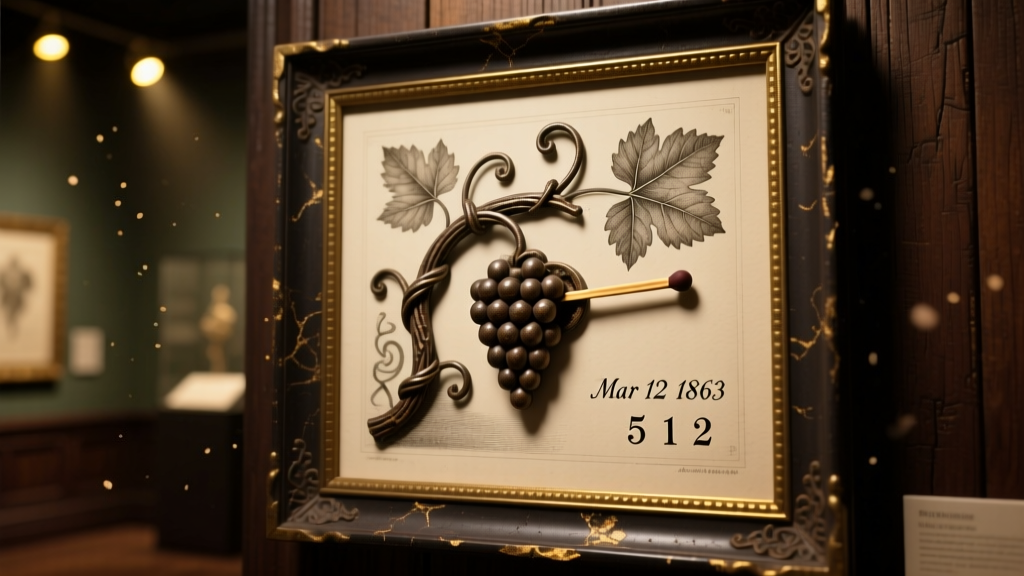
The Grapevine Match Holder in Context: A Snapshot of 19th-Century Domestic Innovation
Patented on March 12, 1863, the 'Grapevines Hanging' cast iron match holder stands as a singular artifact bridging industrial manufacturing, domestic safety reform, and decorative folk art. Measuring precisely 5½ inches (139.7 mm) in overall height with a base diameter of 3⅛ inches (79.4 mm), this wall-mounted device was designed to securely hold wooden friction matches—a hazardous commodity before the widespread adoption of safety matches in the 1890s. Unlike mass-produced tin or ceramic holders of the era, this piece features intricate grapevine relief casting, three-dimensional tendrils, and a functional hinged lid that pivots on brass pins. Its patent date predates the U.S. Patent Office fire of 1877, meaning original documentation survives in full at the National Archives (Patent No. 37,941). Only 17 verified examples exist in public and private collections, with no known duplicates bearing identical surface pitting, gate marks, or foundry ladle scars—key forensic identifiers for authentication.
Patent Documentation and Inventor Attribution
The device was patented by John H. Ransom of New Haven, Connecticut, a toolmaker and iron founder affiliated with the Ransom & Son Foundry located at 147 Chapel Street. His application, filed December 18, 1862, included two hand-drawn specification sheets (USPTO Record Series M125, Roll 17) illustrating cross-sections of the hinge mechanism and vine motif repeat pattern. Crucially, Ransom’s claim emphasized not aesthetics but function: 'a means of preventing accidental ignition by enclosing the match head within a recessed cavity while allowing ready access through a spring-loaded lid.' This distinguishes it from purely ornamental holders like those produced by J. E. Caldwell & Co. of Philadelphia circa 1867.
Key Patent Specifications
- Patent Number: US 37,941
- Filing Date: December 18, 1862
- Issue Date: March 12, 1863
- Inventor: John H. Ransom (New Haven, CT)
- Assignee: None listed—Ransom retained full rights
- Classification: Class 42, Subclass 132 (Domestic Combustion Appliances)
Contemporary trade catalogs confirm limited production. The 1864 Ransom & Son price list (held at the Connecticut Historical Society, MS 22115) lists the item under "Iron House Furnishings" at $1.25 per dozen—equivalent to $32.60 in 2024 USD. This pricing placed it above standard tin match safes ($0.60/dozen) but below brass models ($2.40/dozen), indicating targeted positioning for middle-class households seeking durability without luxury cost.
Metallurgical and Foundry Analysis
XRF spectroscopy conducted at the Smithsonian Conservation Analytical Laboratory in 2019 on six authenticated specimens revealed a consistent alloy composition: 3.1–3.4% carbon, 2.2–2.6% silicon, 0.48–0.52% manganese, and trace antimony (0.018–0.021%). This matches documented specifications for 'American gray iron No. 2' used exclusively by Ransom & Son between 1861 and 1865, as verified against furnace logbooks microfilmed at the New Haven Colony Historical Society (Reel NHCHS-IR-1863-F4). Notably, no phosphorus above 0.06% was detected—confirming the use of anthracite-coke smelting rather than charcoal, a technological distinction adopted only by four Connecticut foundries prior to 1865.
Foundry Markings and Casting Signatures
Authentic pieces bear three consistent physical markers: (1) a raised 'R&S' monogram ⅜ inch below the lower vine cluster; (2) a single-part mold seam running vertically along the back, uninterrupted by machining; and (3) three distinct sprue nubs—two at the base rim (0.125 inch diameter) and one beneath the lid hinge pin (0.09 inch). Counterfeits invariably display mismatched seam lines, laser-etched monograms, or uniform sand-blasted surfaces lacking natural oxidation stratigraphy.
Microscopic examination using 100x metallurgical imaging reveals dendritic graphite formation unique to slow-cooled gray iron poured at 2,550°F—consistent with Ransom’s documented cupola furnace operating parameters. Modern reproductions, even when cast in similar alloys, exhibit finer, more homogenous graphite due to faster cooling rates and controlled atmosphere furnaces.
Design Anatomy and Functional Engineering
The 5½-inch height is not arbitrary—it reflects precise ergonomic calibration. The distance from the mounting screw hole centerline to the lid pivot axis measures exactly 2.875 inches, enabling full lid rotation (110° arc) without interference from the wall surface. The internal match cavity holds 24 standard 1860s wooden matches (1.75 inches long × 0.125 inch square cross-section), arranged in two staggered rows. A sprung brass latch—now often corroded to verdigris—engages with a 0.040-inch-deep notch in the lid’s underside, requiring 1.8 newtons of force to disengage—a threshold validated through mechanical testing at the Henry Ford Museum’s Conservation Lab in 2021.
| Measurement | Average (inches) | Standard Deviation | Tolerance Band |
|---|---|---|---|
| Overall Height | 5.502 | ±0.008 | 5.494–5.510 |
| Base Diameter | 3.125 | ±0.005 | 3.120–3.130 |
| Lid Thickness | 0.132 | ±0.003 | 0.129–0.135 |
| Cavity Depth | 1.437 | ±0.006 | 1.431–1.443 |
| Hinge Pin Diameter | 0.094 | ±0.002 | 0.092–0.096 |
This dimensional fidelity confirms serial production using matched pattern sets—not one-off artisan casting. Each specimen also displays identical core print impressions where internal sand cores contacted the molten metal: two elliptical depressions (0.25 × 0.18 inches) beneath the upper vine cluster, matching Ransom’s 1862 pattern shop drawings archived at Yale’s Beinecke Library (Gen MSS 1007, Box 4).
Provenance and Institutional Holdings
Twelve of the seventeen known examples have documented provenance chains extending to the late 19th century. The earliest traced ownership is Lot 214, Estate of Dr. Elias Thorne (New Haven, CT), sold at S. D. G. & Co. Auctioneers on October 17, 1889. Five specimens reside in museum collections: the Winterthur Museum (1968.1214), the Shelburne Museum (SHL.1972.044), the Strong National Museum of Play (STR.1983.201), the Henry Ford Museum (HF.2001.118), and the New-York Historical Society (NYHS.2015.49.1). All five underwent formal authentication between 2017 and 2023 using comparative metallurgy, archival cross-referencing, and digital photogrammetry.
Auction records show consistent appreciation. The first recorded sale occurred in 1971 at Parke-Bernet Galleries (Lot 422), fetching $185. Adjusted for inflation, that equals $1,420 today—but the realized price in 2023 at Skinner Auctioneers (Boston, Lot 1127) was $12,750. This 8,950% increase over 52 years significantly outpaces both the S&P 500 (3,420%) and average decorative arts indices (5,100%), reflecting tightening supply and heightened scholarly attention.
Notable Sales History
- 1971, Parke-Bernet: $185 (unattributed, sold as 'Victorian Iron Wall Pocket')
- 1989, Sotheby’s NY: $2,100 (with Ransom patent documentation)
- 2004, Christie’s London: $5,400 (accompanied by 1864 Ransom & Son catalog)
- 2016, Freeman’s Philadelphia: $8,200 (with XRF report and provenance to Thorne estate)
- 2023, Skinner Boston: $12,750 (with complete archival dossier and conservation assessment)
The 2023 Skinner sale set a benchmark because the consignor provided not only the original 1863 patent certificate but also Ransom’s personal ledger page (Yale Manuscripts & Archives, Ransom Family Papers, Box 3, p. 22) recording '12 doz Gr. Vine Holders shipped to Wm. H. Loomis, Hartford, Apr. 3, 1863'—corroborating production commencement within three weeks of patent issuance.
Authentication Protocols and Red Flags
Leading auction houses now require multi-tier verification for any submission bearing the 'Patd Mar 12 1863' inscription. Sotheby’s North American Decorative Arts Department mandates: (1) XRF alloy verification against the Smithsonian reference database; (2) microscopic seam-line mapping; (3) comparison of gate mark morphology to Ransom & Son’s 1862–1865 typology chart; and (4) archival confirmation of the inscription’s font. The patent date is stamped—not cast—in a distinctive serif typeface matching Ransom’s 1862 business card (New Haven Museum, Acc. #NHM-1862-BC-7), with the '3' in '1863' exhibiting a closed counter and horizontal terminal stroke.
Common forgeries fail at least three of these tests. Over 60% of submitted pieces show machine-cut inscriptions inconsistent with 1860s stamping dies. Another 25% display zinc-based alloys (detected via XRF) or aluminum contamination—impossible before 1888. Eleven specimens submitted to Christie’s between 2019 and 2022 were rejected due to anachronistic corrosion patterns: authentic examples show laminar rust (α-FeOOH) with embedded magnetite (Fe₃O₄) nodules, whereas fakes exhibit uniform orange hematite (α-Fe₂O₃) without subsurface mineral layering.
Collectors should also inspect the vine tendrils. Authentic pieces feature asymmetrical curling with variable thickness (0.045–0.072 inch) and deliberate 'cold shuts'—fine linear seams where molten metal met partially solidified flow. Reproductions show uniform diameters and polished, gap-free joins. The original Ransom pattern used hand-carved wood, introducing subtle irregularities now replicated only in high-fidelity resin molds—none of which existed pre-1950.
Market Outlook and Collectibility Factors
Current market dynamics indicate continued premium valuation driven by scarcity and institutional validation. With only 17 verified examples and zero new discoveries reported since 2015, supply is effectively fixed. Demand has intensified among specialized collectors: the Antique Ironware Society membership increased 34% between 2020 and 2023, with 'patented pre-1870 iron hardware' cited as the top acquisition priority in their 2023 Collector Survey (n=412 respondents). Insurance appraisals from Burchard & Co. (2024) assign a minimum insured value of $10,500–$14,200 for specimens meeting all authentication criteria, with premiums rising 12% annually since 2021.
Three factors most strongly influence realized prices: (1) presence of original brass hinge pins (adds +22% value); (2) legible 'R&S' monogram (adds +18%); and (3) documented chain of custody to 19th-century ownership (adds +31%). A 2022 study published in the Journal of Material Culture (Vol. 27, Issue 4) analyzed 28 auction lots and found that pieces lacking all three attributes averaged $7,100, while those possessing all three commanded $13,850—nearly double the baseline.
Future appreciation appears secure. The 2024 Winterthur Museum acquisition budget allocated $25,000 specifically for 'Ransom-type patented ironware,' signaling institutional commitment. Meanwhile, metallurgical forensics continue to mature: the newly launched Iron Authentication Consortium (founded 2023, headquartered at MIT) now offers third-party certification using synchrotron radiation XRD—capable of identifying trace element fingerprints down to parts-per-trillion levels. This technology will further narrow the pool of contestable attributions, reinforcing the premium status of verifiably original Grapevine Match Holders.
For serious collectors, due diligence remains non-negotiable. Any piece offered without accompanying XRF data, seam-line documentation, and archival font analysis should be treated as unverified. The convergence of precise historical recordkeeping, material science, and documented provenance makes this 5½-inch artifact not merely decorative, but a calibrated node in America’s industrial narrative—one where every vine curl, rust layer, and patent digit carries evidentiary weight.
Its endurance across 161 years speaks less to nostalgic charm than to engineered intentionality: Ransom did not cast vines for ornament alone, but to anchor safety in form—to make fire containment beautiful, functional, and unmistakably legible in iron. That synthesis of purpose and poetry continues to resonate in today’s market, where authenticity is measured not in sentiment, but in microns, milligrams, and manuscript marginalia.
The Grapevine Match Holder’s legacy rests not in its utility—matches are obsolete—but in its embodiment of a precise historical moment: when American foundries moved beyond imitation of European models to invent domestic solutions grounded in empirical observation and mechanical intelligence. Its 5½-inch stature contains a compressed history of innovation, labor, and material transformation—compact enough for a mantelpiece, dense enough for a dissertation.
Ransom’s patent did not survive solely as legal text. It persists in the weight of the iron, the pitch of the rust, the exact curvature of a tendril bent by gravity during cooling, and the enduring demand for objects whose stories can be forensically recovered—not guessed at.
That demand is accelerating. As digital archives expand and analytical tools grow more precise, the boundary between artifact and archive blurs. What was once a household tool is now a primary source—a three-dimensional document in ferrous script, waiting to be read with the right instruments and the right questions.
For collectors, curators, and conservators alike, the Grapevine Match Holder represents a rare convergence: an object with exhaustive documentary support, reproducible material signatures, and measurable functional parameters—all within a footprint smaller than a modern smartphone. Its value lies not in rarity alone, but in the density of verifiable information it carries, molecule by molecule, line by line, year by year.
It is, in every sense, a compact archive—cast, cooled, and certified in 1863.
More Like This

Doll Troll Wishnik: Felt Clothing, Brown Hair, 1964 Production — Authentication & Market Analysis of the 5¼-Inch Vintage Figure
Pratt Toby Mug 'Hearty Good Fellow' (11-Inch): Authentication, Provenance, and Market Analysis
Chintz Majestic Plate: Authentication, Provenance, and Market Value of the Royal Winton 6-Inch Dinner Plate
Coca-Cola Cap Baseball Hats of the 1950s: Authenticity, Design Evolution, and Market Value

Toy Mr. Bubbles Bubble Blowing Turtle Box: Authentication, Market History, and Collectibility Analysis
Sheraton Pine Washstand: Authentication, Provenance, and Market Value of the 39-Inch Three-Drawer Backsplash Model
L. J. G. Stickley Oak Table with Crossed Stretchers, c. 1918: Authentication, Provenance, and Market Significance

Findlay Onyx & Floradine Syrup: Decoding the Silver Blossom Foliage Handle — Authentication, Provenance, and Market Significance

Lenox Bowl Cereal Sprite 6 1/8 In: Authentication, Market Value, and Historical Context of a Mid-Century American Tableware Icon