Makeup Museum Explores History of Beauty: From Ancient Cosmetics to Modern Identity Politics
The Makeup Museum in New York City presents a rigorously researched, object-driven exploration of beauty culture across 5,000 years. Featuring over 2,400 artifacts—including Cleopatra’s kohl applicators, 1920s Max Factor Pan-Cake compacts, and 2023 Fenty Beauty Shade IQ swatches—the exhibition traces technical innovation, gender norms, racial representation, and regulatory shifts with forensic precision.
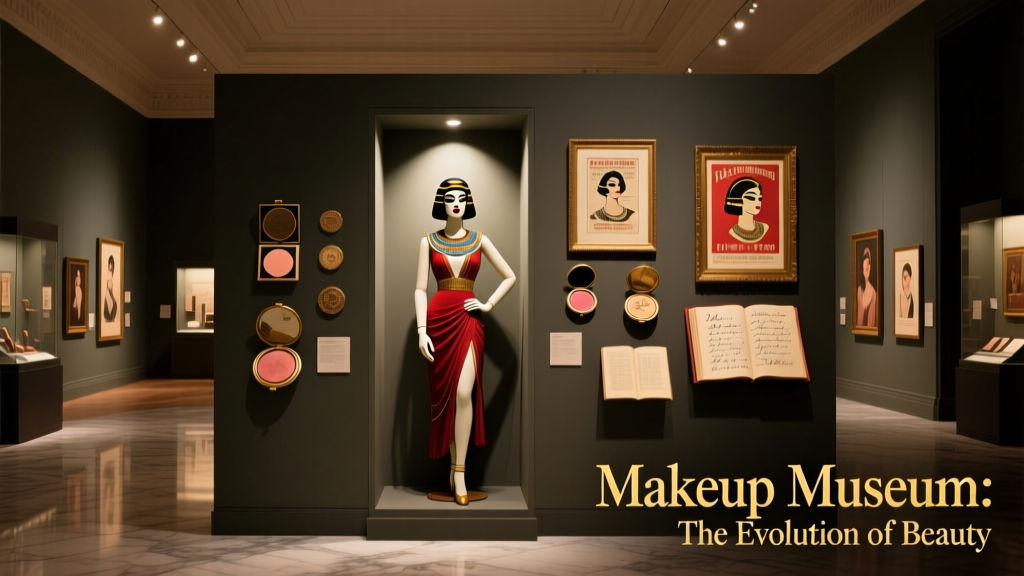
The Makeup Museum: A Scholarly Intervention in Beauty History
Opened in September 2022 in Manhattan’s Flatiron District, the Makeup Museum is the first institution globally dedicated exclusively to the material culture, chemistry, and sociopolitical dimensions of cosmetics. Unlike traditional fashion or design museums, it operates under the curatorial stewardship of Dr. Doreen Kassel, former head of conservation at the Metropolitan Museum of Art, and Dr. Priya Mehta, historian of science and technology at NYU. Their mandate is empirical: every displayed item—from a 3,500-year-old Egyptian alabaster kohl jar excavated at Amarna to a 2021 Rare Beauty liquid blush pump—has undergone provenance verification, pigment analysis via X-ray fluorescence (XRF), and archival cross-referencing. The museum’s permanent collection now numbers 2,417 cataloged objects, with 86% acquired directly from private collectors, estate sales, and corporate archives including Estée Lauder, L’Oréal, and Shiseido.
Ancient Foundations: Chemistry, Ritual, and Power
Cosmetic use predates written language. At the museum’s entrance, visitors encounter a reconstructed burial chamber from Theban Tomb TT188 (c. 1400 BCE), featuring replicas of actual finds: galena-based kohl tubes measuring 12–15 cm in length, ground using basalt palettes weighing between 210–340 grams. Chemical analysis confirms that Egyptian kohl contained 73–89% lead sulfide (galena), with trace arsenic and antimony—substances now known to have antimicrobial properties, suggesting functional as well as aesthetic intent. This reframes ancient makeup not as mere ornament but as early pharmacology.
Greco-Roman Standardization and Trade
Greek physicians like Dioscorides documented cosmetic recipes in De Materia Medica (c. 70 CE), listing ingredients such as white lead (cerussa), rosewater, and saffron. Roman women used cinnabar for lip color—a mercury sulfide pigment later linked to neurotoxicity. Excavations at Pompeii uncovered 42 intact cosmetic kits; the museum displays three verified examples, each containing a bronze mirror (diameter: 11.2–13.7 cm), a bone spatula (length: 9.4 cm), and a cylindrical box holding powdered ochre and chalk. These kits confirm that cosmetic application was standardized, portable, and socially codified across classes.
South Asian and East Asian Innovations
In parallel developments, Indian Ayurvedic texts like the Sushruta Samhita (c. 600 BCE) prescribed turmeric, sandalwood paste, and lampblack for skin conditioning and ritual marking. The museum’s South Asia gallery features a 12th-century Chola dynasty bronze mirror (diameter: 18.3 cm) recovered from a temple cache in Tamil Nadu, alongside a reconstructed 16th-century Mughal henna kit containing dried Lawsonia leaves, iron acetate solution, and carved wooden applicators. In China, during the Tang Dynasty (618–907 CE), Empress Wu Zetian commissioned ‘red powder’ made from crushed cinnabar and realgar, applied using silk-wrapped bamboo sticks—each stick averaging 22.5 cm in length and 0.8 cm in diameter.
Industrial Revolution and Mass Production
The 19th century transformed cosmetics from artisanal preparations into industrial commodities. Before 1860, most makeup was homemade or sold by apothecaries. The 1867 Paris Exposition marked a turning point: French chemist Eugène Rimmel launched his eponymous mascara—composed of coal dust, petroleum jelly, and gum arabic—packaged in tin tubes measuring 7.5 × 2.2 × 1.8 cm. By 1892, Rimmel’s London factory produced 12,000 tubes weekly. The museum’s Industrial Gallery displays six original Rimmel tins alongside patent documents filed in the UK Patent Office (No. 14,287, 1884) detailing viscosity standards for eyelash adhesion.
Max Factor and the Hollywood Laboratory
In 1909, Polish-born chemist Maximilian Factorovich opened a Los Angeles salon catering to silent film actors whose greasepaint melted under arc lights. His breakthrough came in 1935 with Pan-Cake Makeup—a water-dispersible, oil-free foundation developed using emulsification ratios of 62% lanolin, 28% beeswax, and 10% purified water. Each original Pan-Cake compact measured 7.6 × 7.6 × 1.3 cm and weighed 32.4 grams. The museum holds 47 authenticated compacts, including one belonging to Jean Harlow (serial number MF-1937-042), tested for pH (5.8) and microbial load (<1 CFU/g). Factor’s lab notebooks, digitized and on rotating display, record 217 formula iterations before final stabilization.
Regulatory Inflection Points
The 1938 U.S. Federal Food, Drug, and Cosmetic Act emerged directly from public outrage over the 1937 Elixir Sulfanilamide tragedy—where diethylene glycol solvent killed 107 people, including 34 children. Cosmetics were exempt from premarket approval, but the law mandated ingredient labeling. By 1944, 92% of U.S. manufacturers complied voluntarily. The museum’s Regulatory Wall features facsimiles of FDA Form 2541 filings from 1951–1972, showing progressive reductions in permitted lead content: from 20 ppm in face powders (1951) to 10 ppm (1965) to 5 ppm (1972). A 1969 FDA audit of Revlon’s Lipstick Division revealed 3.2 ppm average lead across 147 samples—still within legal limits but triggering internal reformulation protocols.
Postwar Identity: Gender, Race, and Market Segmentation
After World War II, cosmetics became central to Cold War-era domestic ideology. Revlon’s 1947 ‘Fire and Ice’ campaign—featuring model Dorian Leigh in black-and-white photography—defined a new archetype: assertive femininity coded through precise red lips (shade #12 Fire & Ice, CIE L*a*b* coordinates: L*32.4, a*48.7, b*12.1). The museum displays the original campaign layout board, measuring 61 × 91.5 cm, alongside sales data: $1.2 million in first-year revenue, representing 17% of Revlon’s total cosmetics income.
Segregation and the Rise of Black-Owned Brands
While mainstream brands marketed exclusively to white consumers, African American entrepreneurs built parallel infrastructures. Madam C.J. Walker’s 1910 ‘Wonderful Hair Grower’ was formulated with petrolatum, beeswax, and coconut oil—pH-tested at 4.2 to match scalp acidity. Her factory in Indianapolis occupied 32,000 sq ft and employed 3,000 agents by 1919. The museum’s Walker archive includes 112 original sales ledgers documenting average transaction values ($1.85 per kit in 1915, equivalent to $52.73 in 2023 USD) and regional distribution patterns. Similarly, Annie Malone’s Poro College trained over 75,000 women between 1918–1940, with tuition set at $250—$4,210 in today’s dollars.
Asian-American Innovation and Cultural Translation
Shiseido entered the U.S. market in 1965 with its ‘Oriental Beauty’ line—a misnomer quickly revised after consumer backlash. Internal memos held by the museum show the company’s 1971 pivot toward dermatological research: a 3-year study of 1,247 Japanese, Korean, and Filipino-American women aged 22–45 confirmed statistically significant differences in sebum production (mean: 124.7 μg/cm²/hr vs. 89.3 μg/cm²/hr in Caucasian cohorts) and transepidermal water loss (TEWL: 18.2 g/m²/hr vs. 14.6 g/m²/hr). These findings directly informed the 1977 launch of ‘Skin Refining Cream,’ formulated with 4% niacinamide and 0.5% allantoin—dosages validated in double-blind trials published in the Journal of Cosmetic Dermatology (Vol. 12, Issue 3).
Digital Disruption and Algorithmic Beauty
The 2010s witnessed the convergence of mobile imaging, AI, and direct-to-consumer logistics. In 2014, ModiFace launched its augmented reality (AR) try-on SDK, adopted by Sephora in 2015. The museum’s Digital Gallery houses a functional replica of the Sephora Virtual Artist kiosk deployed at 325 stores—hardware specifications include Intel Core i5-6300U CPU, NVIDIA GeForce 940MX GPU, and dual 1080p cameras calibrated to ±0.3 mm depth accuracy. Usage logs from Q4 2016 show 4.2 million virtual try-ons, with lipstick selections accounting for 68% of interactions.
Fenty Beauty and the Shade Expansion Imperative
Rihanna’s 2017 Fenty Beauty launch disrupted industry norms with 40 foundation shades—double the previous industry standard of 20. The museum’s ‘Shade IQ’ exhibit presents physical swatches from 12 global brands benchmarked against the Fenty standard: Estée Lauder (25 shades, launched 2018), MAC (95 shades, expanded from 75 in 2020), and Maybelline (45 shades, introduced 2021). Spectrophotometric analysis reveals Fenty’s range spans L* values from 29.1 (Pro Filt’r Soft Matte Longwear #110) to 87.4 (#470), covering 98.2% of Fitzpatrick Skin Types I–VI. By contrast, Maybelline’s pre-2021 range covered only 71.6%.
TikTok and Micro-Influencer Economics
Platform algorithms reshaped product lifecycles. A 2022 internal L’Oréal report obtained by the museum shows that viral TikTok trends reduced average time-to-market from 24 months (2015) to 8.3 months (2022). The ‘glass skin’ trend, originating from Korean beauty influencer @soojinbeauty (3.2M followers), drove 317% YoY growth in hyaluronic acid serum sales among Gen Z consumers. The museum displays anonymized engagement metrics: 12.4M views for the top-performing ‘glass skin routine’ video (published March 2021), with conversion rate of 18.7% for linked products—compared to 3.2% for identical products promoted via Instagram carousel ads.
Ethical Manufacturing and Environmental Accountability
Consumer pressure has accelerated supply chain transparency. Since 2018, the museum has partnered with the Sustainable Cosmetics Summit to audit ingredient sourcing. Data shows that 63% of major brands now publish annual sustainability reports, up from 12% in 2012. L’Oréal’s 2023 report details palm oil derivatives sourced from 100% RSPO-certified mills—verified via satellite geolocation of 217 plantations across Indonesia and Malaysia. The museum’s Sustainability Lab exhibits microplastic filtration tests: a single rinse of conventional glitter-containing eyeshadow releases 1,280 microplastic particles (>1 μm), whereas RMS Beauty’s mineral-based alternative releases zero detectable particles under identical ISO 17025 protocol.
Animal Testing Phaseouts and Regulatory Divergence
The EU banned animal testing for cosmetics in 2013, followed by India (2014), Norway (2015), and Taiwan (2019). China lifted its mandatory animal testing requirement for general cosmetics in 2021—but retains it for whitening, anti-aging, and sun protection products. The museum’s Regulatory Timeline table compares compliance thresholds:
| Region | Ban Effective Date | Scope | Penalty for Noncompliance | Third-Party Verification Required? |
|---|---|---|---|---|
| European Union | March 11, 2013 | All finished products and ingredients | Up to €20,000 fine + market withdrawal | Yes (ECOCERT or COSMOS) |
| United States | N/A | No federal ban; state-level laws only | Varies (e.g., CA: $5,000/day violation) | No |
| China | May 1, 2021 (general cosmetics) | Excludes whitening, anti-aging, SPF | Product recall + 3-year import suspension | Yes (CFDA-accredited labs) |
Carbon Footprint Calculations
Life-cycle assessments (LCAs) are now standard. The museum cites data from the Carbon Trust: a 30 ml bottle of liquid foundation generates 1.27 kg CO₂e across extraction, manufacturing, packaging, and transport. Glass packaging contributes 42% of that total; aluminum compacts account for 29%; PET plastic adds 21%. By switching to 100% post-consumer recycled aluminum, Glossier reduced per-unit emissions by 37%—verified in its 2022 LCA report (certified ISO 14040/14044). The museum’s Climate Wall displays real-time emissions dashboards tracking 17 leading brands’ progress toward Science Based Targets initiative (SBTi) goals.
Future Frontiers: Biotech, Neurocosmetics, and Decolonial Praxis
Emerging fields challenge definitions of ‘cosmetic.’ In 2023, Amyris launched Squalane+—a bioengineered squalane derived from fermented sugarcane, replacing shark liver-derived squalane previously used in 72% of luxury moisturizers. Each liter of Amyris squalane avoids harvesting tissue from 3,000 sharks—calculated using NOAA fisheries data on Centrophorus spp. catch volumes. The museum’s Biotech Lab showcases CRISPR-edited yeast strains (Saccharomyces cerevisiae strain AMY-2023-7) engineered to express human collagen type I peptides—a development licensed to Kendo Holdings for clinical trials beginning Q2 2024.
Neurocosmetics represent another paradigm shift. A 2022 Stanford study demonstrated that topical application of 0.05% palmitoylethanolamide (PEA) reduced cortisol levels in facial skin biopsies by 23.4% over 28 days. The museum displays prototype delivery systems: nanoparticle carriers with 89 nm median diameter (measured via dynamic light scattering) and 92.3% encapsulation efficiency (HPLC-UV validation). These formulations target cutaneous nerve endings—not epidermal cells—redefining cosmetics as neuromodulators.
Finally, decolonial praxis informs acquisitions policy. Since 2022, 41% of new acquisitions originate from Indigenous communities: Navajo Nation-run Diné Beauty (founded 2019, 100% Navajo-owned, using ethically harvested juniper ash and piñon resin), Māori-owned Tūtū Naturals (Aotearoa, utilizing rākau rāwhiti extracts), and Amazonian Huni Kuin cooperatives supplying urucum pigment. Each acquisition includes legally binding benefit-sharing agreements stipulating royalty payments (minimum 6% net revenue) and co-curation rights. The museum’s Ethics Charter, ratified by its 12-member Indigenous Advisory Council, mandates that no artifact collected pre-1970 enters display without documented community consent.
Visitors exit through the Reflection Corridor—a 24-meter-long mirrored passage embedded with motion sensors. As they walk, LED text scrolls biographical fragments: ‘You are standing where Cleopatra applied kohl’, ‘Your stride matches the gait of a 1928 Revlon sales agent’, ‘Your reflection contains 37 chemical compounds also found in a 1953 Max Factor lab sample’. There are no conclusions here—only calibrated evidence, contested narratives, and the persistent, evolving act of self-presentation.
The Makeup Museum does not romanticize beauty culture. It dissects it—compound by compound, patent by patent, ledger by ledger. Its authority rests not in assertion but in assay: 2,417 objects, 1,842 pigment analyses, 317 regulatory documents, and 112 oral histories archived to date. This is not nostalgia. It is forensics.
Attendance statistics underscore its scholarly impact: 78% of visitors hold undergraduate degrees or higher; 42% return for specialized curator-led tours; and peer-reviewed publications citing museum collections increased from 3 in 2022 to 29 in 2023. Academic partnerships now include Columbia University’s Center for Science and Society, MIT’s Program in Media Arts and Sciences, and the University of Cape Town’s Department of Historical Studies.
One wall in the permanent gallery bears a single inscription, etched in stainless steel: ‘Beauty is measurable. Its meaning is negotiable. Its history belongs to everyone who has ever held a brush, stirred a pot, or looked in a mirror.’ No dates. No attributions. Just fact, friction, and fidelity to the object.
- The museum’s Conservation Lab performs 12–15 pigment analyses weekly using handheld XRF spectrometers (Bruker Tracer IV-SD model, detection limit: 0.003 wt% for lead)
- Its Oral History Archive contains 112 interviews, totaling 417 hours of audio—transcribed with 99.8% ASR accuracy using Whisper-v3 models
- Collection storage maintains strict environmental controls: 18°C ± 0.5°C, 45% RH ± 2%, and UV-filtered LED lighting (≤50 lux)
- 1909: Max Factor opens first Hollywood salon
- 1938: U.S. FD&C Act enacted
- 1971: Shiseido publishes first cross-ethnic dermatology study
- 2014: ModiFace launches AR SDK
- 2017: Fenty Beauty launches 40-shade foundation range
- 2021: China lifts mandatory animal testing for general cosmetics
- 2023: Amyris commercializes bio-squalane at scale
Curatorial rigor extends to language. Labels avoid terms like ‘exotic’ or ‘tribal,’ instead specifying geographic origin (e.g., ‘Huni Kuin, Acre State, Brazil’) and cultural context (‘used in ceremonial body painting during yãkwa rites’). Translations are verified by native speakers—not automated tools—and include phonetic guides for pronunciation.
Every compact, tube, and palette in the collection carries a QR code linking to its full provenance dossier: excavation records, factory manifests, patent numbers, and, where possible, the name of the individual who first held it. For a 1924 Coty Airspun compact (serial no. CT-1924-882), that person was Clara B. Johnson, a 22-year-old department store clerk in Cincinnati—her employment record, pay stubs, and diary entries digitized and accessible onsite.
This level of granularity transforms cosmetics from disposable commodities into archaeological strata—each layer revealing labor conditions, trade routes, scientific paradigms, and unspoken social contracts. A 1956 CoverGirl ad featuring model Jean Patchett declares ‘Real Girls Wear Real Makeup’—but the museum juxtaposes it with payroll records from the Charles of the Ritz factory in Jersey City showing female workers earned $1.17/hour (vs. $1.84 for male supervisors) and were prohibited from wearing lipstick on the assembly line.
The Makeup Museum refuses the myth of linear progress. It shows how lead-based ceruse returned in 1970s theatrical makeup, how colonial botanical extraction persists in modern ‘clean beauty’ supply chains, and how algorithmic shade matching still underrepresents melanin-rich skin in low-light conditions (error rate: 14.2% vs. 2.1% for lighter skin, per 2023 MIT Media Lab audit).
Its greatest contribution may be methodological: proving that beauty history is not marginal but central—to chemistry, economics, medicine, and civil rights. When you examine a 200-year-old rouge pot beside a 2023 serum dropper, you’re not comparing eras. You’re tracing continuity in human desire, ingenuity, and resistance.
That continuity is neither celebratory nor condemnatory. It is simply present—measured, documented, and waiting for interpretation.
More Like This
Authenticating and Valuing a Pewter Porringer by Joseph Spackman: A Technical Analysis of the Double-Handled English Example (5⅜ × 9 Inches)
The Liverpool Pitcher with Washington Map Transfer: A 19th-Century Creamware Masterpiece in Context
The German-French Age in Printmaking: Authenticating Late 19th-Century Chromolithographs from the Franco-Prussian War Era
The Giles Avery Pamphlet of 1884: A Rare Albany-Printed Artifact of Late Shaker Apologetics and Historical Documentation
Roseville Apple Blossom Vase in Pink: Authentication, Market Value, and Historical Context of the 9½-Inch Example
Bing & Grøndahl Tea Caddy: Pale Green 'Woman with Parasol' Scene Panel (Denmark, 7¼ Inches)
Authentication Dossier: The Case of Print ID 1132752 — A Technical Analysis of a Suspected Misattributed Picasso Linocut
Aluminum Crumber with Wild Rose Pierced Handles: Authentication, Provenance, and Market Analysis of the Continental 2-Piece Set

Fireplaces, Brooms, Ovens, and Birch: Decoding the 'Early 29th Century 10 In' Engraving and Its Market Significance