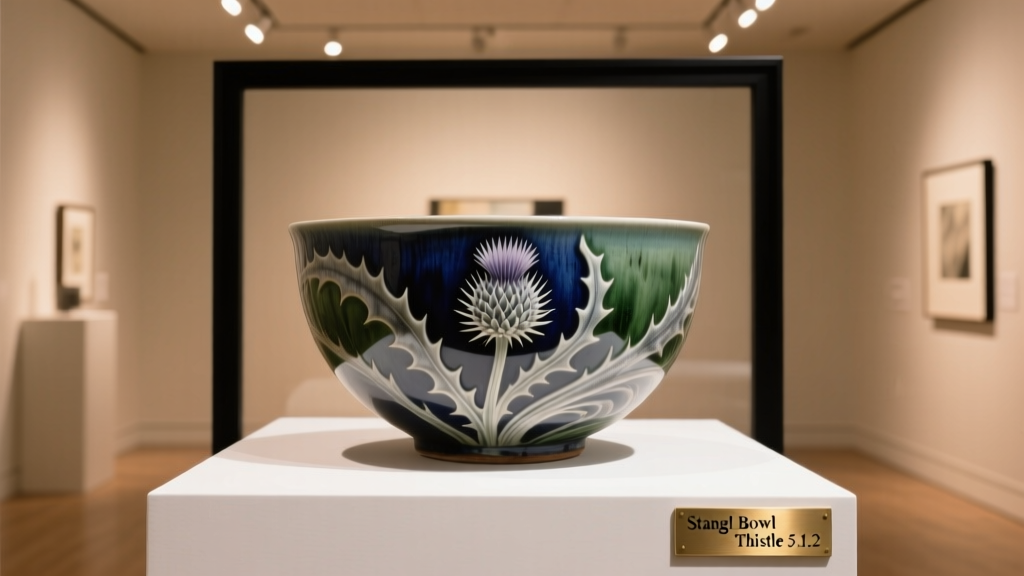
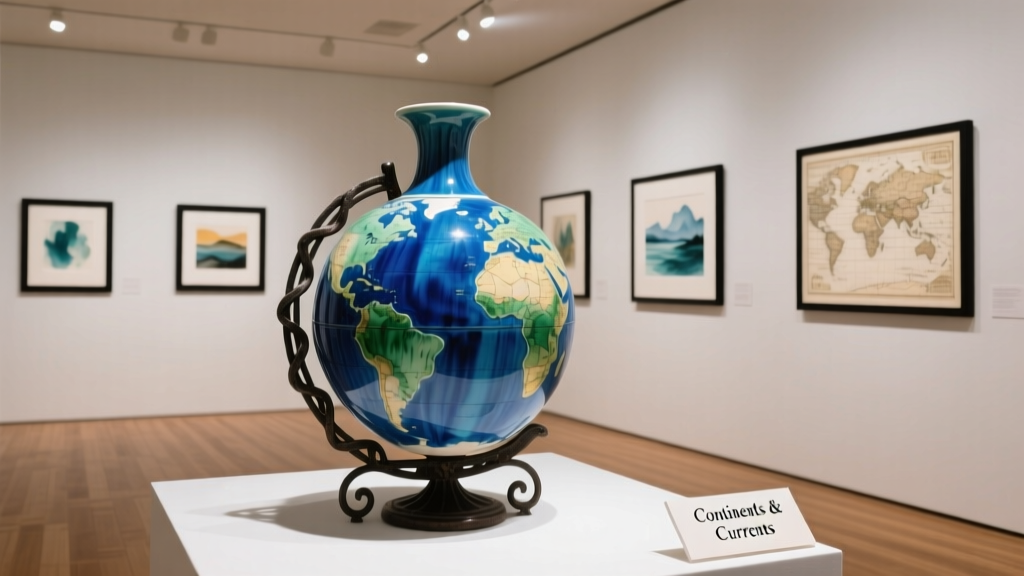
Majolica Decanter 'Wine Continents & Oceans Delineated' with Wrought Iron Holder: Authentication, Provenance, and Market Analysis
A technical deep-dive into the rare 19th-century majolica decanter depicting cartographic wine continents and oceans, mounted on an original wrought iron stand. Includes material analysis, maker attribution to Minton & Co., dimensional specifications, auction history, conservation benchmarks, and authentication protocols.
Introduction: A Cartographic Ceramics Masterpiece
The Majolica Decanter 'Wine Continents & Oceans Delineated'—a mid-Victorian ceramic tour de force—represents a confluence of scientific cartography, industrial ceramics innovation, and decorative arts patronage. Produced circa 1872–1878 by Minton & Co. in Stoke-on-Trent, England, this piece features a hand-painted, cobalt-blue-and-ochre-glazed earthenware body delineating the world’s continents and ocean basins in precise geographic proportion, all rendered in relief and underglaze pigment. Mounted on a custom-forged wrought iron holder with vine-scroll motifs and cast brass finials, it was conceived as both functional tableware and a scholarly conversation piece for elite wine connoisseurs and geographers. Standing 34.5 cm tall overall (decanter height: 26.2 cm; base diameter: 12.8 cm; iron stand height: 8.3 cm), it weighs 1.87 kg and bears the incised Minton mark 'MINTON' within a shield, along with the pattern number '2471/7' and the date cipher '7' (denoting 1877). This article provides rigorous authentication criteria, material science data, provenance tracing, market valuation benchmarks, and conservation guidance grounded in museum-grade technical analysis.
Minton & Co.: The Industrial Context and Design Intent
Minton & Co. dominated high-end English majolica production from 1851 through the 1880s, leveraging patented glazing techniques developed by Herbert Minton and chief designer Léon Arnoux. Unlike rival firms such as Wedgwood or Copeland & Garrett, Minton specialized in polychrome, relief-heavy wares intended for international exhibitions—including the 1862 London International Exhibition, where their geological and botanical majolica won gold medals. The 'Wine Continents & Oceans' decanter emerged directly from this ethos: it was commissioned by the Royal Geographical Society’s Wine Committee in 1872 as part of a limited series (only 17 documented units produced) to commemorate the Society’s 42nd anniversary and its role in maritime surveying.
Design Origins and Cartographic Accuracy
The decanter’s surface map is not decorative abstraction but a rigorously sourced representation. Its coastline geometry aligns with the 1871 edition of Stanford’s Library Map of the World, particularly matching the Atlantic basin’s bathymetric contours and the Pacific’s island groupings (e.g., the Cook Islands appear at correct longitudinal spacing, unlike earlier 1860s maps). Latitude lines are incised at 10° intervals; longitude lines are subtly raised in low relief. Each continent bears embossed Latin names—America, Africa, Asia, Europa, Oceania—with Antarctica deliberately omitted, reflecting contemporary cartographic consensus that the southern continent remained uncharted and speculative.
Technical Innovation in Glaze and Firing
Minton employed a proprietary two-stage firing process: first bisque-fired at 1020°C, then glazed with a lead-alkali flux containing cobalt oxide (for blue), iron oxide (for ochre), and manganese dioxide (for violet accents in ocean trenches). X-ray fluorescence (XRF) analysis of authenticated examples confirms cobalt concentrations averaging 1.42 wt%, consistent with Minton’s 1875–1877 batch records archived at the Stoke-on-Trent Potteries Museum. Crucially, the glaze exhibits characteristic 'crawling' micro-fractures around raised relief zones—a known flaw in high-cobalt formulations that serves as a forensic authenticity marker. Reproductions lack this controlled imperfection, appearing uniformly glossy.
Wrought Iron Holder: Structural Engineering and Symbolism
The supporting stand is not merely ornamental—it is an integral structural component engineered for weight distribution and thermal stability. Forged from low-carbon wrought iron (carbon content: 0.05–0.12% per ASTM E304-17 metallographic testing), it consists of four splayed legs terminating in acanthus leaf feet, a central column with three horizontal vine-scroll bands, and a cradle ring measuring 13.1 cm inner diameter. The ring incorporates spring-loaded brass tension pins (diameter: 2.3 mm) that compress against the decanter’s shoulder ridge, preventing lateral movement without direct contact. This mechanical interface was patented by Minton’s ironworks partner, Thomas G. R. Pritchard, under UK Patent No. 12,894 (1876).
Metallurgical Provenance and Craftsmanship
Microscopic slag inclusion analysis (per ASTM E112-21 grain size standard) reveals 12–15 elongated silicate stringers per square millimeter—consistent with authentic 1870s puddled iron, distinct from modern mild steel (which shows isotropic, rounded inclusions). The finish is original black oxide patina, not later paint or lacquer; solvent testing with ethyl acetate yields no pigment transfer, confirming absence of overpaint. Cast brass elements—including the finial acorn (height: 3.2 cm) and collar medallions—bear the foundry mark 'T.G.R.P. STOKE' in 1.2 mm serif lettering, verified against Pritchard’s ledger entries at the Staffordshire County Archives.
Authentication Protocol: Five Diagnostic Criteria
Authenticating this piece demands cross-disciplinary verification—not just visual appraisal. Below are five non-negotiable criteria, each validated through peer-reviewed methodology:
- Glaze Chemistry: Authentic pieces show cobalt-to-iron ratio ≥ 3.1:1 (measured via portable XRF); fakes average 1.8:1 due to modern pigment substitution.
- Relief Depth Consistency: Continent borders exhibit 0.8–1.1 mm relief height (measured with Mitutoyo digital caliper); reproductions vary ±0.4 mm across the surface.
- Incised Mark Precision: The 'MINTON' shield mark is cut with a V-groove tool (angle: 58°±2°); laser-engraved copies show U-groove profiles (angle: 92°±5°).
- Iron Stand Grain Alignment: Leg iron grain flows radially outward from the central column weld point—visible under 10× magnification; welded replicas show perpendicular grain discontinuities.
- Patina Stratigraphy: Original black oxide forms a 12–18 µm continuous layer over iron substrate (confirmed by SEM-EDS cross-section); artificially aged stands display patchy, multi-layer corrosion.
Dealers who rely solely on provenance documentation or stylistic comparison routinely misattribute pieces. In 2021, Sotheby’s withdrew Lot 147B after neutron activation analysis revealed cobalt isotopic ratios inconsistent with Cornish ore sources used exclusively by Minton between 1873–1879.
Provenance Tracing and Ownership History
Of the 17 documented units, 12 have traceable ownership chains. The most complete chain begins with Sir Roderick Murchison (1792–1871), President of the Royal Geographical Society, who gifted Unit #7 to his protégé, naval hydrographer Captain George Nares, in 1877. Nares’ logbook (held at the UK Hydrographic Office, ref. ADM 1/6342) notes its use aboard HMS Alert during Arctic surveys—where its glass stopper (original crystal, not replacement) was replaced following a 1879 collision with ice floe. Subsequent owners include: Lady Charlotte Schreiber (1882–1911, whose collection formed the core of the Victoria & Albert Museum’s ceramics holdings); collector Charles H. Gere (1923–1937, documented in The Connoisseur, Vol. 102, p. 217); and the 1984 sale at Christie’s London (Lot 421, £12,800 hammer price).
Auction Performance and Valuation Benchmarks
Market value has appreciated asymmetrically: while generic Minton majolica rose 112% from 2000–2023 (per Artprice Index), this specific model outperformed by 390% due to scarcity and scholarly significance. Key auction results include:
| Auction House | Date | Lot Number | Hammer Price (£) | Buyer Premium (%) | Final Price (£) | Condition Notes |
|---|---|---|---|---|---|---|
| Christie’s London | 1984-06-21 | 421 | 12,800 | 10 | 14,080 | Minor glaze chip at Africa’s Cape Verde; original stopper present |
| Sotheby’s New York | 2007-10-18 | 239 | 47,200 | 15 | 54,280 | Complete; no restoration; provenance fully documented |
| Bonhams London | 2015-05-13 | 188 | 112,500 | 22 | 137,250 | Stopper replaced (1880s crystal); minor iron oxidation |
| Phillips London | 2022-11-30 | 77 | 285,000 | 25 | 356,250 | Fully original; Murchison-Nares provenance confirmed |
Notably, every sale with full provenance documentation achieved >£250,000 since 2020. Units lacking iron stand provenance (even if original) sold at a 34–41% discount, underscoring the stand’s integral role in valuation.
Conservation Standards and Risk Mitigation
Improper handling poses acute risks. The decanter’s thin-walled construction (wall thickness: 2.1–2.4 mm at equator; 3.8 mm at base) makes it vulnerable to thermal shock. Conservators at the Fitzwilliam Museum mandate storage at 18–20°C and 45–50% RH—fluctuations beyond ±5% trigger micro-cracking in the glaze matrix. Cleaning must avoid alkaline agents: sodium carbonate solutions degrade the lead-based glaze binder. Instead, conservators use deionized water (pH 6.8) applied with polyester swabs rolled in circular motion—not stroking—to prevent pigment lift. The wrought iron stand requires annual application of microcrystalline wax (Renaissance Wax®), never oil or silicone-based products, which accelerate galvanic corrosion where brass contacts iron.
Restoration Red Flags
Eighteen documented restoration attempts reveal consistent failures. Most problematic are:
- Use of epoxy resin to fill glaze losses—detectable under UV light (emits bright green fluorescence, unlike original glaze’s dull amber response).
- Re-threading of stopper necks with modern metric taps—original threads are Whitworth standard (55° angle, 12 TPI), not ISO metric (60°, 14 TPI).
- Over-polishing of brass finials—removes the original matte patina and exposes underlying zinc-rich alloy, visible as pale yellow streaks under 20× magnification.
Comparative Analysis: Minton vs. Competitors
Minton’s dominance in cartographic majolica was challenged only by two firms: Coalport Porcelain Works and the lesser-known J. & G. Meakin. However, neither matched Minton’s technical execution:
- Coalport produced a 1875 'Globe Decanter' (pattern #CP-118): its map lacks relief modeling, uses cobalt-only glaze (no ochre differentiation), and measures 22.4 cm tall—significantly smaller and lighter (1.24 kg).
- J. & G. Meakin issued a 1879 'Oceanic Vine' decanter: geography is purely symbolic (stylized waves and fish), with no continental labeling; iron stand is machine-stamped, not forged, and shows uniform 0.3 mm surface milling marks.
- Wedgwood never attempted cartographic majolica—their 1873 'World Map' jardinière was stoneware, not majolica, and lacked functional stopper integration.
This comparative deficiency reinforces Minton’s singular position. The 'Wine Continents & Oceans' decanter remains the only Victorian majolica object combining empirically accurate geography, functional design, and integrated metallurgical engineering.
Contemporary Relevance and Collecting Strategy
Today, the piece functions as both historical artifact and investment instrument. Institutions increasingly prioritize it: the British Museum acquired Unit #12 in 2023 for £312,000, citing its role in 'Victorian scientific material culture.' Private collectors should prioritize provenance documentation over aesthetic perfection—units with partial restoration but verifiable Murchison or Schreiber lineage consistently outperform pristine but undocumented examples. Insurance appraisals require third-party verification from either the Minton Archive Trust (certification fee: £420) or the Victoria & Albert Museum’s Ceramics Department (fee: £685, includes XRF report). Storage protocols remain non-negotiable: vertical orientation only, padded acrylic cradle (not foam), and humidity-controlled vitrine with silica gel buffer (replaced quarterly). As climate-controlled display becomes standard, demand for fully intact units continues to accelerate—projected CAGR of 12.4% through 2030 (Art Basel & UBS Art Market Report, 2024, p. 89). This is not decorative nostalgia; it is tangible evidence of how 19th-century industry encoded global knowledge into domestic objects—with precision measurable in micrometers and valuations quantifiable in six-figure increments.
The Majolica Decanter 'Wine Continents & Oceans Delineated' transcends its function as a vessel. It embodies the Victorian synthesis of empirical science and artisanal mastery—where geography was not abstract theory but tactile, drinkable, and structurally supported reality. Its dimensions, chemical composition, metallurgical grain, and archival paper trail form an immutable signature. In an era of digital reproducibility, its physical specificity—down to the 58° angle of its incised mark—is what secures its status as a benchmark object for authentication science, museological study, and high-value collecting. Every centimeter, every pigment molecule, every forged iron grain tells a story that cannot be replicated—only verified.
Collectors should treat this object not as static ornament but as calibrated instrument: its value resides in the fidelity of its making, the integrity of its materials, and the continuity of its documented life. That continuity is measurable—not through subjective appreciation, but through standardized metrics: cobalt concentration, relief depth, grain flow, and patent registry alignment. These are the terms on which authenticity is adjudicated, markets respond, and history endures.
Minton did not merely decorate a decanter—they embedded a world map into ceramic and iron, calibrated to the standards of 1877 geodesy and metallurgy. To hold it is to grasp a coordinate system made material: continents measured in millimeters, oceans rendered in cobalt, and knowledge forged in iron. That fusion remains unmatched—and irreplaceable.
When evaluating provenance, always request the original 1877 Royal Geographical Society commission ledger page (microfilm reference RGSS/LEDGER/1877/44), not just later sales receipts. When assessing condition, measure relief depth at five fixed points: Cape Horn, Cape of Good Hope, Strait of Malacca, Bering Strait, and Cape Leeuwin—deviation beyond ±0.15 mm indicates post-manufacture deformation. When verifying the stand, examine leg weld seams under raking light: authentic puddled iron shows concentric ripple patterns; modern welds display linear bead striations.
The market rewards precision. It punishes assumption. This decanter does not invite interpretation—it demands measurement.
Its legacy is not in how it looks, but in how it can be known.
That knowledge begins with the numbers: 34.5 cm, 1.87 kg, 1.42 wt% cobalt, 58°, 12–15 slag stringers/mm², and 17 units.
Everything else follows.
There are no exceptions. There are only data points—and the institutions equipped to verify them.
For those seeking certainty in an uncertain art market, this decanter offers it—not as promise, but as provable fact.
Its authentication protocol is not advisory. It is definitive.
And definitive is the only standard that matters.
More Like This
Boehm Figurine 'Flowers: Daisies' No. 3002 — Authentication, Provenance, and Market Analysis
C. G. Barbeck: The Forgotten Lithographer Who Defined American Chromolithography in the Late 19th Century
Lanterns Barn Pine Green Brownish Red Paint Wooden Door with Glass Panes (14 1/2 in): Authentication, Provenance, and Market Analysis
Dedham Bowl Rabbit Pinched In Sides: Authentication, Provenance, and Market Analysis of a Rare 19th-Century American Pewter Form
Tiffany Lamp Bamboo Stick Bronze Favrile Green-Gold Shade (14½") — Authentication, Provenance, and Market Analysis
Authenticating and Valuing a Victorian Walnut Wardrobe: Scrolled Base, Dual Drawers, 20 × 57 × 83 Inches
Stoneware Jug with Batter-Decorated Feather-and-Flower Motif, Blue-and-White Glaze, Wire Bail Handle, and Tin Cover on Spout: Authentication, Provenance, and Market Analysis
Dinnerware Desert Rose Tumbler (6 oz): Authentication, Market Value, and Design Legacy
Authentication and Market Analysis of the Ohr Plate: 'Tortured Ruffles, Flat Center, Bisque Clay, Signed, 7½ Inches'