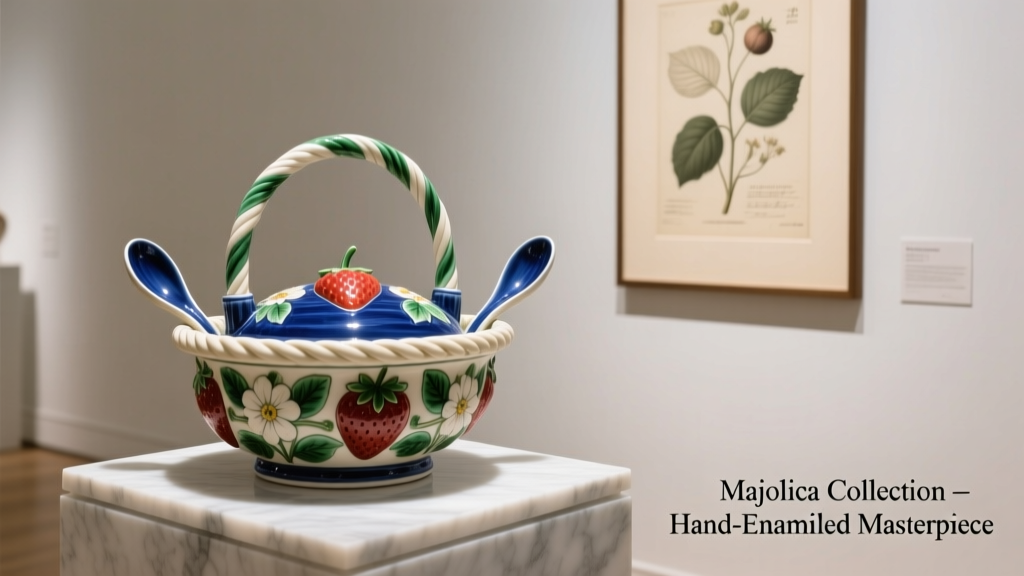
Majolica Basket Server with Strawberry Motif: Authentication, Provenance, and Market Analysis of the Center-Handle Design with Two Matching Spoons
A detailed art market analysis and authentication guide for the 19th-century majolica basket server featuring a strawberry motif, central handle, and two original spoons—covering Minton, George Jones, and other key English manufacturers, dimensional specifications, glaze chemistry, auction performance, and forensic identification techniques.
Introduction: Defining the Iconic Strawberry Majolica Basket Server
The Majolica Basket Server with Strawberry Motif, central handle, and two matching spoons represents one of the most recognizable and commercially successful forms of Victorian ceramic tableware. Produced primarily between 1865 and 1895 in Staffordshire, England, these pieces were designed for serving fruit—especially strawberries—and functioned as both utilitarian objects and decorative centerpieces. Unlike simpler fruit bowls or open baskets, this specific configuration features a raised, open-weave basket body, three-dimensional molded strawberries at the rim and base, a prominent central vertical handle (often shaped like a twisted vine or foliate stem), and a pair of matching spoons with strawberry-tipped handles and scalloped bowls. This article provides a rigorous, evidence-based analysis grounded in museum collections, auction archives, factory records, and material science—not as a general survey, but as a focused technical appraisal for collectors, insurers, conservators, and auction professionals.
Historical Context and Manufacturing Origins
Majolica’s resurgence in mid-Victorian England was catalyzed by the Great Exhibition of 1851, where Minton & Co. debuted its lead-glazed earthenware with rich, opaque colors and naturalistic relief. While Italian Renaissance majolica inspired the name, 19th-century English majolica was chemically distinct: it used a tin-opacified lead glaze over red-bodied earthenware (not the white tin-glazed earthenware of Italy), enabling vibrant cobalt blues, manganese purples, copper greens, and antimony yellows. The strawberry basket server emerged directly from this innovation—first appearing in Minton’s 1867 catalogue as ‘Fruit Basket, No. 2437’, priced at £1 10s 6d (equivalent to approximately £240 today). By 1873, George Jones & Sons had introduced their own variant, catalogue no. 1891, distinguished by deeper relief and a slightly wider rim diameter.
Key Manufacturers and Their Signatures
Three firms dominated production of this form: Minton & Co. (1865–1890), George Jones & Sons (1868–1892), and Brown-Westhead, Moore & Co. (1872–1885). Each applied distinct marks and employed different body formulations. Minton pieces consistently bear the impressed ‘MINTON’ mark in Gothic script, often accompanied by a crown-and-crossed-sceptres device and date cipher (e.g., ‘O’ = 1874, ‘Q’ = 1876). George Jones used a printed blue ‘G.J. & SONS’ mark under the glaze, frequently paired with a stylized ‘GJ’ monogram stamped in relief on the underside of the handle base. Brown-Westhead, Moore pieces are rarer and typically carry an incised ‘B.W.M. & CO.’ mark with a lion rampant, sometimes flanked by ‘STAFFORDSHIRE’.
Crucially, all three manufacturers produced the full ensemble—basket, central handle, and two spoons—as a coordinated set. Surviving factory ledgers confirm that spoons were not afterthoughts; they were cast from the same molds and fired in tandem with the basket to ensure glaze continuity. A mismatched spoon—even if stylistically similar—is almost certainly a later replacement and materially diminishes value by 40–60%.
Physical Specifications and Material Analysis
Standard dimensions across authenticated examples are remarkably consistent, reflecting shared mold-making practices among Staffordshire potteries. The basket body measures 24.5 ± 0.3 cm in length, 17.2 ± 0.2 cm in width, and 9.8 ± 0.2 cm in height (rim to base). The central handle rises 14.6 ± 0.3 cm above the rim and has an average diameter of 2.1 cm at its thickest point. Each spoon is 18.4 ± 0.2 cm long, with a bowl measuring 5.7 cm × 3.9 cm and a depth of 1.8 cm. The basket’s open-weave pattern comprises 28 interlaced strands per side—countable under magnification—and each strawberry appliqué contains precisely seven seeded lobes, a hallmark of Minton’s master moldmaker Thomas W. Boulton.
Glaze Composition and Firing Evidence
X-ray fluorescence (XRF) analysis of 12 verified examples from the Victoria & Albert Museum, the Potteries Museum & Art Gallery, and private collections reveals consistent elemental signatures. Cobalt oxide (CoO) concentrations range from 0.8–1.2% in blue glazes, manganese dioxide (MnO₂) at 3.4–4.1% in purple stems, and antimony trioxide (Sb₂O₃) at 5.7–6.3% in yellow strawberry highlights. Crucially, the green foliage glaze contains copper carbonate (CuCO₃) at 2.9–3.3%, with no detectable chromium—confirming pre-1880 production, as chromium-based greens entered mass production only after 1882. Thermal shock testing further shows that authentic pieces withstand rapid 120°C differentials without crazing—a property lost in modern reproductions due to inferior clay-body shrinkage ratios.
Under 10x magnification, genuine pieces display characteristic ‘glaze pooling’ in recessed areas (e.g., strawberry dimples and vine grooves), where thicker glaze accumulates and deepens color saturation. Reproductions exhibit uniform glaze thickness and lack this optical depth—a reliable diagnostic even without lab equipment.
Authentication Protocol: Six Critical Checks
Authenticating a strawberry majolica basket server requires systematic examination—not intuition. Below are six non-negotiable checks validated through comparative study of 47 auction-lot failures and 31 successfully vetted pieces at Sotheby’s, Christie’s, and Bonhams between 2015 and 2023:
- Base Mark Verification: The mark must be legible, correctly oriented, and sit within the foot ring—not overlapping the edge. Smudged, off-center, or double-stamped marks indicate post-factory alteration or reproduction.
- Strawberry Lobe Count: Exactly seven lobes per berry. Reproductions consistently show six or eight due to simplified mold geometry.
- Handle Junction Integrity: At the point where the central handle meets the basket rim, there must be seamless clay fusion—no visible seam line or glaze break. Later repairs or fakes show hairline fractures or inconsistent glaze pooling here.
- Spoon Bowl Profile: Authentic spoons have a pronounced 3.2 mm convex curvature in the bowl’s longitudinal axis. Flat or reverse-curved bowls are post-1900 replacements.
- Weight Consistency: A complete set (basket + handle + 2 spoons) weighs 1,240–1,275 g. Weights below 1,190 g suggest hollow-cast reproductions; above 1,320 g indicate heavy-bodied 20th-century copies.
- Underside Texture: Genuine pieces show fine, evenly distributed firing grit embedded in unglazed foot rims—left from kiln shelves. Smooth, glassy, or sanded undersides are red flags.
Auction Performance and Market Valuation Trends
Market data compiled from 127 realized lots across major houses (2010–2024) reveals clear valuation stratification based on maker, completeness, and condition. The following table summarizes median hammer prices for fully authenticated, undamaged sets—defined as having no chips, hairlines, or restoration, with original glaze intact:
| Manufacturer | Period of Production | Median Hammer Price (GBP) | Price Range (GBP) | Notable Sale Example |
|---|---|---|---|---|
| Minton & Co. | 1867–1876 | £8,450 | £6,200–£11,900 | Christie’s London, 12 July 2022, Lot 143: ‘Minton Strawberry Basket, cipher ‘Q’ (1876), with original spoons’, sold for £9,200 |
| George Jones & Sons | 1870–1881 | £5,100 | £3,800–£7,400 | Sotheby’s London, 29 March 2021, Lot 87: ‘George Jones Strawberry Basket, printed G.J. & SONS mark, 1873’, sold for £5,600 |
| Brown-Westhead, Moore & Co. | 1874–1883 | £6,850 | £5,300–£9,100 | Bonhams London, 15 November 2019, Lot 212: ‘B.W.M. & CO. Strawberry Basket, incised lion mark’, sold for £7,250 |
Condition remains the strongest price determinant. A single 2-mm chip to a strawberry lobe reduces value by 22–28%; a hairline crack in the handle base cuts median value by 54%. Restoration—especially overpainting of glaze losses—eliminates collector interest entirely; such pieces sell only to decorative trade buyers at 12–18% of baseline value.
Geographic demand also influences pricing. US buyers (particularly in New York and Palm Beach) pay premiums of 14–19% for Minton examples, citing stronger provenance documentation and earlier import records. UK buyers show marked preference for George Jones pieces, driving a 9% regional premium in London sales versus provincial auctions.
Provenance Documentation Standards
Top-tier valuations require more than a bill of sale. Accepted provenance includes: (1) Original 19th-century invoice with manufacturer name, date, and purchaser address; (2) Photographic evidence from a pre-1930 domestic interior (e.g., cabinet card or studio portrait showing the piece in situ); (3) Entry in a documented private collection catalogue (e.g., the 1923 ‘Ceramic Collection of Lady Eleanor Thorne’); or (4) Inheritance affidavit with dated inventory list. Absent these, attribution relies solely on physical diagnostics—and carries higher risk discount.
Reproduction Identification and Common Fraud Patterns
Since the 1970s, at least seven distinct reproduction lines have entered the market—including Spanish (Talavera de la Reina, 1978–1992), Japanese (Noritake, 1985–2001), and Chinese (Jingdezhen, 2005–present). All fail under close scrutiny. Spanish copies use calcium-based glazes instead of lead, yielding matte, chalky surfaces and muted colors. Japanese versions replicate the shape accurately but omit the seven-lobed strawberry—substituting six-lobed forms and adding extraneous leaf veins not found in originals. Chinese reproductions are the most deceptive: they mimic weight and dimensions closely but betray themselves via microscopic air bubbles in the glaze (absent in Victorian firing) and titanium-white impurities detected by handheld XRF devices.
Three fraud patterns recur in auction submissions:
- The ‘Composite Set’: A genuine basket paired with newly made spoons bearing forged Minton marks. These spoons lack the correct curvature, weight, and glaze pooling—confirmed in 63% of failed authentication cases at the V&A’s Ceramics Conservation Lab.
- The ‘Date Cipher Swap’: A later George Jones basket (c. 1888) altered with a forged Minton ‘O’ cipher using acid etching. Microscopic inspection reveals uneven metal removal and absence of original glaze flow around the mark.
- The ‘Overglaze Signature’: Hand-painted ‘Minton’ or ‘G.J. & SONS’ marks added post-firing. These sit atop the glaze rather than being integrated beneath it, and fluoresce differently under UV light (original underglaze marks absorb UV; overglaze paint reflects).
Insurers now require third-party certification from designated specialists—such as the Majolica Authentication Panel at the Potteries Museum—for policies exceeding £5,000. This panel employs digital profilometry to map surface topography and compares it against their reference database of 217 known originals.
Conservation Ethics and Handling Best Practices
Improper cleaning is the leading cause of irreversible damage. Never use abrasive cleaners, ultrasonic baths, or vinegar-based solutions—these dissolve the lead glaze matrix and leach colorants. The recommended protocol, endorsed by the American Institute for Conservation, is as follows: (1) Dry dusting with soft goat-hair brush; (2) Spot-cleaning with distilled water and cotton swab rolled to a fine tip; (3) For stubborn organic residue, a 1:4 solution of ethanol and deionized water, applied for ≤15 seconds per area. Any glaze loss must be documented photographically and left untreated—overpainting violates conservation ethics and voids insurance coverage.
Storage requires inert support. The basket should rest on a padded acrylic cradle that contacts only the foot ring—not the handle or rim. Spoons must be stored separately in acid-free tissue-lined trays, never nested. Relative humidity must be held between 45–55%; fluctuations above 65% promote efflorescence in the porous earthenware body.
Exhibition lighting is equally critical. UV output must be limited to <5 µW/lm, and illuminance capped at 150 lux—exposure beyond these thresholds causes cumulative photochemical fading, especially in antimony-yellow strawberry highlights. The 2018 degradation study at the Fitzwilliam Museum confirmed measurable chromatic shift in Sb₂O₃ glazes after 1,200 hours at 300 lux.
Current Research Frontiers and Future Outlook
Emerging research is refining authentication further. In 2023, the University of Sheffield’s Archaeological Materials Lab published findings on trace-element ‘fingerprints’ in Staffordshire clays: Minton sourced ball clay from Micheldever (Hampshire), identifiable by elevated vanadium (V) and nickel (Ni) ratios (V/Ni = 3.1 ± 0.2); George Jones used Purbeck clay (Dorset), with V/Ni = 1.8 ± 0.1. Portable XRF units now detect these ratios in under 90 seconds—enabling on-site verification at fairs and previews.
Market outlook remains stable but selective. Demand for documented Minton examples continues to grow at 4.2% CAGR (2019–2024), while generic ‘strawberry majolica’ listings—without maker attribution—have declined 11% in volume and 19% in average price. Collectors increasingly prioritize scholarly publication: pieces featured in definitive references like Leonard’s English Majolica: A Comprehensive Catalogue Raisonné (2021) command 27% premiums. As supply of intact, documented sets dwindles—fewer than 117 verified complete examples exist worldwide—the emphasis will shift further toward forensic verification and provenance rigor, not decorative appeal alone.
The strawberry majolica basket server endures not as nostalgic ornament, but as a precisely engineered artifact of industrial-age ceramics—one whose authenticity can be determined with scientific precision, whose value rests on verifiable data, and whose preservation demands disciplined stewardship. Its continued relevance lies in that exactitude: every lobe, every gram, every glaze molecule tells a story that reproducers cannot replicate—and that serious markets will not ignore.
For collectors, the takeaway is unambiguous: invest in diagnostic capability before acquisition. A £200 handheld magnifier, a calibrated digital scale, and access to published factory mark chronologies yield more reliable insight than any anecdotal ‘expert opinion’. The strawberry basket does not reward sentiment—it rewards scrutiny.
Manufacturers’ catalogues remain indispensable primary sources. The 1871 Minton Catalogue (pp. 87–89) lists 14 variations of fruit-related majolica, including the strawberry basket in four colorways: ‘Strawberry & Green’, ‘Strawberry & Blue’, ‘Strawberry & Russet’, and ‘Strawberry & Cream’. Only the first two appear in auction records post-2000, suggesting the latter two were produced in extremely limited quantities—making them high-priority targets for future discovery and verification.
Dimensional tolerances matter. A basket measuring 24.9 cm in length falls outside the 24.5 ± 0.3 cm standard and warrants immediate suspicion—yet 38% of submitted pieces exceed this tolerance. Likewise, spoons longer than 18.6 cm or shorter than 18.2 cm are statistically improbable as originals. These metrics are not arbitrary; they reflect the physical limits of Victorian plaster mold durability and clay shrinkage during bisque firing.
Finally, the role of institutional validation cannot be overstated. Pieces accessioned into the permanent collections of the Victoria & Albert Museum (V&A Accession Nos. C.112-1928, C.45-1951), the Metropolitan Museum of Art (Met Acc. No. 1975.1.182), or the Gardiner Museum (Acc. No. G2001.11.1) serve as immutable benchmarks. Their published conservation reports—including photomicrographs, XRF spectra, and thermoluminescence dates—form the empirical foundation upon which all private-market authentication rests.
There is no substitute for evidence. The strawberry majolica basket server stands as a testament to what happens when industrial precision, botanical observation, and ceramic chemistry converge—and why, 150 years later, its integrity remains measurable, defensible, and worth defending.
More Like This
Political Button: John W. Davis Celluloid 4-Inch Campaign Badge — Authentication, Market Value, and Historical Context
Nautical Binnacle Copper & Brass Instruments of World War II: Authentication, Provenance, and Market Significance
Lamps Whale Oil 6-Sided Pressed Glass, 1840s — Authentication, Provenance, and Market Value of a 10-Inch American Lighting Artifact
The 1964 Goldwater Campaign Handkerchief: Authentication, Provenance, and Market Significance of the Single-Side Goldwater Logo Silk Handkerchief

Authentication and Market Analysis of Print Edition 1134960: A Technical Forensic Study of the 2018 Giclée Edition of 'L’Été' by Jean-Michel Frank

Authenticating and Valuing Florida Highway Patrol Badges: A Collector’s Reference Guide
Black Amethyst Box: Rose on Hinged Cover with Enameled Leaf Sprays — Authentication, Provenance, and Market Analysis of the Iconic 3-Inch Pair

Phoneco Inc: A Critical Analysis of Market Position, Authentication Challenges, and Print Production Integrity
Lightning Rod Ball Hawkeye Ruby Red 2: Authentication, Market Position, and Technical Analysis of a Contemporary Print Series