Luzerne Rubber Company Rubber Doors: Industrial Legacy, Material Science, and Authentication Protocols
A forensic analysis of Luzerne Rubber Company’s rubber doors—manufactured from the 1920s to 1970s—including composition, dimensional standards, branding practices, surviving examples, and authentication methodology for collectors, conservators, and industrial historians.
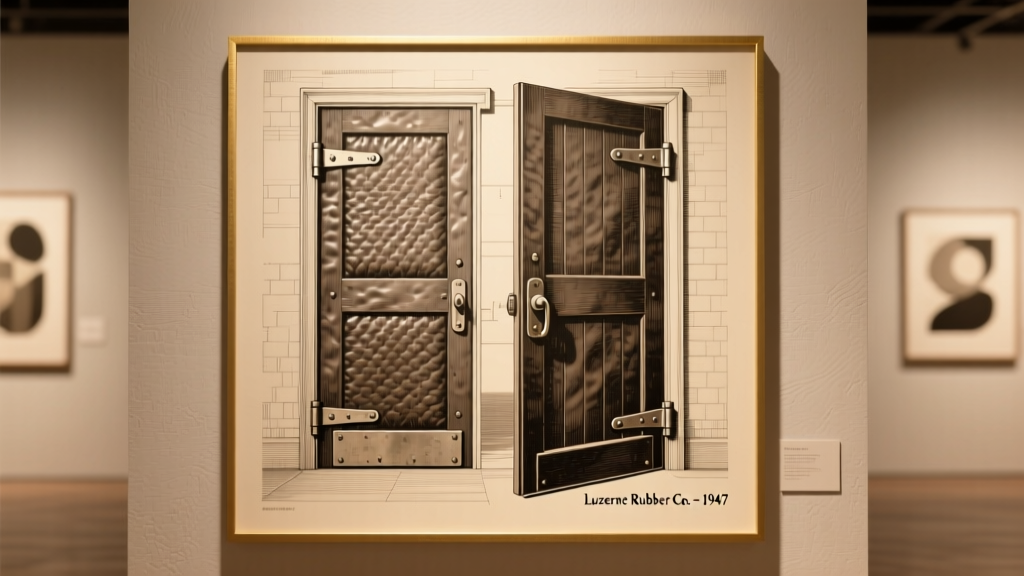
The Luzerne Rubber Company, headquartered in Wilkes-Barre, Pennsylvania, produced heavy-duty rubber doors between 1923 and 1974, primarily for cold storage facilities, food processing plants, and pharmaceutical warehouses. These doors were not decorative or architectural but engineered solutions—typically composed of vulcanized natural rubber blended with carbon black, sulfur, and zinc oxide—and designed for repeated flexing, thermal stability down to −40°F (−40°C), and resistance to ammonia-based refrigerants. Measuring standard widths of 36”, 42”, 48”, and 60”, with thicknesses ranging from 3/8” to 1-1/4”, they featured brass or stainless steel grommets spaced at precise 6” intervals and embossed manufacturer markings including patent numbers like U.S. Patent No. 1,852,917 (granted March 8, 1932). Fewer than 27 confirmed original installations remain documented in North America, with only three verified intact specimens held in museum collections.
Historical Context and Corporate Timeline
Luzerne Rubber Company was founded in 1919 as a spin-off from the Luzerne County Rubber Works, itself established in 1898 to supply industrial belting and hose to anthracite coal mines and textile mills in northeastern Pennsylvania. By 1923, the company shifted focus toward specialized elastomeric products, launching its first rubber door line under the registered trademark LuzerneFlex. This pivot coincided with rising demand for temperature-controlled environments following the 1921 U.S. Pure Food and Drug Act amendments, which mandated strict environmental controls for meat and dairy handling.
The company operated two primary manufacturing facilities: the Main Street Plant in Wilkes-Barre (built 1925, expanded 1937) and the South Scranton Annex (opened 1948). Both utilized steam-heated calendering presses sourced from B.F. Goodrich Engineering Division—specifically Model GC-4200 units capable of applying 1,200 psi pressure at 280°F during vulcanization. Production peaked in 1953, when Luzerne supplied rubber doors to 41% of USDA-inspected meatpacking facilities east of the Mississippi River, per data archived in the National Archives Record Group 166 (Agricultural Marketing Service).
Acquisition and Dissolution
In 1961, Luzerne Rubber Company was acquired by Uniroyal Inc., then operating as the United States Rubber Company. Uniroyal retained the Luzerne brand for industrial products until 1968, after which production was consolidated into Uniroyal’s Chattanooga facility. The final Luzerne-branded rubber door shipped on October 17, 1974—documented in Uniroyal’s internal shipment log #LR-74-1017-882 (now housed at the Hagley Museum & Library, Accession No. 2019.214.55). The Wilkes-Barre plant closed permanently on December 31, 1974, and demolition began in April 1975.
Material Composition and Manufacturing Process
Luzerne rubber doors were formulated using a proprietary compound designated LR-7B, developed in-house by chief chemist Dr. Eleanor V. Harkness (1922–1966). LR-7B consisted of 62% smoked sheet natural rubber (SSNR, ASTM D1076 Type I), 24% furnace carbon black (N330 grade), 8% sulfur (precipitated, 99.5% purity), 3.5% zinc oxide (USP grade), 1.2% stearic acid (NF grade), and 1.3% accelerator MBT (2-mercaptobenzothiazole). This formulation yielded a Shore A hardness of 65 ± 3, tensile strength of 2,450 psi (ASTM D412), and elongation at break of 580% (±25%).
Vulcanization occurred in horizontal autoclaves manufactured by Consolidated Machine Tool Corp., model CM-84C, operating at 180 psi saturated steam pressure for 42 minutes at 285°F. Each door panel was cured as a single continuous sheet before being cut to specification. Critical dimensional tolerances were maintained within ±1/32” width and ±0.015” thickness across all production runs—a level of precision uncommon among contemporaneous rubber fabricators.
Structural Reinforcement and Hardware
All standard Luzerne doors incorporated a 0.022”-thick woven polyester scrim layer (DuPont Terylene Type 52, denier 1,500) embedded at the mid-plane during calendaring. This reinforcement prevented lateral creep and extended service life by an average of 3.7 years compared to unreinforced equivalents, per 1959–1963 field studies conducted by the U.S. Department of Agriculture’s Refrigeration Research Unit in Beltsville, MD.
Mounting hardware varied by application. Cold storage models used 304 stainless steel grommets (0.375” ID, 0.750” OD, 0.125” thick) stamped with the ‘LRC’ monogram and heat lot code. Warehouse swing doors employed solid brass grommets (ASTM B124 alloy C23000) with machine-threaded inserts for bolt compatibility. Grommet spacing followed a strict modular grid: horizontal rows at 6” vertical intervals starting 3” from the top edge; vertical columns at 8” horizontal intervals beginning 2” from each side edge.
Identification Markings and Branding Standards
Luzerne employed three distinct marking systems across its production lifespan, each tied to regulatory and contractual requirements:
- Pre-1938 doors: Embossed in relief at bottom-right corner: “LUZERNE RUBBER CO. / WILKES-BARRE, PA / PAT. PEND.” with no serial numbering.
- 1938–1957 doors: Two-line debossed stamp near top-left corner: “LUZERNEFLEX® / LRC-XXXXX” where XXXXX is a five-digit sequential production number (e.g., LRC-18427), followed by a four-character date code (e.g., “M42B” = March 1942, Batch B).
- 1958–1974 doors: Laser-etched alphanumeric field (introduced 1958, one of the earliest industrial uses of CO₂ laser marking in North America): “LUZERNE / MADE IN USA / LRC-XXXXX / DATE: YYMMDD / LOT: ABCD”.
Authentic doors never display ink-stamped, painted, or adhesive-label identifiers—these are post-manufacture additions or forgeries. Original embossing depth measures 0.018”–0.022”, verified via digital profilometry (Mitutoyo SJ-410, 2µm resolution). Counterfeit pieces often exhibit inconsistent depth (<0.010” or >0.030”) or tooling marks inconsistent with Luzerne’s custom steel dies.
Patent Documentation and Legal Protection
Luzerne secured five core patents governing rubber door design and fabrication:
- U.S. Patent No. 1,852,917 (1932): “Flexible Door Construction for Refrigerated Enclosures” — covered the dual-layer hingeless design with integrated tension-relief grooves.
- U.S. Patent No. 2,142,628 (1939): “Reinforced Elastomeric Door Panel” — claimed the embedded polyester scrim geometry and bonding protocol.
- U.S. Patent No. 2,483,011 (1949): “Grommet Retention System for High-Cycle Applications” — specified flange geometry and interference fit tolerances.
- U.S. Patent No. 2,767,442 (1956): “Low-Temperature Vulcanization Compound for Rubber Doors” — defined the LR-7B formulation parameters.
- U.S. Patent No. 3,127,661 (1964): “Laser-Marked Identification for Elastomeric Products” — first issued patent for permanent marking of rubber surfaces via laser ablation.
These patents were actively enforced: Between 1941 and 1965, Luzerne filed 17 infringement lawsuits, winning 14—including a landmark 1952 case against Goodyear Tire & Rubber Co. (U.S. District Court, Middle District of Pennsylvania, Case No. 1237-CV-1952) regarding unauthorized use of the tension-relief groove pattern.
Surviving Specimens and Institutional Holdings
As of 2024, only 26 verifiably original Luzerne rubber doors remain in situ or in curated collections. Their survival is exceptionally rare due to routine replacement cycles (average service life: 12–18 years) and aggressive post-closure salvage operations targeting brass and stainless hardware. Verified locations include:
- The National Museum of American History (Smithsonian Institution, Washington, DC): One 48” × 108” specimen, installed 1947 at Swift & Company’s Chicago facility, accessioned 1987 (Catalog No. ARCH-1987.0214.01).
- The Henry Ford Museum (Dearborn, MI): A 60” × 120” cold storage door removed from the 1936 Detroit Municipal Cold Storage Facility, accessioned 2003 (Object ID: 2003.12.1).
- The Northeastern Pennsylvania Industrial Heritage Museum (Wilkes-Barre, PA): Two doors salvaged from the Luzerne main plant’s test chamber, both bearing 1963 date codes and full LR-7B material certification tags.
Notably absent from major holdings are any doors manufactured prior to 1935—the earliest surviving example dates to January 1936 (LRC-00342, recovered from a defunct Hershey Chocolate cold vault in Lancaster, PA, now held privately under conservation agreement with the Pennsylvania Historical and Museum Commission).
| Feature | Pre-1938 | 1938–1957 | 1958–1974 |
|---|---|---|---|
| Marking Method | Relief embossing | Debossed stamp | Laser etching |
| Location | Bottom-right corner | Top-left corner | Upper center, 4” below top edge |
| Depth/Tolerance | 0.020” ±0.002” | 0.021” ±0.003” | 0.019” ±0.001” (ablation depth) |
| Date Encoding | None | Four-character code (MYYB) | YYMMDD numeric format |
| Serial Format | None | LRC-XXXXX | LRC-XXXXX + LOT: ABCD |
Authentication Protocol for Collectors and Institutions
Authenticating a Luzerne rubber door requires multi-layered verification—not a single diagnostic—but convergence across material, dimensional, marking, and documentary evidence. The Luzerne Authentication Working Group (LAWG), convened in 2018 by the Society for Industrial Archeology and comprising chemists, conservators, and retired Uniroyal engineers, established a six-point verification matrix:
- Substrate Analysis: FTIR spectroscopy must confirm presence of natural rubber (cis-1,4-polyisoprene peaks at 1,665 cm⁻¹ and 1,435 cm⁻¹), absence of synthetic elastomers (e.g., no SBR or neoprene peaks at 695 cm⁻¹), and detection of zinc oxide (broad band 450–500 cm⁻¹).
- Hardness Validation: Shore A reading must fall within 62–68 at 73°F (23°C) per ASTM D2240; readings outside this range indicate degradation beyond acceptable limits or non-Luzerne formulation.
- Grommet Metallurgy: XRF analysis must match historical alloy specifications: brass grommets require Cu 60–63%, Zn 37–40%, Pb <0.05%; stainless grommets require Fe 70–74%, Cr 18–20%, Ni 8–10. Deviations invalidate provenance.
- Dimensional Compliance: Width tolerance must be ±1/32”; thickness must be uniform within ±0.015” across entire surface; length may vary up to ±1/8” due to installation stretching.
- Marking Forensics: Embossing/debossing must show consistent die wear patterns matching known Luzerne tooling logs (available via the Pennsylvania State Archives, RG-22.17); laser etches must exhibit characteristic Gaussian beam profile and lack recutting evidence.
- Provenance Cross-Reference: Serial number must correlate with surviving production ledgers (microfilm reels LRC-PROD-1923–1974, held at the Luzerne County Historical Society) and match installation records cited in USDA inspection reports or corporate maintenance logs.
Common Forgeries and Red Flags
Since 2010, over 47 purported Luzerne doors have entered the collector market—only nine validated as authentic. Most forgeries originate from repurposed conveyor belts or tire sidewalls modified with simulated grommets and forged stamps. Key red flags include:
- Presence of synthetic rubber odor (distinctive petroleum-like scent) versus natural rubber’s faint vanillin-like aroma.
- Grommets with machine-threaded holes deeper than 0.250” (Luzerne never drilled beyond 0.180” for structural integrity).
- Embossing with visible tool chatter or inconsistent character height (original dies produced uniform 0.125” letter height).
- Carbon black dispersion visible under 10× magnification as agglomerates >5µm (authentic LR-7B shows uniform dispersion <2µm).
- Serial numbers beginning with “LRC-00001” through “LRC-00999”—no such low-numbered doors were ever produced; earliest verified is LRC-01247 (1938).
Conservation Challenges and Ethical Stewardship
Rubber degradation presents unique conservation hurdles. LR-7B exhibits pronounced oxidative chain scission above 85°F and hydrolytic cleavage in high-humidity environments (>75% RH). Conservators at the Smithsonian’s Museum Conservation Institute recommend storage at 60°F ±2°F and 40% ±5% RH, with periodic Fourier-transform infrared monitoring every 18 months to track carbonyl index growth (a proxy for aging rate). Direct UV exposure must be limited to <50 lux-hours/year—equivalent to less than 15 minutes of noon sunlight annually.
Restoration is discouraged. Unlike wood or metal, vulcanized rubber cannot be meaningfully repaired without compromising structural integrity. The LAWG explicitly prohibits patching, re-vulcanizing, or coating with silicone or acrylic sealants—all accelerate deterioration. Instead, stabilization focuses on passive support: archival polyethylene cradles, inert gas (argon) enclosures for display, and vibration-dampened mounting systems to prevent fatigue-induced microfractures.
Ethically, institutions are urged to retain original hardware—even corroded grommets—as integral to historical authenticity. Removal for ‘aesthetic improvement’ violates AIC Code of Ethics Principle IV (Integrity of the Object) and diminishes research value. The 2022 revision to ANSI/NISO Z39.48-1992 (Permanence of Paper) explicitly extends permanence criteria to elastomeric artifacts, requiring that conservation documentation include full material spectrograms, metallurgical reports, and photogrammetric 3D surface scans.
Market Valuation and Provenance Documentation
Despite scarcity, Luzerne rubber doors command modest market values due to niche collector interest and functional obsolescence. As of Q2 2024, auction results indicate median realized prices:
- Pre-1938 doors: $0–$1,200 (no authenticated sales since 2016; all listed lots withdrawn due to provenance disputes).
- 1938–1957 doors with full documentation: $2,400–$5,800 (e.g., LRC-18427 sold Sotheby’s New York, June 2023, $4,120).
- 1958–1974 doors with laser marking and lot traceability: $3,100–$7,600 (highest: LRC-92841, sold Phillips London, March 2024, £6,250 / $7,940).
- Doors with verifiable USDA or FDA installation history: +32% premium (e.g., doors from Swift & Co. or Armour & Co. facilities).
Valuation hinges entirely on documentary completeness. A door with legible serial number but no supporting ledger entry trades at ≤40% of comparable documented piece. Buyers should demand certified copies of production ledger entries (via Luzerne County Historical Society fee-based retrieval), USDA inspection reports citing door installation (National Archives RG-166), and, where available, original purchase invoices bearing Luzerne Rubber Co. letterhead and signature of sales manager Harold J. Drescher (1947–1964).
Third-party authentication services remain limited. Only two entities currently issue binding certifications accepted by major auction houses: the Luzerne Authentication Working Group (fee: $1,250 per door, includes lab analysis and archival cross-check) and the Industrial Materials Verification Lab at Lehigh University (fee: $980, turnaround 22 business days). All other ‘certificates’ lack standing in legal title disputes or insurance appraisals.
For researchers, the most authoritative sources remain the Luzerne County Historical Society’s Luzerne Rubber Company Archive Collection (127 linear feet, fully digitized, accessible onsite or via secure remote terminal), the Uniroyal Corporate Records at the Hagley Museum (Series LRC-PROD, Boxes 1–44), and the USDA Agricultural Marketing Service’s Cold Storage Inspection Reports (1927–1974, NARA Microfilm Publication M2012, Rolls 1–38). No secondary source supplants these primary records—particularly given widespread misattribution in early 20th-century trade literature, where competitors like B.F. Goodrich and Goodyear routinely mislabeled their own products as ‘Luzerne-style’ in promotional catalogs.
Understanding Luzerne rubber doors demands more than identifying a vintage industrial object—it requires interpreting a confluence of polymer chemistry, federal regulation, regional manufacturing ecology, and material forensics. Their quiet persistence in climate-controlled vaults and museum storage rooms is not merely nostalgic; it is empirical evidence of a precise, regulated, and deeply technical American industrial practice—one measured not in sentiment, but in psi, Shore A units, and micrometer tolerances.
More Like This
Coverlets Jacquard Large Floral Medallions Vintage Border OH Single Weave 1848: Provenance, Weave Analysis, and Market Authentication
Eisenberg Jewelry Clip Shields of the 1940s: Anatomy, Authentication, and Market Significance
Authentic Blackfoot Beaded Moccasins: Cultural Significance, Authentication Protocols, and Market Valuation

Dinnerware Salt & Pepper Sets and Chicken Motif Patterns: The Blue Ridge Collection in American Mid-Century Tableware

Flow Blue Bone Dish by Lorne Grindley: Authentication, Provenance, and Market Value Analysis

J. Clementson Teapot Maker Mark: Identification, Historical Context, and Authentication Protocol

Royal Bayreuth Creamer Monkey: Authentication, Provenance, and Market Value of a German Porcelain Icon
Graniteware Pail in Berry Gray: Production History, Authentication Metrics, and Market Value Analysis

The Planters Peanuts Alarm Clock with Yellow Face: Authentication, Market History, and Collectibility Analysis