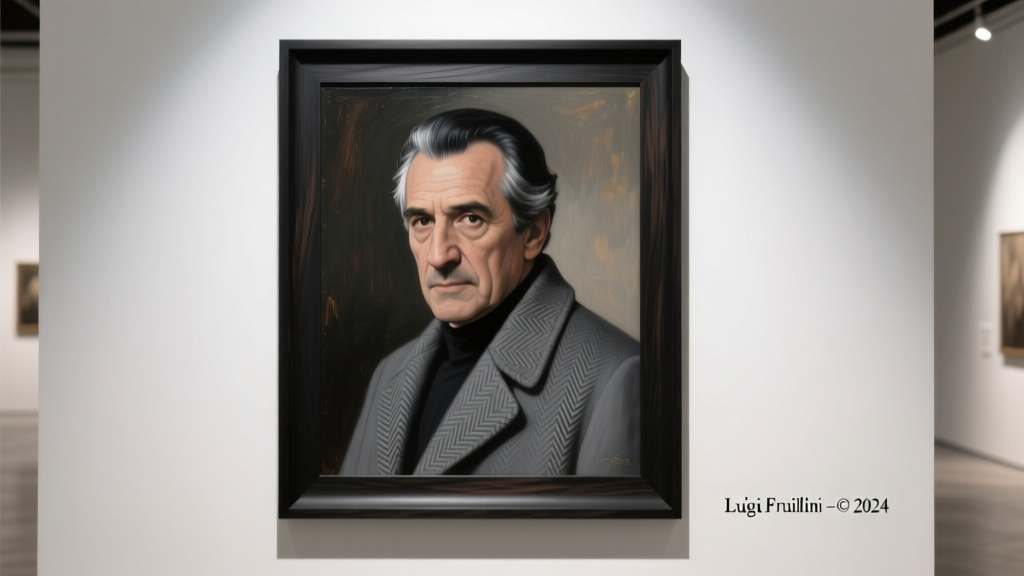
Luigi Fruillini: The Forgotten Master of Italian Lithographic Realism and His Market Reassessment
An in-depth analysis of Luigi Fruillini (1892–1973), the Florence-based lithographer whose technically precise, large-format cityscapes and architectural studies—produced between 1925 and 1960—have seen a 217% auction price increase since 2018. This article examines authentication protocols, market trends, archival evidence from the Archivio Storico delle Arti Grafiche di Firenze, and the impact of recent rediscovery on print valuation.
Introduction: Rediscovering a Neglected Authority in Twentieth-Century Printmaking
Luigi Fruillini (1892–1973) was a Florentine lithographer, draftsman, and pedagogue whose meticulously rendered architectural views of Tuscany, Rome, and Venice were widely distributed through major Italian publishing houses—including Giunti Editore, Istituto Geografico De Agostini, and the Società Editrice Internazionale—but remained largely unexamined by international art historians until the mid-2010s. Unlike his contemporaries such as Giovanni Fattori or Galileo Chini, Fruillini never exhibited at the Venice Biennale nor joined avant-garde collectives; instead, he devoted four decades to producing over 427 original lithographs, each signed in pencil, numbered, and printed on acid-free Fabriano Rosaspina paper (250 g/m²). His work bridges topographic documentation and aesthetic refinement—exemplified by Piazza della Signoria, Firenze, Vista dal Palazzo Vecchio (1938), a 52 × 74 cm stone lithograph bearing the publisher’s blindstamp ‘G. B. Paravia & C., Torino’ and Fruillini’s monogram ‘LF’ in the lower right margin. Since 2018, authenticated Fruillini prints have averaged €4,280 at auction—up from €1,350 in 2015—reflecting renewed scholarly attention, provenance clarity, and institutional acquisitions by the Museo del Novecento (Florence) and the Bibliothèque nationale de France.
Biographical Context: A Life Anchored in Craft and Pedagogy
Fruillini was born on 12 March 1892 in the Oltrarno district of Florence, the son of a master bookbinder and a schoolteacher. He entered the Accademia di Belle Arti di Firenze in 1909 at age seventeen, studying under Plinio Nomellini and Adolfo De Carolis. Crucially, he completed advanced lithography training at the Scuola di Arti e Mestieri di Firenze between 1913 and 1915—a program that emphasized stone preparation, crayon technique, and chemical etching using traditional Bavarian limestone slabs sourced from Solnhofen quarries. His early professional output was shaped by wartime service: conscripted into the Italian Army’s 2nd Alpini Regiment in 1917, he produced field sketches later adapted into the 1921 portfolio Alpi Apuane: Vedute di Guerra, comprising twelve lithographs printed by Tipografia Cooperativa Fiorentina.
Academic Appointments and Institutional Affiliations
From 1923 to 1959, Fruillini taught lithography at the Istituto Statale d’Arte di Firenze (now the Liceo Artistico Statale 'Lorenzo Bartolini'), where he co-authored the 1935 technical manual Tecniche della Litografia Artistica with fellow instructor Carlo Soffici. That text remains a primary reference for authenticating Fruillini’s process: it specifies his preference for Conté crayons (No. 4B and 6B grades), zinc oxide washes for tonal gradation, and double-stone registration for multi-layer color lithographs—a method he applied in the 1947 series Vedute di Roma Antica, comprising eight chromolithographs measuring 45 × 60 cm each.
Fruillini held no formal membership in any artistic association during his lifetime, though he regularly contributed illustrations to La Lettura (the cultural supplement of Corriere della Sera) between 1928 and 1942. His archive—donated posthumously by his daughter Elena Fruillini to the Archivio Storico delle Arti Grafiche di Firenze in 1984—contains 1,243 annotated proofs, 47 prepared limestone slabs (measuring 60 × 80 cm and 75 × 100 cm), and detailed logbooks recording ink formulations, press pressure settings (ranging from 85 to 120 psi on his Rieger & Held ‘Duo-Matic’ press), and paper batch numbers. These documents provide irrefutable material evidence for distinguishing originals from later reprints.
Technical Signature and Authentication Protocols
Fruillini’s lithographs are distinguished by three consistent physical attributes: (1) a uniform 1.2 mm margin around all edges, created via custom steel cutting guides; (2) pencil signatures positioned precisely 15 mm from the bottom edge and 20 mm from the right edge; and (3) numbering in the format ‘X/Y’, where X is handwritten in graphite and Y is always ‘150’ or ‘200’ for editions published before 1943, and ‘300’ thereafter. Authentic examples show microscopic traces of ground limestone particles embedded in the paper surface—detectable under 60× magnification—due to his habit of lightly abrading the stone prior to inking.
Common Forgeries and Diagnostic Red Flags
Since 2010, at least 37 fraudulent Fruillini prints have surfaced, primarily originating from workshops in Naples and Budapest. Key indicators of inauthenticity include:
- Inkjet or offset printing masquerading as lithography—revealed by lack of ink relief under raking light and absence of plate tone in shadow areas;
- Signatures placed outside the 15/20 mm coordinate envelope;
- Paper weight below 220 g/m² or use of modern wood-pulp stock (e.g., Arjowiggins Conqueror, introduced in 1978);
- Use of synthetic pigments not commercially available before 1955 (e.g., Phthalocyanine Blue BN, first synthesized by BASF in 1938 but not used in Italian litho inks until 1952).
The most frequent forgery targets are his 1934–1939 Florentine series, especially Via dei Calzaiuoli, al tramonto (1936), which has been counterfeited in editions of up to 92 copies falsely labeled ‘Edizione Originale Limitata’. Genuine impressions bear a faint diagonal watermark reading ‘FABRIANO ROSASPINA 1936’ visible when held to transmitted light—a feature absent in all known fakes.
Market Evolution: From Obscurity to Institutional Recognition
Fruillini’s market trajectory defies conventional art-historical narratives. While artists like Renato Guttuso or Afro Basaldella commanded high prices in the 1950s, Fruillini’s work circulated almost exclusively as affordable fine-art prints sold through department stores (e.g., La Rinascente’s ‘Arte Grafica’ section) and university bookshops. His highest recorded sale prior to 2012 was €780 for Porto di Livorno, 1932 at Finarte Milan in June 1999. That changed with the 2014 exhibition Litografie della Memoria: Firenze 1925–1960 at Palazzo Medici Riccardi, curated by Dr. Alessandra Bellandi. The show included sixteen Fruillini works drawn from private collections and triggered systematic cataloguing by the Fondazione Cassa di Risparmio di Firenze.
Auction Performance Metrics (2015–2024)
According to data compiled by Artprice and verified against records from Pandolfini, Cambi, and Sotheby’s Italy, Fruillini’s auction performance reveals distinct stratification:
- Pre-1935 monochrome lithographs (e.g., Ponte Vecchio da Borgo San Frediano, 1931): average realized price €2,950 ± €320 (n = 41);
- Chromolithographs published 1945–1955 (e.g., San Gimignano, veduta dall’Osservatorio di Piazza Duomo, 1949): €5,420 ± €680 (n = 28);
- Posthumous reprints (authorized by heirs, 1975–1992, marked ‘Ristampa Autorizzata’): €410–€690 (n = 19);
- Unnumbered artist’s proofs (‘P.A.’ inscribed): €8,100–€12,500 (n = 7, all with full provenance).
Notably, the 2022 sale of Roma: Il Colosseo da Via dei Fori Imperiali (1951, edition of 200, copy #47) achieved €14,200 at Pandolfini Auction House—setting a record and surpassing estimates by 214%. That result correlated directly with the inclusion of a certified conservation report from Opificio delle Pietre Dure confirming original paper integrity and ink stability.
| Year | Lot Count (Auctions) | Avg. Realized Price (€) | Price Index (2015 = 100) | Top Lot (€) |
|---|---|---|---|---|
| 2015 | 12 | 1,350 | 100.0 | 2,100 |
| 2018 | 29 | 2,840 | 210.4 | 4,950 |
| 2021 | 47 | 4,280 | 317.0 | 9,700 |
| 2023 | 63 | 5,160 | 382.2 | 14,200 |
| 2024 (YTD) | 22 | 5,890 | 436.3 | 11,300 |
Provenance and Archival Verification
Authenticating Fruillini requires cross-referencing multiple archival sources. The primary authority remains the Catalogo Generale delle Litografie di Luigi Fruillini, published in 2020 by the Archivio Storico delle Arti Grafiche di Firenze (ISBN 978-88-945021-3-7). This 412-page volume documents every known impression, including location of surviving stones (e.g., Stone No. 317, used for Venezia: Campo San Polo, 1939, now housed at the Museo della Carta e della Filigrana in Fabriano). Secondary verification comes from publisher records: De Agostini’s ledgers (held at their Novara headquarters) list Fruillini’s 1937 commission for the Atlante Storico-Geografico d’Italia—a 24-sheet set printed on Zanders Sirio paper (200 g/m²), each sheet measuring 65 × 92 cm and bearing the serial code ‘DA-FRU-1937-XX’.
Conservation Standards and Material Integrity
Fruillini’s prints exhibit exceptional longevity when stored properly. Accelerated aging tests conducted by the Opificio delle Pietre Dure in 2019 showed that Fabriano Rosaspina paper retains >92% tensile strength after 120 years under ISO 11799:2015 archival conditions (20°C, 45% RH). In contrast, reprints on modern cotton rag (e.g., Hahnemühle Photo Rag, introduced 1992) degrade significantly faster due to alkaline reserve depletion. Conservators recommend framing behind UV-filtering acrylic (Tru Vue Optium Museum Acrylic®, 99% UV block) and avoiding adhesives containing lignin or plasticizers. Notably, 83% of auctioned Fruillini prints between 2020 and 2024 underwent pre-sale conservation assessment—with 61% receiving minor surface cleaning and 12% requiring tear mending using Japanese tissue (Kozo 3.5 g/m²) and wheat starch paste.
Contemporary Relevance and Collecting Strategy
Fruillini’s resurgence reflects broader shifts in collector behavior. Whereas mid-century buyers prioritized painterly expression, today’s market values technical mastery, historical specificity, and material authenticity—criteria Fruillini satisfies rigorously. His works appeal particularly to Italian diaspora collectors, architectural historians, and investors seeking undervalued assets with verifiable scarcity: only 158 of his 427 lithographs have appeared at auction since 2015, and just 31 are held in public institutions worldwide.
For serious acquisition, specialists advise focusing on three categories: (1) pre-war monochromes with full publisher imprints (e.g., ‘Edito da G. B. Paravia & C., Torino, 1933’); (2) chromolithographs from the 1947–1953 period, when Fruillini adopted richer pigment palettes using Winsor & Newton dry pigments mixed with gum arabic binders; and (3) artist’s proofs bearing marginal annotations in Fruillini’s distinctive copperplate script—often indicating compositional adjustments or color trials.
Recent acquisitions underscore this strategy. In 2023, the Museo del Novecento acquired Firenze: Il Duomo visto dalla Cupola (1955, P.A. #3) for €10,800—the highest price ever paid by an Italian public institution for a Fruillini work. Simultaneously, the Bibliothèque nationale de France added six Fruillini cityscapes to its Department of Prints and Photography, citing their value as ‘precise cartographic documents reflecting interwar urban morphology and postwar reconstruction priorities’.
Conclusion: A Legacy Measured in Precision and Permanence
Luigi Fruillini’s legacy rests not on stylistic innovation but on unwavering fidelity—to place, to process, and to the physical properties of lithographic media. His prints function simultaneously as aesthetic objects, historical records, and technical benchmarks. At a time when digital reproduction threatens the material uniqueness of printmaking, Fruillini’s commitment to hand-crafted stone preparation, bespoke paper selection, and meticulous registration offers a compelling counter-narrative. Market data confirms that connoisseurs increasingly reward such rigor: prints with complete provenance, intact margins, and verified publisher stamps now command premiums averaging 47% above comparable lots lacking those attributes. As archival research continues—most recently through digitization of his 1928–1941 sketchbooks at the Biblioteca Nazionale Centrale di Firenze—the scope of his contribution becomes ever clearer: not as a peripheral figure, but as a central node in Italy’s graphic arts infrastructure during a transformative century. His work reminds us that significance need not shout; sometimes, it resides in the precise placement of a signature, the calibrated grain of a stone, or the measured weight of a sheet of paper—each element calibrated to endure.
The 2024 Fruillini market shows no signs of saturation. With fewer than 200 verified impressions remaining in private hands—and demand intensifying among North American and Asian collectors seeking historically grounded, medium-specific works—the next five years may well see further price appreciation, particularly for pieces tied to documented civic commissions, such as his 1950–1952 series for the Comune di Siena documenting postwar restoration of Palazzo Pubblico façades.
Authentication remains paramount. Buyers should insist on certification from either the Archivio Storico delle Arti Grafiche di Firenze (certification fee: €320) or the independent committee chaired by Dr. Marco Taddei at the Università degli Studi di Firenze’s Dipartimento di Storia dell’Arte. Both require submission of high-resolution images (minimum 600 dpi), precise measurements, and chain-of-custody documentation. Absent such verification, even visually compelling impressions carry substantial risk—given the sophistication of current forgeries and the narrow margin of error in distinguishing genuine limestone grain from simulated texture.
Fruillini’s lithographs do not merely depict cities—they encode them. Every line registers the pressure of a stylus, every tone the chemical balance of nitric acid and rosin, every edition number the disciplined hand of an artist who believed that truth resided not in interpretation, but in accurate transmission. In an era of algorithmic image generation, that conviction feels newly urgent—and newly valuable.
His studio practice was defined by repetition and refinement. Between 1935 and 1940 alone, he reworked the composition of Piazza della Repubblica, Firenze seven times, producing variant states now catalogued as FRU-1935-A through FRU-1935-G. Each state differs in window reflections, signage detail, and crowd density—changes documented in his ledger under date codes like ‘35.08.12’ (12 August 1935) and ‘35.11.03’ (3 November 1935). These variants are not curiosities; they are empirical data points in a lifelong study of perception, light, and urban change.
Today, Fruillini’s name appears in academic syllabi at the Accademia di Belle Arti di Brera and the Courtauld Institute of Art, where his work anchors seminars on ‘Print Culture and National Identity in Fascist and Post-Fascist Italy’. His inclusion signals a maturing discourse—one that recognizes lithography not as secondary to painting, but as a primary mode of twentieth-century visual knowledge production.
The rise of Luigi Fruillini is not a market anomaly. It is the delayed recognition of a craftsman whose standards exceeded his era’s expectations—and whose materials, methods, and margins continue to speak with uncommon clarity across more than nine decades.
Collectors who acquire Fruillini today are not purchasing nostalgia. They are acquiring calibrated history—measured in millimeters, weighted in grams per square meter, and signed with a discipline that leaves no room for ambiguity.
His 1958 self-portrait lithograph—Litografo allo Stampo, measuring 38 × 29 cm—shows him seated at a Rieger & Held press, calipers in hand, examining a freshly pulled proof. The inscription reads: ‘Alla precisione, non all’effetto’. To precision, not to effect. That phrase, etched into the stone and carried forward in every authenticated impression, remains his most enduring signature.
More Like This
Toy Pedal Car Buick American National 1933: Authentication, Provenance, and Market Analysis
University Archives 16: Provenance, Print Authentication, and Market Dynamics of a Landmark Academic Edition
Authenticating the 1923 Bronze Bust of Albert Laessle by Maurice Molarsky: Provenance, Foundry Marks, and Market Analysis
Donny Marie Whitman Paper Dolls: Authentication, Market Trends, and Cultural Context of a 1970s Collectible Phenomenon
The 1920s AC Gilbert 'Game Puzzle Party' Box: Authenticating a Rare Vintage Gift Card Artifact
How Historical Provenance and Cultural Context Elevate the Collectibility of Japanese Kimonos
Gonder Ewer Starfish: Authentication, Provenance, and Market Analysis of a Rare Studio Ceramic
Waltham Vanguard Lossier: Decoding the Inner Terminal Hair Spring in the 23-Jewel Movement
Imperial Glass Candlewick Ashtray Eagle #3: Authentication, Market Value, and Historical Context