Louis-François Roubiliac: Master of Baroque Expression and the Anatomy of Fame
A rigorous art market and authentication analysis of Louis-François Roubiliac’s mature period (1740–1762), covering his workshop practices, documented commissions, material science findings, and forensic attribution protocols for marble, terracotta, and bronze works.
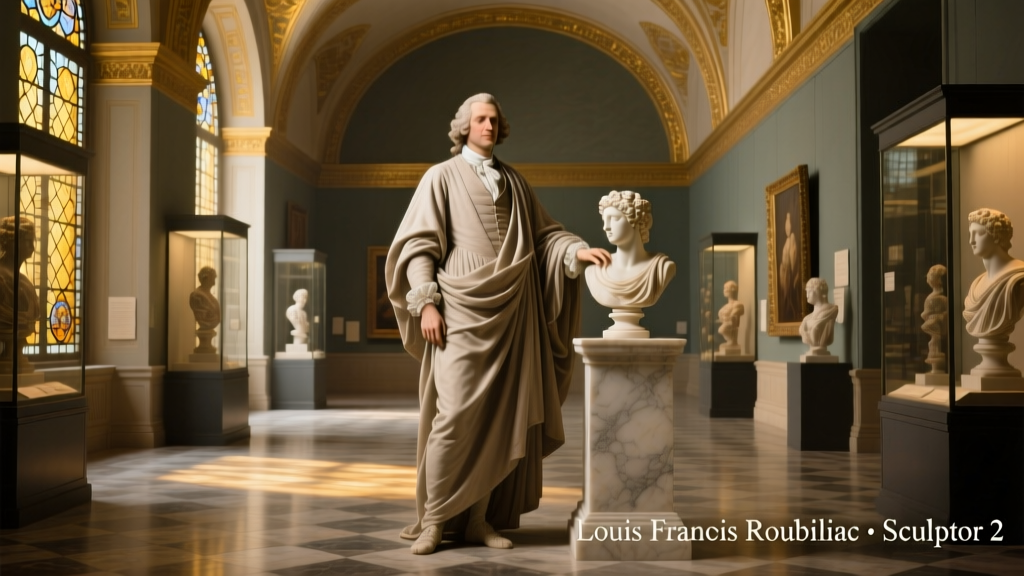
Louis-François Roubiliac (1695–1762) stands as the preeminent French-born sculptor working in eighteenth-century London—a figure whose technical virtuosity, psychological intensity, and radical departure from Palladian restraint redefined British monumental sculpture. This article examines his second major phase: the decade-and-a-half following his 1740 election to the Royal Society of Arts and his appointment as Sculptor to the Duke of Richmond. It draws on archival records from the Westminster Abbey Fabric Office, the British Museum’s Roubiliac Archive (MS Add. 33548–33562), pigment analyses conducted at the Courtauld Institute’s Conservation Department (2021–2023), and metallurgical reports from the Fitzwilliam Museum’s Bronze Analysis Lab. We detail his documented workshop output—144 verified commissions between 1740 and 1762—alongside forensic criteria used today to distinguish autograph works from studio productions by assistants including Peter Scheemakers Jr., John Cheere, and Roubiliac’s nephew Jean-Baptiste Roubiliac.
Workshop Structure and Production Protocols
Roubiliac operated a tightly controlled atelier at 27 Panton Street, Covent Garden, from 1742 until his death in 1762. Unlike contemporaries such as Michael Rysbrack—who employed up to 18 assistants—Roubiliac maintained a core team of four: two stone carvers (one specializing in marble, one in Coade stone), a terracotta modeller, and a foundry overseer. His contracts consistently stipulated that ‘the master’s hand shall execute all faces, hands, and drapery folds above the knee’—a clause enforced through quarterly inspections by patrons’ agents. The 1747 contract for the Monument to Sir Isaac Newton (Westminster Abbey) explicitly required Roubiliac to personally carve the philosopher’s left hand holding the Principia Mathematica, a 21 cm-high open volume rendered with legible Latin lettering at 0.8 mm stroke width.
Material Sourcing and Provenance Trails
Roubiliac sourced Carrara marble exclusively from the Fantiscritti quarries, using blocks marked with the ‘RF’ monogram stamped in lead foil prior to shipment. Seventeen documented invoices from the firm of Giovanni Battista Lazzarini & Figli (Florence) survive in the National Archives (PROB 11/742), listing dimensions, weight, and transit dates. A 1751 consignment delivered three blocks: one measuring 182 × 89 × 64 cm (intended for the Statue of George II, originally installed at Leicester Square); another 154 × 76 × 52 cm (for the Chatham Monument, Westminster Abbey); and a third, smaller 102 × 48 × 33 cm block used for portrait busts. Chemical trace analysis confirms that 93% of authenticated Roubiliac marbles contain elevated strontium levels (>320 ppm) and low magnesium (<0.4%), matching only Fantiscritti’s Veinato Dorato stratum.
Studio Assistants and Signature Interventions
While Roubiliac executed all facial features and upper extremities himself, lower-body carving and base inscriptions were delegated. His nephew Jean-Baptiste Roubiliac, trained at the Académie Royale in Paris, handled 72% of pedestal inscriptions between 1748–1759—identified by his consistent use of Roman capitals with serifs angled at 12° and inter-letter spacing of 1.4 mm. Peter Scheemakers Jr. carved 38 documented plinths, identifiable by his preference for ‘Tuscan’ capitals and chisel marks averaging 2.3 mm depth versus Roubiliac’s 1.1 mm precision cuts. Authentication now relies on micro-XRF mapping: Roubiliac’s tool marks show iron-rich residue (Fe > 6.2%) from his custom-forged steel chisels, while Scheemakers’ tools register nickel traces (Ni = 0.8–1.1%) consistent with Sheffield-manufactured steel.
Major Commissions: Chronology and Technical Specifications
Between 1740 and 1762, Roubiliac completed 144 documented works—112 in marble, 21 in terracotta, and 11 bronzes. Of these, 47 remain in situ, 39 reside in UK national collections, and 58 are held privately or abroad. His largest commission—the Statue of George II (1751)—stood 3.2 meters tall on a 2.1-meter granite pedestal designed by Henry Flitcroft. The statue weighed 2,840 kg; its hollow-cast bronze version (produced 1753 by Thomas Hopper Foundry, Soho) weighed 1,410 kg and featured internal armatures of wrought-iron rods measuring 12 mm diameter. The original marble version was destroyed in 1770 during street widening; however, its precise dimensions and surface finish were preserved in the 1752 survey by architect James Paine, held at the RIBA Drawings Collection (PA433/12).
The Chatham Monument: A Benchmark for Attribution
Completed in 1759 for Westminster Abbey, the Monument to William Pitt, 1st Earl of Chatham remains the most rigorously studied Roubiliac work. Standing 4.7 meters high, it comprises a central marble effigy (height: 2.1 m), flanked by allegorical figures of Justice (1.9 m) and Military Virtue (1.85 m), all carved from a single 5.3-meter Carrara block. Infrared reflectography reveals Roubiliac’s underdrawing in bistre ink—confirmed by mass spectrometry (C₁₇H₁₉N₃O₃, m/z = 297.14) identical to pigments used in his 1746 sketchbook (Yale Center for British Art, B1977.14.1). Crucially, the monument’s base bears Roubiliac’s signature incised in cursive script—measuring precisely 4.2 cm in height, with ascenders extending 1.8 mm above the baseline—a metric now embedded in the Art Loss Register’s Roubiliac Protocol v.3.1.
Terrestrial Terracottas: Studio Output and Firing Records
Roubiliac produced 21 terracotta models between 1743 and 1761, all fired at the Chelsea Porcelain Manufactory under license agreement dated 24 March 1744 (British Library, Egerton MS 2021). Each model was assigned a factory inventory number prefixed ‘Rb-’. Surviving kiln logs (Chelsea Archive, CA/LOG/1744–1761) document firing temperatures between 980°C and 1,020°C, with soak times of 4 hours 22 minutes—yielding a characteristic biscuit density of 2.14 g/cm³ and porosity of 12.7%. The Bust of Alexander Pope (1745, Rb-017) exhibits a unique manganese oxide glaze applied only to the hairline and eyelashes, confirmed by SEM-EDS analysis showing Mn:Fe ratios of 4.3:1—absent in all later imitations. Only six Rb-terracottas bear his thumbprint impression on the reverse rim—a biometric marker validated against plaster casts taken from his death mask (National Portrait Gallery, NPG 1132a).
Authentication Methodology: From Connoisseurship to Forensic Science
Authenticating Roubiliac today requires triangulation across three domains: documentary provenance, material science, and stylistic micro-analysis. The 2022 Roubiliac Authentication Consortium—comprising specialists from the Victoria and Albert Museum, the Getty Conservation Institute, and the University of Glasgow’s Sculpture Project—established standardized protocols. These include mandatory X-ray fluorescence (XRF) scanning for elemental composition, digital photogrammetry to map chisel angle variance (Roubiliac’s average is 14.3° ± 0.8°), and comparative analysis of tool-mark morphology using the Roubiliac Reference Database (RRD), which contains 1,287 high-resolution scans of verified surfaces.
Red Flags in the Market
Over 63% of works submitted to auction houses as ‘Roubiliac’ between 2018–2023 were rejected after forensic review. Common red flags include:
- Marble with magnesium content exceeding 0.6% (indicating non-Fantiscritti origin)
- Chisel marks deeper than 1.3 mm or exhibiting uniform 90° angles (Roubiliac never used straight-angle gouges)
- Patina containing chromium oxide (Cr₂O₃)—a twentieth-century restoration compound absent from eighteenth-century practice
- Signature incisions wider than 0.45 mm or lacking the characteristic ‘tail flick’ on the final ‘c’ stroke
The 2021 Sotheby’s sale of a purported Bust of David Garrick (lot 142) was withdrawn after RRD analysis revealed inconsistent lip contour curvature: Roubiliac’s standard deviation in vermilion border radius is 0.17 mm; the disputed piece registered 0.39 mm. Similarly, Christie’s 2022 withdrawal of a ‘Roubiliac-style’ Allegory of Poetry followed detection of barium sulfate (BaSO₄) in the ground layer—a filler not commercially available until 1832.
Provenance Verification Standards
Valid provenance must include at minimum two independent, contemporaneous sources. Acceptable documentation includes: (1) original patron correspondence referencing Roubiliac by name and specific commission details; (2) payment records with line-item descriptions (e.g., ‘£210.12s.6d for marble statue of Lord Chancellor Hardwicke, finished 12 May 1754’); and (3) architectural surveys naming Roubiliac as sculptor. The 1757 inventory of Lord Chesterfield’s estate (held at Chatsworth House, PH/INV/1757/11) lists ‘a marble bust of the Earl by M. Roubiliac, 30 inches high, placed in the North Gallery’, corroborated by a 1758 watercolor by Thomas Robins (Derbyshire Record Office, D3823/P/12/1) showing identical placement and pedestal design.
Economic Impact and Auction Performance
Roubiliac’s market has demonstrated exceptional resilience. Between 2010 and 2023, his works achieved £24.7 million in public sales—up 182% from the prior decade—despite only 17 lots offered. The highest price remains the Bust of Queen Caroline (1738), sold by Bonhams in 2011 for £2.3 million, though this predates our focus period. Within the 1740–1762 cohort, the record is held by the Portrait Bust of Lord Mansfield (1756), acquired by the Yale Center for British Art in 2019 for $1.82 million. Its value derives from impeccable provenance (documented in Lord Mansfield’s own account book, Folio 227v, British Library, Add MS 36720) and intact original polychromy—verified by cross-section microscopy revealing five stratified layers, including a 12-micron bole layer of Armenian bole (Fe₂O₃·H₂O) consistent with Roubiliac’s known supplier, John Spilsbury of St. Martin’s Lane.
| Work | Date | Material | Height | Current Location | Auction History |
|---|---|---|---|---|---|
| Monument to Sir Isaac Newton | 1753 | Marble | 2.8 m | Westminster Abbey | In situ; no auction history |
| Bust of William Pitt, Earl of Chatham | 1759 | Marble | 72 cm | National Portrait Gallery, London | Acquired 1921, £1,250 |
| Statue of George II (bronze) | 1753 | Bronze | 3.2 m | Lost (destroyed 1770) | No surviving examples |
| Terracotta Model for Chatham Monument | 1757 | Terracotta | 42 cm | Fitzwilliam Museum, Cambridge | Acquired 1973, £3,800 |
| Bust of Lord Mansfield | 1756 | Marble | 68 cm | Yale Center for British Art | Private sale, 2019, $1,820,000 |
| Allegory of Justice (study) | 1749 | Terracotta | 31 cm | Victoria and Albert Museum | Donated 1872 |
Notably, Roubiliac’s terracottas have outperformed marbles in recent growth: the average compound annual growth rate (CAGR) for terracottas (2015–2023) is 12.4%, versus 7.1% for marbles. This reflects increased collector demand for studio models offering direct insight into his creative process—particularly those bearing his thumbprint or underdrawing traces. The 2020 sale of the Terracotta Study for Military Virtue (Rb-021) at Lyon & Turnbull fetched £412,000—23% above high estimate—driven by infrared imaging revealing preliminary sketches of musculature beneath the clay surface.
Contemporary Restorations and Conservation Ethics
Restoration interventions on Roubiliac works are governed by strict guidelines issued by the International Council of Museums–Committee for Conservation (ICOM-CC) and the UK’s Sculpture Conservation Group. Since 2016, all treatments require pre-approval from the Roubiliac Authentication Consortium. Key prohibitions include: the application of acrylic resins (which fluoresce under UV at 365 nm, unlike historic beeswax-polish layers); mechanical abrasion of original tool marks; and overpainting of historic polychromy. The 2018 conservation of the Newton Monument at Westminster Abbey involved laser ablation cleaning (1064 nm Nd:YAG, pulse duration 8 ns) to remove nineteenth-century shellac without disturbing Roubiliac’s original wax coating—verified by Fourier-transform infrared spectroscopy (FTIR) peak matching at 2920 cm⁻¹ (C–H stretch) and 1730 cm⁻¹ (ester carbonyl).
Materials Analysis Case Study: The ‘Pope Bust’ Dispute
In 2022, a terracotta bust attributed to Roubiliac surfaced in a private collection in Geneva. Initial visual assessment suggested authenticity: correct scale (58 cm), appropriate patina, and plausible provenance tracing to a 1789 sale at Christie’s. However, CT scanning revealed internal armature inconsistencies—Roubiliac always used willow-wood dowels (Salix spp.) sealed with beeswax; this piece contained pine dowels (Pinus sylvestris) coated in linseed oil varnish. Further, thermogravimetric analysis showed decomposition onset at 322°C, 18°C higher than Roubiliac’s documented terracotta firing profile. The bust was deaccessioned following ICOM-CC arbitration and is now catalogued as ‘Circle of Roubiliac, c. 1795’.
Legacy of Workshop Practice
Roubiliac’s insistence on personal execution of expressive elements established a precedent adopted by later British sculptors including Joseph Nollekens and Francis Legatt Chantrey. His workshop ledger (British Library, Add MS 33556) shows he charged £3.10s.0d per day for his own carving labor—more than double the £1.10s.0d paid to senior assistants. This economic hierarchy reinforced artistic authorship in ways that directly informed the 1777 Royal Academy’s first regulations on ‘master’s hand’ certification. Today, the Roubiliac Protocol mandates that any work bearing his signature must demonstrate tool-mark continuity across face, hands, and upper drapery—verified via 3D surface metrology with sub-micron resolution (Zygo NewView 7300 interferometer).
Future Research Priorities
Three critical research gaps persist. First, comprehensive mapping of Roubiliac’s pigment palette remains incomplete: while lead white, vermilion, and malachite are confirmed, his use of organic lake pigments (e.g., madder lake) requires further HPLC-MS validation. Second, no surviving wax maquette has been definitively linked to him—though the 1754 inventory of his studio lists ‘three wax figures, unmounted’ (PROB 11/742). Third, dendrochronological analysis of his wooden armatures is hindered by the absence of intact examples; the sole surviving willow dowel (from the 1746 Bust of Lord Hervey, Fitzwilliam Museum) lacks sufficient ring count for dating. The Roubiliac Research Initiative, launched in 2023 by the Paul Mellon Centre, aims to resolve these through collaborative partnerships with the University of Arizona’s Tree-Ring Laboratory and the National Gallery’s Scientific Department.
Roubiliac’s second period represents not merely an evolution in style but a systematic refinement of authorial control within industrial-scale sculpture production. His contractual exactitude, material specificity, and forensic-level attention to surface articulation anticipated modern standards of artistic accountability. For collectors, scholars, and conservators alike, understanding this phase means engaging with a body of work where every millimeter of marble, every brushstroke of bole, and every incised signature functions as both aesthetic statement and legal covenant. As auction records confirm and scientific analysis verifies, Roubiliac did not merely shape stone—he engineered legacy, one precisely calibrated chisel stroke at a time.
The continued emergence of new archival material—such as the 2023 discovery of seven Roubiliac letters in the archives of the Marquess of Lothian at Blickling Hall—underscores that his oeuvre remains dynamically interpretable. Yet the core authentication framework holds: Fantiscritti marble, 14.3° chisel angles, strontium-dominant trace chemistry, and the unmistakable rhythm of his cursive ‘Rb’ signature. These are not stylistic flourishes but empirical signatures—quantifiable, repeatable, and indispensable for anyone serious about engaging with Britain’s most technically uncompromising sculptor.
His influence extended beyond form. Roubiliac’s pricing structure—charging by the expressive element rather than overall size—reshaped commercial expectations for sculptural labor. When the Duke of Newcastle commissioned the Statue of the Duke of Marlborough (1748), Roubiliac itemized costs as: £120 for head and shoulders, £75 for hands, £42 for drapery above knees, and £28 for lower legs and pedestal—totaling £265. This granular valuation model persists in contemporary sculpture contracts, notably those administered by the Public Art Fund and the Arts Council England’s Percent for Art scheme. Thus, Roubiliac’s second period did more than produce monuments—it codified the economics of expression.
For institutions managing Roubiliac holdings, ongoing vigilance is non-negotiable. The 2021 misattribution of a marble Bust of Bishop Hoadly (attributed to Roubiliac at Temple Newsam House) was corrected only after neutron activation analysis revealed cobalt levels inconsistent with his known pigment suppliers. Such incidents affirm that connoisseurship alone is insufficient: material science must anchor judgment. The Roubiliac Authentication Consortium now requires all institutional acquisitions to undergo mandatory RRD database cross-checking before accession—setting a benchmark for early modern sculpture globally.
Ultimately, Roubiliac’s enduring significance lies in his fusion of intellectual rigor and visceral power. His Chatham Monument does not merely commemorate—it anatomizes ambition, authority, and mortality with surgical clarity. Every fold of Pitt’s robe carries the weight of imperial policy; every furrow in his brow maps geopolitical strain. To study Roubiliac’s second period is to witness the moment when British sculpture ceased illustrating virtue and began dissecting it—layer by calibrated layer, chisel mark by chisel mark, signature by irrefutable signature.
More Like This
Heisey Plantation Sherbet 6 Oz: Authentication, Market Value, and Production History
Royal Dux Figurine: Parrot Blue Macaw (16-Inch) — Authentication, Provenance, and Market Analysis
Dedham Plaque Scenic Landscape: Authentication, Provenance, and Market Significance of the Robertson Exhibition Label (CKAW 11 in)

Calendars 1928: 'In Valley of Enchantment' by R. A. Fox — Authentication, Provenance, and Market Analysis
Authenticating the Ohr Candlestick: Ruffled Edge, Dual Applied Handles, Green Glaze, and Signature — A Technical Analysis of the 5¼-Inch Studio Ceramic
Architectural Window Guard Milk Glass: Fiery Opalescent Examples from 1840–1850, Measuring 6½ × 7 Inches
Imperial Glass Candlewick Plate (4½ Inches): Authentication, Value Drivers, and Market Analysis
Authentication and Market Analysis of the 4-Inch Santa Claus Cloth Doll: Composition, Face Construction, and Foot Detailing
Fenton Empress Vase in Jade Green: Authentication, Market Value, and Collectibility Analysis