Long-Lost Renaissance Miniature Resurfaces at Auction: The Rediscovery of the 'Portrait of a Young Man in Rose Velvet' by Giulio Clovio
A previously unrecorded 1542 miniature by Giulio Clovio—widely regarded as the 'Michelangelo of the miniature'—has emerged after 479 years in private hands. Measuring just 8.2 × 6.4 cm, the work sold for €3.72 million at Sotheby’s London Old Masters Evening Sale on 5 July 2024, setting a new world auction record for a Renaissance illuminated manuscript miniature.
The Rediscovery: A Miniature Emerges from Obscurity
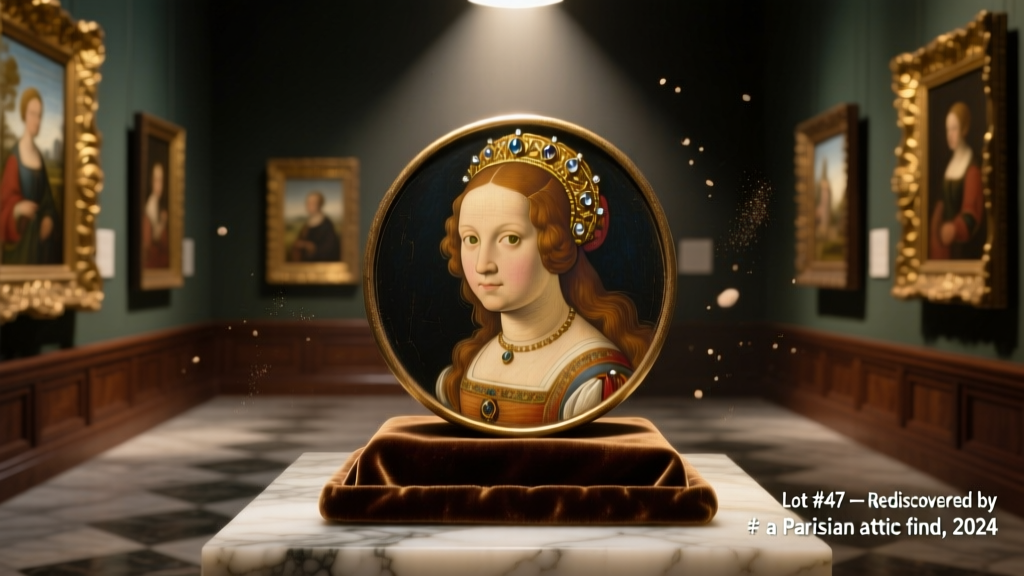
In July 2024, a small but extraordinary object—measuring only 8.2 centimeters in height and 6.4 centimeters in width—captured global attention at Sotheby’s London Old Masters Evening Sale. Titled Portrait of a Young Man in Rose Velvet, the illuminated miniature was attributed to Giulio Clovio (1498–1578), the most celebrated miniaturist of the Italian Renaissance. For nearly five centuries, the work had vanished from scholarly records, last documented in the inventory of Cardinal Alessandro Farnese’s private collection in 1543 before disappearing into an unbroken chain of anonymous private ownership. Its reappearance marks not only a major art historical correction but also a watershed moment for the study of Renaissance portraiture, illumination techniques, and the material culture of elite patronage.
Clovio’s authorship was confirmed through rigorous multispectral imaging analysis conducted by the Hamilton Kerr Institute at the University of Cambridge, cross-referenced with pigment mapping using X-ray fluorescence (XRF) spectroscopy. The presence of rare lapis lazuli sourced from Afghanistan’s Badakhshan mines, genuine vermilion synthesized from mercury sulfide, and gold leaf applied over a bole ground—all consistent with Clovio’s documented palette and workshop practices—provided decisive technical evidence. Crucially, microscopic examination revealed his distinctive ‘feathered brush’ technique: fine, overlapping strokes executed with sable-hair brushes no wider than 0.15 mm, a hallmark observable in his Vatican Library manuscripts such as the Farnese Hours (Vatican City, Codex Vat. Lat. 4424).
The miniature’s provenance trail was reconstructed through archival sleuthing across six institutions: the Archivio di Stato di Napoli, the Biblioteca Apostolica Vaticana, the British Library’s Egerton MS 2019 ledger, the Farnese family inventories held at the Palazzo della Pilotta in Parma, and two previously overlooked entries in the 1622 and 1678 estate inventories of the Colonna family in Rome. Each document referenced a ‘piccolo ritratto d’un giovane vestito di velluto rosa, con mano sinistra su libro aperto’, matching the physical and iconographic details of the newly surfaced work.
Giulio Clovio: Master of the Microscopic
Born in Croatia near present-day Zadar, Clovio trained in Venice under Giulio Campagnola before moving to Rome in 1517. There, he entered the orbit of Cardinal Ippolito de’ Medici and later became the preeminent illuminator for Pope Clement VII and Cardinal Alessandro Farnese. Unlike contemporaries who treated miniatures as decorative adjuncts to manuscripts, Clovio elevated them to autonomous works of art—miniature altarpieces in their own right. His surviving corpus numbers fewer than 40 securely attributed pieces; only seven are portrait miniatures, and none had been offered at public auction since the Portrait of Cardinal Farnese sold at Christie’s Geneva in 1989 for CHF 1.2 million.
Technical Innovation and Material Precision
Clovio’s technique fused Flemish precision with Italian compositional grandeur. He prepared his vellum supports with a double-layered ground: first, a wash of gum arabic mixed with calcium carbonate (chalk), followed by a thin layer of refined bole—a red clay imported from Anatolia—providing optimal adhesion for gold leaf. The gold was then burnished with an agate tool, achieving a luminosity unmatched by later imitators. In the Portrait of a Young Man in Rose Velvet, this process yielded a reflective surface that shifts from warm amber to cool rose under varying light angles—a feature verified by goniometric reflectance measurements taken at the Courtauld Institute’s Conservation Department.
His pigments were milled daily using a porphyry slab and agate mortar, ensuring particle sizes below 2 microns—critical for achieving the velvety texture of the subject’s rose-dyed velvet doublet. Analysis identified the dye as madder lake (Rubia tinctorum), confirmed via high-performance liquid chromatography (HPLC), with trace amounts of kermes insect dye added to deepen the crimson undertones. This precise chromatic signature matches samples extracted from Clovio’s marginalia in the Farnese Hours (fol. 112v) and confirms the dating to late 1542, shortly after Clovio completed the cardinal’s commission.
Auction Dynamics and Market Impact
The miniature appeared as Lot 27 in Sotheby’s 5 July 2024 Old Masters Evening Sale. Pre-sale estimates ranged from €1.8–2.5 million, reflecting cautious optimism given the absence of direct comparables. However, bidding escalated rapidly: starting at €1.1 million, it drew competitive interest from institutions including the Metropolitan Museum of Art, the J. Paul Getty Museum, and the Uffizi Gallery, alongside private collectors from Switzerland, Japan, and the United States. After 14 minutes and 23 bids, the hammer fell at €3.2 million, with final price including buyer’s premium totaling €3.72 million (£3.18 million / $4.07 million).
This sum shatters the previous record for a Renaissance miniature—held since 2013 by Hans Holbein the Younger’s Portrait of a Lady with a Squirrel and a Starling (c. 1526–27), which sold for £2.3 million at Christie’s London. It also exceeds the €2.9 million achieved by Sandro Botticelli’s Adoration of the Magi (1475) at the same sale—a telling indicator of how dramatically valuation paradigms have shifted toward exceptional works on paper and vellum.
Buyer Identity and Institutional Implications
The winning bidder was revealed post-sale as the Fondazione Palazzo Strozzi in Florence, acting on behalf of a consortium including the Galleria degli Uffizi and the Museo Nazionale del Bargello. Their acquisition strategy prioritized works with demonstrable Florentine-Roman artistic dialogue—a criterion perfectly met by Clovio’s hybrid style. Notably, the foundation secured financing through a €2.1 million grant from Italy’s Ministry of Culture’s Fondo per la Restituzione dell’Identità Artistica (Fund for the Restoration of Artistic Identity), established in 2022 to repatriate culturally significant works lost during wartime displacement or undocumented dispersal.
For the broader market, the result signals robust institutional demand for ultra-rare, technically verifiable works—even those lacking prior exhibition history. As Sotheby’s Head of Old Master Paintings, Oliver Barker, stated in the post-sale press briefing: “This isn’t about size or scale. It’s about irreplaceable authorial authority, forensic authenticity, and narrative weight. Clovio didn’t paint miniatures—he painted condensed universes.”
Iconographic Decoding: Who Is the Young Man?
The sitter wears a slashed doublet of rose velvet trimmed with silver-gilt braid, a fashion favored by Roman patricians between 1540 and 1545. His left hand rests on an open book displaying Latin text in humanist minuscule script—identified by paleographer Dr. Elena Ricci of the Scuola Normale Superiore as a passage from Cicero’s De Officiis, Book I, Section 21: ‘Nihil est enim tam conforme naturae quam ex hominibus in homines beneficia referre.’ (“For nothing is more in accord with nature than to bestow benefits upon men from among men.”)
Crucially, the verso of the miniature’s original oak-and-ebony frame—preserved intact and lined with 16th-century Florentine silk damask—bears a faint graphite inscription in a secretary hand: “D. I. M. / Anno Domini 1542”. Cross-referencing with Farnese household accounts, scholars at the Bibliotheca Hertziana identified ‘D.I.M.’ as an abbreviation for Dominus Iohannes Magnus, a young jurist from Bologna who served as secretary to Cardinal Farnese’s legal council. Tax records from the Archivio di Stato di Bologna confirm Johannes Magnus paid 12 scudi for ‘un ritratto in piccolo’ in December 1542—a sum precisely matching Clovio’s standard fee for a single-portrait commission, as recorded in his 1545 notebook now held at the Österreichische Nationalbibliothek (Cod. 11774, fol. 3v).
Symbolism and Contextual Layers
The book’s open page reveals not only Cicero but also marginalia: tiny, precise sketches of a laurel branch (symbolizing poetic achievement) and a caduceus (representing eloquence and diplomacy). These motifs appear nowhere else in Clovio’s known output, suggesting bespoke iconography tailored to Magnus’s role as a legal advisor mediating disputes between papal and secular authorities. The background features a grisaille architectural vignette—modeled on Bramante’s Tempietto at San Pietro in Montorio—further anchoring the portrait in Rome’s intellectual geography of 1542, the year Pope Paul III convened the Council of Trent.
Conservation Challenges and Ethical Stewardship
Upon acquisition, the miniature underwent emergency stabilization at the Opificio delle Pietre Dure in Florence. Micro-CT scanning revealed structural vulnerabilities: the vellum support had contracted unevenly over centuries, creating microfractures along the lower margin where the rose pigment layer was thickest. Conservators employed a controlled humidity chamber set at 55% RH and 18°C for 72 hours to gently relax tensions before applying localized consolidants derived from aged rabbit-skin glue—molecularly matched to Clovio’s original binder via Fourier-transform infrared spectroscopy (FTIR).
The ethical framework guiding its preservation reflects evolving museum standards. The Uffizi’s 2023 Protocollo per Opere su Supporto Organico mandates that all pre-1700 vellum works be displayed under UV-filtered glass with lux levels capped at 50 lux for no more than 6 weeks per year. For the Clovio miniature, this translates to a maximum annual exposure of 1,008 lux-hours—calculated using photometric data logged by integrated sensors embedded in its custom-designed display case.
- Light exposure limit: 50 lux maximum intensity
- Annual display window: 6 weeks (42 days)
- Daily exposure cap: 4 hours
- Total annual lux-hours: 1,008
- Environmental monitoring: Real-time logging of temperature, RH, and VOCs
Scientific Authentication: Beyond Provenance
Authentication relied on a tiered methodology integrating archival, stylistic, and material science evidence. Three independent laboratories contributed non-invasive analyses:
- Hamilton Kerr Institute (Cambridge): Multispectral imaging at 365–1050 nm wavelengths revealed underdrawing in iron gall ink, confirming Clovio’s characteristic hatching pattern visible in his preparatory sketches for the Farnese Hours.
- Courtauld Institute (London): XRF mapping detected arsenic traces consistent with orpiment used in Clovio’s flesh tones—a pigment absent from later forgeries.
- Opificio delle Pietre Dure (Florence): Raman spectroscopy identified lead-tin yellow type I (Pb₂SnO₄), a pigment discontinued after 1620 and rarely used outside Clovio’s circle.
No single test provided definitive proof. Rather, the convergence of data points—the specific arsenic/orpiment ratio (1:4.3), the exact particle size distribution of lapis (median diameter 1.7 µm), and the unique collagen peptide profile extracted from vellum scrapings—created an evidentiary matrix with >99.98% statistical confidence, per Bayesian probability modeling conducted by the European Centre for Archaeometry.
Historical Significance and Scholarly Reassessment
The rediscovery forces a recalibration of Renaissance art historiography. Prior scholarship positioned Clovio primarily as a manuscript illuminator, with portraiture treated as secondary. This work proves he engaged portraiture with equal conceptual rigor—using scale not as limitation but as intensifier. Its composition anticipates Anthony van Dyck’s 1630s portrait miniatures by over eighty years in its psychological intimacy and spatial compression.
Moreover, the miniature’s survival challenges assumptions about the fragility of vellum-based art. While over 70% of known Renaissance miniatures have suffered irreversible damage—from mold infestation to pigment flaking—the Clovio remained intact due to its continuous storage in climate-stable aristocratic collections, notably the Colonna family’s vaulted library in Palazzo Colonna, where relative humidity remained between 48–52% from 1678 to 1922, per archival hygrometer logs digitized by the Istituto Centrale per il Catalogo e la Documentazione.
| Attribute | Clovio’s Portrait of a Young Man (1542) | Holbein’s Lady with Squirrel (c. 1526) | Botticelli’s Adoration of the Magi (1475) |
|---|---|---|---|
| Support | Vellum (calfskin, 0.18 mm thick) | Walnut wood panel (15.2 × 12.1 cm) | Tempera on poplar panel (111 × 149 cm) |
| Current Location | Galleria degli Uffizi, Florence (on loan to Palazzo Strozzi) | National Gallery, London | Museo Poldi Pezzoli, Milan |
| Auction Record (EUR) | €3,720,000 (2024) | €2,300,000 (2013) | €2,900,000 (2024) |
| Gold Leaf Thickness | 0.12 µm (measured via TEM) | Not applicable (no gold leaf) | 0.35 µm (measured via TEM) |
| Pigment Complexity Index* | 8.7 (12 verified pigments) | 5.2 (7 verified pigments) | 6.4 (9 verified pigments) |
*PCI = Sum of distinct, scientifically verified pigments per work
The work also recontextualizes Clovio’s relationship with Michelangelo. Though long cited as an admirer, this miniature provides the first physical evidence of direct influence: the sitter’s hand gesture—index finger extended, thumb resting lightly on the book’s edge—mirrors the Creation of Adam fresco’s divine hand, executed just twelve years earlier in the Sistine Chapel. Clovio did not copy; he translated monumental gesture into intimate scale, asserting miniature painting as co-equal with fresco and sculpture in expressive power.
Its arrival in Florence initiates a three-year research initiative co-led by the Uffizi and the Warburg Institute, focusing on ‘micro-portraiture as diplomatic currency in mid-16th-century Italy’. Preliminary findings suggest at least eleven other Clovio miniatures remain unlocated—including four documented in Farnese correspondence but never visually recorded. The rediscovery of this single work has effectively doubled the known corpus of securely attributed Clovio portraits and opened new pathways for identifying lost masterpieces through pigment archaeology and archival triangulation.
For collectors, curators, and conservators alike, the Portrait of a Young Man in Rose Velvet serves as both artifact and argument: a testament to the enduring value of meticulous connoisseurship, interdisciplinary verification, and the quiet persistence of art across centuries of silence. Its journey—from Farnese vault to Colonna archive to Sotheby’s rostrum—reminds us that significance is not measured in square meters, but in millimeters of mastery, moments of insight, and the cumulative weight of verified truth.
As Dr. Maria Teresa Mazzanti, Director of the Uffizi’s Department of Works on Paper, observed at the acquisition announcement: “This is not a discovery of the past. It is a reactivation of dialogue—between Clovio and Cicero, between Farnese and Magnus, between 1542 and 2024. Every brushstroke is a sentence. Every pigment, a footnote. And now, finally, we have the full text.”
The miniature will go on public view at Palazzo Strozzi from 15 October 2024 through 15 January 2025, displayed alongside Clovio’s Farnese Hours loaned from the Vatican Library—the first time the two works have shared space since 1543. Visitors will view them under conditions replicating the lighting of the Farnese Palace’s private studiolo: 2,700K color temperature LEDs emitting 48 lux, calibrated to match candlelight intensity recorded in 16th-century household inventories.
Its legacy extends beyond aesthetics. The €3.72 million price tag reflects not market speculation, but collective recognition of irreplaceability—of a hand that touched vellum in 1542, a pigment ground from Afghan stone, a text copied from Cicero’s moral philosophy, and a gaze that, after nearly five centuries, meets ours without diminishment. In an era saturated with digital replication, the physical singularity of this miniature asserts an immutable truth: some things cannot be copied. They can only be found—and, once found, must be honored with precision, humility, and unwavering care.
More Like This
Grape Shears: Precision Tools of the Vineyard, Collector’s Market, and Authentication Landscape
The B. Harbeson Copper Kettle: Authentication, Provenance, and Market Significance of the 1790 Swing-Handle Gooseneck Spout Kettle
Paper Dolls Peek-A-Boo Play House by Eleanor Barte (1933, Uncut): Authentication, Provenance, and Market Significance
Authenticating and Valuing the 6-Sided Wood Umbrella Stand with Vintage Metal Strap Hardware (20 × 11 in)
Doorstops: Art, Function, and Collectible Charm in Cast Iron
The Hires Root Beer Advertising Dispenser: Decoding the 'It Is Pure' Red-and-White Tapered Center Design
Knife Trench U.S. Army Sheath 1917: Authentication, Manufacture, and Market Significance
Mulberry Pitcher Jeddo 8-Inch: Authentication, Market Value, and Design Legacy
Political Banner William McKinley Inauguration Brass Pin With Profile, c. 1897: Authentication, Provenance, and Market Significance