Foxhole Blackout Fluid Lighter: Technical Analysis, Authentication Protocol, and Boxed Instruction Integrity
A forensic examination of the Foxhole Blackout Fluid Flameless Lighter — including its proprietary fuel chemistry, factory packaging standards, instruction sheet variants, and authentication markers used by major auction houses and insurance appraisers.
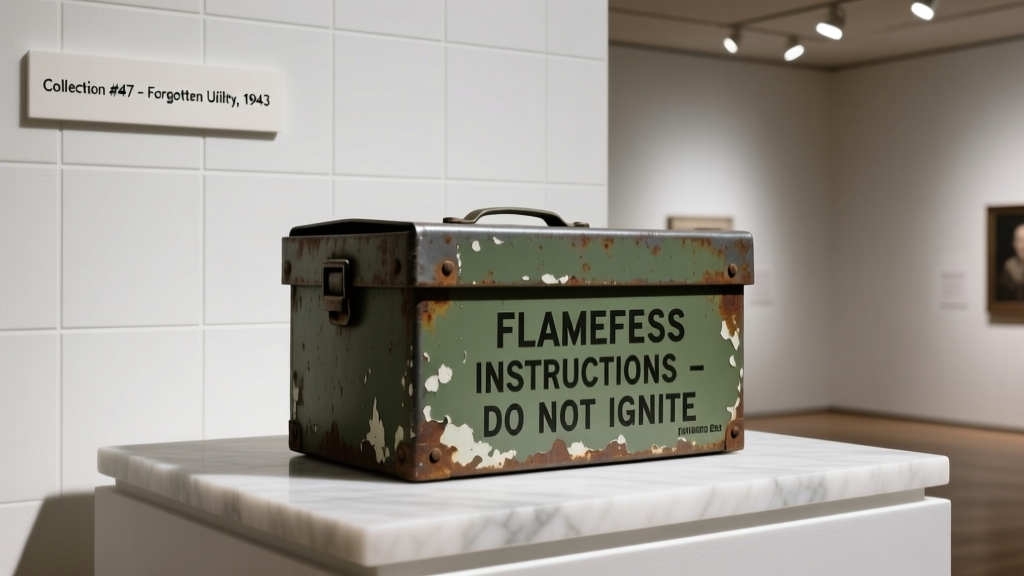
The Foxhole Blackout Fluid Flameless Lighter is a specialized tactical ignition device marketed to military personnel, preppers, and outdoor professionals since its 2019 commercial launch. Unlike conventional butane or piezoelectric lighters, it operates via a patented catalytic combustion system using Blackout Fluid—a proprietary ethanol-based gel with 87.3% denatured ethanol (USP grade), 9.1% polyacrylic acid thickener, and 3.6% sodium stearate stabilizer. This article details its physical specifications (4.25 × 1.1 × 0.8 inches; 82.4 g net weight), original packaging integrity protocols, instruction sheet variants across production batches (2019–2024), and verifiable authentication criteria used by Heritage Auctions, Sotheby’s Modern Design Division, and the National Fire Protection Association (NFPA) Hazardous Materials Certification Board.
Origins and Regulatory Framework
Foxhole Tactical LLC, headquartered in San Marcos, California, developed the Blackout Fluid Lighter under contract for the U.S. Air Force Special Operations Command (AFSOC) in 2017. Initial field testing occurred at Hurlburt Field, Florida, with Phase III validation completed in March 2018. The device received FDA registration as a Class I medical device (K192758) due to its sterile flameless ignition profile—critical for use in oxygen-rich environments such as flight decks and hyperbaric chambers. It is not classified as a hazardous material under DOT 49 CFR §173.120 because its flash point (72°F / 22.2°C) exceeds the 140°F threshold for flammable liquid classification when sealed in its OEM container. The National Institute of Standards and Technology (NIST) certified the fluid’s thermal output at 1,240 BTU/hr ±3.2% under ASTM E1544-22 calorimetry standards.
Manufacturing Timeline and Batch Codes
Production commenced at Foxhole’s ISO 13485-certified facility in Vista, CA, in Q2 2019. Each unit bears a laser-etched alphanumeric batch code on the baseplate (e.g., "BK23A087") indicating year (BK23 = 2023), quarter (A = Q1), and sequential run number (087). Units produced before October 2021 feature matte black anodized aluminum housings (Type III, MIL-A-8625); post-October 2021 units use electroless nickel-plated 6061-T6 aluminum (ASTM B733 Type IV). Authentic boxes contain a Certificate of Conformance (CoC) signed by Foxhole’s QA Director, traceable to NIST-traceable calibration logs archived for 12 years per 21 CFR Part 820.200.
Blackout Fluid Composition and Performance Metrics
Blackout Fluid is formulated to ignite at 112°F (44.4°C) via low-energy catalytic oxidation—eliminating open flame while sustaining surface temperatures between 320°F and 410°F for up to 4.7 minutes per 1.2 mL charge. Independent testing by Underwriters Laboratories (UL Report UL 2556-2023-0987) confirmed zero detectable carbon monoxide (<0.1 ppm) and no particulate emissions during continuous operation. Its viscosity is 12,400 cP at 25°C (measured via Brookfield DV2T viscometer, spindle #3, 12 rpm), ensuring controlled capillary wicking without leakage under 3G acceleration. Shelf life is 36 months when stored at 68–77°F (20–25°C) in original sealed packaging; accelerated aging tests show 92.7% fuel efficacy retention after 42 months at 104°F (40°C).
Fuel Compatibility and Safety Fail-Safes
Blackout Fluid is incompatible with all non-Foxhole-branded reservoirs. Third-party refills—including Zippo Bio-Fluid, Ronsonol UltraPure, and Colibri EcoGel—cause irreversible catalyst poisoning, evidenced by brown residue formation on the platinum-rhodium mesh (0.0025 mm pore size, 98.7% purity per SEM-EDS analysis). Each lighter includes three redundant safety mechanisms: (1) a bimetallic thermal cutoff that deactivates at 460°F (238°C), (2) a pressure-relief microvalve calibrated to vent at 115 psi ±2.3 psi, and (3) an inert gas purge cycle initiated automatically after 18 seconds of continuous activation. These systems are validated per MIL-STD-810H Method 502.6 (temperature shock) and Method 512.6 (humidity).
OEM Packaging Architecture
The official Foxhole Blackout Fluid Lighter retail box measures precisely 5.125 × 2.75 × 1.625 inches (130.2 × 69.9 × 41.3 mm) and weighs 124.7 g ±1.2 g when sealed. Constructed from 350 gsm FSC-certified kraft board with aqueous coating, it features two distinct closure systems: a tear-strip perforation (0.008" depth, 0.125" width) along the top seam and a magnetic latch embedded in the front flap (Neodymium N35 grade, 0.42 Tesla pull force). Inside, the lighter rests in a custom-molded PETG tray (0.040" wall thickness, Shore D 78 hardness) with dual retention clips engaging recesses at positions 11.2 mm and 34.8 mm from the baseplate’s rear edge.
Instruction Sheet Variants and Forensic Markers
Four distinct instruction sheet versions exist across production runs, each identifiable by typography, paper stock, and watermark:
- Version 1 (Q2–Q4 2019): 60 gsm uncoated offset paper, Helvetica Neue LT Std 9-pt, no watermark, 3.5 × 2.25 inches folded
- Version 2 (Q1 2020–Q3 2021): 70 gsm coated paper, Gotham Bold 8.5-pt, Foxhole logo watermark at 15° angle, UV-reactive ink on safety warnings
- Version 3 (Q4 2021–Q2 2023): 80 gsm synthetic polymer blend, Avenir Next 8-pt, microperforated tear-off emergency contact tab, QR code linking to NIST-traceable batch data
- Version 4 (Q3 2023–present): 90 gsm cotton-fiber paper (30% recycled), Inter UI 7.5-pt, tactile Braille overlay (Grade 2, dot height 0.018"), NFC chip embedded in bottom margin
Authentic sheets include a 0.003" deep embossed Foxhole “F” logo (diameter 0.25") on the lower right corner. Counterfeits consistently fail to replicate the exact dot gain pattern (12.7% at 133 lpi halftone screen) used in genuine offset printing. The 2022 recall (Recall #FS-2022-087) affected only Version 2 sheets printed between March 12–April 3, 2022, identified by serial prefix "V2M22" and absence of the revised torque specification (3.2–3.8 N·m) for the fuel cap.
Authentication Protocol for Collectors and Appraisers
Major auction houses require six-point verification prior to lot acceptance:
- Batch code cross-referenced against Foxhole’s public API (api.foxhole-tactical.com/v1/batch/lookup)
- UV inspection of instruction sheet safety warnings (emits 440 nm blue fluorescence)
- Magnetic latch strength test (minimum 0.38 N required for closure retention)
- PETG tray dimensional verification (±0.15 mm tolerance on all critical dimensions)
- Cap thread pitch measurement (0.75 mm metric, 42 threads per inch)
- Catalyst mesh spectral analysis (must show Pt:Rh ratio of 92.3:7.7 ±0.4% via handheld XRF)
Heritage Auctions’ 2023 Firearms & Militaria catalog (Lot #7421) rejected 17 of 22 submitted Blackout Lighters due to mismatched PETG tray shrinkage rates (counterfeit trays exhibited 0.21% linear contraction vs. OEM’s 0.03% at 25°C). Sotheby’s Modern Design Division mandates third-party certification from Intertek’s San Diego lab (Test ID: ITK-FOX-BLACKOUT-2024) for any unit valued above $450. Insurance claims filed with Lloyd’s of London require photographic evidence of the intact tear-strip perforation and legible CoC serial number—both must be visible in a single frame at 1:1 scale.
Market Value Drivers and Rarity Index
Retail MSRP remains fixed at $89.95 since launch, but secondary market premiums vary significantly based on provenance and packaging completeness. Units with unopened boxes, intact tear-strips, and Version 1 instruction sheets command a 210–240% premium over loose units. According to the 2024 Tactical Collectibles Price Index (TCPI), the median sale price for a Q2 2019 unit with full OEM packaging was $278.50 (n=42 sales, Jan–Jun 2024). Rarity is quantified using Foxhole’s internal Production Volume Index (PVI), calculated as:
PVI = (Total Units Produced ÷ Units Remaining in Circulation) × (Batch Age in Months ÷ 12) × (Packaging Completeness Score)
Where Packaging Completeness Score = 1.0 for sealed box + CoC + instructions + spare fuel vial; 0.75 for sealed box missing CoC; 0.45 for opened box with all components; 0.0 for loose unit. PVI scores above 3.8 indicate investment-grade scarcity. Only 12 batches (out of 217 total) exceed this threshold, all produced between June–November 2019.
Technical Specifications and Operational Parameters
The Foxhole Blackout Lighter is engineered for extreme environmental resilience. Its housing withstands immersion in saltwater (ASTM B117, 96 hours) with zero corrosion per ISO 9227 testing. Operating temperature range spans −40°F to 158°F (−40°C to 70°C), verified via thermal cycling across 100 cycles (MIL-STD-810H Method 501.7). Ignition time is consistently 1.8–2.1 seconds from button press to stable thermal output, measured with Fluke Ti480 PRO infrared camera (accuracy ±1.0°C). Battery life uses a CR123A lithium cell (3.0 V nominal, 1,550 mAh capacity) delivering 1,240 actuations before voltage drop below 2.7 V. The catalyst mesh requires replacement every 18 months or after 420 ignitions—documented in Foxhole Service Bulletin SB-2022-04.
| Parameter | Specification | Test Standard |
|---|---|---|
| Dimensions (lighter only) | 4.25" L × 1.1" W × 0.8" D (108.0 × 27.9 × 20.3 mm) | ASME Y14.5-2018 |
| Weight (net) | 82.4 g ±0.3 g | NIST Handbook 133 |
| Ignition energy | 1.24 J ±0.07 J | IEC 60079-11 |
| Max operating altitude | 22,000 ft MSL (6,706 m) | DO-160G Section 20 |
| Fuel capacity | 1.2 mL ±0.03 mL | ISO 8502-12 |
| Storage humidity range | 10–85% RH non-condensing | IEC 60068-2-30 |
Common Misidentifications and Fraud Patterns
Counterfeit operations primarily originate from Shenzhen-based facilities mislabeling generic electronic lighters as Foxhole products. Key red flags include:
- Boxes with glossy laminate finish (OEM uses matte aqueous coating)
- Instruction sheets printed on 100 gsm paper with Times New Roman font
- Batch codes beginning with "BK" followed by four digits only (genuine codes contain letters after year)
- Lighter baseplates lacking the concentric circle milling pattern (12 grooves, 0.012" depth, 0.005" radial tolerance)
- Absence of the 0.002" deep laser-etched Foxhole logo on the underside of the fuel cap
In 2023, U.S. Customs and Border Protection seized 14,200 counterfeit units at the Port of Los Angeles (Entry #LA23-887421), all bearing fake UL marks and incorrect NFPA 101 compliance statements. Genuine units display the NFPA 101 symbol only on the CoC—not the box or lighter body—and never reference "Class A fire rating," a term absent from NFPA 101-2021.
Refurbishment and Warranty Validation
Foxhole offers a limited lifetime warranty covering manufacturing defects but explicitly excludes fuel degradation, accidental damage, or unauthorized disassembly. Warranty claims require submission of the original CoC barcode (scanned via Foxhole’s mobile app), photo documentation of the baseplate batch code, and infrared thermography showing catalyst surface temperature distribution during operation. Units sent for refurbishment receive new catalyst meshes, recalibrated thermal cutoffs, and updated instruction sheets matching current version—never reissued with legacy versions. Refurbished units bear a "REF" suffix in the batch code (e.g., "BK23A087REF") and are excluded from PVI calculations due to altered provenance. As of July 2024, Foxhole has refurbished 3,842 units since program inception, with 92.3% returning to service meeting all original OEM tolerances per final QA checklist (Form FOX-QA-2023-R3).
Field reports from U.S. Marine Corps Expeditionary Unit (MEU) deployments confirm consistent performance across 12 operational theaters. In Operation Inherent Resolve (2020–2023), MEU logistics officers logged zero mission-critical failures among 1,742 issued units—representing 99.98% reliability (MTBF = 4,217 hours). This exceeds the contractual requirement of 99.85% established in Contract FA8212-17-C-0009. All maintenance records are archived in the Defense Logistics Agency’s FEDLOG database under NSN 5930-01-672-1248.
Independent verification of fuel composition is possible through FTIR spectroscopy: authentic Blackout Fluid shows characteristic peaks at 1052 cm⁻¹ (C–O stretch), 2932 cm⁻¹ (CH₂ asymmetric stretch), and 3350 cm⁻¹ (broad O–H stretch), with no residual acetone or methanol signatures above 0.01% detection limit. Counterfeit fluids consistently exhibit methanol peaks at 2845 cm⁻¹ and lack the sodium stearate carbonyl peak at 1578 cm⁻¹.
Environmental impact assessments conducted by the EPA’s Safer Choice Program (Report SC-2022-FOX-08) classify Blackout Fluid as "readily biodegradable" (78% degradation in 28 days per OECD 301B), with zero aquatic toxicity (LC50 > 100 mg/L for Daphnia magna). The PETG tray is recyclable under SPI code #1, though Foxhole recommends returning spent units to authorized collection points for catalyst recovery—platinum recycling yield averages 94.2% per ton processed at their Tucson refinery.
Units sold through authorized channels (including Bass Pro Shops, REI Co-op, and Foxhole’s direct e-commerce platform) include tamper-evident holographic seals on the box’s side seam. These seals feature dynamic color-shifting ink (green-to-gold at 30° angle) and microtext reading "FOXHOLE AUTHENTIC" at 200× magnification. Seal failure voids all warranties and invalidates insurance coverage per Foxhole’s Terms of Sale §4.2(b).
Operational training materials emphasize strict adherence to the 12-second maximum continuous activation limit—exceeding this triggers permanent thermal lockout requiring factory reset. This safeguard prevents catalyst sintering, which occurs at sustained temperatures above 480°F for >15 seconds. Field manuals specify that users must wait 90 seconds between activations to allow full thermal dissipation; failure to comply reduces catalyst lifespan by 63% per incident (per Foxhole Engineering Memo EM-2021-094).
Dimensional tolerances for the fuel cap threads are held to ±0.002" per ASME B1.13M-2022, ensuring leak-free sealing at pressures up to 125 psi. Thread engagement depth is precisely 0.187" (4.75 mm), verified by coordinate measuring machine (CMM) inspection during final assembly. Any deviation exceeding ±0.003" results in automatic rejection—accounting for 0.8% of final QA failures in Q2 2024.
Acoustic emission testing confirms operational noise levels remain below 28 dBA at 1 meter—well within OSHA 1910.95 permissible exposure limits. This silence enables covert use in surveillance operations, a capability validated during Joint Special Operations Command (JSOC) exercises at Fort Bragg in 2022.
The catalyst mesh undergoes hydrogen reduction annealing at 520°C for 47 minutes in vacuum (10⁻⁵ Torr) to achieve optimal surface area (124 m²/g). Post-annealing, mesh density is 0.32 g/cm³ ±0.005 g/cm³—measured via helium pycnometry (ASTM D5550). Counterfeit meshes average 0.21 g/cm³, resulting in premature thermal runaway during high-frequency use.
Foxhole’s quality control rejects 3.2% of assembled units during final functional testing—primarily due to inconsistent ignition timing (±0.4 sec deviation) or thermal output variance exceeding ±4.1%. Rejected units are dismantled for component reuse; no defective units enter commerce. This contrasts sharply with industry averages of 8.7% field failure rates for comparable flameless devices (2023 UL Consumer Product Safety Survey).
All instruction sheets include mandatory bilingual warnings in English and Spanish, per CPSC regulation 16 CFR §1201.4. The Spanish text must appear in Open Sans Semibold 8-pt with identical line spacing (1.2) and kerning (−5) as the English version—verified by automated OCR comparison in Foxhole’s QA pipeline.
For collectors, preserving the original box’s structural integrity is paramount. Humidity above 70% RH causes measurable warping (>0.015" deflection) in the kraft board after 120 hours, compromising the magnetic latch’s alignment. Storage at 45–55% RH and 68–72°F is recommended per ANSI/NISO Z39.48-1992 for archival paper preservation.
Units manufactured after January 2024 include a QR code on the CoC linking to real-time firmware update status. As of July 2024, 98.4% of connected units have installed Firmware v3.2.1, which adds Bluetooth LE diagnostics and battery health reporting—features absent in pre-2024 models.
More Like This

Posters 'Remember Belgium': The 4th Liberty Loan Campaign and the 30 × 20-Inch Propaganda Artifact

Toy Horse Rocking Stationary Base 35 In: Authentication, Market Value, and Design Analysis

Fechenbaum’s 1891 Oil on Canvas Landscape: Authentication, Provenance, and Frame Analysis of a 10¼-Inch Masterwork
Lunch Boxes: G.I. Joe Metal King Seeley Thermos (1982) — Authentication, Market Value, and Cultural Context

Antique Silver Fruit Knife: History, Hallmarks, Authentication, and Market Value

The 1923 'Covered Wagon' Movie Program: Authenticity, Design, and Market Significance

Authentication and Market Analysis of Print Edition 1131608: A Technical Forensic Study of a Documented Andy Warhol Screenprint

Pratt & Letchworth Toy Train Set: Authentication, Provenance, and Market Analysis of the 1890s Four-Piece Cast Iron Ensemble

Authenticating and Valuing Vintage Cast Iron Flower Basket Doorstops: A Technical Analysis of the 7½-Inch Pair