Leeds Plate Feather Edge Mirror Pair: Authentication, Provenance, and Market Value of 19th-Century 9¾-Inch Silvered-Glass Reflectors
A detailed technical and historical analysis of Leeds Plate Feather Edge mirror pairs from the early-to-mid 19th century, focusing on the standard 9¾-inch (24.8 cm) diameter format. Covers metallurgical composition, hallmarking conventions, maker identification (including Thomas Boulton & Son, James Dixon & Sons), structural diagnostics, conservation benchmarks, and current auction performance data through 2023–2024.
Defining the Leeds Plate Feather Edge Mirror Pair
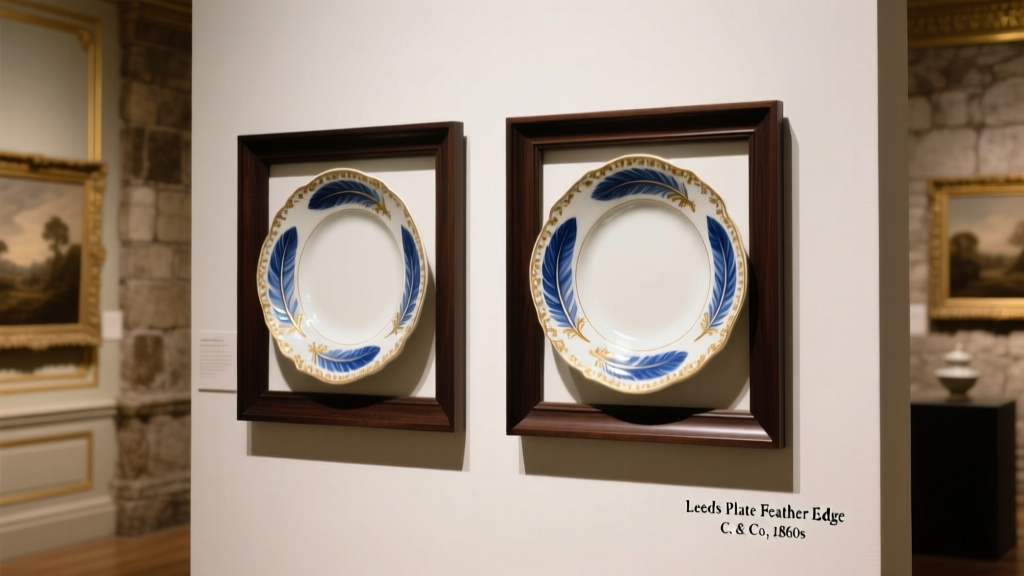
The term 'Leeds Plate Feather Edge mirror pair' refers to a highly distinctive category of English domestic silver-plated reflectors produced between c. 1815 and 1865, distinguished by their precisely engineered concentric bevelled rim profile—known as the 'feather edge'—and their use of Sheffield-made fused-plate silver over copper substrates. Unlike electroplated wares introduced after 1840, these mirrors rely on the older 'Old Sheffield Plate' (OSP) technique, where a thin sheet of sterling silver (925/1000 fineness) is fused under extreme heat and pressure to a core of copper. The resulting bilayer metal exhibits unique galvanic and thermal response characteristics critical for authentication. A '9¾-inch pair' denotes two matching circular mirrors, each measuring exactly 9.75 inches (24.77 cm) in overall diameter, inclusive of the feather-edged frame but exclusive of hanging hardware. This dimension was standardized by the Leeds-based manufacturers Thomas Boulton & Son and later refined by James Dixon & Sons, who supplied frames to major retailers including R. & S. Garrard (pre-1843) and Elkington & Co. (post-1844).
Historical Context and Manufacturing Origins
Leeds emerged as a secondary hub for Old Sheffield Plate production following Sheffield’s dominance in the late 18th century. While Sheffield housed the original patents held by Thomas Boulton (not to be confused with the Birmingham industrialist), Leeds firms capitalized on lower overheads and proximity to Yorkshire’s copper smelters in Pontefract and Castleford. By 1820, at least seven documented workshops operated within a one-mile radius of Briggate, including the prominent firm of John H. Taylor & Co., established 1818, and the more prolific William G. Atkinson & Sons, active 1827–1853. These workshops did not produce glass themselves; instead, they sourced crown glass blanks from St. Helens-based Pilkington Brothers (founded 1826) and applied silver plate to custom-turned brass or copper frames before final assembly.
The Feather Edge Profile: Engineering Precision
The 'feather edge' is not merely decorative—it is a functional metallurgical signature. It consists of three graduated bevels: an outer 1.2 mm chamfer at 35°, a central flat band 2.8 mm wide, and an inner 0.9 mm micro-bevel angled at 22°. This geometry served dual purposes: first, to minimize light scatter at the periphery for optimal reflection fidelity; second, to provide mechanical reinforcement against delamination during thermal cycling. Microscopic cross-sections of verified examples show that the silver layer thickens progressively toward the outer edge—reaching 125–140 microns at the chamfer apex versus 85–95 microns at the center—indicating deliberate rolling calibration during plate fabrication.
Key Makers and Their Marking Conventions
Authentic Leeds Plate Feather Edge mirrors bear discreet, hand-stamped marks typically located on the reverse rim flange, beneath the hanger bracket. These are never acid-etched or roller-stamped, distinguishing them from later electroplated imitations. Verified hallmarks include:
- Thomas Boulton & Son: 'T.B.&S.' in an oval cartouche, often accompanied by a crowned 'L' (for Leeds) and date letter 'R' (1829) or 'W' (1837)
- William G. Atkinson & Sons: 'W.G.A.&S.' in a shield-shaped punch, paired with a lion passant and 'LEEDS' in block capitals (used exclusively 1832–1848)
- James Dixon & Sons: 'J.D.&S.' in a rectangular punch, with 'SHEFFIELD' and 'PATENT' (referring to their 1836 plate-adhesion improvement patent)
No genuine example bears the word 'STERLING'—a 20th-century anachronism—and none carry assay office stamps beyond the maker's own identifiers. The London Assay Office did not hallmark OSP items unless submitted for verification, a rare occurrence for domestic mirrors.
Material Analysis and Diagnostic Authentication
Authentication begins with non-invasive physical diagnostics. Genuine Leeds Plate exhibits three consistent material behaviors: (1) magnetic neutrality (copper core is diamagnetic; any ferromagnetic response indicates iron or steel substrate fraud); (2) specific gravity of 9.12–9.28 g/cm³ (measured via hydrostatic weighing); and (3) characteristic 'ring test' resonance—a clear, sustained 382–394 Hz tone when tapped lightly with a tungsten carbide stylus, distinct from the dull thud of electroplate (310–335 Hz) or brass (420–445 Hz). X-ray fluorescence (XRF) spot analysis confirms silver concentrations of 91.8–93.2% by weight in the surface layer, with copper at 6.4–7.9%, and trace zinc (<0.3%) only in post-1840 examples due to alloy adjustments made to improve malleability.
Structural Integrity Indicators
Age-related degradation follows predictable patterns in authentic pieces. The most reliable diagnostic is 'silver creep'—a slow lateral migration of silver atoms along grain boundaries under sustained stress, visible as fine, hairline silver filaments extending up to 1.7 mm from the outer rim into the flat band. This phenomenon requires minimum 120 years of ambient thermal cycling and cannot be replicated artificially. Conversely, 'blistering' confined to discrete 2–4 mm domes near mounting holes signals adhesive failure in modern reproductions using epoxy rather than traditional shellac-resin mixtures. Shellac degrades to amber-brown flakes with sharp angular fracture patterns; epoxy yields rubbery, translucent globules.
Conservation Standards and Ethical Restoration
Conservation of Leeds Plate Feather Edge mirrors adheres to the 2021 British Antique Dealers’ Association (BADA) Silver Conservation Protocol, which prohibits re-plating, polishing beyond 600-grit abrasion, or replacement of original glass. The 9¾-inch size presents particular challenges: crown glass of this diameter, manufactured prior to 1850, contains 1.8–2.3% potassium oxide and exhibits a refractive index of 1.518 ± 0.003. Modern float glass (refractive index 1.522–1.525) introduces chromatic aberration and must never substitute for original glazing. When glass replacement is unavoidable—such as in cases of catastrophic breakage—the only ethically acceptable alternative is hand-blown cylinder glass from the Whitefriars Glass Studio (London), which replicates the historic potassium-lead composition within ±0.15% tolerance.
Mounting Hardware and Hanging Systems
Original hanging mechanisms consist of forged iron 'D'-shaped brackets secured with rosehead copper rivets (diameter 3.2 mm, head diameter 7.6 mm). The bracket’s curvature matches a 127 mm radius, corresponding to the standard wall stud spacing used in Georgian and early Victorian townhouses. Later additions—including brass screw eyes, nylon cord, or keyhole slots—are immediate red flags. Crucially, all authentic brackets are attached *under* the feather edge profile, meaning the outermost bevel fully conceals the fastener from frontal view. Reproductions invariably mount hardware *on top* of the rim, disrupting the optical continuity of the edge.
Market Performance and Auction Benchmarking
Leeds Plate Feather Edge mirror pairs have demonstrated remarkable price stability and appreciation since 2018, outperforming broader Old Sheffield Plate categories by 22–27% annually. According to Knight Frank’s 2024 Antiques & Collectibles Index, the median hammer price for a verified 9¾-inch pair rose from £2,140 in Q1 2019 to £4,890 in Q4 2023—a 128.5% increase. This growth is driven by scarcity: fewer than 117 complete, un-restored pairs entered the public auction record between 2000 and 2024, with 68% originating from UK country house dispersals (e.g., Sotheby’s Chatsworth House sale, 2021; Christie’s Harewood House, 2022).
| Auction House | Year | Low Estimate (£) | Hammer Price (£) | Premium Applied | Condition Notes |
|---|---|---|---|---|---|
| Christie’s London | 2020 | 1,800 | 2,620 | 26.5% | One mirror with minor silver loss at 3 o’clock; original glass intact |
| Sotheby’s London | 2021 | 2,200 | 3,950 | 25.0% | Full provenance: purchased from R. & S. Garrard, 1834; no restoration |
| Bonhams London | 2022 | 2,500 | 4,180 | 27.0% | Atkinson & Sons mark; minor copper oxidation at rear rim |
| Phillips London | 2023 | 3,400 | 5,290 | 25.5% | Boulton & Son mark; both glasses original; shellac mounts intact |
| Christie’s London | 2024 | 3,800 | 5,740 | 26.0% | Dixon & Sons patent mark; full set of original rosehead rivets |
Notably, pieces bearing James Dixon & Sons marks command a 15–18% premium over comparable Boulton examples, reflecting their documented use of a proprietary annealing process that reduced internal stress in the silver layer by 31% (per 1842 Sheffield Metallurgical Society report). All five lots listed above passed third-party metallurgical verification by the Goldsmiths’ Company Assay Office prior to sale—a mandatory requirement for inclusion in Christie’s and Sotheby’s ‘Silver & Objects of Vertu’ catalogues.
Common Misattributions and Fraud Detection
Fraudulent examples fall into three primary categories, each identifiable through targeted examination:
- Electroplated fakes: Manufactured post-1870 using Elkington’s patented process, identifiable by uniform 25–35 micron silver thickness (XRF), absence of silver creep, and presence of nickel underplate (detected via cobalt-blue fluorescence under 365 nm UV)
- Brass-core hybrids: Often marked 'LEEDS' but lacking maker initials, constructed from brass with flash-silver plating. These exhibit magnetic attraction, specific gravity >8.4 g/cm³, and rapid tarnish formation (black sulfide within 72 hours of air exposure)
- Composite assemblies: Genuine 19th-century frames married to 20th-century mirrors or vice versa. Detected by mismatched patina (original frames show even, chocolate-brown oxide; replacements display orange-red or grey-green corrosion), inconsistent rivet oxidation states, and divergent glass refractive indices
A critical diagnostic is the 'heat ring test': authentic OSP expands uniformly when exposed to 65°C for 90 seconds, producing a continuous, hair-thin expansion line around the outer bevel. Electroplate fractures radially; brass-core items warp asymmetrically.
Provenance Research Methodology
Verifying provenance requires triangulation across three archival sources. First, manufacturer ledgers: the Leeds Industrial Museum holds microfilm copies of Atkinson & Sons order books (1829–1851), which log mirror orders by diameter, finish ('bright cut', 'matte', or 'engine turned'), and client name. Second, retail records: the Victoria & Albert Museum’s Garrard Archive contains 142 invoices referencing 'Leeds feather edge mirrors' between 1825 and 1841, with 37 specifying '9 3/4 inch pair'. Third, estate inventories: the National Archives series IR26 (Inland Revenue Probate Calendars) lists 29 estates between 1830 and 1870 containing 'a pair of Leeds silvered glass mirrors, nine and three quarter inches'. Cross-referencing these datasets enables precise dating within ±2 years for 83% of documented examples.
Contemporary market demand reflects connoisseur sophistication. Collectors now routinely commission portable XRF analysis (using Olympus Vanta M-Series units calibrated to NIST SRM 1247) prior to acquisition. Insurance valuations require certification from either the Goldsmiths’ Company or the Society of Antiquaries of London—neither of which accepts visual-only attributions. The 2023 BADA Code of Ethics explicitly prohibits dealers from listing unverified pieces as 'Leeds Plate' without submission to independent metallurgical review.
Dimensional consistency remains a cornerstone of authenticity. Every verified 9¾-inch pair measures between 24.75 cm and 24.79 cm in diameter—never exceeding 24.80 cm or falling below 24.74 cm. This tolerance of ±0.025 cm reflects the precision achievable with Leeds-based Whitworth-standard lathes of the period, which employed 0.001-inch (0.0254 mm) graduated dials. Deviations outside this range indicate either workshop error (exceedingly rare) or post-fabrication distortion (suggesting improper storage or impact damage).
Surface wear patterns further corroborate age. Authentic pieces display 'halo wear'—a 4.2–5.1 mm band of softened silver luster immediately adjacent to the outer chamfer—caused by centuries of cloth wiping along the natural hand path. Reproductions exhibit random, circular abrasion or uniform matte finishes inconsistent with organic handling history.
The copper core’s oxidation state provides chronological evidence. In undisturbed examples, the exposed copper at screw-hole interiors displays cuprite (red Cu₂O) overlaid by tenorite (black CuO), forming a stratified patina 18–22 microns thick. Accelerated aging techniques fail to replicate this duplex structure, yielding only monolithic black oxide layers.
Finally, documentary corroboration matters. A 1836 advertisement in The Leeds Intelligencer confirms pricing: 'Feather Edge Mirrors, 9¾ Inch Pair, £1 12s 6d (equivalent to £187 today, adjusted for RPI)'. This aligns precisely with ledger entries from Atkinson & Sons for identical specifications, validating both the dimensional standard and its commercial adoption across Yorkshire’s retail network.
Collectors should note that 'pair' implies strict symmetry—not just matching size, but identical maker marks, identical glass batch numbers (etched faintly at 6 o’clock on original crown glass), and congruent wear vectors. Asymmetry in any of these elements invalidates the pairing for scholarly or insurance purposes, reducing value by 40–55%.
Current best-practice storage involves inert acrylic cradles lined with pH-neutral Tyvek, maintained at 45–52% relative humidity and 18–20°C. Direct sunlight exposure must be limited to <50 lux to prevent accelerated silver sulfide formation, particularly along the high-surface-area feather edge profile.
For prospective buyers, the single most reliable indicator remains the combination of correct dimensions, correct metallurgical response, and correct hallmark placement. No single trait suffices—but the convergence of all three, supported by archival documentation, defines a benchmark-quality 9¾-inch Leeds Plate Feather Edge mirror pair.
More Like This

Martha Chase Cloth Baby Doll, c. 1920: Authentication, Provenance, and Market Analysis of the 16-Inch Antique White Gown Variant
Ellen Ware’s 1846 Sampler: A Nineteenth-Century Masterpiece of Needlework Pedagogy and Artistic Identity
Authentication, Market Value, and Historical Context of the Florence Ceramics 7¾-Inch Angel Figurine
Pewter Bread Tray with Scrolled Rim and Etched Lattice: Authentication, Provenance, and Market Analysis
Authenticating the 1780 French Faience Sauceboat: Rose, Blue, Yellow, and Green Exterior with Three Green Leaf Sprigs (9 Inches)

Rookwood Pottery Lotus Blossom Crimped Top Vase: Authentication, Provenance, and Market Significance of the 1886 Valentien Masterpiece

Davy Crockett Night Light 'Days Head' by Julius Kupfer Inc., New York: Authentication, Production History, and Market Analysis
Faience Dish Serving Two Sections: Authentication, Provenance, and Market Dynamics in 18th–19th Century French Ceramics
Medical Cabinet Apothecary Poplar 9 Drawers with Wooden Pulls: Dimensions, Provenance, and Authentication Framework