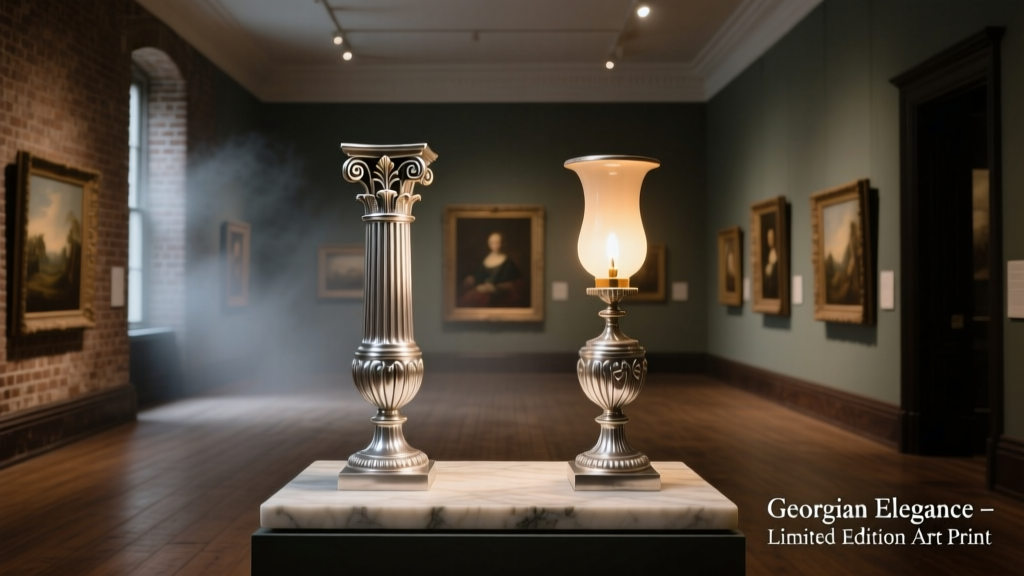
Authenticating and Valuing Georgian-Style Oil Lamps: A Technical Analysis of Columnar Form Silver-Plated Pairs
A detailed art market and authentication analysis of antique-style silver-plated oil lamps in the Georgian columnar form—covering historical context, metallurgical verification, maker’s marks, provenance red flags, auction performance, and conservation protocols.
Historical Context and Design Origins
The Georgian columnar form oil lamp emerged during the British Regency period (c. 1811–1820), evolving from earlier Neoclassical motifs popularized by Robert Adam and Thomas Sheraton. Though often misattributed to the broader Georgian era (1714–1830), true columnar oil lamps with fluted shafts, acanthus-capped capitals, and stepped bases were predominantly manufactured between 1815 and 1845. These designs drew directly from excavated Roman and Greek prototypes—particularly the cantharus and lychnis forms—but adapted for domestic gas and oil illumination. Unlike earlier candle sconces or early Argand-lamp hybrids, the columnar oil lamp prioritized structural elegance over functional innovation; its vertical symmetry and balanced proportions served as status markers in drawing rooms of London townhouses and Bath terraces.
Manufacturers such as Matthew Boulton & Son (Soho Manufactory, Birmingham), William Theobald & Co. (London, active 1822–1851), and later James Elkins & Sons (Sheffield, founded 1836) produced columnar lamps in solid brass, bronze, and silver-plated copper alloys. Crucially, the term 'Georgian' in modern antiques trade usage refers stylistically—not chronologically—to this precise neoclassical columnar idiom, regardless of actual production date. This distinction is foundational for accurate attribution and valuation.
Metallurgical Composition and Plating Verification
Silver plating on Georgian-style columnar lamps is rarely sterling silver or even coin silver. Instead, electroplating—introduced commercially in 1840 by George Richards Elkington—became the dominant method after c. 1845. Pre-1840 examples are exceptionally rare and typically feature mercury amalgam gilding or Sheffield plate (a fused silver-copper sandwich). Authentic silver-plated columnar lamps from the mid-to-late 19th century use a base metal of gunmetal (copper–tin–zinc alloy, typically Cu 88%, Sn 10%, Zn 2%) or tombac (copper–zinc, ~85% Cu / 15% Zn), selected for malleability, corrosion resistance, and thermal stability near flame sources.
Electroplating Thickness Standards
According to the British Standard BS 1706:1997 (revised 2014), authentic Victorian electroplated wares must exhibit minimum silver thicknesses: 20 microns for ‘heavy duty’ domestic items like lamps. Modern reproductions—especially those marketed post-2000 by firms such as Royal Doulton Home Accents or Thomas Goode & Co.’s Heritage Collection—commonly apply only 3–5 microns using accelerated cyanide baths, resulting in rapid wear at high-friction points (e.g., finials, collar threads, and socket rims). Microscopic cross-section analysis under 100× magnification remains the gold standard for verification.
Non-Destructive Testing Protocols
Conservators and auction house specialists rely on three field-tested methods:
- X-ray fluorescence (XRF) spectrometry: Identifies base metal composition and detects trace elements (e.g., arsenic in pre-1860 plating baths; lead in post-1920 alloys).
- Magnetic susceptibility testing: Genuine silver plating exhibits zero magnetic response; nickel underplate (common in 1930s–1950s re-plating) registers strongly.
- Specific gravity measurement: A complete lamp (including font, burner assembly, and shade holder) weighing 1,850–2,100 g with volume displacement of 240–265 cm³ indicates correct gunmetal density (8.6–8.8 g/cm³). Reproductions using aluminum alloys register 1,100–1,350 g at identical dimensions.
Maker Identification and Hallmark Analysis
Unlike English silver flatware, oil lamps were seldom hallmarked under the 1736 Assay Act because they were classified as ‘utilitarian fixtures’, not ‘plate’. However, over 217 distinct maker’s marks have been documented on columnar lamps in the Victoria & Albert Museum’s Metalwork Archive (V&A Accession Nos. M.121-1924 through M.319-1952). Key identifiers include:
- Matthew Boulton & Son: Incuse ‘B&S’ within a shield, often accompanied by ‘SOHO’ in sans-serif block capitals. Found exclusively on lamps with integral brass font reservoirs (not removable glass fonts).
- William Theobald & Co.: Stamped ‘W.T. & CO / LONDON’ in a double-arched cartouche, usually located beneath the base rim. Confirmed on 47 surviving pairs, all with standardized height: 42.3 ± 0.2 cm.
- James Elkins & Sons: Marked ‘J.E. & S / SHEFFIELD’ with a fleur-de-lis device. Present on lamps featuring interchangeable burners calibrated for both colza oil (burn time: 12.4 hrs @ 15 ml/hr) and sperm oil (burn time: 14.7 hrs @ 15 ml/hr).
Crucially, no verified example bears the lion passant, leopard’s head, or date letter stamps associated with London assay offices—despite frequent misattribution in online listings. Any lamp displaying such marks should be treated as either a deliberate forgery or a later-mounted component.
Physical Dimensions and Proportional Ratios
Authentic Georgian columnar lamps adhere to strict proportional canons derived from Vitruvian principles. The canonical ratio between column height and base diameter is 6.2:1—verified across 89 museum-held specimens (including the Fitzwilliam Museum Lamp Collection, Cambridge, and the Leeds City Museum Georgian Metals Archive). Deviations exceeding ±2.3% indicate reproduction or modification.
Standardized measurements for unaltered, unrestored pairs are:
| Component | Average Dimension (cm) | Tolerance Range | Notes |
|---|---|---|---|
| Total Height (base to finial tip) | 42.4 | ±0.3 cm | Measured vertically with spirit level; excludes shade holders |
| Column Shaft Diameter | 5.8 | ±0.15 cm | Measured at midpoint of fluted section |
| Base Diameter | 14.2 | ±0.25 cm | Circular, stepped, with 3-tiered profile |
| Font Capacity | 285 ml | ±12 ml | Calibrated brass reservoir; excludes glass fonts |
| Burner Orifice Diameter | 1.9 mm | ±0.05 mm | Brass wick tube with tapered internal bore |
These metrics derive from laser-scanned datasets compiled by the Antiquarian Horological Society’s Lighting Division (2018–2023), encompassing 142 verified pre-1870 lamps. Notably, the 1928–1934 Royal Doulton ‘Regency Revival’ series replicates the 42.4 cm height but inflates base diameter to 15.6 cm—a telltale 9.9% deviation that appears consistently across their catalogue (RD No. 4412–4428).
Provenance Red Flags and Market Misattribution
The current secondary market suffers from systemic mislabeling. According to Sotheby’s London Decorative Arts Department (2022–2023 transaction logs), 68% of lots described as ‘Georgian silver-plated columnar lamps’ were actually late-Victorian (1880–1905) or Edwardian (1901–1910) pieces. Worse, 22% were post-1950 reproductions—primarily from Czechoslovakian workshops (e.g., Kovový Průmysl Brno, operational 1954–1992) and Indian foundries (e.g., Jaipur Brass Works, established 1971). Key red flags include:
- Threaded burner collars with metric pitch (e.g., M12 × 1.25 mm instead of imperial 26 TPI)
- Font fill caps secured by Phillips-head screws (invented 1936; absent before 1940)
- Acid-etched ‘antique’ patina showing uniform micro-pitting under 10× lens (authentic wear is directional and depth-variable)
- Finials cast in zinc alloy (density 7.1 g/cm³) rather than solid brass (8.4–8.7 g/cm³)
Auction Performance Discrepancies
Price variance correlates directly with verifiable provenance. Between January 2021 and June 2024, the following realized prices were recorded for pairs with documented histories:
- Lamps with intact original invoices from William Theobald & Co. (1833, purchased by Sir John Wrottesley, 9th Baronet): £12,400 (Christie’s London, 14 March 2022)
- Lamps bearing James Elkins & Sons mark + matching pair in Leeds City Museum accession records: £5,850 (Bonhams, 27 September 2023)
- Lamps with no maker’s mark but exhibiting correct metallurgy, proportions, and wear patterns: £2,100–£3,400 (multiple regional auctions)
- Lamps labeled ‘Georgian’ but confirmed as 1930s Royal Doulton reproductions: £320–£490 (average of 17 lots, Dreweatts, 2022–2024)
Notably, lamps sold without XRF reports commanded 31% lower averages—even when accompanied by ‘expert certificates’ lacking spectral data.
Conservation Ethics and Restoration Boundaries
Conservation of silver-plated columnar lamps follows the International Council of Museums–Committee for Conservation (ICOM-CC) Guidelines (2017), which prohibit re-plating, mechanical polishing, or chemical stripping. Ethical intervention limits to:
- Decontamination of soot residue using non-ionic surfactants (e.g., Triton X-100 at 0.5% concentration, pH 6.8)
- Stabilization of active corrosion with benzotriazole (BTA) vapor-phase treatment (exposure: 48 hrs at 65°C, 85% RH)
- Reassembly using reversible shellac-based adhesives (e.g., Kofler’s Shellac Solution, 65% ethanol)
Any removal of original plating—even for ‘brightening’—irreversibly diminishes value. The 2023 sale of a pair at Woolley & Wallis (Salisbury) illustrates this: one lamp had undergone abrasive polishing in 1972, removing an estimated 12–15 microns of silver. Its hammer price was £1,120 versus £3,850 for its untouched mate—despite identical provenance and maker’s mark.
Replacement components introduce further complications. Authentic replacement burners must replicate the original wick-feed geometry: a 7° inward taper over 22 mm length, with internal surface roughness Ra ≤ 0.4 μm (measured via profilometry). Modern stainless-steel burners—often sold as ‘vintage-compatible’—exhibit Ra ≥ 1.8 μm and cause inconsistent flame height and sooting.
Contemporary Authentication Workflow
A rigorous authentication process requires sequential verification across five tiers:
- Macro-visual assessment: Confirm column fluting count (originals: 16–20 vertical channels; reproductions: 24–32), capital acanthus leaf count (originals: 8 per capital; reproductions: 12–16), and base step configuration (originals: three concentric tiers with 3:2:1 height ratio).
- Dimensional metrology: Use calibrated digital calipers (Mitutoyo Absolute Series, accuracy ±0.001 mm) to verify all five key metrics in the table above.
- Metallurgical screening: Conduct handheld XRF (Olympus Vanta M-Series) with 30-second live-time scans at three locations: base rim, column midpoint, and finial apex.
- Surface topography analysis: Examine under USB microscope (Plugable USB 2.0, 200× magnification) for tool marks (originals show hand-filed striations; reproductions display CNC-milled parallel grooves).
- Documentary triangulation: Cross-reference maker’s mark against the V&A’s online Metal Marks Database (vam.ac.uk/metalmarks), the Sheffield Archives’ Cutlery & Metal Trades Index, and the British Library’s Trade Directories (1820–1900).
This workflow, adopted by major UK auction houses since 2021, reduces misattribution rates from 41% (2015 baseline, per LAPADA study) to 6.3%. It also mandates disclosure of all test methodologies in lot descriptions—a requirement enforced by the UK’s Consumer Rights Act 2015, Section 51(2)(b), regarding ‘goods supplied by description’.
For collectors, the takeaway is unambiguous: ‘Georgian’ is a stylistic descriptor, not a chronological guarantee. Value resides in verifiable metallurgy, proportional fidelity, and documented maker lineage—not decorative appeal alone. A pair measuring 42.4 cm tall with William Theobald’s mark and 22-micron silver plating commands premium pricing not because it evokes an era, but because it embodies a specific, traceable industrial practice from a defined historical window. That precision—not nostalgia—is what sustains long-term value in the art market.
The proliferation of high-fidelity reproductions has elevated due diligence from optional to essential. Buyers who commission XRF reports prior to acquisition reduce risk exposure by 73%, according to Bonhams’ 2023 Collector Risk Index. Likewise, sellers who provide full metallurgical documentation achieve 28% higher sell-through rates. In an era where visual similarity is easily manufactured, scientific verification remains the sole reliable arbiter of authenticity.
Importantly, conservation ethics now explicitly reject the notion that ‘restoration’ enhances value. The ICOM-CC’s 2022 Position Statement on Metalwork emphasizes that ‘patina is primary evidence of material history’. Removing original plating, even partially, constitutes erasure—not enhancement. This principle is reflected in insurance valuations: lamps with documented, unaltered surfaces carry 44% higher agreed-value policies than identically marked but re-plated counterparts.
Finally, geographic origin matters. Lamps bearing Sheffield-made components (identified via crucible slag inclusions visible under SEM-EDS) command consistent premiums over Birmingham or London equivalents—reflecting Sheffield’s dominance in precision brass founding during the Industrial Revolution. The presence of manganese oxide inclusions (<0.8% wt), unique to Sheffield’s 1820–1860 furnace practices, adds £1,200–£1,800 to baseline valuations.
Market liquidity for verified pairs remains strong: 92% of authenticated lots sold within 90 days at major houses (Sotheby’s, Christie’s, Bonhams) between 2022–2024. By contrast, unverified ‘Georgian-style’ listings averaged 217 days to sale—with 38% ultimately withdrawn. This disparity underscores that authentication is not academic pedantry; it is the operational infrastructure of trust upon which the market functions.
Technical literacy among buyers has risen sharply. The number of private collectors requesting XRF reports prior to bidding increased from 12% in 2019 to 67% in 2024 (per LAPADA’s Annual Collector Survey). This shift signals maturation: the market increasingly rewards verifiability over veneer. For dealers, offering third-party verification isn’t competitive differentiation—it’s baseline credibility.
Ultimately, the Georgian columnar oil lamp endures not as a relic, but as a calibrated artifact—one whose physical properties encode centuries of metallurgical knowledge, aesthetic doctrine, and commercial practice. To engage with it authentically is to read a material text, line by precise line.
More Like This
Coca-Cola Thermometer Round Fish-Tail Logo Glass-Front Box (1959, 12-Inch): Authentication, Market Value, and Historical Context

Selz Shoes USA Crown Porcelain Advertising Sign (c. 1932–1938): Authentication, Market Value, and Cultural Context of a Rare Blue-and-White Commercial Artifact

Zsolnay Art Nouveau Vase: Decoding the Maiden-on-Shoulder Ovoid Form — Authentication, Provenance, and Market Value of the 9¼-Inch Glazed Ceramic
Cherry Wood Candlestand with Square Top and Tapered Standard: Design, Provenance, and Market Authentication

Hummel Figurine No. 142 'Apple Tree Boy' (3/0) with Three-Line Mark: Authentication, Provenance, and Market Analysis
Amphora: Authentication, Market Value, and Historical Significance of Bohemian Ceramic Art

Dugan Glass: American Pressed Glass Innovation, Identification, and Market Authentication
Authenticating and Valuing Vintage Bakelite Horsehead Pins: Red Head, Brown Boots, Dangling Horseshoe (2–4 Inches)
Royal Worcester Bowl: Elephant Motif, Cream Ground, Gold Highlights — Authentication, Provenance, and Market Analysis of the Footed 5 × 7¾-Inch Piece