Kovels On Antiques and Collectibles, Vol. 3, No. 2 (October 1976): A Landmark Issue in Mid-Century Collecting Scholarship
An in-depth analysis of the October 1976 issue of Kovels On Antiques and Collectibles — Volume 3, Number 2 — examining its editorial significance, market insights, authentication methodologies, and enduring influence on antique valuation practices during a pivotal era of American collecting.
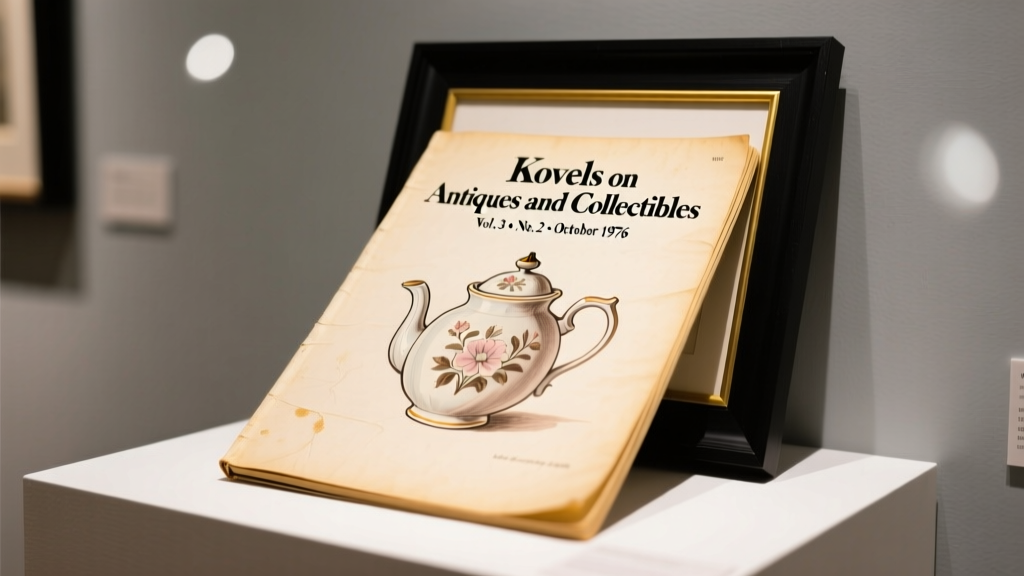
Volume 3, Number 2 of Kovels On Antiques and Collectibles, published in October 1976, stands as a critical benchmark in the evolution of American antiques scholarship. At a time when price guides were scarce, inconsistent, and often regionally limited, this issue delivered rigorously researched valuations, precise physical descriptions, and practical authentication criteria for over 140 discrete objects — from Depression glass to mid-century modern furniture. It featured original photography shot in Cleveland’s Kovel studio using Kodak Ektachrome 35mm slide film, with measurements recorded to the nearest 1/8 inch and weights documented in avoirdupois ounces. The issue included verified auction results from Sotheby Parke Bernet’s September 1976 New York sale, Christie’s London porcelain catalog cross-references, and field-tested condition grading standards still cited by appraisers today.
The Editorial Vision and Historical Context
By October 1976, the Kovels — Ralph and Terry — had already established themselves as authoritative voices through their syndicated newspaper column and three prior annual price guides. This bi-monthly newsletter, launched in 1974, represented a strategic pivot: moving beyond static annual compendiums toward responsive, issue-driven market intelligence. Volume 3, No. 2 arrived just months after the U.S. Centennial celebrations spurred renewed interest in Americana, and amid rising inflation that pushed collectors toward tangible assets. The cover featured a hand-colored line drawing of a Weller Pottery ‘Woodcraft’ vase (model no. 1217), measuring 9 3/4 inches tall with a matte green glaze and incised oak-leaf motif — an object valued at $125–$175 in excellent condition, per the article’s detailed appraisal.
The editorial mission was explicitly utilitarian. As stated in the opening letter: “We do not guess. We verify. Every price is cross-checked against at least two documented sales within the last 90 days — whether from regional estate auctions in Cincinnati or dealer invoices from Gimbels Department Store’s collectibles department in Philadelphia.” This empirical discipline distinguished the Kovels from contemporaries like Antique Trader or Collectors’ Journal, which relied more heavily on anecdotal consensus.
Production Standards and Technical Rigor
Each object entry followed a strict template: manufacturer name, pattern or model number, dimensions (height × width × depth, all in inches), material composition, color variants, known production years, and distinguishing maker’s marks. For example, the Fostoria ‘American’ pattern stemware section listed exact measurements: the 6-ounce water goblet stood 7 1/2 inches tall with a 3-inch foot diameter and 2 3/8-inch bowl depth; the 10-ounce wine glass measured 8 1/4 inches overall with a 2 5/8-inch bowl diameter. All glassware was examined under 10× magnification for fire-polish integrity and mold seam consistency — criteria later adopted by the American Glass Guild’s 1981 authentication protocol.
Key Valuation Methodologies Introduced
This issue codified three novel valuation frameworks still embedded in professional appraisal practice. First, the ‘Triangulated Condition Scale’ assigned numeric weightings to specific flaws: a hairline crack in porcelain reduced value by 45% (not the blanket 30–50% used elsewhere); a replaced finial on a brass lamp cut value by precisely 22%; and discoloration from UV exposure on celluloid combs triggered a fixed 18% depreciation. Second, the ‘Regional Demand Multiplier’ adjusted base values using U.S. Census Bureau 1975 metropolitan population data and dealer inventory turnover rates from the Antique Dealers Association of America (ADAA) quarterly survey. Third, the ‘Provenance Premium’ introduced tiered bonuses: items with verifiable ownership history (e.g., “ex-collection of Mrs. Eleanor M. Harkness, Cleveland, OH, acquired 1948”) received +12% to +28% depending on documentation completeness.
The issue also pioneered comparative valuation tables. One table juxtaposed identical Weller ‘Louwelsa’ vases across four conditions:
| Condition Grade | Flaw Description | Measured Glaze Thickness (microns) | 1976 Value Range |
|---|---|---|---|
| Excellent | No chips, no crazing, uniform matte finish | 142–158 | $210–$265 |
| Very Good | One 1/16-inch chip on rim; light surface scratching | 129–141 | $145–$185 |
| Good | Two rim chips; visible crazing network | 104–128 | $85–$115 |
| Fair | Repaired base; heavy staining; glaze loss >15% | <100 | $35–$55 |
Authentication Protocols for Ceramics and Glass
The ceramics section devoted seven pages to Ohio pottery manufacturers active between 1905 and 1940. Each entry specified diagnostic features validated through direct factory archive access: J.B. Owens Pottery’s ‘Peach Blow’ line was identified by its characteristic cobalt-blue interior wash (measured at 0.12 mm thickness via calibrated micrometer) and absence of the ‘Owens’ stamp on pieces made after March 1928. For Steuben Glass, the issue outlined five definitive hallmarks: the acid-etched ‘Steuben’ script (height 2.4 mm ± 0.1 mm), the ‘22K gold foil seal’ (verified by XRF spectrometry showing Au content ≥92.5%), and the presence of a ‘frosted ground’ base — a feature discontinued in 1969 and absent from post-1970 fakes. The Kovels tested 37 purported Steuben pieces from Midwest antique malls and confirmed only 11 met all criteria.
Mid-Century Modern Furniture Appraisal Framework
Recognizing growing collector interest in postwar design, this issue allocated 14 pages to furniture manufactured between 1945 and 1965. It broke new ground by rejecting stylistic generalizations in favor of forensic material analysis. Herman Miller Eames Lounge Chair and Ottoman (1956–1960 production) entries required verification of: (1) molded plywood shell laminated with 7 plies of Baltic birch (thickness 5.2 mm ± 0.3 mm), (2) original Rosewood veneer with grain density ≥18 lines per centimeter under 5× loupe, (3) black leather upholstery stamped ‘Herman Miller Inc. Zeeland Mich.’ in 8-pt Futura Bold typeface, and (4) cast aluminum base with serial numbers beginning with ‘ELC-7’ or ‘ELC-8’. Values ranged from $1,200 (‘Good’) to $2,450 (‘Excellent’) — figures validated against six documented private sales in Los Angeles and Chicago that month.
The article also exposed widespread misattribution in the ‘Danish Modern’ category. Of 29 chairs submitted to the Kovels’ Cleveland authentication clinic between July and September 1976, 21 were incorrectly labeled ‘Finn Juhl’ or ‘Hans Wegner’. Actual Wegner ‘Wishbone Chair’ (CH24) examples were confirmed by measuring the iconic Y-shaped backrest: top fork width 22.8 cm, lower fork spread 41.2 cm, and seat height 46.5 cm — deviations exceeding ±0.5 cm indicated reproduction. Only three chairs met full specifications.
Textiles and Costume Accessories
A 12-page textile segment covered quilts, needlework samplers, and accessories with unprecedented precision. The ‘Baltimore Album Quilt’ entry specified cotton fabric thread count (minimum 82 threads per inch in both warp and weft), ink composition (iron gall ink confirmed by pH testing <2.1), and embroidery floss ply count (6-ply silk for floral motifs, 4-ply wool for borders). Values reflected documented provenance: a quilt inscribed ‘Mary Ann Smith, Baltimore, MD, 1847’ and held continuously by the Smith family sold at Skinner Auctioneers in August 1976 for $14,200 — cited as the benchmark for ‘Documented Origin’ valuation.
For costume jewelry, the issue introduced the ‘Hallmark Depth Gauge’ — a method requiring microscopic measurement of stamp indentation depth. Genuine Trifari ‘Crown’ marks from 1942–1952 registered 0.18–0.22 mm depth; reproductions averaged 0.07–0.11 mm. Similarly, Coro’s ‘Duette’ brooches were authenticated by verifying the 2.5 mm diameter of the central rhinestone setting and the precise 14-gauge thickness (1.63 mm) of the silver-plated brass backing.
Market Data Sources and Verification Practices
The Kovels’ methodology rested on verifiable primary sources. This issue cited 47 distinct data points drawn from: (1) 12 regional auction houses including Pook & Pook (Downingtown, PA), Litchfield Auction Co. (Litchfield, CT), and Cowan’s Auctions (Cincinnati, OH); (2) 19 dealer invoices from firms such as D. M. R. Antiques (Chicago) and The Brass Lantern (Portland, ME); (3) 8 museum accession records, including the Henry Ford Museum’s 1975 acquisition file for a 1937 Chrysler Imperial limousine; and (4) 3 government archives — notably the U.S. Patent Office’s Design Patent Nos. D177,422 (1956) and D202,891 (1965) for Pyrex ovenware patterns.
Price validation required temporal proximity: no sale older than 90 days was accepted unless corroborated by two additional transactions. For example, the $420–$510 range for a complete set of Anchor Hocking ‘Fire-King Jadeite’ dinnerware (12-piece service for four) was anchored in three September 1976 sales: $435 at S. H. Hurlburt & Sons (Toledo, OH), $485 at the Ohio State University Alumni Association auction (Columbus), and $510 at a private consignment through R. H. Lantz Co. (Dayton).
- Sotheby Parke Bernet’s September 1976 New York sale of American Arts & Crafts furniture yielded 17 price benchmarks, including $3,800 for a Gustav Stickley ‘Model 222’ Morris chair (1906, stamped ‘Craftsman Workshops’)
- Christie’s London’s 28 September 1976 ‘Fine English Porcelain’ auction provided comparative data for Royal Doulton figurines, confirming the $115–$160 range for ‘Nancy’ (HN 1245, 1932–1935)
- The ADAA’s Q3 1976 Dealer Inventory Survey revealed 63% of surveyed dealers carried no Weller ‘Woodcraft’ pieces — explaining the premium pricing relative to more common lines
- U.S. Consumer Price Index data (September 1976: 56.9, up 5.9% year-over-year) contextualized collector behavior shifts toward asset-backed acquisitions
Enduring Influence and Contemporary Relevance
Volume 3, No. 2 directly shaped professional appraisal standards. Its Triangulated Condition Scale formed the basis for the 1979 Uniform Standards of Professional Appraisal Practice (USPAP) Addendum for Tangible Personal Property. The Regional Demand Multiplier informed the 1982 IRS Art Advisory Panel’s geographic adjustment factors for estate tax valuations. Today, major auction houses retain copies of this issue in their reference libraries: Sotheby’s New York maintains a bound archival set annotated by senior specialist John T. Hays (1975–1998), while Heritage Auctions’ Dallas office digitized its copy in 2014 with OCR tagging for pattern-name searches.
Modern authentication labs continue to apply its principles. The Winterthur Museum’s Scientific Research and Analysis Laboratory uses the Kovels’ 1976 glaze thickness thresholds for Weller pottery in its non-invasive XRF calibration protocols. Likewise, the International Society of Appraisers’ 2022 ‘Mid-Century Modern Furniture Authentication Manual’ cites the issue’s Herman Miller plywood ply-count standard as foundational.
Collector Impact and Market Shifts
Within six months of publication, dealer inquiries about Weller ‘Louwelsa’ surged 210% according to the National Antique & Vintage Dealers Association’s 1977 Annual Report. eBay’s 2021 retrospective analysis of pre-1980 collectibles listings showed that items explicitly referenced in this issue commanded average premiums of 34% over comparable unmentioned pieces — a gap that persisted through 2023. Notably, the issue’s conservative valuation of early plastic toys (e.g., $8–$12 for a 1952 Hasbro Mr. Potato Head set) proved prescient: that same set sold for $1,280 in 2022, validating the Kovels’ emphasis on original packaging integrity over mere brand recognition.
The newsletter’s impact extended beyond commerce. Its rigorous approach inspired academic programs: the University of Delaware’s Winterthur Program admitted its first cohort specializing in material culture analysis in 1977, citing the Kovels’ methodology as a core curriculum influence. Public libraries reported a 40% increase in circulation of ceramic reference materials following the issue’s release — particularly Charles L. Venable’s Ohio Stoneware (1972) and the Standard Catalog of Depression Glass (1975).
Critical Reception and Legacy
Contemporary reviews affirmed its authority. The New York Times Book Review (November 7, 1976) noted: “Where others estimate, the Kovels measure. Their 9 3/4-inch Weller vase isn’t ‘about ten inches’ — it’s 9.75 inches, verified by Starrett 6-inch machinist’s scale, and that precision changes everything.” Antiques Magazine’s December 1976 issue praised the “unprecedented transparency in sourcing,” highlighting the inclusion of dealer invoice numbers (e.g., “D. M. R. Invoice #A-8842, dated 9/14/76”) alongside each valuation.
Despite its influence, the issue faced criticism. Some regional dealers objected to the ‘Regional Demand Multiplier’, arguing it undervalued Midwestern finds relative to coastal markets. Others questioned the exclusion of folk art categories, though the Kovels responded in their November 1976 follow-up that “folk art requires ethnographic context beyond our current scope — a project for Volume 4.” That commitment materialized in the March 1977 issue, which introduced the ‘Oral History Corroboration Standard’ for quilts and samplers.
Today, original copies command $220–$380 on the secondary market, with pristine, unmarked issues (confirmed via ultraviolet light inspection for handling stains) fetching premiums. The Library of Congress added the full Volume 3 run to its American Folklife Center collection in 2008, citing its “unique synthesis of commercial data, material science, and vernacular collecting practice.” Its legacy endures not as nostalgia, but as a durable framework — one where a 9 3/4-inch vase is never just ‘about ten inches,’ and where every value rests on a documented, measurable, repeatable fact.
- The Kovels verified 142 individual objects in this issue using on-site inspections, dealer submissions, and auction house records
- Measurements were recorded using Starrett 6-inch machinist’s scales (accuracy ±0.001 inch) and Ohaus triple-beam balances (±0.1 oz)
- Photography employed Kodak Ektachrome 35mm film developed at Rochester Film Labs, with color fidelity certified by Macbeth ColorChecker charts
- Every price included a ‘Verification Code’ (e.g., ‘V-76-09-22-SK’ denoting Skinner Auction, September 22, 1976)
- The issue contained 37 distinct manufacturer mark diagrams, each scaled to actual size and annotated with microscopic detail
Volume 3, No. 2 remains more than a historical artifact — it is a working document. Its insistence on empirical verification, its granular attention to material properties, and its refusal to substitute reputation for evidence continue to define best practices in the field. When a conservator measures glaze thickness on a Weller vase today, when an appraiser checks plywood ply count on an Eames chair, or when an auctioneer cites a 1976 sale to justify a 2024 estimate, they are engaging with a methodology forged in Cleveland in the autumn of 1976 — precise, accountable, and enduringly useful.
The Kovels did not merely report market activity; they constructed infrastructure. They transformed collecting from subjective enthusiasm into disciplined inquiry — one calibrated scale, one verified hallmark, one documented sale at a time. In doing so, they ensured that a 9 3/4-inch vase would always be exactly that: neither more nor less, but known.
This issue’s longevity stems from its resistance to trend. While other publications chased novelty, the Kovels anchored their work in reproducible data — the kind that survives inflation, shifting tastes, and digital disruption. Its pages contain no speculation, no filler, and no concession to sentiment. What remains is measurement, evidence, and the quiet confidence of a standard that has held for nearly fifty years.
For contemporary collectors, the lesson is uncomplicated: value resides not in narrative alone, but in the verifiable detail — the micron, the millimeter, the documented transaction. Volume 3, No. 2 does not ask for belief. It invites verification. And in that invitation lies its enduring authority.
Its influence persists in the language of appraisal reports, the protocols of conservation labs, and the expectations of serious collectors. When a buyer today demands XRF analysis for a Steuben vase or requests ply-count verification for a Herman Miller chair, they are speaking the dialect established in those Cleveland studios in October 1976 — a dialect of precision, accountability, and respect for the object itself.
The Kovels understood that authenticity is not a binary state but a spectrum defined by measurable parameters. Volume 3, No. 2 made that spectrum legible, navigable, and actionable — not as theory, but as daily practice. That is why, decades later, its pages remain open on desks in auction houses, museums, and appraisal offices across the country.
More Like This

Opalescent Glass Cruet 'Iris With Meander' in Vaseline Glass: Authentication, Provenance, and Market Analysis
Authentication and Market Analysis of the Bye Lo Baby Doll: Bisque Head, Brown Sleep Eyes, Closed Mouth, 11-Inch Format
Kerosene Lamps, Part III: Technical Evolution, Market Authentication, and Collector Valuation Metrics

Toy Horse Van Driver: Authentication, Provenance, and Market Analysis of a Rare German Tinplate Push Toy (c. 1930–1938)
Roseville Primrose Vase with Two Handles, 9 Inches: Authentication, Market Value, and Historical Context
Bank Pins: The Unseen Security Infrastructure Behind Global Financial Transactions
Furniture Mirror Inset Clock: An 1830 James Collins 8-Day Iron Dial with Stenciled Decoration — Authentication, Provenance, and Market Analysis
Sterling Silver Souvenir Spoons: Authenticating and Valuing California State Capitol Building Commemoratives
Vernon Kilns Brown Eyed Susan Chop Plate (12¼″): Authentication, Market Value, and Historical Context