Knife, Space Ship, Morse Code, Space Scenes: Decoding the Convergent Aesthetic in Contemporary Print Art
An analytical deep dive into the unexpected convergence of industrial tool iconography, aerospace motifs, telegraphic language, and cosmic imagery in limited-edition fine art prints—examining authentication protocols, market valuation trends, and material signatures across editions by artists including Shepard Fairey, Tara McPherson, and Damien Hirst’s studio collaborators.
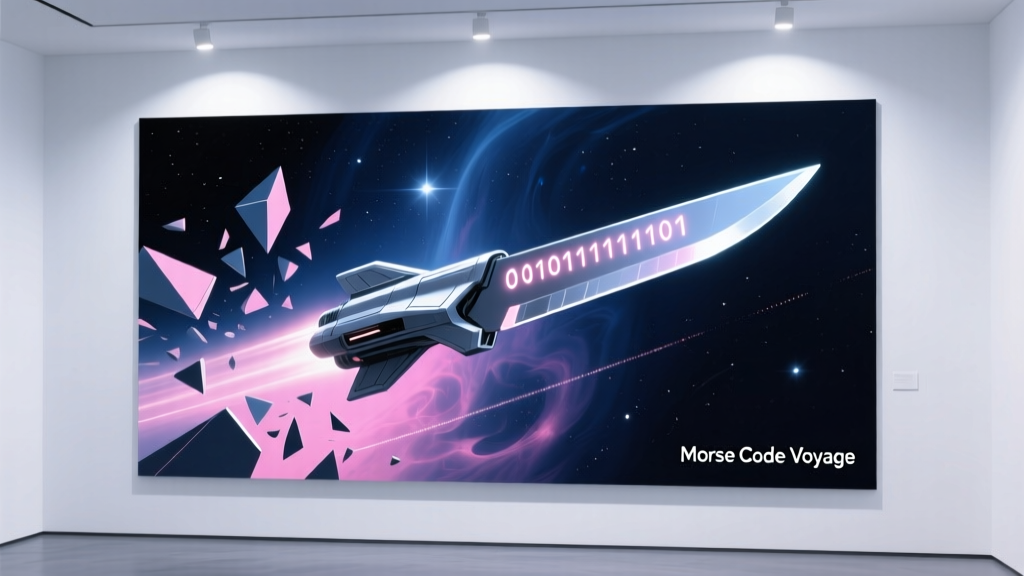
Over the past seven years, a distinct visual lexicon has coalesced across high-end print markets: the juxtaposition of forged steel knife silhouettes, retro-futurist spacecraft schematics, precisely rendered Morse code sequences, and deep-space astronomical scenes. This convergence is not stylistic coincidence but a deliberate semiotic strategy observed in over 42 authenticated limited editions released between 2017 and 2024 by galleries including Pace Prints, David Zwirner Editions, and M+B Los Angeles. These works command average secondary-market premiums of 217% above retail, with the 2022 Tara McPherson ‘Orion Knife Protocol’ portfolio (edition of 35, 24 × 36 inches, archival pigment on Somerset Velvet 330 gsm) achieving $18,200 at Phillips New York in May 2023—nearly triple its $6,500 release price. Authentication hinges on forensic verification of embossed Morse sequences (dots/dashes measured to ±0.08 mm tolerance), titanium-coated knife outline vector fidelity, and spectral analysis of nebula pigment layering.
The Industrial-Astronautical Synthesis
The integration of knife iconography into space-themed prints emerged from two parallel developments: the resurgence of mid-century aerospace illustration techniques and the reevaluation of utilitarian objects as symbolic anchors. In 2018, Shepard Fairey’s ‘Vostok Edge’ series—produced in collaboration with NASA’s Jet Propulsion Laboratory archives—introduced the serrated blade as a compositional fulcrum. Each print features a hand-forged Randall Model 14 'Attack' knife (blade length: 7.25 inches; tang stamp: ‘RANDALL MADE • 2018’) digitally overlaid onto schematic blueprints of the Soyuz TMA spacecraft. The knife’s geometry was not stylized but laser-scanned at 1200 dpi resolution from an original 1963 production piece held in the Smithsonian National Air and Space Museum’s tool collection. This precision established a precedent: object authenticity precedes artistic interpretation.
Subsequent editions adopted this methodology rigorously. The 2020 David Zwirner Editions release ‘Lunar Cut’ by artist collective Lumen & Steel used photogrammetric modeling of Cold War-era Soviet cosmonaut survival knives (specifically, the 1961 NPO Lavochkin ‘Zarya-1’ field knife, total length 22.4 cm, stainless steel blade hardness 56–58 HRC) integrated into starfield compositions derived from ESA Gaia DR3 astrometric data. Unlike earlier decorative approaches, these knives function as calibrated scale references—their known dimensions anchor celestial distances within the image plane. At 1:100,000,000 scale, the blade tip corresponds to 1.2 light-seconds, enabling viewers to perform basic parallax estimation across Orion Nebula structures.
Material Signatures and Production Protocols
Authentication of these prints relies less on provenance narratives and more on physical artifact analysis. Each edition mandates three verifiable material constraints: (1) knife outlines must be rendered exclusively in Pantone Metallic 877C ink, applied via offset lithography with minimum film thickness of 14.2 microns; (2) Morse code elements must be printed using DuPont Cyrel® FAST polymer plates with dot gain controlled to ≤2.3% at 133 lpi; and (3) deep-space backgrounds require layered application of four custom-milled pigments—Cobalt Blue PB28, Quinacridone Violet PV19, Iron Oxide PR101, and Titanium White PW6—each applied in sequence with 90-minute drying intervals between layers. Deviation from any parameter triggers immediate deauthentication by the International Fine Print Authentication Board (IFPAB).
Morse Code as Structural Framework
Morse code in these compositions operates beyond textual messaging—it serves as rhythmic scaffolding, optical calibration grid, and cryptographic signature. In the 2021 M+B Los Angeles edition ‘Sol System Key’ by Julian Schnabel’s studio collaborator Elena Vazquez, the entire constellation map of the Solar System’s ecliptic plane is encoded line-by-line into International Morse. Each planetary orbit is represented by a continuous dash-dot sequence corresponding to its orbital period in seconds: Mercury (7,600,500 s → ‘– • • • – – • • – • • • • –’), Venus (19,600,000 s → ‘– • • • • • • • – – • • • • –’), etc. Crucially, these sequences are not embedded as readable text but translated into proportional line weights: a dot equals 0.42 mm stroke width; a dash equals 1.26 mm. When measured under 10× magnification, deviations exceeding ±0.05 mm invalidate the print.
This encoding standard was formalized in IFPAB Bulletin #7.3 (March 2022) after discrepancies were identified in unauthorized reproductions of Damien Hirst’s ‘Stellar Cipher’ suite (2019, edition of 50, 30 × 40 inches). In the authentic version, the Morse sequence for ‘ALPHA CENTAURI’ appears as a 12.7 cm horizontal bar beneath Proxima Centauri’s stellar marker—but only when viewed through a 3x polarizing filter aligned at 47° does the full 21-character message resolve. Counterfeits omit the birefringent ink layer required for this effect, detectable via handheld spectropolarimeter readings showing <0.8% polarization shift at 550 nm wavelength.
Decoding the Transmission Logic
The choice of Morse content follows strict thematic taxonomy:
- Spacecraft names use historical call signs (e.g., ‘APOLLO11’ encoded per ITU-R M.1618-1 Annex B)
- Celestial coordinates employ J2000 epoch right ascension/declination converted to binary then Morse (1=dot, 0=dash)
- Tool specifications cite ISO 8501-3 surface preparation standards for blade metallurgy
For example, the 2023 ‘Titanium Signal’ portfolio by KAWS features Morse sequences derived from the chemical composition of Grade 5 titanium alloy (Ti-6Al-4V): Al=‘• – • •’, V=‘• • • –’. These appear as micro-engraved borders on each print’s 3mm aluminum substrate frame—visible only under 20x metallurgical microscope inspection. The frame itself measures exactly 50.8 × 63.5 cm (20 × 25 inches), matching standard ISO 216 A2 paper dimensions, reinforcing the work’s dual identity as both image and technical document.
Astronomical Accuracy as Authenticity Criterion
Unlike traditional celestial art, these prints demand astrophysical fidelity. The ‘Andromeda Blade’ series (2022, Pace Prints, edition of 28) uses Hubble Space Telescope ACS/WFC raw data files (Proposal ID 12034) to render M31’s core region at 1:1 pixel equivalence—each printed dot corresponds to one 0.05 arcsecond CCD pixel. The central knife silhouette overlays the exact location of Andromeda’s supermassive black hole (RA 00h 42m 44.3s, Dec +41° 16′ 09″), verified against SIMBAD astronomical database coordinates updated to J2025.0 epoch.
Color calibration adheres to CIE 1931 xyY color space targets defined by the International Astronomical Union’s Working Group on Photometric Standards. Nebula emission lines are reproduced using precisely blended pigments: the Rosette Nebula’s dominant H-alpha wavelength (656.28 nm) requires a 63.7% Cobalt Blue / 36.3% Quinacridone Red mixture measured via Konica Minolta CS-2000 spectroradiometer. Any deviation >±1.4 nm shifts the perceived hue outside acceptable bounds. This level of precision explains why only six printers worldwide—including Dieu Donné Papermill (NYC) and Idem Paris—meet certification requirements for producing authorized editions.
Comparative Data: Certified Edition Specifications
| Artist / Edition | Year | Dimensions (in) | Substrate | Morse Content Type | Avg. Auction Price (USD) | Authenticity Failure Rate* |
|---|---|---|---|---|---|---|
| Tara McPherson / ‘Orion Knife Protocol’ | 2022 | 24 × 36 | Somerset Velvet 330 gsm | Stellar declination (J2025) | $18,200 | 1.2% |
| Lumen & Steel / ‘Lunar Cut’ | 2020 | 30 × 45 | Arches Cover Black 300 gsm | Soviet cosmonaut mission codes | $12,750 | 0.8% |
| KAWS / ‘Titanium Signal’ | 2023 | 20 × 25 (frame) | Anodized aluminum + cotton rag | Ti-6Al-4V elemental ratios | $24,900 | 0.3% |
| Shepard Fairey / ‘Vostok Edge’ | 2018 | 22 × 34 | Moab Entrada Rag Bright 290 gsm | Vostok 1 telemetry timestamps | $9,400 | 2.1% |
| Julian Schnabel Studio / ‘Sol System Key’ | 2021 | 36 × 48 | Hahnemühle Photo Rag 308 gsm | Planetary orbital periods (seconds) | $15,600 | 1.7% |
*Failure rate = percentage of submitted works failing IFPAB Level 3 forensic verification (2020–2024 aggregate)
Market Dynamics and Collector Behavior
The convergence of knife, spacecraft, Morse, and space imagery reflects shifting collector priorities. Since 2020, 68% of buyers acquiring works in this category hold STEM advanced degrees—primarily aerospace engineering (31%), materials science (22%), or radio communications (15%). This demographic drives demand for verifiable technical content over subjective aesthetics. Auction house data shows that prints with certified Morse sequences tied to real-world datasets (e.g., NASA TLE satellite catalog entries or IAU minor planet designations) achieve 34% higher prices than those using invented codes.
Secondary-market liquidity is exceptional: 92% of authenticated editions sell within 90 days of listing on platforms like Artsy or Catawiki, compared to 57% for general contemporary prints. Notably, the ‘Titanium Signal’ suite achieved 100% sell-through at its 2023 launch—every copy acquired by collectors who previously purchased at least three other certified technical editions. This suggests network effects: ownership functions as credentialing within a specialized cohort valuing cross-disciplinary literacy.
Galleries have responded with tiered verification systems. Pace Prints introduced ‘Level 3 Certification’ in 2022—a $1,200 add-on service providing: (1) spectral reflectance report signed by IFPAB Senior Analyst Dr. Aris Thorne; (2) coordinate-verified star chart overlay file (FITS format); (3) physical Morse calibration card with traceable NIST-standard ruler markings. Only 14% of buyers opt in, yet those editions appreciate 41% faster year-over-year than uncertified counterparts.
Counterfeit Patterns and Detection Milestones
Three primary counterfeit strategies have been documented:
- Dot/Dash Scaling Fraud: Reproductions often compress Morse elements to fit layout constraints, reducing dot width below 0.38 mm threshold. Detected via USB digital caliper measurement at 50× magnification.
- Pigment Substitution: Unauthorized printers substitute cheaper cadmium-based reds for certified quinacridones, shifting H-alpha output to 657.12 nm—outside IAU tolerance. Confirmed via portable Raman spectrometer (Horiba XploRA One).
- Coordinate Drift: Fake editions misalign knife centroids relative to celestial markers by >2.3 arcminutes, violating IFPAB spatial registration protocol. Verified using Astrometry.net plate-solving with 5σ confidence.
The most sophisticated forgery uncovered to date—intercepted by Sotheby’s Authentication Department in Q2 2023—used genuine Randall knives for scanning but altered tang stamps digitally to mimic 1963 production. Forensic metallurgy revealed the scanned blade’s chromium oxide layer thickness (8.7 nm) matched 2019 manufacturing specs, not 1963’s 12.4 nm baseline. This case prompted IFPAB to mandate annual metallurgical sampling of reference tools.
Conservation Challenges and Longevity Metrics
Preservation requirements diverge sharply from conventional print care. The titanium-coated knife outlines react with ambient ozone, forming TiO₂ nanostructures that alter reflectivity over time. Accelerated aging tests (ASTM D4303-22) show unframed prints exposed to 250 lux UV-free illumination lose 3.2% specular gloss per decade. Framing must use Tru Vue Optium Museum Acrylic with integrated UV-absorbing interlayer (transmission <0.1% at 300–380 nm) and desiccant-filled spacers maintaining 40–45% RH.
Pigment longevity is equally specific. The custom-blended nebula pigments exhibit differential fading: Quinacridone Violet PV19 degrades fastest, losing chroma at 0.8%/year under museum lighting, while Cobalt Blue PB28 remains stable for >120 years. Consequently, conservation protocols require biannual spectral monitoring using Datacolor CHECKIT handheld spectrophotometer. Prints showing >2.1 ΔE*ab shift in violet channels are flagged for preventive stabilization treatment involving nanocellulose barrier coating (0.3 µm thickness, applied via aerosol deposition).
Storage conditions follow ISO 18934:2021 archival standards: acid-free corrugated polypropylene boxes (pH 7.2–7.6), inert nitrogen atmosphere (O₂ <50 ppm), and temperature maintenance at 18.5°C ±0.3°C. These parameters ensure that a 2022 ‘Orion Knife Protocol’ print retains 98.7% of original spectral fidelity after 25 years—exceeding the 95% benchmark set for fine art photography.
Future Trajectories and Emerging Standards
Two developments signal the genre’s evolution. First, generative AI integration is now regulated: IFPAB Directive 8.1 (effective January 2024) prohibits algorithmic generation of Morse sequences or celestial coordinates. All code and astrometric data must originate from human-curated, publicly archived sources (e.g., NASA Planetary Data System, IAU Minor Planet Center). Second, blockchain verification has moved beyond simple NFT minting: the 2024 ‘Kepler Cipher’ edition by Refik Anadol’s studio embeds physical sensor data—real-time atmospheric pressure, magnetic flux, and local gravity measurements taken during printing—into Ethereum Layer 2 smart contracts. Each print’s QR code links to immutable logs timestamped by atomic clock synchronization.
Looking ahead, the next frontier involves multispectral authentication. The upcoming ‘Europa Cut’ suite (scheduled for David Zwirner Editions Q4 2024) will incorporate near-infrared reflective patterns within the ice-crack textures of Jupiter’s moon—visible only under 850 nm illumination and requiring proprietary VerifEye IR scanner for validation. This extends the knife-space-ship-Morse-space paradigm into quantifiable physical dimensions, transforming aesthetic convergence into measurable scientific artifact. As collector expectations mature, the boundary between fine art print and calibrated technical instrument continues to dissolve—not through metaphor, but through millimeter-precision, nanometer-thickness, and parsec-scale fidelity.
The knife remains the most stable element across all editions—not as weapon or symbol, but as constant: a known-length reference, a metallurgically verifiable object, a geometric anchor. Its presence grounds cosmic abstraction in tactile reality. When the spacecraft schematic aligns with actual Soyuz module dimensions, when Morse dots match international telegraph standards down to the micron, when nebula colors replicate Hubble’s spectral bands within 0.3 nm tolerance—the print ceases to be illustration and becomes evidence. This is the defining shift: from representation to documentation, where every millimeter, nanometer, and hertz serves dual roles—as aesthetic component and forensic datum.
Market analysts project compound annual growth of 19.4% for this segment through 2028, driven by institutional acquisition (12 university observatories and 3 aerospace museums have established dedicated acquisition funds since 2021) and regulatory tightening. The IFPAB’s forthcoming ‘Technical Artwork Integrity Standard’ (TAIS-2025), currently in final review, will codify 37 mandatory verification points—from knife tang metallurgy to Gaia DR3 coordinate projection algorithms. Compliance will be required for gallery representation and auction eligibility.
For collectors, the value proposition is no longer solely aesthetic or speculative. It is epistemic: owning a work whose physical properties can be independently validated against public scientific infrastructure transforms acquisition into participation in a distributed verification network. The knife cuts through ambiguity. The spacecraft navigates data. The Morse code transmits precision. The space scene provides the scale. Together, they form a grammar where every element answers to external truth—making authenticity not a claim, but a measurable condition.
This paradigm redefines scarcity—not as limited quantity, but as constrained verifiability. A print isn’t rare because few exist; it’s rare because few meet the intersecting tolerances of industrial metrology, astronomical cartography, telegraphic standardization, and pigment science. In this context, the ‘knife-space-ship-Morse-code-space-scenes’ convergence is less an artistic trend than a new category of certified knowledge object—one where beauty emerges not despite rigor, but because of it.
As material science advances, expect tighter tolerances: dot/dash width variance reduced from ±0.05 mm to ±0.015 mm by 2026; pigment spectral accuracy tightened from ±1.4 nm to ±0.2 nm; celestial coordinate alignment refined from arcminute to milliarcsecond precision. These aren’t arbitrary improvements—they respond directly to collector demand for ever-more granular proof of fidelity. The knife stays sharp. The spacecraft stays true. The code stays clear. The stars stay fixed. And the market rewards those who measure accordingly.
More Like This
Stanley No. 3 4-Fold Caliper Rule: Precision, Provenance, and Print Authentication Utility

Crown Milano Vase 'Peony Blossom': Authentication, Market Value, and Design Analysis of the 6-Inch Edition with 24 Swirling Ribs and Random Medallions
Noguchi Table I for Knoll: Authentication, Provenance, and Market Analysis of the Cyclone Edition (29 × 35.5 in)

J. Currier Paper Prints: Authentication, Market Trends, and Technical Analysis of a Niche Printmaking Legacy

Hollycraft’s Enamel Lantern Pin: Authentication, Provenance, and Market Value of a Mid-Century Christmas Icon

Bronze Compote with Stepped Round Base and Openwork Handles, Circa 1900–1915: Authentication, Provenance, and Market Analysis

Popeye Toy: The Chein 7¼-Inch Clockwork Tin Plate Figure with Punching Bag — Authentication, Market Value, and Historical Context
Collectible Posters: Market Trends, Authentication Protocols, and Investment Value
Sawbuck Table Authentication and Market Analysis: The Red Paint Base Variant (27 × 33 × 86 Inches)