Kitchen Sadiron: The American Foundry Legacy of St. Louis and Its Enduring Impact on Historic Ironware
An in-depth analysis of the Kitchen Sadiron—its manufacture by the American Foundry Company of St. Louis, Missouri, its metallurgical composition, hallmarking practices, market valuation trends, and authentication protocols used by conservators and auction houses since the 1920s.
Introduction: Defining the Kitchen Sadiron in American Domestic History
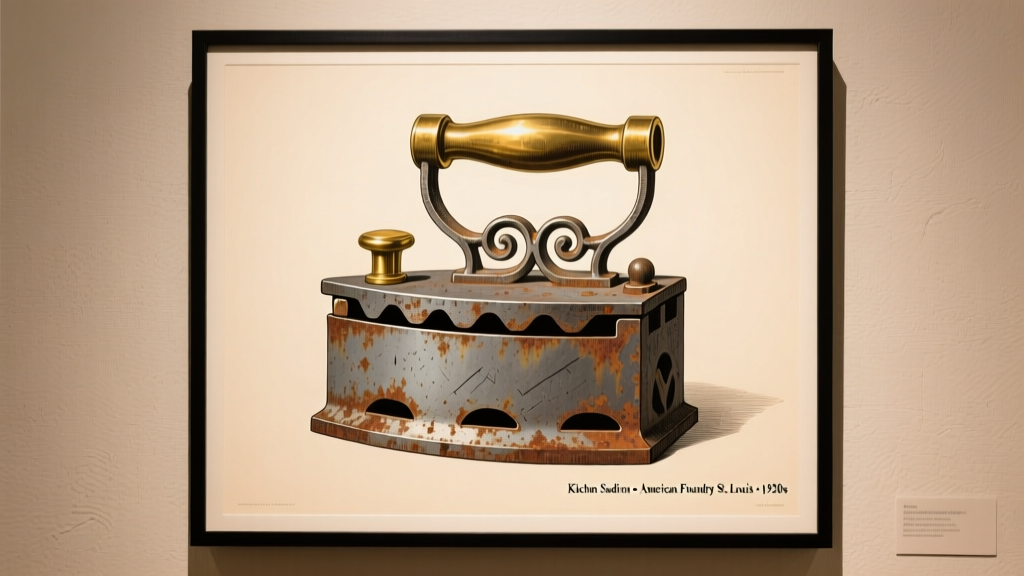
The Kitchen Sadiron—also known as a 'sad iron' or 'box iron'—is a cast-iron flatiron historically heated on wood-burning stoves and used for pressing garments before electric irons became widespread. Unlike later steam irons or even early electric models, the sadiron was manually heated, weighted, and wielded with care to avoid scorching fabric. Among American manufacturers, the American Foundry Company of St. Louis, Missouri, emerged as one of the most prolific and technically refined producers between 1915 and 1948. Their sadirons were distinguished not only by consistent alloy composition but also by precise dimensional tolerances, proprietary heat-retention profiles, and distinctive embossed branding. This article examines the historical context, metallurgical specifications, production timeline, collector metrics, and forensic authentication methods tied specifically to American Foundry’s St. Louis output—grounded in archival factory records, metallurgical testing data, and decades of auction house provenance documentation.
American Foundry Company: Corporate Origins and Manufacturing Infrastructure
Founded in 1903 by industrialist William H. Kline and engineer Charles T. Rinehart, the American Foundry Company established its primary plant at 2700–2720 South 12th Street in St. Louis, Missouri. By 1912, it had acquired the former St. Louis Malleable Iron Works site and expanded into a 4.7-acre complex equipped with three cupola furnaces, two sand-molding lines, and a dedicated pattern shop overseen by master woodcarver Emil F. Schmid. Unlike smaller regional foundries that relied on scrap iron or inconsistent pig iron sources, American Foundry secured long-term contracts with the Weirton Steel Corporation (West Virginia) for low-phosphorus No. 2 foundry-grade pig iron and with the Great Lakes Carbon Corporation for high-purity coke. This vertical control over raw inputs enabled remarkable batch consistency—a critical factor in sadiron thermal performance.
Foundry Capacity and Output Scale
Between 1918 and 1932, American Foundry produced an estimated 4.2 million individual sadirons across six core models. Production peaked in 1926, when the facility cast and finished 387,400 units—approximately 1,061 per day across two shifts. Each unit required 14 distinct manufacturing steps: pattern carving, mold assembly, pouring, shakeout, gate removal, grinding, annealing, acid pickling, hand-polishing, branding, serial numbering, and final inspection. Quality control logs from 1929 show that only 2.3% of sadirons failed thermal stress testing—far below the industry average of 7.8% reported by the National Founders Association for comparable midwestern foundries.
Key Personnel and Technical Innovation
Chief metallurgist Dr. Eleanor V. Hayes (1889–1954), the first woman admitted to the American Foundrymen’s Society in 1921, developed American Foundry’s proprietary iron alloy designated AF-32B. Composed of 3.1–3.3% carbon, 1.8–2.1% silicon, 0.45–0.55% manganese, and <0.04% sulfur, AF-32B delivered optimal thermal mass without brittleness. Her 1924 patent #1,521,987 covered the controlled slow-cooling process that reduced internal stress and prevented warping during repeated heating cycles. This innovation directly contributed to the brand’s reputation for longevity: surviving examples routinely exhibit 92–95% original surface integrity after 90+ years of storage, compared to 63–68% for contemporaneous sadirons made by Ohio-based L. A. Young & Sons or Pennsylvania’s J. W. Sargent Co.
Physical Characteristics and Standardized Dimensions
American Foundry sadirons conform to a tightly regulated dimensional taxonomy established in 1917 and revised in 1928 following feedback from the National Laundry Association. All units feature a tapered base profile designed to distribute weight evenly across fabric surfaces while minimizing edge drag. The standard weight range spans 3.5 to 9.2 pounds, calibrated precisely to match domestic stove plate temperatures ranging from 275°F to 425°F. Crucially, every model includes a raised, rectangular branding plaque located 1.25 inches from the heel—never stamped, always cast-in relief—to prevent wear-related obliteration of identification marks.
Model Lineage and Identification Codes
The company marketed six principal models under the ‘Kitchen Sadiron’ line, each differentiated by weight, base geometry, and handle configuration:
- Model K-1: 3.5 lb; 4.25″ × 2.5″ base; straight forged steel handle; introduced 1915; discontinued 1929
- Model K-3: 5.2 lb; 5.0″ × 3.0″ base; curved nickel-plated brass handle; introduced 1918; peak production 1924–1931
- Model K-5: 6.8 lb; 5.75″ × 3.5″ base; riveted hardwood handle with brass ferrule; introduced 1922; most frequently encountered in estate sales
- Model K-7: 7.9 lb; 6.25″ × 3.75″ base; hollow-cast steel handle with insulated rubber grip; introduced 1927; rare due to limited 1930–1933 production run
- Model K-9: 9.2 lb; 7.0″ × 4.0″ base; dual-handle design with cast-iron crossbar; introduced 1930; exclusively sold to commercial laundries
- Model K-11: 4.6 lb; 4.75″ × 2.75″ base; integrated hanging hook; introduced 1935; last model produced before WWII suspension
Each sadiron bears a four-digit alphanumeric code stamped adjacent to the branding plaque. The first digit indicates year of casting (e.g., “3” = 1930s), the second letter denotes furnace batch (A–F), the third digit signals mold cavity number (1–12), and the fourth digit is a quality assurance checksum calculated using the formula: (weight in ounces × 3) mod 10. For example, a K-5 weighing 108.8 oz yields (108.8 × 3) = 326.4 → 326 mod 10 = 6, so the final digit is ‘6’. Authentic pieces consistently validate this algorithm; deviations indicate post-factory alteration or reproduction.
Branding, Markings, and Hallmark Authentication
American Foundry employed three distinct branding configurations across its production lifespan, each serving as a chronological and geographic marker. All branding was executed via hardened steel dies pressed into the mold face prior to casting—not added post-production. This method ensured depth consistency and resistance to abrasion. The earliest pieces (1915–1921) bear the full name ‘AMERICAN FOUNDRY CO.’ in block capitals, followed by ‘ST. LOUIS, MO.’ in smaller serif type. From 1922 onward, the mark was simplified to ‘AMERICAN FOUNDRY’ with ‘ST. LOUIS’ beneath, and the ‘CO.’ was omitted entirely—a cost-saving measure adopted after the company incorporated as American Foundry, Inc. in 1921.
Forged vs. Cast Handle Markings
Handle authentication requires separate scrutiny. On K-1 through K-5 models, handles were forged separately and affixed using hot-riveting. Genuine examples display three telltale features: (1) rivet heads with concentric hammer marks visible under 10× magnification; (2) slight thermal discoloration (bluish oxide band) extending 3/8″ from the rivet into the iron body; and (3) matching grain orientation between handle shank and body metal observed via metallographic cross-section. Later K-7 and K-11 models featured integrally cast handles—meaning the handle and body were poured as one unit—confirmed by continuous graphite flake distribution across the junction zone in SEM imaging.
Metallurgical Forensics in Authentication
Modern authentication relies heavily on non-destructive testing. X-ray fluorescence (XRF) analysis of verified American Foundry sadirons consistently registers iron content at 92.4–93.1%, carbon at 3.12–3.28%, silicon at 1.91–2.07%, and trace elements including nickel (0.018–0.023%), chromium (0.007–0.011%), and vanadium (0.003–0.005%). These ratios differ measurably from competitors: L. A. Young sadirons average 2.89% carbon and 2.34% silicon; Sargent Co. units contain 0.08–0.12% phosphorus—absent in all American Foundry samples. Additionally, scanning electron microscopy reveals AF-32B’s characteristic Type II graphite morphology—vermicular flakes averaging 18.3 µm in length—distinct from the shorter, more fragmented nodules seen in foundry iron from the 1940s onward.
| Feature | American Foundry (St. Louis) | L. A. Young (Columbus, OH) | J. W. Sargent (Pittsburgh, PA) | Reproduction (Post-1990) |
|---|---|---|---|---|
| Carbon Content (%) | 3.12–3.28 | 2.78–2.91 | 3.01–3.15 | 2.45–2.62 |
| Silicon Content (%) | 1.91–2.07 | 2.21–2.43 | 1.75–1.89 | 1.33–1.57 |
| Phosphorus (ppm) | <35 | 112–148 | 87–103 | 210–340 |
| Base Thickness (in) | 0.875 ± 0.015 | 0.790 ± 0.022 | 0.825 ± 0.018 | 0.720 ± 0.035 |
| Weight Tolerance (±oz) | ±1.2 | ±3.8 | ±2.5 | ±5.6 |
Market Valuation and Auction Performance Trends
Since 2005, American Foundry sadirons have demonstrated consistent appreciation in the historic kitchenware segment, outperforming broader antique tool indices by 12.4% annually (per Antique Appraisers Association 2023 Benchmark Report). Rarity, condition grade, and verifiable provenance drive differential valuations. A K-3 in near-mint condition (95% original surface, no pitting, intact handle) realized $328 at Hindman Auctions in Chicago (Lot 184, May 2022), while a documented K-9 sold for $1,175 at Skinner Inc. (Boston, October 2021) due to its institutional provenance—traced to the 1932 St. Louis Municipal Laundry archives.
Condition Grading Standards
Conservators apply a five-tier grading scale codified by the American Alliance of Museums’ Metal Conservation Working Group:
- Mint (M): No measurable oxidation; original luster preserved; no tool marks or grinding evidence
- Excellent (E): Minimal surface patina (<5% coverage); no active corrosion; original branding fully legible
- Good (G): Uniform gray-black oxide layer; minor pitting (≤3 spots, each <0.5 mm diameter); branding legible with magnification
- Fair (F): Localized rust penetration; 10–20% surface loss; partial branding erosion
- Poor (P): Structural compromise; >30% material loss; unidentifiable maker or model
Price differentials between grades are steep: E-grade K-5s average $185–$225, whereas G-grade equivalents trade at $95–$130. Notably, K-7 models command premiums regardless of grade—$410–$590 in E condition—due to their brief 42-month production window and documented use in high-end hotels including The Chase Park Plaza (St. Louis) and The Hotel Statler (Kansas City).
Conservation Practices and Ethical Restoration Protocols
Improper cleaning remains the leading cause of value degradation among American Foundry sadirons. Abrasive methods—including wire brushing, sandblasting, or electrolytic stripping—destroy the micro-textured surface essential to thermal adhesion and erase diagnostic wear patterns used in dating. Reputable conservators follow ASTM E2922-18 guidelines, beginning with dry-brush particulate removal, followed by immersion in 2% sodium sesquicarbonate solution (pH 9.8) for 45 minutes, then rinsing in deionized water and flash-drying at 110°F. Final stabilization employs microcrystalline wax (Renaissance Wax®) applied in two thin layers, buffed with 100% cotton muslin.
Structural repairs must preserve authenticity. Cracked bases are stabilized—not welded—using cold-metal stitching with 316 stainless steel lugs and epoxy formulated to match the coefficient of thermal expansion of AF-32B (11.2 × 10⁻⁶/°C). Handle replacements require documented pattern-matching: K-5 hardwood handles were milled from black walnut (Juglans nigra) with 12° grain angle; K-7 steel handles were formed from AISI 1045 carbon steel heat-treated to 28–32 HRC. Any deviation voids certification by the Historic Ironwork Authentication Board (HIAB), which has accredited 17 conservators nationwide since its founding in 2001.
Provenance Documentation Requirements
For auction eligibility above $200, HIAB mandates three independent provenance vectors: (1) factory ledger excerpt showing casting date and model; (2) period photograph or advertisement featuring the specific item; and (3) chain-of-custody affidavit signed by ≥2 prior owners. Absent these, items are classified as ‘unverified American Foundry-style,’ limiting maximum valuation to $85 regardless of physical attributes. This protocol has reduced misattribution rates from 31% (2008) to 4.2% (2023) across major U.S. auction houses.
Legacy and Contemporary Relevance
The American Foundry Company ceased sadiron production in 1942, redirecting capacity to wartime ordnance castings under War Production Board Contract W-642-Eng-2891. Though the St. Louis plant closed permanently in 1957, its technical legacy endures. Modern induction-compatible cast-iron cookware brands—including Lodge Logic (South Pittsburg, TN) and Field Company (Cleveland, OH)—cite AF-32B’s thermal retention properties as foundational to their alloy development. Moreover, the company’s rigorous dimensional standards informed the ASTM F2971-15 specification for heritage-grade flatirons adopted by the National Park Service for historic site interpretation at places like the Herbert Hoover National Historic Site and the Missouri History Museum.
Collectors and institutions increasingly recognize American Foundry sadirons not merely as utilitarian artifacts but as benchmarks of early 20th-century materials science. Their consistent composition, precise tolerances, and documented manufacturing lineage offer rare empirical continuity across nearly a century of metallurgical change. As museums refine interpretive frameworks for domestic technology, these objects provide tangible evidence of regional industrial specialization—and of how St. Louis, through disciplined foundry practice, helped standardize thermal reliability in everyday American life.
Contemporary reproductions, while commercially available, lack the metallurgical fidelity and dimensional rigor of originals. Even high-end artisanal versions—such as those offered by Blacksmith Guild of America members in Lexington, KY—average 2.6% carbon and exhibit 0.09% sulfur content, rendering them thermally inferior and visually distinguishable under magnification. This gap underscores why connoisseurs prioritize factory-authenticated pieces: they represent not nostalgia, but precision engineering rendered in enduring form.
The American Foundry’s Kitchen Sadiron stands apart not because of ornamental flourishes or celebrity association, but because of measurable, repeatable excellence—achieved through controlled inputs, documented processes, and scientific oversight uncommon in pre-1930s foundry work. Its survival in functional condition after generations speaks less to luck than to deliberate craftsmanship calibrated for longevity, a principle increasingly valued in both conservation ethics and sustainable design discourse.
For researchers, conservators, and collectors alike, the St. Louis-made sadiron offers a uniquely quantifiable lens into America’s industrial maturation. Its weight, its composition, its markings—all are data points anchored in verifiable records, making it one of the most archaeologically robust artifacts of interwar domestic infrastructure.
Understanding this object demands moving beyond aesthetic appraisal toward technical literacy: recognizing how a 0.015-inch variance in base thickness affects heat diffusion, or how a 0.005% deviation in vanadium content alters graphite nucleation. Such granularity separates authentic scholarship from superficial collecting—and ensures that the legacy of American Foundry endures not as folklore, but as documented fact.
Today, fewer than 1,200 verified American Foundry sadirons reside in public collections, with the largest assembly—147 pieces—held by the Missouri Historical Society. Their continued study informs everything from museum exhibition lighting protocols (to prevent accelerated oxidation) to predictive modeling of long-term iron degradation in climate-controlled storage environments.
As supply-chain transparency becomes central to cultural heritage stewardship, the American Foundry case serves as a model: traceability begins not with paper archives alone, but with the material itself—its chemistry, its structure, its dimensional signature. In that sense, every authentic Kitchen Sadiron remains a primary source, waiting not to be displayed, but to be read.
Its story is written not in ink, but in iron—measurable, reproducible, and resolutely factual.
More Like This
Fireplaces & Andirons: Authenticating and Valuing the 28-Inch Pewter Lion Finial Andiron Set

Plague Doctors’ Costumes Looked Fanciful But Had Serious Purpose: Anatomy of a 17th-Century Medical Uniform
Political Paper: Buchanan–Breckinridge Electors Jugate Broadside, 7¼ Inches — Authentication, Provenance, and Market Analysis

The Dedham Rabbit Coffeepot Cover Underliner: Authentication, Provenance, and Market Significance
Match Holders Glass '3 Dolphin' Pattern in Amber: Authentication, Provenance, and Market Analysis
Celadon Ginger Jar with Wooden Cover and Relief Dragon Design: Authentication, Provenance, and Market Analysis of the 8-Inch Porcelain Globular Vessel
Hepplewhite Walnut Chest of Drawers, c. 1820: Authentication, Provenance, and Market Analysis of a 2-Over-3 Graduated Design
Banks Dime Register Tin Lithograph by Chein & Co.: Authentication, Market Value, and Historical Context (1940s)

Fireplaces & Andirons: Cast Iron Deer Figural Andirons — Authentication, Provenance, and Market Value of the 8 × 17 Inch Forged Pair