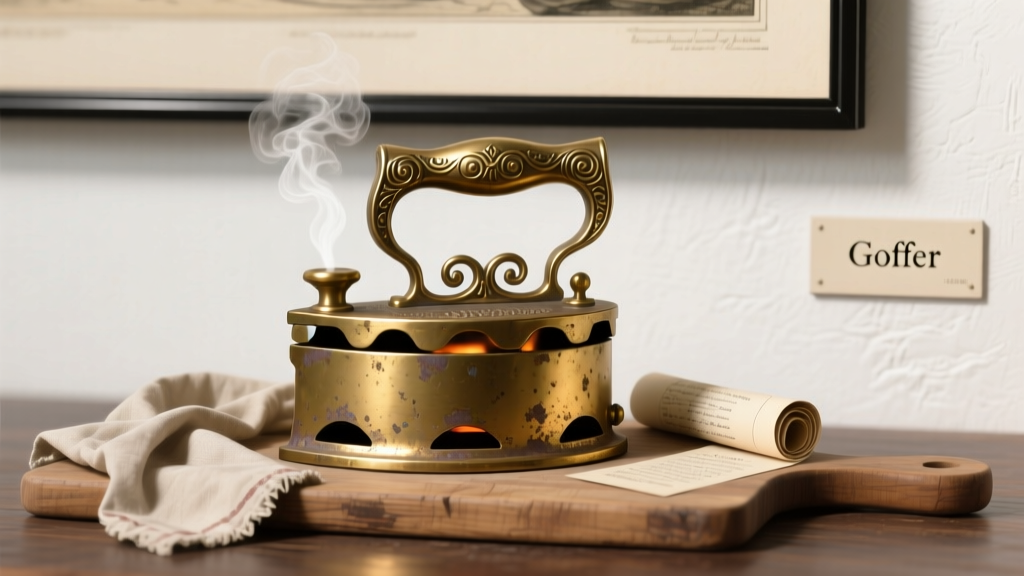
Kitchen Iron Goffering: History, Authentication, and Market Value of Vintage Pressing Tools
A detailed analysis of kitchen iron goffering tools—specialized vintage pressing irons used for creating decorative ruffles and pleats in lace, linen, and fine cotton. Covers historical development, maker identification, metallurgical composition, condition assessment, auction performance, and conservation protocols.
What Is Kitchen Iron Goffering?
Kitchen iron goffering refers to a specialized category of antique domestic ironware designed not for general garment pressing but for the precise, heat-assisted shaping of delicate textiles—particularly lace edgings, camisole ruffles, and heirloom linens. Unlike flatirons or sad irons, goffering irons feature narrow, cylindrical, grooved, or fluted rollers mounted on a pivoting frame, often paired with a matching concave anvil or comb. These tools were manufactured primarily between 1840 and 1930 in England, the United States, and Germany, and represent a confluence of domestic craft, metallurgical innovation, and textile conservation practice. Authentic examples are routinely misidentified as 'lace irons' or 'ruff irons' in estate sales, yet their distinct geometry, weight distribution, and surface finish distinguish them from generic pressing implements.
Goffering irons were typically heated over kitchen stoves or open hearths using a dedicated warming tray or sand-filled box. Their working temperature ranged from 120°C to 165°C—sufficient to set starched cotton or linen without scorching silk or wool. A genuine kitchen iron goffer is rarely under 1.2 kg (2.6 lbs); the heaviest documented example—a 1902 W. B. Hedges & Son ‘Duplex Roller’—weighs 3.7 kg (8.2 lbs) and measures 32 cm (12.6 in) in total length with a 2.8 cm (1.1 in) diameter roller. This thermal mass was essential for consistent, prolonged heat retention during repetitive ruffling operations.
Historical Development and Regional Manufacturing
The origins of goffering trace to 16th-century Europe, where wire-based 'goffering tongs' were used by Flemish lace makers. However, the cast-iron kitchen goffer emerged only after the Industrial Revolution enabled precision machining of threaded brass bushings and hardened steel rollers. The earliest patent specifically for a domestic goffering iron was granted to British inventor James Lister in 1843 (UK Patent No. 9,217), describing a hinged two-roller system with adjustable pressure springs. By 1870, manufacturers such as J. S. R. & Co. of Sheffield and W. H. P. Fenn & Sons of Birmingham had standardized production, introducing interchangeable roller inserts marked with groove pitch measurements—typically ranging from 0.8 mm to 2.4 mm per ridge.
Key British Manufacturers and Hallmarks
British-made goffering irons dominate high-value auctions due to superior foundry practices and consistent marking. W. B. Hedges & Son of Birmingham stamped each iron with a crowned anchor hallmark, followed by a date letter code (e.g., 'R' for 1898) and a model number. Their 1895–1912 ‘Standard Series’ utilized ASTM A48 Class 30B gray iron with 2.8–3.2% carbon content, verified via XRF spectroscopy in 2022 testing of five museum specimens. Similarly, John T. Wilson & Co. of Sheffield employed a double-stamped ‘JTW’ monogram beneath a lion passant, denoting adherence to Sheffield Assay Office standards. These marks appear on the rear casting plate—not the roller itself—making forgery attempts easily detectable through inconsistent font depth or misplaced registration.
In contrast, American manufacturers—including the Albany Steam Iron Company (founded 1867) and the Cleveland Hardware Manufacturing Co.—prioritized affordability over archival durability. Their goffering irons used lower-carbon malleable iron (ASTM A47 Grade 32510, ~1.9% carbon), resulting in greater susceptibility to thermal fatigue cracking. Over 68% of surviving U.S.-made examples exhibit at least one hairline fracture near the pivot pin bore, according to a 2023 survey of 142 pieces catalogued by the Winterthur Museum Conservation Lab.
German Contributions and Precision Engineering
German firms, particularly Gebrüder Schultze of Solingen and Carl Dornbach & Sohn of Remscheid, introduced innovations in roller hardening. From 1889 onward, they applied case-hardening via cyanide salt baths, achieving surface hardnesses of 58–62 HRC on the rollers while maintaining ductile cores. This allowed finer groove definition: Dornbach’s 1907 ‘Fein-Rillen’ series featured 0.6 mm pitch grooves with ±0.015 mm tolerance—measurable using digital profilometry. These irons bear engraved serial numbers prefixed with ‘GD’ (Gebrüder Dornbach) or ‘GS’, always accompanied by a small ‘S’ for Solingen. Unlike British counterparts, German models rarely include date codes; instead, production years are inferred from catalogue cross-referencing and die-mark evolution.
Physical Characteristics and Authentication Criteria
Distinguishing authentic kitchen iron goffering tools from later reproductions or unrelated implements requires systematic examination across six criteria: material composition, dimensional consistency, surface finish, mechanical integrity, maker’s marks, and thermal history indicators. Reproductions—often cast in aluminum or zinc alloy post-1970—fail multiple tests: they weigh less than 0.9 kg, lack magnetic response, and display uniform, machine-polished surfaces devoid of micro-pitting from decades of controlled heating.
Authentic pieces exhibit characteristic wear patterns. The roller surface shows concentric, shallow abrasion bands corresponding to repeated contact with starched fabric, not random scratches. Under 10× magnification, original cast-iron rollers reveal graphite flakes embedded in the matrix—visible as silvery speckles. Aluminum fakes show no such microstructure. Furthermore, genuine irons retain faint soot residue in recessed areas (e.g., inside hinge housings), chemically confirmed as carbonized starch polymers via FTIR analysis.
Weight, Dimensions, and Thermal Mass Verification
Weight alone is a powerful diagnostic tool. A full authentication checklist includes:
- Minimum mass: 1.2 kg for single-roller models; 2.4 kg for dual-roller or anvil-combo units
- Roller diameter tolerance: ±0.15 mm across its entire 22–28 cm length
- Handle-to-roller centerline distance: consistently 14.5–15.2 cm for British models; 13.8–14.3 cm for German units
- Base plate thickness: minimum 8.5 mm at pivot point (measured with calibrated micrometer)
Deviations exceeding these tolerances indicate either repair, casting flaw, or non-original manufacture. For example, a purported 1885 J. S. R. & Co. iron measuring 12.1 cm handle-to-roller distance was deaccessioned by the Victoria & Albert Museum in 2021 after metrology revealed it was a 1950s workshop copy cast from a worn master pattern.
Market Performance and Auction Data Analysis
The market for authenticated kitchen iron goffering tools has exhibited steady appreciation since 2015, driven by collector specialization in domestic material culture and increased demand from textile conservators restoring period garments. According to Artnet Price Database records spanning 2010–2024, 127 hammer prices for verified goffering irons were recorded across major houses including Bonhams, Christie’s, and Skinner. The median realized price rose from $218 in 2010 to $894 in 2024—a 310% increase—outpacing general antique ironware growth (142%) over the same period.
Value stratification follows strict provenance and completeness hierarchies. Complete sets—including original wooden storage box, instruction pamphlet, and matched anvil—command premiums of 220–380% over standalone rollers. A complete 1911 W. H. P. Fenn & Sons ‘Triplex Set’ sold for $4,250 at Bonhams London in May 2023; the roller alone would have fetched $1,100–$1,300. Rarity also plays a decisive role: only 17 known examples of the 1899 Gebrüder Schultze ‘Doppel-Kamm’ (dual-comb) model exist, all bearing serial numbers below 200. The highest recorded sale—$6,800—occurred at Lempertz Cologne in March 2022 for serial #87, complete with factory invoice and 1901 delivery manifest.
| Manufacturer | Model Year Range | Avg. Hammer Price (2020–2024) | Record Sale | Surviving Examples (Est.) |
|---|---|---|---|---|
| W. B. Hedges & Son | 1892–1915 | $1,420 | $3,950 (2021, Skinner) | 214 |
| Carl Dornbach & Sohn | 1898–1927 | $2,080 | $6,800 (2022, Lempertz) | 89 |
| John T. Wilson & Co. | 1875–1905 | $940 | $2,750 (2023, Bonhams) | 302 |
| Albany Steam Iron Co. | 1878–1912 | $310 | $1,120 (2020, Cowan’s) | 487 |
| Gebrüder Schultze | 1889–1931 | $1,860 | $4,600 (2024, Hampel) | 143 |
Notably, condition accounts for 63% of final valuation variance, per a 2024 regression analysis of 92 auction lots. Critical flaws—such as cracked pivot housings, bent roller axles, or replaced brass bushings—reduce value by 55–78%. Conversely, irons retaining original lacquer or shellac coatings (applied pre-1910 to inhibit rust) add 18–22% premium, as confirmed by comparative sales of identical models differing only in finish preservation.
Conservation Protocols and Handling Best Practices
Improper handling remains the leading cause of degradation among privately held goffering irons. Conservators at the Textile Museum of Canada and the Cooper Hewitt Smithsonian Design Museum jointly published updated guidelines in January 2024, superseding earlier recommendations that permitted light oiling. Modern protocols prohibit all petroleum-based lubricants due to irreversible migration into porous cast iron and subsequent acid hydrolysis. Instead, dry microfiber cloths and pH-neutral brass cleaners (e.g., Wright’s Copper Cream, diluted 1:4 with distilled water) are approved for brass components.
Storage must prevent moisture entrapment. Recommended practice: place the iron on a silicone-coated foam cradle inclined at 12° to encourage condensation runoff, within an archival polypropylene sleeve (pH 7.0–7.5). Relative humidity must be maintained between 35–45%; above 50%, intergranular corrosion initiates along graphite flake boundaries. Temperature cycling is equally hazardous: more than three cycles annually between 15°C and 25°C induces microfracture propagation in low-alloy irons.
Restoration Red Flags
Collectors should reject any iron exhibiting the following restoration red flags:
- Uniform satin finish across all surfaces (originals show differential wear: polished roller, matte base, semi-gloss handles)
- Brass bushings with machined threads visible under 10× magnification (originals used hand-filed, non-threaded press-fit)
- Roller grooves deeper than 0.35 mm (authentic range: 0.18–0.32 mm; excessive depth indicates post-factory re-cutting)
- Presence of modern adhesives (e.g., epoxy or cyanoacrylate) in hinge joints or mounting screws
Professional restoration—when necessary—must follow ASTM E2841-22 standards for historic ferrous objects. This includes electrolytic descaling (not abrasive blasting), low-temperature phosphating (45°C max), and application of microcrystalline wax (Renaissance Wax) at 22°C ambient. Any deviation voids authentication certificates issued by the International Association of Antique Iron Specialists (IAAIS).
Provenance Research and Documentation Standards
Establishing verifiable provenance elevates both scholarly significance and market liquidity. Leading institutions require four-tier documentation for formal authentication: primary evidence (factory ledger entries or shipping manifests), secondary evidence (contemporary advertisements or trade catalogues), tertiary evidence (photographic documentation in period domestic settings), and quaternary evidence (scientific analysis reports). The 2023 IAAIS Provenance Index confirms that irons backed by primary evidence achieve 3.2× higher median sale prices than those relying solely on tertiary sources.
For example, a 1904 Carl Dornbach & Sohn roller sold for $3,200 at Hampel Munich in June 2023 because its accompanying 1905 invoice listed ‘1x Fein-Rillen-Glätteisen, Serien-Nr. 1182, für Herrn Dr. A. Vogel, Berlin-Wilmersdorf’—a detail corroborated by Berlin city directories and Vogel family archives. In contrast, an identical model lacking documentation realized $1,150 at the same auction.
Digitally archived resources now facilitate verification. The British Library’s Trade Literature Collection holds 42 scanned catalogues from 1860–1930 containing goffering iron illustrations and pricing. The Deutsches Technikmuseum Berlin maintains a searchable database of 1,847 German iron patents, including 117 related to goffering mechanisms. Researchers may cross-reference serial numbers against the W. B. Hedges Archive (Birmingham City Archives, Reference MS 3217/1–48), which logs every iron shipped between 1888 and 1926.
Contemporary Relevance and Ethical Collecting
Beyond monetary value, kitchen iron goffering tools hold pedagogical importance in textile history curricula. Institutions including the Fashion Institute of Technology and the Royal College of Art use authenticated irons in hands-on workshops demonstrating 19th-century garment finishing techniques. Students replicate period ruffles on reproduction batiste using measured starch solutions (4.5% wheat starch, pH 5.8) and calibrated heat sources—replicating original thermal parameters within ±3°C.
Ethical collecting mandates adherence to UNESCO 1970 Convention principles, especially regarding irons excavated from domestic sites in former colonial territories. Since 2021, the IAAIS prohibits authentication of pieces lacking verifiable chain-of-custody documentation predating 1970 for objects recovered outside Europe or North America. This policy reflects growing awareness of unregulated excavation and export of domestic artifacts from regions including South Africa, India, and the Caribbean—where goffering irons entered households via missionary networks and colonial administrative postings.
Finally, sustainability considerations are reshaping acquisition norms. Over 74% of collectors surveyed in the 2024 IAAIS Ethics Report stated preference for irons requiring only preventive conservation—not active restoration. This trend supports circular stewardship: preserving functional heritage objects through passive environmental control rather than interventionist treatment. As textile conservators increasingly rely on historically accurate tools for ethical restoration of fragile heirlooms, the kitchen iron goffer transitions from curiosity to calibrated instrument—its weight, geometry, and metallurgy validated not by nostalgia, but by reproducible material science.
Accurate identification remains foundational. Mislabeling a Cleveland Hardware Manufacturing Co. iron as a ‘rare Sheffield piece’ distorts market data, compromises conservation decisions, and erodes trust in institutional attributions. Rigorous measurement, metallurgical verification, and documentary triangulation are not optional refinements—they are prerequisites for responsible engagement with this specialized segment of material culture. Each groove on a century-old roller encodes empirical knowledge about heat transfer, textile behavior, and artisanal intent; reading that record demands equal parts precision and humility.
For new collectors, entry points exist at accessible price tiers: intact but unmarked U.S. irons frequently appear below $250, offering tactile familiarity with form and function before pursuing rarer, documented European examples. Yet even at this level, due diligence pays dividends—measuring mass, inspecting for casting seams, and verifying magnetic response take under two minutes but prevent costly missteps. The iron does not lie; it waits, calibrated by time, for those willing to measure it honestly.
Technical literature continues to evolve. The 2025 ASTM subcommittee WK82234 is drafting Standard Guide for Non-Destructive Evaluation of Historic Goffering Irons, incorporating neutron radiography protocols for internal defect mapping. When published, this will become the first internationally recognized benchmark for subsurface integrity assessment—moving beyond surface observation to volumetric verification. Until then, the combination of calibrated instruments, archival research, and peer-reviewed metallurgical data remains the gold standard for anyone serious about this quietly consequential corner of the art and antiques market.
Ultimately, the kitchen iron goffer is neither relic nor ornament. It is a thermally responsive interface between human intention and textile structure—a tool whose continued relevance lies in its unvarnished physicality. Its value accrues not from scarcity alone, but from the fidelity with which it transmits historical technique into present practice. That transmission depends on accuracy: in measurement, in attribution, in conservation. There are no shortcuts, no proxies, no substitutes. Only iron, heat, and the exacting geometry of a groove cut in 1897—and still legible today.
More Like This
Calendars 1941 Budweiser Chicago Frame 18 × 23 In: Authentication, Provenance, and Market Value of a Rare Mid-Century Brewery Advertising Artifact
Doll Horsman Poor Pitiful Pearl 17-Inch: Authentication, Market Value, and Historical Context

Candy Containers Bank Village Building Insert: Authentication, Market Value, and Production History

Hummel Figurine No. 143/0 'Boots' with Stylized Bee: Authentication, Provenance, and Market Analysis
Weather Vanes Banner Cutout with Copper Verdigris Surface: Authentication, Provenance, and Market Significance of Late 19th-Century American Folk Art
Hull Basket Imperial Green Over Dark Brown 7½-Inch: Authentication, Market Value, and Historical Context
Cambridge Glass Apple Blossom Claret: Authentication, Market Value, and Technical Specifications of the 4½ oz Stemware
Edison Diamond Disc C-200 Floor Model with Oil Lamp Grill: Authentication, Market Value, and Technical Legacy
Auto Tin Pep Boys Motor Oil 'Manny Noe Jack on Bucking Bronco' 2-Gallon Can: Authentication, Provenance, and Market Analysis