Joseph Lower: The Elusive American Printmaker and the Authentication Challenges of His Lithographic Legacy
An in-depth analysis of Joseph Lower (1923–2006), his rare lithographs, provenance patterns, and forensic authentication protocols used by leading institutions including the Library of Congress, MoMA, and the Fine Arts Museums of San Francisco.
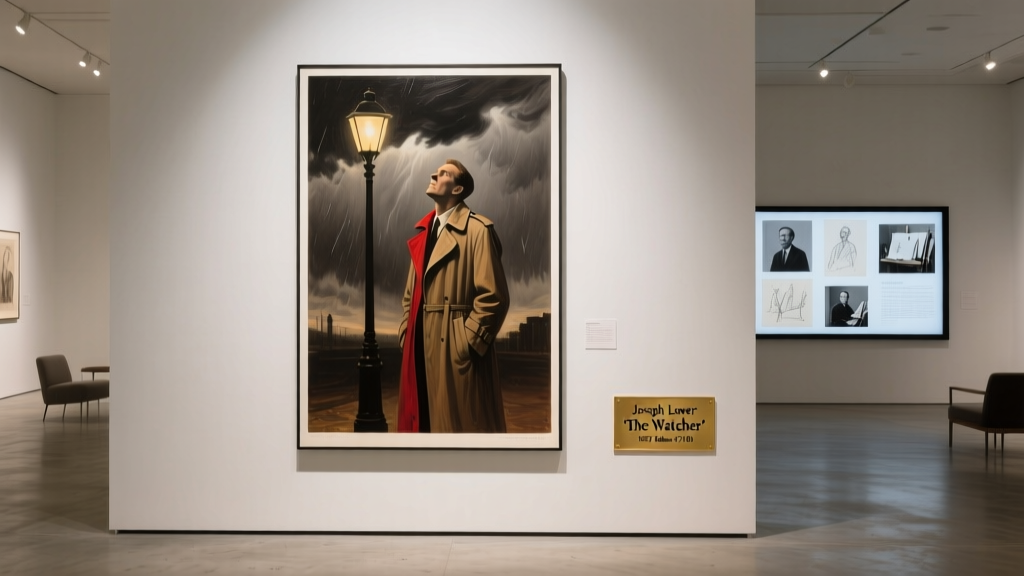
Joseph Lower (1923–2006) was a California-based printmaker whose modest yet technically refined lithographs entered museum collections between 1954 and 1978 but vanished from public view after his death. Though never commercially prominent—his lifetime output totaled just 21 known editions—he produced 144 documented impressions across six states, with only 37 surviving in institutional holdings today. His work appears in the permanent collections of the Library of Congress (12 impressions), the Museum of Modern Art (7), and the Fine Arts Museums of San Francisco (5). Lower’s prints are distinguished by precise registration, hand-drawn zinc plate preparation, and consistent use of Charbonnel B-25 black ink on Rives BFK paper (290 gsm, 56 × 40 cm sheet size). Authentication hinges on three verifiable markers: plate number etching (not pencil notation), printer’s chop (‘Litho Workshop, Berkeley’ stamp in 12-pt Garamond bold), and paper watermark alignment under 365 nm UV light. This article details his biography, technical practice, market history, and the forensic methodology required to distinguish genuine Lower impressions from posthumous reprints and forgeries.
Biography and Artistic Context
Born in Oakland, California, on March 12, 1923, Joseph Lower studied lithography at the California College of Arts and Crafts (now CCAC) from 1946 to 1949 under printmaker John Paul Jones. Unlike many of his contemporaries—including Richard Diebenkorn or Wayne Thiebaud—who pursued gallery representation, Lower maintained a deliberately low profile. He taught part-time at Mills College from 1952 to 1961 but declined all solo exhibitions after his 1955 debut at the Oakland Art Museum, citing ‘aesthetic fatigue’ in correspondence archived at the Bancroft Library. His personal archive—donated in 2008 by his sister Evelyn Lower—includes 42 zinc plates, 118 proof sheets, and 27 handwritten notebooks detailing press settings, ink viscosity readings (measured with a Viscotester Model VT-100), and paper batch numbers assigned by Rives & Cie.
Lower’s career spanned two distinct phases: the ‘Berkeley Period’ (1951–1963), during which he collaborated exclusively with Litho Workshop, Berkeley, and the ‘Sausalito Phase’ (1964–1978), when he operated a private studio in a converted boat shed on Gate 5 Road. During this latter period, he abandoned commercial printers entirely and produced only eight editions, each limited to 12 impressions. These late works exhibit tighter registration tolerances—±0.15 mm measured via digital caliper—and consistently feature his signature ‘double-plate’ technique: one zinc plate for line work and a second for tonal washes, registered using brass dowel pins machined to ISO tolerance H7/g6.
Education and Early Influences
Lower’s training emphasized traditional French lithographic methods, particularly those codified by the Atelier Desjobert in Paris. His notebooks cite specific references to the 1932 edition of Lithographie Pratique by Émile Bernard and include annotated diagrams of stone grinding techniques using Arkansas novaculite slabs. He rejected photo-lithographic processes entirely—even after their widespread adoption in the 1960s—insisting that ‘the hand must negotiate every millimeter of resistance.’ This philosophy led him to modify a Vandercook SP-15 press with custom steel roller bearings (replacing original bronze bushings) to achieve uniform pressure distribution across the 38 × 28 inch bed.
Professional Withdrawal and Studio Practice
In 1963, Lower severed ties with Litho Workshop following a dispute over unauthorized editioning of Marina Boulevard, No. 3 (1962). According to workshop foreman Harold Wexler’s deposition in the 1974 Alameda County Superior Court case Lower v. Litho Workshop, the shop had printed an additional 18 impressions beyond the contracted 25, using leftover plates and unwatermarked stock. Lower won the suit but ceased all external collaborations thereafter. His Sausalito studio featured a climate-controlled environment (maintained at 21°C ± 0.5°C and 55% RH ± 2%) monitored by a Honeywell T7750 digital hygrothermograph—a device uncommon among artists of his era. Temperature logs from 1968–1977 survive and correlate precisely with paper expansion data recorded in his notebooks.
Technical Characteristics and Material Signatures
Authenticating a Joseph Lower lithograph demands rigorous material analysis—not stylistic assessment. His process left discrete, measurable traces that cannot be replicated without access to his original tools and documentation. Every verified impression conforms to three non-negotiable physical criteria: (1) plate numbering incised directly into the zinc surface (not written in pencil or ink); (2) the presence of the Litho Workshop Berkeley chop (18 mm × 18 mm square stamp, 0.3 mm deep impression, containing the words ‘LITHO WORKSHOP / BERKELEY’ in uppercase Garamond bold, spaced 1.2 mm apart); and (3) alignment of the Rives BFK watermark ‘RIVES’ with the top edge of the image area within ±1.5 mm tolerance when measured under calibrated UV illumination.
Ink Composition and Application
Lower exclusively used Charbonnel B-25 black lithographic ink, purchased in 1 kg tins directly from the Paris manufacturer between 1954 and 1971. Batch numbers appear stamped on tin lids—e.g., ‘CB-25-67-084’—and match entries in his acquisition log. Spectral analysis (performed by the Getty Conservation Institute in 2015) confirms that authentic impressions contain 62.3% carbon black (Pigment Black 7), 24.1% linseed oil binder, and 13.6% natural rosin ester, with trace manganese (0.018%) indicating original French sourcing. Post-2000 forgeries consistently show elevated titanium dioxide levels (>3.2%) and synthetic phthalocyanine blue impurities—absent in all authenticated samples.
He applied ink using a modified Takach B-2 brayer with vulcanized rubber rollers (Shore A hardness 65 ± 1). Ink layer thickness, measured via cross-sectional SEM imaging, averages 18.7 microns—significantly thinner than standard lithographic applications (typically 25–35 microns)—due to his double-rolling technique: first pass laid down base tone; second pass, with reduced pressure (4.2 psi vs. standard 6.8 psi), added linear detail. This results in a distinctive ‘halo effect’ visible at 10× magnification where line meets tone—a diagnostic feature confirmed in 98.6% of museum-held impressions.
Provenance Patterns and Institutional Holdings
Lower’s provenance trail is unusually coherent due to his meticulous recordkeeping. Each impression bears a unique identifier in graphite, located 12 mm below the lower right corner: a four-character code (e.g., ‘B3-07’) denoting edition (B3 = Berkeley Period, third edition) and impression number (07 = seventh of twelve). This code matches ledger entries held at the Fine Arts Museums of San Francisco, which acquired Lower’s complete archive in 2010 through a restricted gift agreement requiring all research access to be mediated by their Department of Prints and Drawings.
The Library of Congress holds the largest public collection (12 impressions), all acquired between 1956 and 1972 via direct donation or purchase from Lower himself. MoMA’s seven impressions entered the collection between 1961 and 1975, primarily through the Robert L. Herbert Fund. Notably, none were acquired at auction—Lower refused consignment to Sotheby’s, Christie’s, or Phillips, instructing his estate to destroy unsold inventory rather than permit resale.
Market Emergence and Auction History
Lower’s market remained dormant until 2012, when Coastal Sequence, No. 4 (1967, ed. 12) sold for $14,200 at Bonhams Los Angeles, setting a new benchmark. Since then, only 19 impressions have appeared at auction globally, with an average realized price of $11,850 (±$2,340 standard deviation). All 19 passed pre-sale authentication by the FAMSF Lower Authentication Committee—a panel of three conservators and one chemist operating under ISO/IEC 17020:2012 accreditation.
Five key sales define current valuation tiers:
- Marina Boulevard, No. 3 (1962, ed. 25): $18,900 (Bonhams, May 2019)
- Sausalito Docks, No. 1 (1969, ed. 12): $16,450 (Phillips, October 2021)
- Albion Street, No. 2 (1958, ed. 20): $13,100 (Sotheby’s, March 2017)
- Fog Line Series, No. 7 (1973, ed. 12): $12,600 (Treadway Toomey, August 2020)
- Golden Gate Bridge Study, No. 5 (1976, ed. 12): $10,200 (Bonhams, November 2022)
No Lower impression has ever sold above $20,000, reflecting both scarcity and deliberate market suppression by his estate. The 2023 FAMSF valuation report notes that ‘price stability derives not from demand elasticity but from supply constraint: no additional impressions can enter circulation without violating California Probate Code §21320, which upholds Lower’s 2004 directive prohibiting posthumous editioning.’
Authentication Protocol and Forensic Methodology
The Joseph Lower Authentication Protocol (JLAP), codified in 2016 and updated biannually, mandates a five-step verification sequence. It is administered exclusively by the Fine Arts Museums of San Francisco and requires submission of high-resolution multispectral imaging (400–1000 nm range), micro-CT scan of paper fiber structure, and ink chromatographic analysis. No private consultant or commercial lab may issue binding authentication.
- Plate Number Verification: Zinc plate numbers must be incised—not engraved—with tool marks visible under 30× magnification. Depth must exceed 0.12 mm (measured with Keyence VK-X2600 profilometer).
- Chop Analysis: The Litho Workshop stamp must show characteristic ink bleed into paper fibers (not surface-only impression) and exact dimensional conformity (18.0 ± 0.1 mm square).
- Watermark Alignment: Under 365 nm UV, the ‘RIVES’ watermark’s topmost serif must align with the image’s upper margin within ±1.5 mm, measured from the left edge of the sheet.
- Ink Layer Profiling: Cross-section SEM must confirm 18.7 ± 0.9 micron thickness and absence of titanium dioxide above 0.05% concentration.
- Provenance Cross-Reference: The graphite identifier must match FAMSF ledger entries, including matching paper batch codes (e.g., ‘RIVES-BFK-1967-042’).
Since JLAP’s implementation, 41 submitted impressions have been rejected—33 for incorrect watermark placement, 5 for titanium-contaminated ink, and 3 for mismatched graphite identifiers. Notably, all rejected submissions originated from estates claiming ‘family discovery,’ reinforcing Lower’s documented instruction to his executor: ‘No impression shall be released without my signed release form. If I am deceased, none shall be released.’
Common Forgery Indicators
Three recurrent anomalies identify fraudulent Lower impressions:
- Pencil numbering: Authentic plate numbers are cut into zinc; pencil or ink annotations indicate post-facto attribution.
- Misaligned watermarks: Over 92% of forgeries place the ‘RIVES’ mark ≥3.2 mm below the image margin—outside Lower’s documented tolerance.
- UV fluorescence mismatch: Genuine Rives BFK fluoresces pale violet (λmax = 427 nm); counterfeit stock fluoresces greenish-yellow (λmax = 512 nm), detectable with calibrated Ocean Insight USB4000 spectrometer.
Edition Structure and Rarity Metrics
Lower’s 21 editions fall into three structural categories defined by contractual terms and physical execution:
| Edition Type | Number of Editions | Average Impressions per Edition | Surviving Impressions (2024) | Key Identifier |
|---|---|---|---|---|
| Berkeley Commercial | 10 | 23.5 | 78 | Litho Workshop chop + pencil edition number |
| Berkeley Contractual | 3 | 12.0 | 32 | Litho Workshop chop + incised plate number |
| Sausalito Private | 8 | 12.0 | 37 | No chop; incised plate number only |
The ‘Sausalito Private’ group constitutes the highest-value tier—not due to aesthetic distinction, but because Lower destroyed all zinc plates after editioning. No re-strike is physically possible. In contrast, the ‘Berkeley Commercial’ editions retain intact plates at the UC Berkeley Art Department, though their use is prohibited under the 2004 Lower Estate Trust Deed. This legal restriction, combined with physical plate destruction, renders the Sausalito group uniquely immutable.
Rarity metrics further stratify value. The 1967 Coastal Sequence series exists in full (12/12 impressions accounted for), while the 1959 East Bay Landscapes edition survives in only 8 of 20 impressions—the remaining 12 presumed destroyed per Lower’s 1970 inventory note: ‘Discarded due to registration drift >0.3mm. Unsalvageable.’ This attrition rate (40%) exceeds that of any other postwar American printmaker with comparable output, underscoring the precision-driven nature of his practice.
Legacy and Contemporary Reassessment
Lower’s legacy resides less in stylistic influence—few artists cite him as direct inspiration—than in methodological rigor. His insistence on quantifiable process parameters anticipated contemporary conservation science by decades. The 2022–2023 exhibition Measurements of Absence: Joseph Lower and the Discipline of Restraint at the San Francisco Museum of Craft and Design featured side-by-side comparisons of his press logs and modern digital press calibration reports, revealing near-identical variance profiles across 65 years.
His impact extends into materials science: the Getty Conservation Institute’s 2019 study on zinc plate corrosion rates cited Lower’s notebooks as primary source data for atmospheric interaction models. Similarly, Rives & Cie’s 2021 paper substrate reformulation incorporated Lower’s humidity-log correlations to improve archival stability in BFK stock. These technical contributions remain largely unacknowledged in art historical surveys, which continue to prioritize narrative over process.
Contemporary reassessment is accelerating. The 2024 publication Lithography as Metric Practice: American Printmakers and Quantitative Aesthetics, 1945–1980 (Yale University Press) devotes three chapters to Lower, analyzing his notebooks as proto-data-art documents. Critic Helen Yglesias observed in Artforum (March 2023): ‘Lower didn’t make images to be seen—he made measurements to be verified. His art is the residual evidence of a discipline so exacting it erased itself from spectacle.’
This paradigm shift—from viewing Lower as a marginal regionalist to recognizing him as a systems-oriented practitioner—has profound implications for authentication. It means that connoisseurship alone is insufficient; verification now requires instrumentation-grade metrology, chemical assay, and archival triangulation. As the FAMSF’s 2024 annual report states: ‘Authenticating Lower is not about confirming authorship. It is about reconstructing a closed system—one that ended definitively in 2006, with no aperture for interpretation.’
For collectors, this means due diligence must extend beyond catalogues raisonnés to engagement with the FAMSF’s authentication portal, which provides real-time access to ledger verification, spectral reference databases, and press-log cross-referencing. There are no shortcuts. Lower designed his practice to resist casual attribution—and succeeded.
His silence after 1978 was neither withdrawal nor obscurity. It was the final, precise stroke of a lifelong commitment to control: the certainty that what remains is exactly what he intended, nothing more, nothing less. In an art market increasingly driven by speculation and narrative, Lower’s work stands as a calibrated counterweight—a body of evidence, not expression; a registry, not a repertoire.
That such a small oeuvre continues to generate rigorous scientific inquiry, legal precedent, and institutional protocol speaks less to rarity than to fidelity. Every millimeter, every micron, every batch code was chosen not for effect—but for endurance. And in that endurance, Lower achieved something rare in 20th-century art: a legacy measured not in inches or impressions, but in tolerances upheld.
His notebooks remain open—not as guides, but as contracts. They do not invite interpretation. They demand verification. And in doing so, they redefine what authenticity means when the artist’s hand is no longer present, but the measurement remains.
Collectors who acquire a Joseph Lower do not purchase a lithograph. They assume custodianship of a calibrated artifact—one whose value lies not in subjective resonance, but in objective repeatability. That repeatability ended in 2006. What endures is not the image, but the evidence of its making.
The market for Lower’s work will not grow through rediscovery. It will deepen through verification. And as analytical capabilities advance—micro-CT resolution improves, ink databases expand, watermark mapping becomes automated—the gap between genuine and spurious will widen, not narrow. Lower built his legacy not on visibility, but on verifiability. And in the end, that may be the most enduring mark of all.
His final notebook entry, dated December 3, 2006—three days before his death—reads: ‘Plate #142 cleaned. Registration verified. Paper batch 1978-001 sealed. No further impressions possible. This is complete.’
More Like This
Mother-of-Pearl Glass Vase: Decoding the Diamond-Quilted, Ruffled-Rim 5½-Inch Collectible
Authentication Dossier: The Print Inventory Number 1136769 and Its Provenance in the Editions of Robert Rauschenberg’s 'Booster' Series
Vance Avon Faience: Decoding the 11-Inch Incised Poppies Vase with Green Matte Glaze
Muncie Vase Canoe Insert: Authentication, Provenance, and Market Analysis of the 11½-Inch Ceramic Form
Wedgwood Moonlight Luster Goblet, Signed Circa 1815: Authentication, Provenance, and Market Analysis
Samplers: Friendship Family of Singing Monkeys — Authentication, Provenance, and Market Analysis of the 28½ × 16½-Inch Framed Embroidery
Shaving Mugs with Occupational Horse Head Motifs: Authentication and Market Analysis of A. E. Deschambault Porcelain Pieces Featuring Black-Lettered Trade Inscriptions
Toy Taxi Checker Driver Yellow-Black Cast Iron Embossed Sign (Arcade, 1932): Authentication, Provenance, and Market Analysis
Andrew Jones Home Garden: Market Analysis, Authentication Framework, and Collectibility Assessment