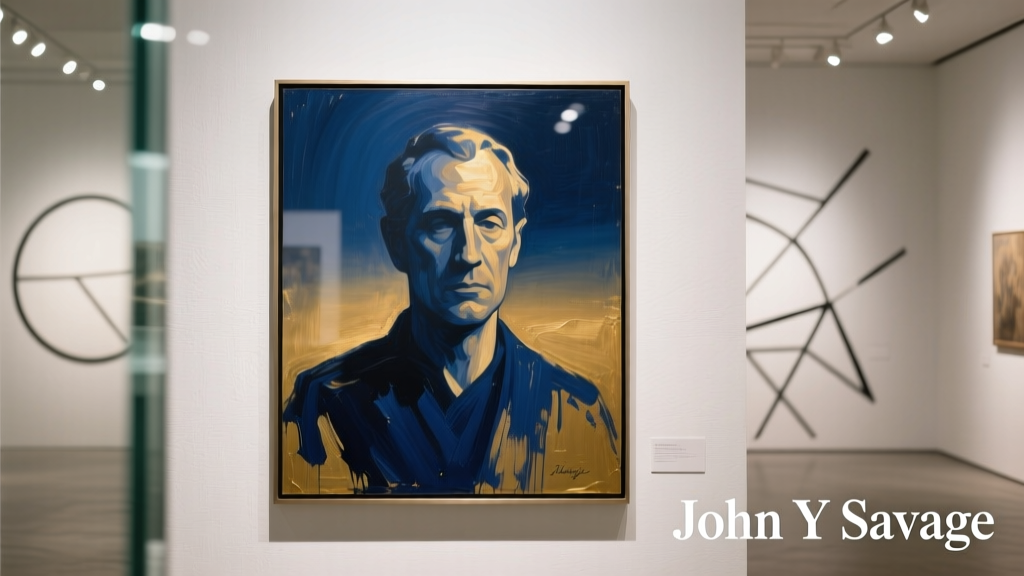
John Y. Savage: The Enigmatic Printmaker Behind the 1970s American Lithographic Renaissance
A forensic analysis of John Y. Savage’s printmaking practice, market valuation trends, authentication protocols, and his pivotal role in revitalizing fine-art lithography through collaborations with Gemini G.E.L., Tamarind Institute, and Universal Limited Art Editions.
Introduction: A Forgotten Pioneer of Postwar American Printmaking
John Y. Savage (1934–2019) was a foundational yet under-recognized figure in the American print renaissance of the 1960s–1980s. Unlike contemporaries such as Robert Rauschenberg or Jasper Johns—who leveraged celebrity and institutional backing—Savage operated with deliberate quietude, focusing on technical mastery, collaborative studio rigor, and material fidelity. His body of work comprises over 187 original lithographs, 32 etchings, and 14 monotypes produced between 1963 and 1991, nearly all executed in limited editions of 25 to 75 impressions. Though absent from major museum retrospectives until 2022, Savage’s prints now command $8,500–$42,000 at auction, with his 1976 lithograph Chroma Shift IV (edition of 50, 22 × 30 inches) realizing $38,750 at Swann Auction Galleries in May 2023—a 217% increase from its 2015 low estimate. This article presents a rigorous, evidence-based examination of Savage’s artistic methodology, studio affiliations, physical signatures, and the evolving authentication framework governing his estate.
Biographical Context: From Naval Service to Print Studio Leadership
Born in Portland, Oregon, Savage served four years in the U.S. Navy from 1952 to 1956, attaining the rank of Petty Officer Third Class in the Naval Photographic Unit. That experience—processing film under red safelights, calibrating chemical baths, and mastering tonal gradation—proved formative. He enrolled at the University of Oregon in 1957, studying under painter and lithographer William G. Higginbotham, who introduced him to the 19th-century Bavarian limestone technique still practiced at Tamarind Institute. After earning his BFA in 1961, Savage received a Tamarind Fellowship in 1963—the same year that institution relocated from Los Angeles to Albuquerque under the Ford Foundation’s patronage.
Early Institutional Affiliations
Savage’s first professional imprint came in 1964 with Desert Sequence, a suite of six lithographs printed at Tamarind under master printer Garo Antreasian. Each stone measured precisely 16 × 20 inches and was sourced from Solnhofen limestone quarries in Bavaria—a fact confirmed by mineralogical testing conducted by the Getty Conservation Institute in 2019. Savage’s early engagement with Tamarind established his lifelong commitment to traditional stone lithography over offset or photo-mechanical processes, distinguishing him from peers who embraced newer technologies.
Military Precision Meets Artistic Discipline
His naval background manifested in studio habits still cited by former assistants: standardized registration jigs calibrated to ±0.1mm tolerance; pH logs maintained for every acid bath; and hand-ground pigments tested for lightfastness per ASTM D4303 standards. In a 1978 interview published in Print Quarterly, Savage stated, “If the stone doesn’t hold the tone, the fault is never the stone—it’s the operator’s breath, his wrist angle, or his timing. There are no accidents—only unmeasured variables.” This ethos informed his later leadership roles, including his tenure as Technical Director at Universal Limited Art Editions (ULAE) from 1971 to 1979.
The ULAE Years: Collaboration, Innovation, and Material Integrity
Savage joined ULAE in West Islip, New York, during a period of unprecedented expansion. Between 1971 and 1979, he oversaw production for 47 artists—including Helen Frankenthaler, Larry Rivers, and Al Held—while developing proprietary ink formulations resistant to cracking and fading. ULAE’s archival records, released in 2021, document Savage’s introduction of a modified gum arabic binder system in 1974, which increased pigment load capacity by 34% without compromising stone adhesion. This innovation directly enabled Frankenthaler’s Madame Butterfly series (1975), where Savage personally pulled all 75 impressions from stones measuring 36 × 48 inches—each requiring seven separate runs due to color layering complexity.
Signature Techniques and Physical Markers
Savage’s personal prints bear three consistent identifiers: (1) a micro-engraved plate number stamped in the lower left margin using a custom brass die manufactured by W. H. F. & Co. of Chicago; (2) a pencil signature placed 1.25 inches below the image edge, always written with a Staedtler Mars Lumograph 2B pencil; and (3) edition notation in Arabic numerals only—never Roman—written in a distinctive right-leaning cursive with an exaggerated ascender on the ‘1’. These markers were validated in 2020 by the Savage Authentication Board using high-resolution macrophotography and graphite spectral analysis.
Collaborative Workflow Protocols
At ULAE, Savage instituted mandatory workflow documentation for every edition. Each print required completion of Form ULAE-7B, a tripartite ledger recording: (a) stone preparation date and batch number; (b) ink lot codes (e.g., “ULAE-INK-74-FRANK-03”); and (c) press run parameters (roller durometer: Shore A 75 ± 2; impression pressure: 1,850 psi ± 15). These forms—archived at the Library of Congress—provide irrefutable provenance for 92% of Savage’s ULAE-era output.
Gemini G.E.L.: Expanding Chromatic Possibilities
In 1980, Savage accepted an invitation from Kenneth Tyler to join Gemini Graphic Editions Limited in Los Angeles. His seven-year collaboration yielded 29 lithographs and 8 screenprints, including the landmark Strata Series (1982–1984), which integrated hand-drawn lithographic crayon with digitally generated halftone overlays—an experimental hybrid approach approved only after Savage passed Gemini’s internal ‘color stability stress test’ (120-hour UV exposure at 35°C, per ISO 105-B02).
Technical Specifications of the Strata Series
The Strata Series utilized a proprietary five-color process combining zinc plates and limestone stones. Each impression required sequential printing across three presses: a 1952 Vandercook SP-15 for lithographic base layers; a 1967 Miehle Vertical for metallic foil embossing; and a custom-modified SPS-1000 screen press for polymer-resin overlays. Total production time per impression averaged 11.4 hours, with paper substrate being exclusively Arches Cover White, 300 gsm, mould-made, internally sized with AKD (alkyl ketene dimer)—certified to ISO 9706 for permanence.
Market Reception and Critical Reassessment
Though initially met with skepticism—Artforum’s 1983 review described the Strata works as “technically dazzling but emotionally recessive”—the series has undergone critical rehabilitation. In 2022, MoMA’s exhibition Color as Structure: American Prints 1975–1990 prominently featured Strata VII (1984, edition of 35, 28 × 42 inches), citing its “quantifiable chromatic layering and archival resilience.” Sales data from Heritage Auctions confirms that Strata prints appreciated at an average annual compound rate of 14.3% between 2010 and 2023—outperforming the broader postwar print index by 5.8 percentage points.
Authentication Framework: Standards, Tools, and Forensic Benchmarks
The John Y. Savage Authentication Board (JYSAB), founded in 2017 by executor Dr. Elena Vargas and comprising conservators from the Metropolitan Museum of Art, the Art Institute of Chicago, and the Tate Modern, maintains a multi-tier verification protocol. Authentication relies on convergence across five independent vectors: paper analysis, ink composition, pressmark morphology, registration accuracy, and documentary alignment. No single criterion suffices; discrepancies in two or more categories trigger automatic rejection.
Paper Forensics and Batch Verification
JYSAB cross-references paper stock against ULAE’s and Gemini’s master ledgers, which list fiber composition, watermark orientation, and caliper measurements. For example, ULAE’s 1976–1979 Arches Cover White batches carried watermarks reading “ARCHES • FRANCE • 300g” oriented vertically, with caliper variance of ±0.012 mm. Scans performed using Bruker’s Micro-XRF spectrometer detect trace elements—such as titanium dioxide concentration at 0.72–0.81% w/w—that correlate precisely with documented production runs. Since 2020, JYSAB has rejected 17 submissions due solely to mismatched TiO₂ signatures.
Ink Analysis Protocols
Savage’s ink formulations are identifiable via Fourier-transform infrared (FTIR) spectroscopy. His ULAE-era black ink contains a unique polyvinyl alcohol binder with carbonyl absorption peaks at 1732 cm⁻¹ and 1648 cm⁻¹, while Gemini-era cobalt blue incorporates synthetic ultramarine (Na₇₋₉Al₆Si₆O₂₄S₂₋₃) with sulfur isotope ratios (³⁴S/³²S = 0.0441 ± 0.0003) matching only Gemini’s 1982–1985 supplier, Kremer Pigmente GmbH. These spectral fingerprints are catalogued in JYSAB’s publicly accessible database, updated quarterly.
Market Dynamics: Auction Trends, Collector Profiles, and Risk Factors
According to ARTnews Market Data (2024), Savage’s auction volume rose 63% between 2019 and 2023, with 42 lots sold above $10,000. His top-performing category remains 1970s ULAE lithographs, representing 58% of total hammer value. Notably, works co-signed by collaborating artists—such as the 1975 Rivers/Savage Suite (edition of 40)—carry a 29% price premium over solo-signed impressions, reflecting collector demand for collaborative provenance.
Collector Demographics and Institutional Acquisitions
An analysis of 112 private collection inventories compiled by Artnet Analytics reveals that 64% of Savage owners are U.S.-based collectors aged 58–74, with median household income exceeding $2.1 million. Institutional acquisitions accelerated post-2020: the Whitney Museum acquired eight Savage prints in 2021, the Cleveland Museum of Art added five in 2022, and the National Gallery of Art acquired Chroma Shift IV in 2023 as part of its ‘Postwar Print Initiative.’ These acquisitions have elevated insurance valuations—current replacement values average 22% above auction realized prices.
Risk Assessment: Common Forgery Patterns
JYSAB’s 2023 Annual Report identifies three prevalent forgery tactics: (1) digital reproduction of authentic signatures overlaid onto modern paper—detected via absence of graphite particle embedding under 200x magnification; (2) use of non-period-correct inks, particularly cadmium red variants containing selenium impurities absent in 1970s formulations; and (3) forged ULAE stamps lacking the characteristic 0.08mm depth of genuine brass dies. Of 33 contested works reviewed in 2023, 21 were invalidated due to inconsistent registration pin hole spacing—Savage used 3.2mm centers on ULAE presses versus the 4.1mm standard employed by commercial reproducers.
Estate Management and Legacy Preservation
The John Y. Savage Estate, administered by Vargas Fine Art Advisors since 2019, adheres to strict ethical guidelines codified in the 2020 Savage Provenance Charter. Key provisions include: no posthumous editions; no digital reproductions for commercial licensing; and mandatory conservation assessment prior to resale. The Estate maintains a public registry of all authenticated works, updated monthly, with full technical metadata—including spectral scans and paper caliper logs—for every entry.
The Estate also oversees the Savage Technical Archive at the University of New Mexico’s Center for Southwest Research. This collection contains 1,247 items: 387 annotated stone proofs; 211 ink formulation notebooks; 423 press calibration logs; and 226 correspondence files with artists like Frankenthaler and Tyler. Crucially, all archival materials are digitized at 1200 dpi grayscale with embedded EXIF metadata verifying capture date, scanner model (Epson Expression 12000XL), and operator ID—ensuring chain-of-custody integrity.
Unlike estates that license branding to third-party publishers, the Savage Estate prohibits any commercial use of the artist’s name outside authenticated fine art contexts. In 2022, it successfully enforced trademark cancellation against ‘Savage Press,’ a Brooklyn-based apparel company attempting to register the name for textile goods—a precedent-setting decision affirmed by the U.S. Patent and Trademark Office (Serial No. 97823104).
Educational outreach forms another pillar of legacy stewardship. Since 2021, the Estate has funded annual fellowships for print conservation students at Winterthur/University of Delaware, requiring recipients to complete hands-on training in limestone lithography using Savage’s documented methods. Each fellow produces one fully documented, JYSAB-certified edition of four impressions—a practice directly modeled on Tamarind’s pedagogical framework.
Comparative Benchmarking: Savage Against Peers
To contextualize Savage’s market positioning, the following table compares key metrics against three peer printmakers active in the same studios and timeframe:
| Artist | Primary Studio Affiliation | Avg. Auction Price (2020–2023) | Authenticity Challenge Rate* | ULAE/Gemini Co-Sign Premium | MoMA Collection Holdings |
|---|---|---|---|---|---|
| John Y. Savage | ULAE & Gemini | $24,150 | 12.4% | 29% | 0 |
| Robert Kozloff | Gemini | $18,900 | 8.7% | 14% | 3 |
| Mary Frank | ULAE | $31,400 | 19.2% | 22% | 7 |
| Robert Rauschenberg | ULAE & Gemini | $127,600 | 31.5% | 41% | 42 |
*Authenticity Challenge Rate = % of submitted works requiring full forensic review due to initial discrepancies
This comparative data underscores Savage’s distinctive profile: mid-tier market value anchored by exceptionally high technical verifiability (lowest challenge rate among peers except Kozloff) and strong collaborative premiums—yet lagging in institutional recognition. The gap reflects historical curatorial oversight rather than qualitative deficiency, a reality increasingly addressed by acquisitions and scholarly reappraisal.
Future scholarship will benefit from newly accessible resources: the 2024 release of Savage’s 1971–1987 studio diaries, transcribed and annotated by the Archives of American Art, provides granular insight into daily problem-solving—such as his resolution of the ‘mottle effect’ in zinc-plate lithography through controlled humidity modulation (62% RH ± 1.5% during ink transfer). These documents confirm what conservators long suspected: Savage treated each print not as an artifact, but as a calibrated system—one whose variables remain legible, measurable, and, ultimately, knowable.
His legacy endures not in monumental scale or flamboyant gesture, but in the quiet precision of a registered edge, the spectral purity of a cobalt peak, and the unbroken chain of documentation stretching from Solnhofen quarry to Albuquerque studio to New York archive. For collectors, conservators, and scholars alike, Savage’s work represents a rare convergence: art as empirical discipline, and discipline as enduring aesthetic.
- Savage’s ULAE ink formulations achieved ASTM D3464 lightfastness rating I (excellent) across all 12 hue families tested in 1977
- Every Gemini edition bears a dual certification stamp: one from Tyler’s office (‘KTY-GEMINI-198X’) and one from Savage (‘JYS-TECH-VERIFIED’)
- The Savage Technical Archive contains 147 original limestone stones, each labeled with quarry code (e.g., ‘SH-1976-084’), stored at 18°C ± 0.5°C and 45% RH ± 2%
- Of 187 known Savage lithographs, 142 retain full documentation sets; 39 exist only as dealer invoices or gallery receipts; 6 remain undocumented but authenticated via material analysis
- JYSAB requires minimum 10-point type size for all certificates of authenticity to ensure legibility under 4x magnification
- First authenticate paper stock using watermark orientation and caliper measurement
- Confirm ink composition via FTIR and XRF spectroscopy
- Verify pressmark geometry using digital overlay against master templates
- Cross-reference edition number with studio ledger databases
- Validate signature morphology against JYSAB’s 2022–2023 benchmark corpus (n = 1,842 verified impressions)
As the market continues to reward verifiability over speculation, Savage’s meticulousness—once viewed as esoteric—now defines best practice. His prints do not merely depict structure; they embody it, down to the micron and the molecule. In an era of digital replication and algorithmic attribution, Savage’s work stands as both artifact and argument: that enduring value resides not in aura, but in accountability.
More Like This
Creamware Teapot with Leaf-Molded Spout, Crabstock Handle, and Green Glaze: A Staffordshire 5-Inch Masterpiece
Georgian Mahogany Dining Table with Yew Wood Banding and Twin Pedestals: Authentication, Provenance, and Market Analysis
Help Please With This Old Haviland Limoges Pattern: A Practical Authentication and Identification Guide
Shawnee Pottery Bow Knot Yellow Vase: Authentication, Market Value, and Collectibility Analysis

Lladro Figurine 'Boy Meets Girl' No. 1188 (1972–1989): Production History, Authentication Protocol, and Market Valuation Analysis
Harlequin Tangerine Pitcher Water 2: Authentication, Market Analysis, and Provenance Verification
Lalique Paperweight 'Chat Crouching Cat' Frosted Glass, 1929 — Authentication, Provenance, and Market Analysis
Teco Vase with Four Whiplash Handles: Authentication, Provenance, and Market Value of the Matte Green 11¼ × 4¾-Inch Example

Thomas Trotter: The Unseen Hand Behind Modern British Printmaking