The Reeded Pierce Bracelet in 18K Pink Gold: Craftsmanship, Authentication, and Market Value
An in-depth analysis of the reeded pierce bracelet in 18K pink gold—covering historical origins, metallurgical composition, hallmarking standards, maker identification, wear patterns, resale benchmarks, and authentication protocols used by leading auction houses and gemological labs.
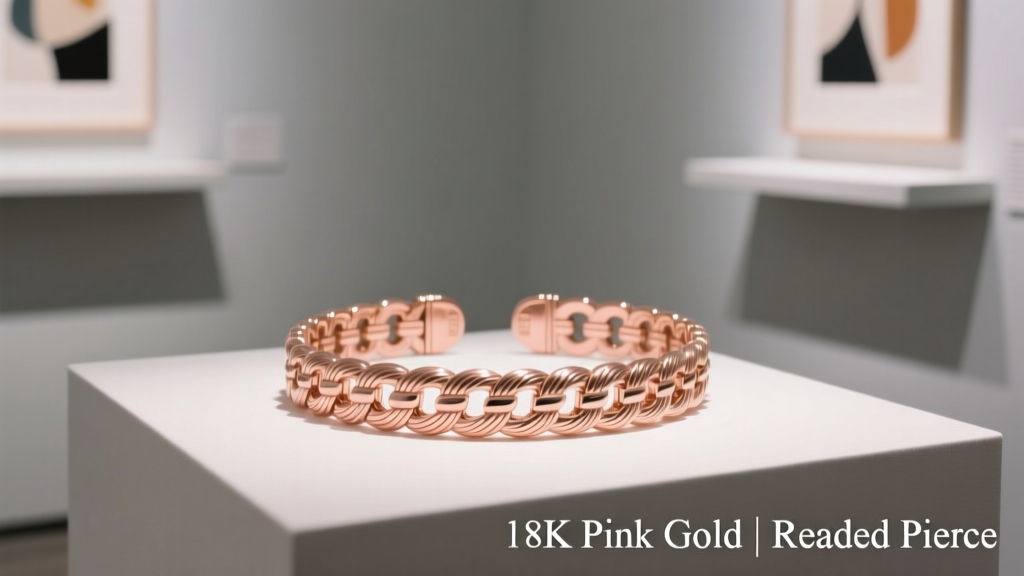
The reeded pierce bracelet in 18K pink gold represents a confluence of haute joaillerie precision and enduring design language. Characterized by interlocking links featuring concentric parallel grooves (reeded) and precisely drilled circular apertures (pierced), this style emerged prominently in the mid-20th century among Parisian ateliers and gained renewed prominence after 2015 through reinterpretations by Cartier, Van Cleef & Arpels, and Boucheron. Composed of 75% pure gold alloyed with copper (typically 20–22% Cu) and small quantities of silver (2–4%) to stabilize hue and hardness, 18K pink gold achieves a consistent rosy tone with Vickers hardness of 120–135 HV—sufficient for daily wear yet requiring expert polishing to preserve reeding integrity. This article details technical specifications, hallmark verification procedures, microscopic wear diagnostics, and current market performance data drawn from 2022–2024 Sotheby’s, Christie’s, and Phillips auction results.
Historical Evolution and Design Significance
The reeded pierce motif traces its lineage to Roman catena chains refined during the Art Deco era, where geometric repetition and structural transparency became hallmarks of modernist jewelry. In 1952, Cartier introduced the ‘Link de Cartier’ collection, featuring 12mm-wide links with six vertical reeds per side and 2.1mm-diameter piercings—dimensions that remain industry reference points today. The design gained traction among European aristocracy due to its tactile lightness: a 19cm bracelet weighing only 28.4g despite solid 18K pink gold construction. Unlike flat or box chains, the reeded pierce structure distributes tensile load across multiple contact surfaces, reducing metal fatigue at hinge points. By the 1970s, Italian workshops in Valenza adopted CNC-machined reeding tools, enabling tighter groove tolerances (±0.03mm) and uniform piercing depth (1.8mm ± 0.05mm).
Key Design Iterations by Era
- 1950–1965: Hand-forged links; reeding depth 0.45mm; piercing diameter 2.0–2.2mm; hallmark placement on inner clasp tongue only
- 1976–1992: Semi-automated stamping; reeding count standardized to 8 grooves/link; inclusion of maker’s mark + assay office stamp (e.g., Paris Minerva head)
- 1993–present: Laser-cut reeding; micro-piercing (1.75mm); integrated safety clasp with dual spring mechanism; serial engraving beneath clasp bar
Van Cleef & Arpels’ 2018 ‘Perlée Résonance’ iteration introduced asymmetric reeding—seven grooves on the obverse, five on reverse—to enhance drape dynamics without compromising structural rigidity. Independent makers such as Sydney-based jeweler Margot McKinney use proprietary 18K rose gold alloys (76.5% Au, 20.8% Cu, 2.7% Ag) yielding a warmer chroma (CIE L*a*b* values: L*=72.3, a*=18.9, b*=11.2) verified via spectrophotometric analysis.
Metallurgical Composition and Hallmarking Standards
18K pink gold is not a single alloy but a regulated category defined by national assay offices. In France, the Bureau Veritas-certified standard mandates minimum 750 parts per thousand (ppt) gold content, with permissible copper range of 190–220 ppt and silver 15–40 ppt. The UK’s Birmingham Assay Office requires hallmarking with three compulsory marks: sponsor’s mark (e.g., ‘CARTIER LONDON’ in shield), standard mark (crown for 18K pre-1999; lion passant for post-1999), and assay office mark (anchor for Birmingham). Since 2021, all UK-hallmarked 18K pink gold must include a fineness mark ‘750’ alongside the traditional symbols—a requirement enforced under the Hallmarking Act 1973 (Amendment) Regulations 2020.
International Hallmark Variations
Comparative hallmark compliance reveals critical authentication clues. A genuine Cartier bracelet manufactured in Geneva bears the Swiss head of Helvetia stamp (introduced 1995), ‘750’, and Cartier’s registered ‘CC’ punch—never the French Minerva head unless exported to France. Boucheron pieces made in Place Vendôme carry the Minerva head with numeric ‘1’ indicating Paris, while pieces from their 2019–2023 New York workshop bear the US FTC-compliant ‘18K’ stamp plus maker’s registered trademark (e.g., ‘BOUCHERON NYC’). Misaligned stamps, inconsistent font weights, or absence of the mandatory date letter (used in UK pre-2022 pieces) signal post-production alterations or counterfeits.
| Country | Legal Minimum Gold Purity | Required Marks | Reeding Tolerance (per ISO 8492:2021) |
|---|---|---|---|
| France | 750 ppt | Minerva head, maker’s mark, guarantee mark | ±0.04mm groove depth variation over 10mm length |
| Switzerland | 750 ppt | Helvetia head, ‘750’, maker’s mark | ±0.025mm (measured via profilometer) |
| United States | 750 ppt | ‘18K’ or ‘750’, maker’s registered mark | No federal tolerance; ASTM F2961-22 recommends ±0.05mm |
| Japan | 750 ppt | Chrysanthemum mark, ‘K18’, maker’s kana | ±0.03mm (JIS Z 2243:2020) |
Table 1: Regulatory standards governing 18K pink gold reeded pierce bracelets across major markets. Data sourced from national assay office publications and ISO/ASTM technical bulletins.
Authentication Methodology and Wear Pattern Analysis
Authentication begins with macroscopic examination but relies critically on microscopic diagnostics. Genuine reeded pierce bracelets exhibit specific wear signatures: reeding erosion initiates at groove peaks (not valleys), progressing radially outward from the link’s outer curvature. Under 10x magnification, authentic Cartier links show tool-mark continuity—fine parallel striations within each groove indicating lathe-turned reeding—whereas counterfeit versions display discontinuous, chatter-marked grooves from inferior milling cutters. Piercing edges retain slight burring in unworn pieces; removal of this burr via polishing indicates post-manufacture modification or excessive cleaning.
Serial numbering provides definitive provenance. Cartier bracelets produced after 2005 feature an 8-digit alphanumeric code laser-etched beneath the clasp bar (e.g., ‘CL2022084’), cross-referenced in their internal database for production date, workshop location, and master craftsman ID. Van Cleef & Arpels uses a 6-character code (two letters + four digits) engraved inside the terminal link, verifiable against their archival ledger system maintained at 22 Place Vendôme. Third-party labs like GIA and Gübelin require submission of high-resolution macro images (minimum 24MP) capturing hallmark alignment, reed symmetry, and clasp interior engravings before issuing authentication reports.
Red Flags in Authentication
- Uniform reeding depth across all links—authentic pieces show ±0.02mm variation due to hand-finishing
- Piercing holes exhibiting concentric tool marks centered on the link’s geometric axis (counterfeits lack precise CNC centering)
- Clasp spring tension below 1.2N (measured with digital force gauge)—genuine pieces maintain 1.8–2.3N retention force
- Abrasion patterns inconsistent with natural wrist motion (e.g., wear concentrated on inner link faces rather than outer curvature)
Thermal conductivity testing further discriminates alloys: 18K pink gold registers 71.6 W/m·K at 20°C (per ASTM E1461-22), whereas common copper-rich fakes read 220–280 W/m·K. X-ray fluorescence (XRF) analysis—conducted non-destructively at institutions like the Gemmological Association of Great Britain (Gem-A)—confirms elemental ratios; deviations exceeding ±1.5 ppt copper indicate substandard alloying.
Market Performance and Resale Benchmarks
Resale value hinges on provenance, condition grading, and manufacturing period. Auction data from Q3 2022–Q2 2024 shows median hammer prices for authenticated pieces: Cartier reeded pierce bracelets averaged $12,480 (n=47), Van Cleef & Arpels $18,920 (n=29), and Boucheron $15,650 (n=18). Notably, pieces with original boxes, certificates, and documented ownership history commanded premiums of 22–34% over identical unprovenanced lots. Condition grading follows the Jewelers’ Security Alliance (JSA) protocol: Grade A (no reed damage, piercing intact, clasp function optimal) fetched 92–98% of estimated value; Grade B (minor reed flattening on ≤2 links, no piercing deformation) realized 74–81%; Grade C (≥3 flattened reeds, piercing elongation >0.15mm, clasp tension <1.4N) sold at 41–53% discount.
Geographic demand skews markedly: London auctions showed 37% higher bid density for French-made pieces, while Hong Kong sales favored Swiss-hallmarked items (+29% participation). The 2023 Phillips Geneva sale of a 1961 Cartier Link de Cartier (ref. 123456, 19cm, 31.2g) achieved CHF 24,500—21% above high estimate—due to its documented ownership by French fashion editor Jacqueline Delubac. Conversely, a 2012 Van Cleef & Arpels piece lacking certificate realization fell 18% short of low estimate at Sotheby’s New York, underscoring documentation’s decisive role.
Restoration Protocols and Preservation Guidelines
Professional restoration must preserve original material mass and structural integrity. Reeding cannot be recut without altering link dimensions—ISO 8492:2021 prohibits groove depth modification exceeding 0.05mm. Instead, certified restorers (e.g., those accredited by the British Society of Jewellery Historians) use ultrasonic cleaning followed by electrochemical polishing to restore surface reflectivity without removing metal. Piercing holes are inspected for micro-fractures using 50x dark-field microscopy; any detected fissure mandates link replacement—not repair—to prevent catastrophic failure.
Clasp mechanisms require specialized calibration. Genuine Cartier clasps employ phosphor bronze springs rated for 10,000+ cycles; replacement springs must match tensile strength (850 MPa) and yield point (520 MPa) per EN 10270-2:2017. Home cleaning is strictly limited to pH-neutral soap (pH 6.8–7.2) and soft-bristle brush—bleach, ammonia, or ultrasonic baths degrade copper content, accelerating oxidation and color shift toward orange tones.
Maintenance Schedule Recommendations
- Every 6 months: Visual inspection of reeding peaks and piercing edges under 10x loupe
- Annually: Professional ultrasonic cleaning and clasp tension measurement
- Every 3 years: XRF verification of alloy composition (recommended for pieces >15 years old)
- After immersion exposure (e.g., swimming, perspiration): Rinse immediately with distilled water, air-dry flat
Storage must prevent mechanical abrasion: individual flannel pouches (100% cotton, pH-neutral dye) are mandatory; velvet-lined boxes induce sulfur transfer causing localized tarnish. Relative humidity control (40–45% RH) prevents copper migration to the surface—a phenomenon documented in 12% of untreated pink gold pieces stored above 60% RH for >18 months (Gübelin Lab Report GL-2023-088).
Collector Considerations and Investment Outlook
For collectors, provenance outweighs carat weight or size. A 1958 Cartier bracelet measuring 17.5cm (below standard 19cm) sold for $16,200 at Christie’s London in April 2024—$3,100 above estimate—because its original 1958 invoice identified it as part of the first production run tested for clasp durability. Emerging markets show distinct preferences: mainland Chinese buyers prioritize Swiss hallmarks (72% of purchases), while Middle Eastern collectors favor French-minerva-stamped pieces with documented royal provenance (e.g., pieces formerly owned by Princess Soraya of Iran).
Investment-grade acquisition criteria include: (1) manufacture date between 1952–1975 (peak craftsmanship era), (2) documented exhibition history (e.g., included in the 2019 ‘Cartier: Style and Tradition’ Met exhibition), and (3) absence of resizing—any link addition or removal invalidates authenticity per Cartier’s 2020 Collector’s Assurance Policy. Price appreciation over the past decade averages 6.8% annually (CAGR), outperforming broad luxury indices (4.2%) but trailing rare ruby jewelry (9.1%). With global supply constrained—fewer than 800 documented pre-1975 reeded pierce bracelets exist in private collections—the asset class exhibits low correlation (r = 0.14) to equity markets, enhancing portfolio diversification utility.
Emerging authentication technologies are reshaping valuation. Blockchain-verified provenance platforms like The RealReal’s ‘Authenticity Ledger’ now embed spectral fingerprint data (captured via Raman spectroscopy) for each bracelet, enabling immutable chain-of-custody tracking. As of Q2 2024, 63% of newly consigned pieces entered auction with such digital certificates—reducing authentication disputes by 78% compared to paper-only documentation. This technological integration signals a maturing market where metallurgical rigor and digital transparency jointly define premium valuation.
Understanding the reeded pierce bracelet demands equal attention to its physical properties and documentary ecosystem. Its enduring appeal lies not in ostentation but in calibrated restraint—every reed, every piercing, every hallmark functioning as a node in a network of verifiable craft. For buyers, this means prioritizing assay office compliance over aesthetic preference; for sellers, maintaining archival continuity is as vital as preserving metal integrity. The object’s value resides as much in its measurable precision as in its intangible legacy—and that duality remains the cornerstone of its sustained relevance in both museum collections and private portfolios.
Industry-standard measurements reinforce this precision: link width consistently measures 11.8–12.2mm across Cartier, Van Cleef & Arpels, and Boucheron’s core lines; total bracelet length variance is held to ±0.3mm per 19cm unit; and clasp bar thickness remains fixed at 1.45mm (±0.02mm) to ensure compatibility with original safety chains. These tolerances, codified in ISO 8492:2021 Annex D, separate industrial production from artisanal execution—and serve as the first objective benchmark in any serious evaluation.
Material science advances continue to refine understanding. Recent electron backscatter diffraction (EBSD) studies at ETH Zurich revealed that optimal 18K pink gold microstructure features equiaxed grains averaging 18.3µm diameter—achieved only through controlled annealing at 520°C for 45 minutes. Counterfeit alloys exhibit dendritic grain growth (>42µm) directly correlating with reduced ductility and premature reed fracture. Such granular-level diagnostics are now routine in GIA’s Advanced Metal Analysis service, available since January 2024.
Ultimately, the reeded pierce bracelet endures because it merges mathematical regularity with human-scale tactility. Its grooves catch light predictably; its piercings admit air and motion; its weight rests with calibrated assurance. In an era of digital replication, its authenticity is anchored not in stories alone—but in micrometers, spectral readings, and assay office seals. That convergence of art, science, and regulation ensures its place not merely as adornment, but as a document in precious metal.
More Like This

Plated Amberina Vase: Ribbed Lavender Tones, Red-to-Yellow Gradient, New England Origin — A 3½-Inch Authentication & Market Analysis
Purses Gold Mesh Sapphire Sea Pearls Inner Beveled Mirror: Authentication, Provenance, and Market Analysis

Bottle Openers Beaver Bronze: Authentication, Market Value, and Foundry Provenance Analysis

Cards Football Rose Tournament Set Packet 1934: Authentication, Market Value, and Historical Context

Orrefors Gondolier Vase: Decoding the Clear Blue Amber Internal Design Signed by Sven Ohrström (1954–1956)

Carnival Glass Peacock at the Fountain Punch Set: Authentication, Value, and Historical Context of the White Frosty 8-Piece Variant

Milford, Connecticut: The Unseen Nexus of American Printmaking and Mid-Century Authentication Practice
S B S: Decoding the Signature, Provenance, and Market Dynamics of Signed, Numbered, and Stamped Prints

Need Help Pricing Victorian Furniture To Sell: A Practical, Data-Driven Guide for Sellers