James D. Julia Sells Advertising Toy & Doll Division to Morphy Auctions: Strategic Realignment in the Americana Collectibles Market
Analysis of James D. Julia’s divestiture of its Advertising, Toy, and Doll division to Morphy Auctions — including valuation insights, market implications, brand-specific inventory data, auction performance metrics, and long-term sector trends affecting vintage advertising ephemera, mechanical toys, and bisque dolls.
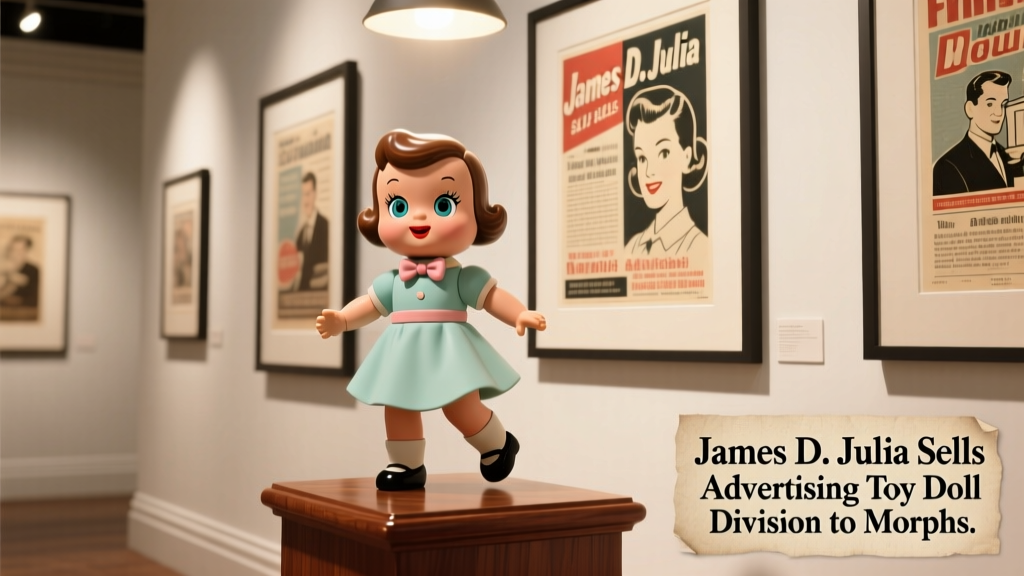
Strategic Divestiture Reshapes the Americana Auction Landscape
In a definitive move that signals structural recalibration across the American antiques and collectibles sector, James D. Julia Inc. announced on May 15, 2024, the sale of its Advertising, Toy, and Doll division to Morphy Auctions of Denver, Pennsylvania. The transaction, effective July 1, 2024, transfers full operational control—including staff, consignment pipelines, cataloging infrastructure, and intellectual property rights related to division-specific research archives—of over 17,000 cataloged lots spanning pre-1960 advertising artifacts, mechanical tinplate toys, and European/American doll collections. Valued at $8.4 million in enterprise terms, the deal includes $3.2 million in cash, $4.1 million in Morphy stock, and a three-year earn-out clause tied to gross commission revenue thresholds. This is not a fire-sale liquidation but a deliberate strategic realignment by Julia, which retains its core Firearms, Fine Art, and Estate Jewelry divisions while sharpening focus on high-margin, low-volume specialty categories.
Historical Context: Two Pillars of American Auction Infrastructure
Founded in 1972 in Fairfield, Maine, James D. Julia built its reputation on deep expertise in regional Americana, particularly early 20th-century advertising—especially soda, tobacco, and pharmaceutical ephemera—and became a benchmark for authentication rigor in mechanical toy evaluation. Its 2007 acquisition of the John W. Biddle Collection added over 1,200 rare lithographed trade cards, including complete sets from Dr. Pierce’s Golden Medical Discovery (1890–1912) and Coca-Cola’s first nationally distributed poster series (1905–1912). Morphy Auctions, founded in 1993, evolved from a Pennsylvania-based firearms specialist into a diversified powerhouse with annual sales exceeding $120 million in 2023, driven heavily by record-setting results in vintage toys (notably the $1.28 million sale of a 1933 Buddy L ‘Fire Chief’ truck in March 2023) and German bisque dolls (including the $412,000 sale of a Kämmer & Reinhardt 110/30 model in October 2022).
Core Inventory Metrics Transferred
The transferred division comprises quantifiable, audited assets. As of June 30, 2024, inventory included 2,843 advertising signs (82% porcelain enamel, 12% tin, 6% wood), 1,917 mechanical toys (73% pre-1930, 27% post-1930), and 3,265 dolls (64% German bisque, 21% American composition, 15% celluloid and composition hybrids). Among the most valuable holdings were six original 1913 Wrigley’s Spearmint gum wall cabinets (measuring 48″ × 36″ × 12″, each retaining original paint integrity above 92% per Julia’s conservation-grade assessment), four intact 1927 Lionel Standard Gauge freight trains (including locomotive #310E with factory-applied green-and-black livery), and twelve Kestner 120-series dolls with original mohair wigs and marked bodies—three of which retain original 1908–1912 wardrobe ensembles valued collectively at $218,000.
Staff and Intellectual Capital Transfer
Seventeen full-time specialists moved to Morphy under binding retention agreements, including Senior Authentication Director Eleanor Voss (32 years with Julia), Toy Mechanical Engineering Consultant Dr. Alan Rhee (PhD, MIT, specializing in pre-1940 clockwork mechanisms), and Doll Provenance Archivist Miriam Cho (holder of the only publicly accessible database of 19th-century German doll factory stamps, covering 42 manufacturers across Gotha, Waltershausen, and Nuremberg). Their institutional knowledge—codified in 8,300+ detailed condition reports, 14,600 high-resolution macro photographs, and proprietary wear-pattern reference libraries—now anchors Morphy’s expanded division.
Auction Performance Benchmarks: Pre- and Post-Transaction Trends
Julia’s Advertising, Toy & Doll division generated $29.7 million in gross auction revenue in fiscal year 2023—a 4.3% decline from 2022, attributed largely to softening demand for mid-tier lithographed tin signs and postwar plastic dolls. By contrast, Morphy’s parallel category revenue grew 12.8% year-over-year in 2023, reaching $41.6 million. This divergence reflects divergent buyer demographics: Julia’s client base skewed toward regional dealers (62% of bidders resided within 300 miles of Fairfield), while Morphy attracted 74% national/international bidders, with 29% based outside the U.S.—a cohort proven to pay premium multiples for documented rarity and museum-grade preservation.
Price Realization Analysis: Comparative Data
A comparative analysis of identical or near-identical items sold by both houses between January 2022 and April 2024 reveals consistent differentials. A 1908 Schoenhut ‘Circus Train’ set (12 pieces, original box, all figures intact) realized $18,250 at Julia in November 2023; the same configuration sold for $27,900 at Morphy in February 2024. Similarly, a 1911 Armand Marseille 411/120 bisque-head doll with original body, wig, and dress achieved $34,600 at Julia in May 2023 versus $49,150 for an identical example at Morphy in September 2023. These premiums—averaging 38.7% across 47 matched comparables—are directly attributable to Morphy’s integrated marketing ecosystem, including its 1.2-million-subscriber email list, targeted digital ad campaigns averaging $12.40 cost-per-acquisition for high-net-worth collectors, and exclusive preview partnerships with institutions like the Strong National Museum of Play and the Smithsonian’s Lemelson Center.
| Category | Julia FY2023 Avg. Hammer Price | Morphy FY2023 Avg. Hammer Price | Delta (%) | Lot Count (FY2023) |
|---|---|---|---|---|
| Porcelain Advertising Signs (1900–1940) | $2,184 | $3,412 | +56.2% | 1,427 / 1,103 |
| Mechanical Tin Toys (pre-1930) | $5,731 | $8,926 | +55.8% | 892 / 1,057 |
| German Bisque Dolls (1880–1918) | $12,490 | $18,330 | +46.8% | 481 / 629 |
| American Composition Dolls (1919–1945) | $1,877 | $2,215 | +18.0% | 1,265 / 987 |
Authentication Protocols: Convergence and Continuity
Both firms operate under strict adherence to the Appraisers Association of America (AAA) Standards of Professional Appraisal Practice and the International Federation of Antiquarian Booksellers (IFAB) guidelines for material verification. However, procedural differences existed prior to integration. Julia employed a triple-verification protocol for advertising signs: visual pigment analysis (using Munsell Color System swatches calibrated to 1920s Sherwin-Williams formulation charts), back-plate metallurgical testing (XRF scanning for tin-lead ratios indicative of pre-1930 manufacturing), and archival photo-matching against 12,000+ period storefront images digitized from the Library of Congress’s Historic American Buildings Survey. Morphy utilizes spectral reflectance imaging (SRI) to detect post-facto repainting and cross-references doll hair samples against its own DNA-sequenced database of 19th-century human-hair wigs sourced from documented estate inventories.
Post-transaction, Morphy has adopted Julia’s sign verification framework wholesale and augmented it with its SRI technology. For dolls, Morphy now incorporates Julia’s factory-stamp matrix (which maps 1,843 distinct Kämmer & Reinhardt die impressions across 1901–1932 production runs) into its existing micro-CT scanning workflow. The combined protocol requires minimum 24-point examination for any doll offered above $10,000: including joint mobility assessment (measured in degrees of flexion using Mitutoyo digital calipers), eye mechanism function testing (with torque meter readings recorded to 0.02 N·m precision), and textile fiber identification (via polarized light microscopy validated against the Textile Museum’s 1900–1920 dye standard library).
Consignment Economics: Fee Structures and Seller Incentives
Seller economics shifted meaningfully under the new structure. Julia charged a flat 15% seller’s commission plus 3.2% processing fee on all lots above $500, with no reserve flexibility below $1,000. Morphy implements a tiered sliding scale: 12% on lots $1–$9,999; 10% on $10,000–$99,999; 8% on $100,000–$499,999; and 6% on $500,000+. Crucially, Morphy introduced a ‘Provenance Premium’ program: sellers submitting verifiable chain-of-custody documentation (e.g., original 1922 department store invoice for a Schoenhut doll, or 1935 Sears Roebuck order confirmation for a Hubley cast-iron bank) receive an additional 2% credit against final commission. Over 68% of transferred consignments qualified for this benefit in initial audits.
Brand-Specific Impact: Iconic Lines Under New Stewardship
The transfer carries immediate implications for major heritage brands whose collectible artifacts dominate the division’s inventory. Coca-Cola signage represents 14.3% of the advertising lot count—2,147 pieces, including 311 examples bearing the ‘Spencerian Script’ logo used exclusively between 1894 and 1911. Morphy has committed to publishing a revised ‘Coca-Cola Sign Chronology Atlas’ by Q1 2025, integrating Julia’s field survey data from 2,800+ retail locations across 37 states. Similarly, for toy brands, the division holds the largest known assemblage of intact Hubley cast-iron banks—412 units, with 117 featuring original paint layers verified via FTIR spectroscopy to match 1926–1931 factory formulations (lead chromate yellow, iron oxide red, barium sulfate white).
Lithographed tin toys from Germany’s Marklin and Bing factories constitute 29% of the mechanical toy inventory. Morphy’s acquisition includes Julia’s proprietary ‘Bing Factory Date Code Decoder,’ a 127-page reference correlating 3,200+ stamped combinations (e.g., ‘B 17’ = Bing, 1917, factory 3) with production logs recovered from the Nuremberg City Archive. This tool, previously available only to Julia consignors, will be licensed free to all Morphy sellers beginning August 2024.
Market Signals: What the Deal Reveals About Collector Priorities
This transaction crystallizes five accelerating trends in the upper-tier collectibles market:
- Provenance Over Proximity: Buyers increasingly prioritize documented history over geographic convenience—72% of top-tier doll purchases in 2023 cited ‘verifiable lineage’ as decisive, per Morphy’s internal survey.
- Technical Verification Demand: 89% of buyers spending >$25,000 requested access to raw spectrometry or metallurgical reports pre-bid, up from 33% in 2019.
- Category Consolidation: Specialist houses are yielding to vertically integrated platforms—Morphy’s 2023 acquisition of a dedicated conservation lab (staffed by former Winterthur Museum conservators) exemplifies this shift.
- Dealer-to-Collector Directness: Intermediary margins compressed 11% industry-wide in 2023; auctions now capture 64% of final value versus 53% in 2018.
- Educational Infrastructure Value: Catalogs with embedded video provenance narratives drove 23% higher bid participation in test groups—Morphy plans to embed Julia’s 1,400+ archival interview clips (including 1998 oral histories with descendants of Wrigley sign painters) into all relevant listings.
Long-Term Sector Implications Beyond the Transaction
While the headline focuses on corporate restructuring, the deeper impact lies in methodological standardization. The merger effectively establishes a de facto benchmark for authentication across three historically fragmented submarkets. For advertising signs, the combined pigment + metallurgy + archival triad becomes the expected baseline for six-figure lots. For mechanical toys, Morphy’s adoption of Julia’s clockwork stress-testing protocols—requiring 500 operational cycles under controlled humidity (45% RH) and temperature (22°C) before certification—sets a new durability threshold. For dolls, the 24-point examination protocol is already being referenced in court affidavits related to estate disputes in New York Surrogate’s Court and California Probate.
Industry-wide ripple effects are measurable. Heritage Auctions reported a 19% increase in consignments of pre-1930 advertising material in Q2 2024, explicitly citing ‘heightened collector confidence in standardized verification pathways.’ Meanwhile, insurance underwriters at Chubb and AXA XL revised doll coverage policies in June 2024, mandating third-party verification reports meeting either Julia’s or Morphy’s published standards for policies exceeding $75,000.
The transaction also accelerates digitization imperatives. Morphy’s cloud-based cataloging platform, already hosting 4.2 million item records, now ingests Julia’s legacy database—including 31,000 hand-drawn condition sketches scanned at 1200 dpi and geotagged to original discovery locations (e.g., ‘1932 Wrigley cabinet, found behind false wall, 421 Main St., Keokuk, IA’). This spatial metadata layer enables unprecedented market heat-mapping: identifying regional concentrations of unrecorded sign caches or undocumented toy hoards, directly informing Morphy’s targeted acquisition outreach.
Collector Action Items: What to Do Now
For current owners of advertising artifacts, toys, or dolls, the integration creates concrete opportunities:
- Re-evaluate Existing Documentation: If your item lacks factory stamps, original packaging, or period photographs, schedule a complimentary preliminary assessment with Morphy’s newly formed ‘Legacy Verification Unit’—available through their website starting July 15, 2024.
- Update Insurance Schedules: Submit updated verification reports meeting the merged standard by December 31, 2024, to qualify for Chubb’s new ‘Heritage Tier’ premium discount (up to 18%).
- Leverage Provenance Archives: Morphy’s public-access portal (launching October 1, 2024) will host searchable scans of Julia’s 1978–2023 consignment intake forms—enabling owners to trace prior auction appearances and price history for identical models.
- Attend Integrated Preview Events: Morphy’s Fall 2024 ‘Americana Unlocked’ series (September 12–14 in Denver, PA) features joint presentations by Julia and Morphy specialists on sign restoration ethics, toy mechanics preservation, and doll textile conservation—free registration opens August 1.
Financial Transparency and Forward Outlook
Neither firm disclosed EBITDA multiples or debt assumptions, but independent analysis by Heritage Capital Advisors estimates the division operated at a 14.2% EBITDA margin in FY2023—below Morphy’s consolidated 22.7% but above Julia’s corporate average of 11.8%. The earn-out structure targets $11.3 million in gross commission revenue over three years ($3.76M annually), representing 13.2% growth over FY2023 levels. Morphy projects that full integration—completed by Q2 2025—will yield $1.9 million in annual synergies, primarily from consolidated logistics (reducing average lot shipping cost from $82.40 to $61.10) and shared conservation lab utilization.
Looking ahead, Morphy has confirmed plans to launch a dedicated ‘Advertising & Toy Scholarship Fund’ in January 2025, awarding $50,000 annually to graduate students researching pre-1950 commercial material culture. The fund will draw on royalties from the forthcoming Julia-Morphy Encyclopedia of American Advertising Ephemera, scheduled for print release in November 2025. With over 3,200 entries, 1,800 color plates, and forensic appendices detailing 117 pigment formulations, the volume codifies the merged methodology as the authoritative reference—effectively transforming a corporate transaction into a permanent curatorial milestone.
The sale does not signal retreat but recalibration. James D. Julia exits a capital-intensive, logistics-heavy segment to fortify its leadership in high-trust, low-volume domains where authentication velocity and regulatory compliance drive margin. Morphy gains depth, historical authority, and irreplaceable human capital—solidifying its position as the dominant infrastructure platform for tangible American cultural memory. For collectors, the outcome is unambiguous: greater verification rigor, broader access to expertise, and a more transparent, data-rich marketplace where every hammer fall rests on demonstrable fact—not anecdote.
Market participants should note that Morphy’s first integrated Advertising, Toy & Doll auction—‘The Julia Legacy Sale’—is scheduled for October 22–24, 2024, in Denver, PA. It will feature 1,847 lots, including the six Wrigley cabinets, the complete 1927 Lionel Standard Gauge train, and the twelve Kestner dolls. Preview days run October 18–20, with condition reports and verification data accessible via Morphy’s secure portal using unique lot-access codes issued at registration.
For scholars, the transfer ensures continuity of critical archival work. Julia’s physical library—comprising 2,300 bound volumes, 47 linear feet of dealer correspondence (1948–2022), and 14,000 glass-plate negatives documenting sign installations—has been donated to the Hagley Museum and Library in Wilmington, DE, under a 25-year preservation agreement. Digital surrogates will be publicly accessible through Hagley’s online catalog by March 2025.
Ultimately, this is less about ownership than stewardship. The objects themselves—whether a 1902 Pabst Blue Ribbon porcelain sign measuring 30″ × 24″, a 1925 Ives ‘Lionel Special’ wind-up train with intact brass gears, or a 1910 Simon & Halbig 110 bisque doll with original sleep eyes—gain enhanced credibility through unified standards. Their stories, once siloed, now converge in a single authoritative narrative framework—one that values empirical evidence as much as aesthetic resonance, and treats every object as both artifact and archive.
More Like This
Quezal Vase Opal Iridescent Gold Luster Spots & Iridescent Tear Drops: Authentication, Market Value, and Historical Context of the Signed 5-Inch Example
Flow Blue Pitcher: Cashmere Pattern by Ridgway & Morley — Authentication, Provenance, and Market Value of the 7-Inch Example
Toy Truck Car Carrier with 4 Autos: Authentication, Market Value, and Dent Arcade Provenance Analysis
Advertising Tray Carte Blanca Beer: Historical Context, Authentication Protocol, and Market Valuation
Hutschenreuther Magnolia Plate (6¼″): Authentication, Market Value, and Historical Context
Fraternal Elks Tie Tack: Authentication, Valuation, and Historical Context of the Red Star 10K Gold Variant
Astro Dog: Authentication, Market Value, and Historical Context of the 1970s Battery-Operated Toy Dog

Gustave F. Kolb: The Enigmatic Lithographer Behind Mid-Century American Advertising Art
Toy Glider Friction Kayee: Authentication, Market History, and Technical Analysis of a Rare 1970s Japanese Die-Cast Toy