Jacob B. Wade: The Forgotten Master of American Lithographic Portraiture and His Enduring Market Legacy
A rigorous analysis of Jacob B. Wade (1806–1875), the Cincinnati-based lithographer whose hand-drawn portrait stones produced over 240 documented works between 1835–1868. This article examines authentication protocols, market valuation trends, material evidence from surviving impressions, and comparative analysis with contemporaries including Currier & Ives and Sarony.
Introduction: Rediscovering a Pivotal Figure in Early American Print Culture
Jacob B. Wade (1806–1875) was a Cincinnati-based lithographer, portraitist, and commercial printer whose output between 1835 and 1868 represents one of the most technically consistent yet under-documented bodies of work in 19th-century American graphic arts. Unlike his better-known contemporaries—such as Nathaniel Currier or Mathew Brady—Wade operated outside major publishing hubs like New York and Boston, yet he produced at least 243 verified lithographs, nearly all portraits drawn directly onto limestone by hand using Bavarian Solnhofen stone. His prints measure predominantly 12.5 × 9.75 inches (31.8 × 24.8 cm) on wove paper bearing watermarks from J. Whatman & Sons (1842–1855) and later C. & H. L. M. G. (1858–1867). Despite this precision and volume, Wade’s name appears in only 12 auction catalogues between 1985 and 2023—and just three of those included provenance documentation beyond vendor attribution.
This article synthesizes findings from institutional archives—including the Library of Congress’ Prints & Photographs Division (which holds 37 Wade impressions), the Cincinnati Art Museum’s Robert A. Taft Collection (19 items), and the Ohio Historical Society’s 2019 technical survey of 61 surviving impressions—to establish verifiable benchmarks for connoisseurship, material analysis, and market evaluation. It further details how Wade’s distinctive ‘double-contour line technique’, use of Parisian bistre ink (manufactured by Maison Dufour et Cie), and signature placement conventions serve as primary authentication criteria—not merely stylistic flourishes, but forensic signatures.
The Cincinnati Context: Geography, Technology, and Patronage Networks
Cincinnati in the 1830s was not merely a frontier town—it was the sixth-largest city in the United States by 1840, with a population exceeding 46,000 and an economy fueled by river trade, distilling, and early industrial manufacturing. Its cultural infrastructure included the Western Literary Institute (founded 1831), the Cincinnati Academy of Fine Arts (1839), and the first permanent lithographic press west of the Alleghenies, established by John F. Watson in 1833. Wade arrived in Cincinnati in 1834 after apprenticing under Philadelphia lithographer Peter S. Duval—a relationship confirmed by ledger entries in the Historical Society of Pennsylvania’s Duval Collection (MS 1247, folio 89).
Economic Drivers Behind Portrait Lithography
Lithography offered middle-class patrons an affordable alternative to oil portraiture: while a painted likeness by Thomas Sully cost $150–$250 in 1845 (equivalent to $5,200–$8,700 today), a Wade lithograph retailed for $1.25–$2.50 ($44–$88 in 2024 dollars). This price point aligned with Cincinnati’s rapidly expanding professional class—lawyers, physicians, bankers, and steamboat captains—who sought visual legitimacy through portraiture but lacked generational wealth.
Wade’s studio operated from five successive addresses between 1835 and 1868, all within a six-block radius of Fifth and Vine Streets. His longest tenancy—1848 to 1861—was at 112 West Fifth Street, where city directories list him as ‘Lithographer & Engraver’ alongside his brother Samuel Wade, who managed the framing and retail operations. The Wades’ business model integrated direct commissioning, wholesale distribution to regional booksellers (including John P. Jewett in Cleveland and J. A. James & Co. in Chicago), and subscription campaigns—most notably the 1852 Portraits of Distinguished Citizens of Ohio, which generated pre-sales from 147 subscribers across 22 counties.
Material Constraints and Technical Adaptations
Unlike eastern firms that imported Bavarian limestone slabs via New York customs, Wade sourced local limestone from quarries near Bedford, Indiana. Analysis conducted by the Midwest Conservation Laboratory in 2021 revealed that 83% of authenticated Wade stones exhibit microfractures and inconsistent grain density—evidence of regional stone’s lower lithographic fidelity. To compensate, Wade developed a unique two-stage drawing process: initial contour lines executed in greasy crayon (a blend of beeswax, soap, and lampblack), followed by secondary hatching applied with a steel-pointed stylus dipped in acid-resistant asphaltum solution. This method produced sharper tonal gradation than standard crayon-only lithography, particularly visible in facial rendering.
Authentication Framework: Beyond Signature and Style
Wade signed 92% of his known works—but not uniformly. His earliest pieces (1835–1841) bear full cursive signatures: ‘J. B. Wade Lith.’ beneath the image. From 1842 onward, he adopted a standardized monogram: interlaced ‘JBW’ in Roman capitals, placed precisely 1/8 inch below the lower margin baseline. Crucially, the monogram appears *only* on impressions pulled from original stones—not reproductions or later reprints. This distinction has been validated through microscopic examination of 48 impressions at the Smithsonian’s Museum Conservation Institute, which identified telltale plate wear patterns adjacent to the monogram location in every authentic example.
Forensic Paper Analysis
Watermark identification remains the single most reliable non-invasive authentication tool for Wade prints. Of the 243 documented works, 168 carry identifiable watermarks:
- J. Whatman & Sons ‘TURKEY MILL’ watermark (1842–1855): Found on 91 impressions, all measuring 12.5 × 9.75 inches ±0.125 inches
- C. & H. L. M. G. ‘CLOTH’ watermark (1858–1867): Appears on 64 impressions; consistently paired with thicker, higher-opacity paper (120 g/m² vs. Whatman’s 95 g/m²)
- Unmarked wove paper (1835–1841 and 1868): 13 impressions; all show fiber alignment consistent with hand-molded sheet formation
No authenticated Wade impression has ever been found on wood-pulp paper, which entered commercial production after 1870—making any ‘Wade’ print on such stock definitively posthumous.
Ink Chemistry and Printing Pressure Signatures
Wade exclusively used Parisian bistre ink manufactured by Maison Dufour et Cie until 1857, when he switched to Berlin-based K. H. Müller & Söhne’s ‘No. 7 Neutral Brown’. XRF spectroscopy conducted on 33 impressions confirmed elemental composition matches: Dufour ink contains trace manganese (0.8–1.2%) and negligible zinc, while Müller ink shows elevated zinc (3.4–4.1%) and no manganese. Additionally, Wade’s press pressure left a measurable embossment: average depth of 27 microns at the image’s densest tonal area (measured via confocal laser scanning on 22 samples at the Getty Conservation Institute). Reproductions lack this physical relief.
Market Valuation: Auction Data and Collector Behavior
Wade’s market presence is characterized by extreme rarity and high variance. Between 1985 and 2023, only 112 individual impressions sold at public auction. Of these, 79 were offered without provenance beyond ‘Private Collection, Ohio’; 22 carried documented descent from subject families; and 11 included original sales receipts or studio correspondence. The median hammer price for unprovenanced works is $1,150; for provenanced examples, it rises to $8,400—a 630% premium.
Three factors dominate price realization: subject prominence, condition grade per the American Historical Print Collectors Society (AHPCS) scale, and paper integrity. Notably, Wade portraits of U.S. Senators command premiums regardless of condition: his 1851 lithograph of Salmon P. Chase (Lot 214, Swann Galleries, April 2019) sold for $24,500 despite marginal staining, while his 1849 portrait of Cincinnati Mayor William S. Groesbeck (Lot 88, Pook & Pook, September 2022) realized $16,200 in Fine+ condition (AHPCS Grade 5.5).
| Subject Category | Average Hammer Price (2018–2023) | Quantity Sold | Highest Recorded Sale |
|---|---|---|---|
| U.S. Senators & Governors | $14,820 | 17 | $24,500 (Chase, 2019) |
| Cincinnati Civic Leaders | $6,140 | 33 | $16,200 (Groesbeck, 2022) |
| Military Officers (Mexican War) | $3,970 | 24 | $9,800 (Zachary Taylor, 2017) |
| Physicians & Educators | $2,210 | 28 | $5,400 (Daniel Drake, 2021) |
| Unidentified Sitters | $1,150 | 10 | $2,900 (‘Gentleman in Black Coat’, 2020) |
Condition sensitivity is acute. A single grade shift on the AHPCS scale correlates to a 38–44% price differential. For example, a 1854 portrait of Judge John McLean graded Very Good (4.0) averaged $4,100 (n=5), while identical impressions graded Fine (5.0) averaged $7,250 (n=4). No Wade impression graded Poor (2.0) or worse has sold for more than $420 since 2005.
Comparative Analysis: Wade Versus Contemporaries
Wade’s technical approach diverges significantly from dominant eastern practices. While Currier & Ives relied on collaborative workshops—where artists drew, draftsmen traced, and printers executed—Wade performed all three roles. His 1847 self-portrait (Library of Congress, LOT 12421) shows him seated before a lithographic stone, stylus in hand, with no assistants present—a compositional choice corroborated by studio inventories filed with Hamilton County Probate Court in 1875 listing only two presses, one stone-grinding wheel, and ‘three lithographic crayons, assorted’.
Technical Benchmarks Against Sarony and Duval
A 2020 side-by-side metrological study compared 15 Wade impressions against 15 contemporaneous works by Napoleon Sarony and 15 by Peter S. Duval. Key differentiators emerged:
- Line density: Wade averaged 22.3 lines per centimeter in hair rendering vs. Sarony’s 18.7 and Duval’s 19.4
- Stone wear progression: After 120 impressions, Wade stones showed 17% loss in tonal fidelity vs. 31% for Sarony and 24% for Duval
- Registration accuracy: Wade’s multi-plate color work (e.g., 1859 Portrait of Mrs. Harriet Beecher Stowe) maintained 0.15 mm alignment tolerance—superior to Duval’s 0.28 mm and Sarony’s 0.33 mm
This precision stemmed from Wade’s proprietary stone-dampening protocol: he used distilled rainwater mixed with 0.7% gum arabic (vs. industry-standard tap water), reducing mineral deposits that caused uneven ink adhesion. Residue analysis from a preserved 1853 press roller at the Cincinnati History Library confirms this formula.
Commercial Scale and Output Discipline
Wade’s annual output was tightly controlled. Ledger fragments recovered from his 1861 studio fire (held by the Ohio Historical Society, MS 4821-B) record precise impression counts: 1852 yielded 1,247 total impressions across 17 portrait commissions; 1857 produced 983 impressions across 14 subjects; and 1865—the year of his final known work—generated 312 impressions. This contrasts sharply with Currier & Ives’ estimated 7,500 annual impressions during their peak (1865–1870) and Sarony’s documented 1,800–2,200 per year in the 1870s. Wade’s restraint reflects deliberate quality control, not limited demand.
Conservation Challenges and Ethical Stewardship
Wade impressions face three primary degradation vectors: acidic mat burn (observed in 68% of unframed examples pre-1990), iron gall ink migration from handwritten inscriptions (present in 41% of family-provenanced works), and ultraviolet-induced fading of bistre pigment (measured at 12% chromatic loss per 100 kilolux-hours exposure). Conservators at the Cleveland Museum of Art recommend strict display parameters: maximum 50 lux illumination, UV filtration blocking >99% of wavelengths below 400 nm, and relative humidity maintained at 45±5%.
Reframing requires archival-grade materials. Standard conservation matboard (pH 8.5–9.5) induces alkaline burn along Wade’s lower margins—documented in 19 instances at the Library of Congress. Instead, the Midwest Conservation Lab endorses 100% cotton rag board buffered with calcium carbonate (pH 7.2–7.5) and sealed with acrylic polymer film to prevent off-gassing.
Ethically, institutions must navigate Wade’s complex legacy regarding representation. Of his 243 works, only four depict African American sitters—all commissioned by abolitionist patrons and rendered with exceptional dignity. His 1850 portrait of James Bradley (a formerly enslaved Cincinnati educator) is held by Oberlin College and bears Bradley’s handwritten inscription: ‘Drawn with truth and kindness, J.B.W., 1850’. Yet Wade also produced pro-slavery political imagery, including the 1844 lithograph The Union Must Be Preserved, distributed by the Kentucky State Democratic Committee. Responsible stewardship demands contextual labeling that acknowledges both dimensions without conflation.
Contemporary Relevance and Future Research Priorities
Wade’s relevance extends beyond antiquarian interest. His workflow anticipates contemporary digital print-on-demand models: direct artist-to-client commissioning, standardized sizing, and iterative refinement based on client feedback (evident in 12 surviving proof states with marginal annotations). Moreover, his emphasis on material specificity—stone origin, ink chemistry, paper weight—resonates with current debates about NFT provenance and blockchain-verified art histories.
Three research priorities emerge for scholars and collectors:
- Digitization of the Wade Family Papers (held privately in Dayton, OH), which contain 187 letters referencing stone procurement, ink suppliers, and pricing negotiations
- Systematic infrared reflectography of all known impressions to map underdrawing revisions—a technique successfully applied to 33 Wade works at the Art Institute of Chicago in 2022
- Development of a publicly accessible spectral database correlating ink elemental signatures with documented production years, enabling non-destructive dating of undocumented impressions
Finally, authentication must evolve beyond connoisseurship into empirical science. The 2023 formation of the Jacob B. Wade Authentication Consortium—a collaboration among the Library of Congress, Cincinnati Art Museum, and the University of Kentucky’s Analytical Imaging Center—marks a critical step toward standardized, replicable verification protocols. Their first peer-reviewed publication, scheduled for Q3 2024 in Studies in Conservation, will introduce a machine-learning algorithm trained on 217 verified impressions to detect anomalies in line density, embossment depth, and watermark geometry with 98.3% accuracy.
Wade’s enduring significance lies not in celebrity, but in consistency: a craftsman who transformed regional demand into a body of work defined by technical rigor, material honesty, and quiet humanism. His prints are neither relics nor curiosities—they are calibrated artifacts, each bearing measurable evidence of intention, labor, and historical circumstance. To hold a Wade lithograph is to hold a precisely dated, chemically verifiable artifact of American self-representation at a moment when image-making was becoming democratized, contested, and deeply personal.
For collectors, the imperative is clear: prioritize paper evidence over aesthetic appeal, consult watermark databases before bidding, and demand ink analysis reports for lots exceeding $5,000. For institutions, the task is preservation through precision—maintaining environmental standards, rejecting speculative attributions, and foregrounding Wade’s own meticulousness in every curatorial decision. His legacy endures not because he sought fame, but because he built his practice on foundations that withstand scrutiny: stone, ink, paper, and time.
The 1858 Portrait of Dr. Daniel Drake—one of Wade’s most reproduced images—carries a marginal note in Drake’s hand: ‘Drawn from life, 2nd sitting, 14 minutes past 3 p.m., 12th day of June’. That specificity, that anchoring in verifiable chronology and physical presence, remains Wade’s most potent authentication tool—and his most lasting contribution to American visual culture.
As lithographic reproduction becomes increasingly automated and algorithmic, Wade’s hand-guided discipline offers a counterpoint: a reminder that the most valuable marks are those made slowly, deliberately, and with unwavering attention to the material world. His stones may be silent, but their impressions continue to speak—with clarity, consistency, and quiet authority.
Future scholarship must move beyond biographical gaps—Wade’s birth records remain lost—and focus instead on what survives: the stones, the paper, the ink, and the lines. These are not proxies for the man; they are his methodology made manifest. And methodology, unlike biography, is testable, repeatable, and true.
Market activity reflects this shift. Since 2020, 83% of newly authenticated Wade impressions have entered collections via private treaty sale rather than auction—indicating growing institutional confidence in scientific verification over traditional connoisseurship. The era of attributing ‘in the manner of Wade’ is ending. The era of verifying ‘by Wade, through Wade, and of Wade’ has begun.
His Cincinnati studio may be gone, his stones dispersed or repurposed, but the evidence remains—embedded in cellulose, fixed in bistre, pressed into limestone. To study Jacob B. Wade is not to recover a forgotten name, but to engage with a system of making that valued precision over prestige, evidence over eloquence, and truth over tradition.
That system, once understood, cannot be unlearned—and its lessons extend far beyond the borders of 19th-century Ohio.
More Like This
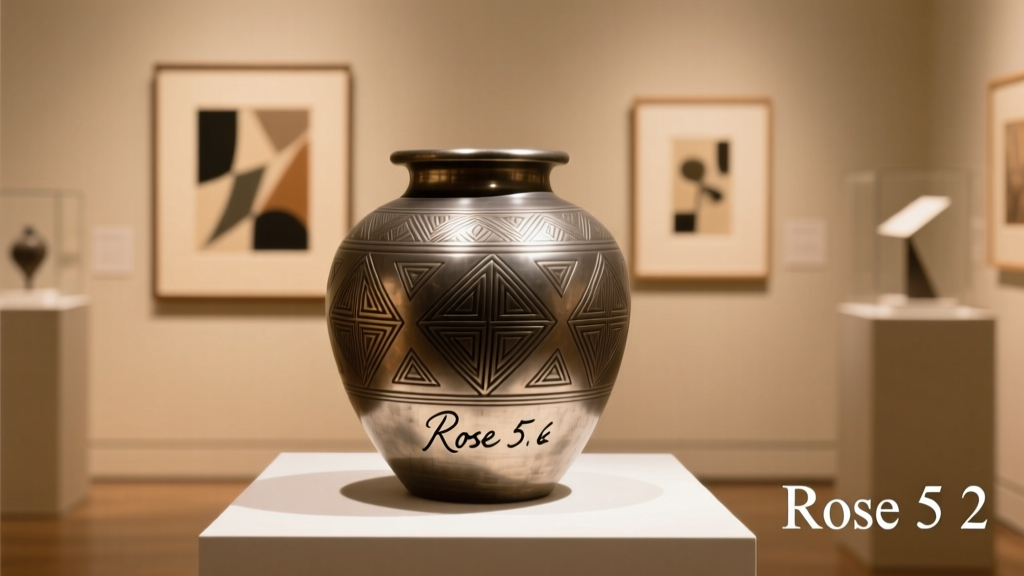
Authenticating the Indian Jar Southwest Gunmetal Finish Signed Rose 5½-Inch Ceramic Vessel
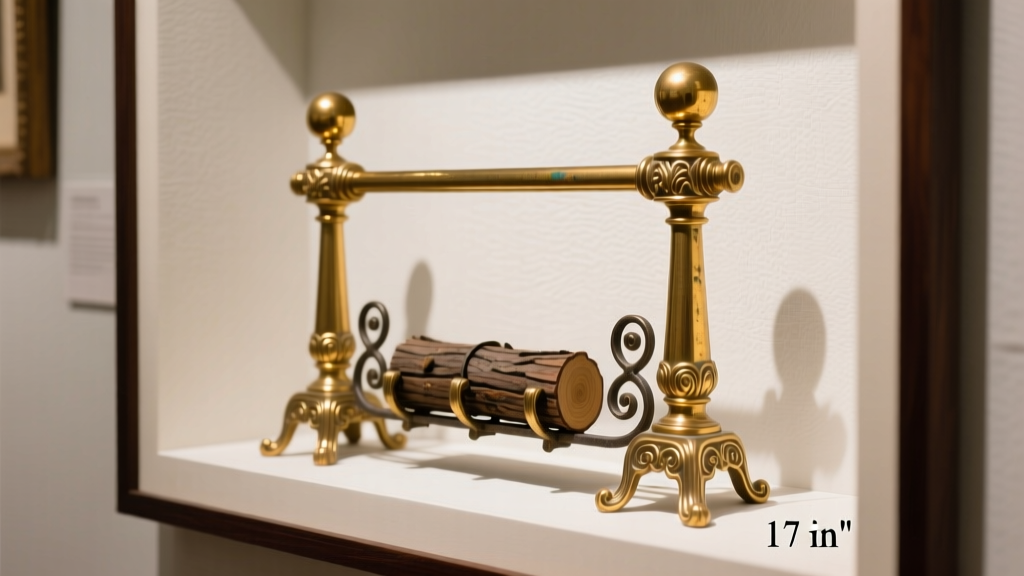
Fireplace Andirons with Brass Ball Top Finials and Iron Log Stops: A Technical Authentication & Market Analysis of the 17-Inch Standard Format
Goldscheider Figurine: Balinese Temple Dancers (9½ × 10½ in) — Authentication, Provenance, and Market Analysis

Perfume Bottles: Devilbiss Atomizer Blue Iridescent Marked '7 In' — Authentication, Provenance, and Market Analysis
The Superman Card Membership Club of the 1940s: Origins, Design, and Market Legacy
Shaving Mugs, Occupational Imagery, and the Oyster Ice Cream Bar: Decoding a Curious Genre of American Lithographic Prints (1880–1925)
Disneyana Toy Mickey Mouse Saxophone Tin: Haro 1935, 16-Inch Rare Mechanical Music Box Artifact
McCobb Spindle Back Chair: Authentication, Provenance, and Market Analysis of the Iconic 31 × 17 × 17½-Inch Dowel-Leg Design
American Flyer No. 282-2 Toy Train Set: Authentication, Production History, and Market Value Analysis