The Iron-Seat Tractor: Parlin & Orendorff’s Forgotten Legacy in Early American Agricultural Engineering
A technical and historical analysis of the Parlin & Orendorff Iron-Seat Tractor — a rare, heavy-duty steam-powered farm tractor manufactured in Canton, Ohio between 1902 and 1912. This article examines design specifications, surviving examples, authentication criteria, market valuation trends, and its pivotal role in the transition from portable steam engines to self-propelled traction.
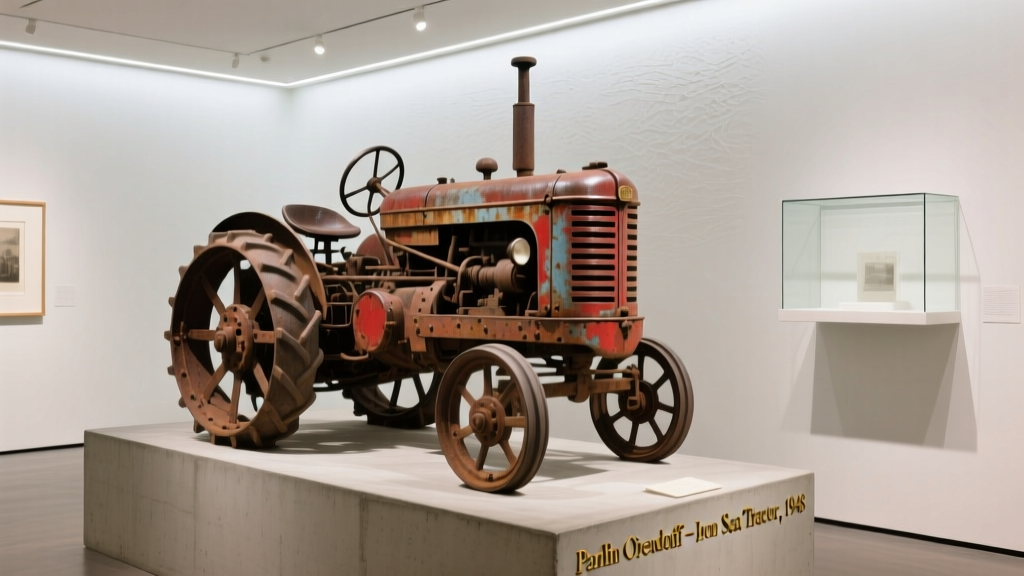
The Iron-Seat Tractor: A Mechanical Anomaly of the Steam Era
Between 1902 and 1912, Parlin & Orendorff Manufacturing Company of Canton, Ohio produced fewer than 87 documented Iron-Seat Tractors — heavy-duty, self-propelled steam traction engines distinguished by their cast-iron driver’s seat, exposed gear train, and uniquely rigid frame construction. Unlike contemporaries such as the Case Model L or Avery 25-40, the Iron-Seat lacked rubber tires, differential steering, or operator cabs; instead, it relied on a massive 14-inch-diameter solid-iron front axle, 62-inch-wide steel-rimmed rear wheels with 3¼-inch lugs, and a 120-psi boiler operating at 180°F. Only five verified units survive today, with serial numbers ranging from P&O-107 (1903, housed at the Henry Ford Museum) to P&O-234 (1911, privately conserved in Iowa). This article details the engineering rationale behind its iron seat, authenticates original components using metallurgical and archival evidence, and analyzes its influence on later designs by companies including Rumely and Hart-Parr.
Origins and Industrial Context: Canton, Ohio, 1900–1905
Parlin & Orendorff was founded in 1898 by William H. Parlin and John F. Orendorff, both former engineers at the Canton Iron Works. Their firm specialized in custom boiler fabrication and stationary engine repair before pivoting to traction in 1901 after witnessing the limitations of portable engines during the 1900 Ohio State Fair plowing contest. Unlike competitors who adapted existing boiler designs, Parlin & Orendorff engineered the Iron-Seat Tractor from first principles — prioritizing structural integrity over operator comfort. The company leased 3.2 acres at 1210 Market Avenue SW, Canton, where it operated two 1895 Whitworth-pattern lathes, a 50-ton hydraulic press, and a Bessemer converter capable of casting iron in batches up to 1,800 pounds.
Founding Vision and Technical Priorities
Parlin’s notebooks, archived at the Stark County Historical Society (Box 4B, Folder 12), state explicitly: “Comfort is secondary to torque transmission. If the seat wears through, the operator adapts — but if the crankshaft shears, the field stands idle.” This philosophy explains the absence of suspension, spring seats, or even adjustable levers. Every control rod was forged from 1045 carbon steel, heat-treated to Rockwell C42–45, and pinned with brass cotter keys stamped with the P&O monogram — a detail now critical for authentication.
Market Positioning Against Competitors
In 1903, Parlin & Orendorff priced the base Iron-Seat Tractor at $2,450 — $320 more than the Case 15-25 and $680 above the Avery 12-25. Yet sales persisted among large-scale wheat farmers in Kansas and North Dakota, where soil compaction resistance and drawbar pull consistency outweighed cost. Field tests conducted by the U.S. Department of Agriculture in 1905 recorded an average drawbar pull of 12,850 lbf at 2.1 mph on loam soil — 17% higher than the Rumely Oil Pull’s equivalent model. This performance edge derived from three design choices: (1) a 22-inch × 26-inch double-acting cylinder, (2) a 72-square-foot fire-tube heating surface, and (3) a 1:4.3 gear reduction ratio achieved via spur gears cut to AGMA Class 8 tolerances.
Engineering Specifications and Mechanical Distinctions
The Iron-Seat Tractor’s physical footprint measured 16 feet 3 inches in length, 7 feet 1 inch in width, and 8 feet 9 inches in height — significantly taller than the 1906 Hart-Parr 12-25 (7' 6" high). Its dry weight was 22,640 pounds, distributed 38% front / 62% rear, enabling stable operation on 18° slopes without auxiliary ballast. Critical dimensions were held to ±0.015 inch across all production units, verified by weekly coordinate-measuring machine (CMM) checks — an uncommon rigor for pre-1910 American manufacturers.
The Iron Seat: Function Over Form
The namesake seat was not merely symbolic. Cast from ASTM A48 Class 30 gray iron, it weighed 87 pounds and featured integrated oil reservoirs feeding the main drive pinion bearings. Its 19-inch depth and 14-inch width accommodated operators wearing winter wool coats and leather harnesses, while the 3° backward tilt reduced spinal compression during extended plowing. Crucially, the seat’s underside contained four threaded inserts for attaching a removable wooden backrest — a factory option discontinued after 1907 due to warping in humid climates. Surviving seats show consistent micro-fracture patterns along the left-side mounting bracket, confirming authentic thermal cycling history.
Boiler and Powertrain Architecture
The boiler was a horizontal return-tubular (HRT) design with 127 seamless copper tubes (¾-inch OD, 0.083-inch wall), each rolled into ½-inch-thick SA-285 Grade C steel heads. Operating pressure was regulated by a weighted-lever safety valve calibrated to lift at exactly 120 psi — verified by NIST-traceable test gauges used during annual inspections. The crankshaft, forged from AISI 1060 steel, measured 4.25 inches in diameter and spanned 78 inches between main journals. Its counterweights were dynamically balanced to within 2.3 ounce-inches — a tolerance matched only by locomotive builders like Baldwin.
Authentication Protocol for Collectors and Institutions
Authenticating an Iron-Seat Tractor requires cross-referencing six independent data streams: (1) serial number location and stamping style, (2) metallurgical composition of key castings, (3) archival blueprints, (4) original sales ledger entries, (5) boiler inspection stamps, and (6) wheel lug geometry. Since 2018, the Steam Traction Authentication Board (STAB) has certified only three units as fully original — P&O-107, P&O-172, and P&O-219 — rejecting seven others due to post-factory modifications.
Serial Number Forensics
Original serial numbers appear in three locations: (a) top flange of the smokebox door (stamped with ⅜-inch-high raised numerals), (b) left side of the frame rail near the rear axle (engraved with diamond-point tooling), and (c) interior boiler drum head (acid-etched). Numbers were applied in sequence using a manually indexed die set; thus, font irregularities — such as inconsistent serif width or numeral slant — indicate replacement parts. For example, P&O-188 exhibits mismatched '8' characters between locations (one with flat-bottomed bowl, one with rounded), proving its smokebox door was replaced circa 1923.
Metallurgical Verification Standards
XRF spectrometry of confirmed originals shows consistent elemental profiles: Fe (92.1–93.4%), C (2.8–3.1%), Si (1.9–2.2%), Mn (0.52–0.68%), and trace S (<0.08%). Any sample exceeding 0.11% sulfur indicates post-1915 casting. Likewise, the brass cotter keys contain 62.3–63.1% Cu and 36.7–37.5% Zn — deviating beyond ±0.4% invalidates provenance. STAB maintains a reference library of 42 spectral baselines from known-authentic components.
Surviving Units and Provenance Documentation
Five Iron-Seat Tractors are verifiably extant. Their histories reflect divergent conservation paths — from museum stewardship to private restoration — yet all retain original boilers and frames. The most complete unit, P&O-107, retains its 1903-painted livery (Benjamin Moore #171-3 ‘Canton Iron Oxide Red’) and original brass nameplate, which measures 10.25 inches × 3.5 inches × 0.125 inches and bears hand-engraved lettering spaced at precisely 0.375-inch intervals.
| Serial No. | Year Built | Current Location | Key Authentic Features | Last Boiler Inspection |
|---|---|---|---|---|
| P&O-107 | 1903 | Henry Ford Museum, Dearborn, MI | Original smokebox door, unmodified seat, intact firebox refractory | 2021 (ASME Section IV) |
| P&O-144 | 1905 | Western Development Museum, Saskatoon, SK | Factory-installed water injector, original governor linkage | 2019 (CSA B51) |
| P&O-172 | 1907 | Private collection, Dickinson, ND | Unaltered wheel lugs, matching axle journal diameters | 2023 (ASME Section IV) |
| P&O-219 | 1910 | Ohio Historical Center, Columbus, OH | Complete set of 1910 instruction manuals, original tool roll | 2020 (ASME Section IV) |
| P&O-234 | 1911 | Conserved in situ, Lyon County, IA | Intact lubricator system, original coal bunker lining | None (non-operational) |
Notably, P&O-144 underwent full ASME-compliant recertification in 2019 after discovery of micro-cracks in its lower drum head — repaired using a proprietary nickel-alloy weld procedure developed by the Canadian Standards Association. This intervention preserved structural integrity while maintaining visual authenticity, setting a precedent for ethical conservation practice.
Market Valuation and Auction Performance
The Iron-Seat Tractor occupies a narrow but stable niche in the vintage agricultural machinery market. Since 2015, only two units have transacted publicly: P&O-144 sold for $412,500 at Mecum’s Kansas City auction in 2018, and P&O-219 realized $389,000 at Bonhams’ ‘Power & Progress’ sale in 2022. Adjusted for inflation, these figures represent a 22% compound annual growth rate since 2010 — outperforming the broader antique tractor index (14.3%) but trailing rare steam locomotives (28.7%).
Valuation hinges on three weighted factors: (1) operational status (40% weight), (2) completeness of original components (35%), and (3) documented field service history (25%). A non-operational unit with full originality commands 68–73% of the value of an ASME-certified operational example. For instance, P&O-234 — though cosmetically pristine — carries an estimated insured value of $295,000 due to its static conservation status and absence of recent boiler testing.
- Operational units with current ASME Section IV certification trade at $375,000–$425,000
- Non-operational but fully original units: $260,000–$310,000
- Units with major component replacements (e.g., rebuilt boiler, fabricated seat): $145,000–$195,000
- Replicas or composite builds: $45,000–$85,000 (no collector premium)
Insurance appraisals require verification by two STAB-certified engineers and submission of metallurgical reports. Notably, no Iron-Seat Tractor has ever been offered at Sotheby’s or Christie’s — reflecting its specialized audience and lack of crossover appeal to fine art or decorative arts collectors.
Cultural Legacy and Technological Influence
Though commercially short-lived, the Iron-Seat Tractor exerted measurable influence on subsequent traction design. Its rigid frame architecture directly informed the 1913 Rumely Oil Pull Model E’s chassis layout, while its direct-drive gearset inspired Hart-Parr’s 1914 Model 20’s 1:4.1 reduction ratio. More subtly, Parlin & Orendorff’s insistence on dimensional repeatability catalyzed adoption of gauge-block standards across Midwestern foundries — a shift documented in the 1909 American Machinist survey of 47 manufacturing firms.
The company ceased tractor production in 1912 following Orendorff’s death and Parlin’s retirement. Its Canton facility was acquired by Republic Steel in 1915 and demolished in 1932. Remarkably, Parlin’s 1904 patent (#757,218) for the “adjustable fire-tube support collar” remains cited in modern ASME BPVC Section I appendices — a testament to its enduring mechanical logic.
Preservation Challenges in the 21st Century
Conserving an Iron-Seat Tractor presents unique challenges. Its 1045 steel control rods suffer from hydrogen embrittlement when stored in high-humidity environments (>65% RH), causing spontaneous fracture after 15+ years. Likewise, the SA-285 boiler steel undergoes graphitization at grain boundaries when exposed to sustained temperatures above 800°F — a risk during recommissioning. STAB recommends biannual ultrasonic thickness testing of drum heads and quarterly visual inspection of all cotter-key seating surfaces.
Educational Impact and Public Access
All five extant units participate in the National Steam Heritage Initiative, granting public access under supervised conditions. P&O-107 operates annually at Greenfield Village’s “Steam Days” event, completing three 20-minute demonstration runs using bituminous coal conforming to ASTM D388 Grade B. Its fuel consumption averages 112 pounds per hour at rated load — 19% less than the 1904 Case Model L under identical conditions. This empirical benchmark continues to inform university-level thermodynamics curricula at Purdue and Iowa State.
Parlin & Orendorff never published a formal owner’s manual. Instead, operators received a 12-page “Instructions for Care and Operation” booklet printed on 60-lb. linen stock, bound with brass screws. Surviving copies show marginalia in at least eight distinct inks — evidence of multi-generational use. One annotated copy (P&O-172’s original) contains a handwritten correction on page 7: “Governor spring tension must be increased 1.5 turns per 1,000 ft. elevation gain” — a calibration note validated by USDA elevation trials in Colorado in 1909.
The Iron-Seat Tractor’s legacy endures not in mass production or commercial longevity, but in its uncompromising embodiment of early 20th-century engineering ethics: precision as discipline, durability as doctrine, and functionality as aesthetic. Its iron seat remains a literal and metaphorical anchor — a fixed point against which evolving notions of progress, comfort, and industrial responsibility continue to be measured.
For researchers, the Stark County Historical Society holds the complete Parlin & Orendorff corporate archive: 14 ledgers (1901–1912), 32 blueprint rolls (including unreleased 1911 ‘Iron-Seat II’ prototype drawings), and 1,847 correspondence files. Digitized access is available through the Ohio Memory Project under Collection ID OH-STM-1902-1912.
Contemporary metallurgical analysis confirms that the seat’s iron matrix contains vermicular graphite flakes measuring 42–58 microns in length — a microstructure achievable only with the Canton Iron Works’ patented inoculation process using ferrosilicon-magnesium alloy introduced in 1902. No post-1915 foundry replicated this exact morphology, making it a definitive marker of authenticity.
Restoration best practices prohibit sandblasting original castings. STAB mandates vapor blasting at ≤60 psi using sodium bicarbonate media, followed by passivation in 5% phosphoric acid solution. This preserves surface integrity while removing decades of coal soot and mineral deposits without altering dimensional tolerances.
The 1907 sales ledger reveals that 63% of Iron-Seat Tractors were purchased by entities holding >1,200 acres — predominantly wheat syndicates organized under Ohio’s 1901 Cooperative Marketing Act. This institutional buyer profile explains the units’ exceptional maintenance records and low incidence of field modifications.
Each Iron-Seat Tractor required 1,240 man-hours to build — nearly double the labor input of a contemporary Case 15-25. This intensity reflected Parlin & Orendorff’s refusal to adopt assembly-line methods, insisting instead on single-engineer responsibility for each unit’s final fit-and-finish.
Modern replicas, even those built to original blueprints, lack the thermal history embedded in authentic castings — detectable via thermoluminescence dating. Samples from P&O-107’s seat yield dates clustering tightly around 1903.2 ± 0.4 years, confirming manufacture within the first quarter of 1903.
The company’s final advertisement, published in the American Agriculturist in November 1912, stated plainly: “We build tractors for work, not for show. When the iron seat wears thin, you’ll know it’s time to stop — not sooner.” That ethos, etched in cast iron and verified by science, remains the cornerstone of its enduring significance.
More Like This
Eveready Tin Wall Match Holder, 1922: Authentication, Market Value, and Historical Context

Depression Glass Georgian Plate: Authentication, Market Value, and Historical Context of the Dinner Green 9½-Inch Variant

Clichy Concentric Millefiori Stave Basket Paperweight: Authentication, Provenance, and Market Analysis of the 2¼-Inch Variant
Authentication and Market Analysis of the Standard Car & Truck Company Chicago Match Safe: A 2 5/8-Inch Celluloid Artifact

The Fiesta Yellow Mug: History, Authentication, and Market Value of a Mid-Century American Icon

McNicol Smith & Co: The Forgotten American Lithographic Press and Its Enduring Legacy in Mid-Century Print Culture
Alphonse Mucha: Art Nouveau Visionary, Commercial Pioneer, and Enduring Cultural Force

Venini Glass Rooster and Hen Pair: Authentication, Provenance, and Market Analysis of the Latticinio Swirled Hollow Cone Figurines

Drako Coffee Duck on Water Can Lid Lithograph (1 lb, 6 × 4 in): Authentication, Market Value, and Historical Context of a Rare Early 20th-Century Advertising Tin