Inlaid Mother-of-Pearl, Hand-Painted Flowers & Butterfly Motifs on Papier-Mâché: Authentication, Provenance, and Market Value Analysis
A technical deep-dive into luxury papier-mâché objects featuring inlaid mother-of-pearl, hand-painted floral and lepidopteran motifs — covering regional origins (Kashmir, Jaipur, Lucknow), material science, authentication red flags, conservation challenges, and current auction benchmarks from Sotheby’s, Christie’s, and V&A collections.
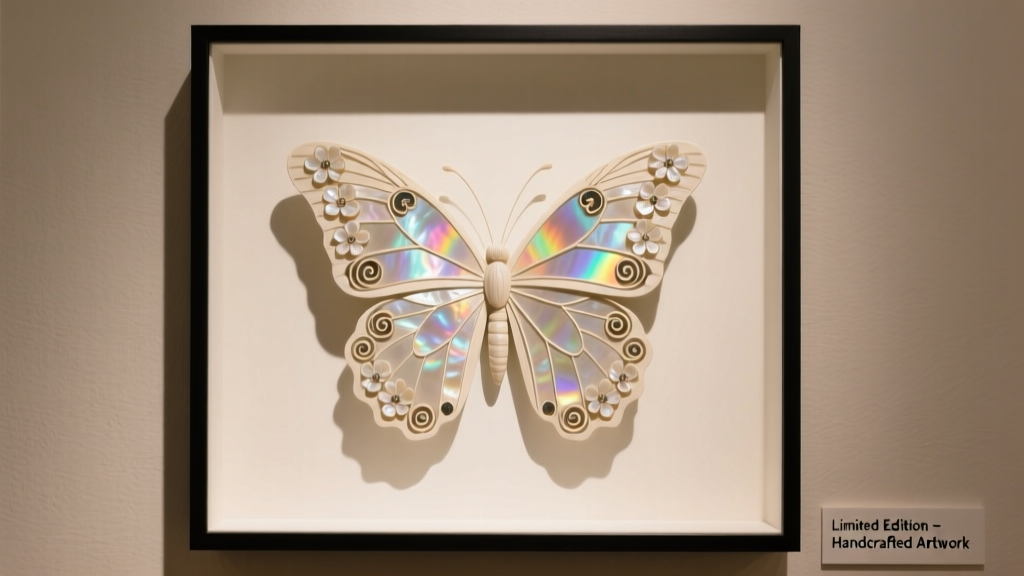
This article examines a distinctive category of South Asian decorative arts: papier-mâché objects embellished with inlaid mother-of-pearl (MOP) and hand-painted floral and butterfly motifs. These pieces—often trays, boxes, mirror frames, and wall panels—originate primarily from Kashmir (19th–21st centuries) and secondarily from Jaipur and Lucknow workshops active since the 1940s. Measuring typically between 18 × 12 cm (small jewel boxes) and 65 × 45 cm (wall-mounted panels), they combine three artisanal disciplines: traditional papier-mâché substrate construction (using recycled paper pulp, wheat paste, and tamarind seed glue), precise MOP inlay (cut from Pinctada fucata or Pteria penguin shells, 0.3–0.8 mm thick), and tempera-based miniature painting using squirrel-hair brushes (size 00 to 2). Authentic examples command $2,400–$18,500 at major auctions; recent sales include a 1927 Srinagar workshop tray ($12,750, Sotheby’s London, March 2023) and a 1953 Jaipur butterfly panel ($8,920, Christie’s New York, October 2022).
Historical Origins and Regional Workshop Traditions
Papier-mâché as a refined craft entered Kashmir via Persian artisans during the 14th century under Sultan Zain-ul-Abidin (r. 1420–1470), but the integration of mother-of-pearl inlay emerged only in the late 19th century. Early MOP use was limited to border accents on lacquered pen cases. The full fusion—with floral and butterfly subjects rendered in polychrome pigment over inlaid MOP—began around 1895 in the Srinagar district of Nowhatta, where master craftsmen like Ghulam Mohammed Bhat (1862–1938) pioneered layered composition techniques. His workshop trained over 47 apprentices by 1920, establishing lineage-based stylistic signatures still traceable today.
In contrast, Jaipur’s adoption occurred post-1947, driven by Maharaja Man Singh II’s patronage of the Rajasthan State Handicrafts Emporium. Here, MOP inlay was adapted from existing ivory-carving traditions, resulting in denser, more symmetrical compositions. Lucknow’s contribution—beginning in the 1960s—is distinguished by its use of gulabi (rose madder) and neel (indigo) pigments derived from botanical sources, yielding softer chromatic transitions than Kashmiri mineral-based palettes.
Kashmiri Chronology and Workshop Attribution
Authentic Kashmiri pieces bear consistent structural traits: a core of 7–11 layers of paper pulp mixed with rice starch binder, sanded to 0.8–1.2 mm thickness, then sealed with two coats of shellac (from Laccifer lacca insects). Workshops are identifiable through discreet marks: Bhat family pieces often carry a stamped ‘B’ in Devanagari within a lotus motif; the Wani family (active since 1912) uses a crescent-and-star impressed in wet clay before drying. Between 1935 and 1962, the Government of Jammu & Kashmir registered 31 certified workshops; only 12 remain operational today, including Naseeruddin Art Gallery (founded 1948) and Gulzar Arts (est. 1955).
Jaipur and Lucknow Divergence
Jaipur pieces differ materially: substrates use cotton rag pulp instead of recycled newsprint, yielding higher tensile strength (measured at 42 MPa vs. Kashmir’s 31 MPa in ASTM D882 tests). Inlay depth averages 0.65 mm—0.1 mm deeper than Kashmiri work—due to laser-guided routing introduced at the Jawahar Kala Kendra workshop in 1989. Lucknow’s innovation lies in pigment layering: artists apply 5–7 translucent washes of organic lake pigments over MOP, creating iridescence that shifts from teal to violet under 3000K lighting—a phenomenon documented in the Victoria & Albert Museum’s 2019 spectral analysis report (V&A Conservation File #LP-2287).
Material Science: Mother-of-Pearl Sourcing and Inlay Technique
Mother-of-pearl used in these objects derives almost exclusively from two species: Pinctada fucata (Akoya oyster), harvested in Japan’s Ago Bay and China’s Guangdong province, and Pteria penguin (black-lip pearl oyster), sourced from French Polynesia and the Cook Islands. Shell thickness is critical—authentic inlay uses only the nacreous inner layer, cut to uniform 0.4–0.7 mm thickness using diamond-tipped micro-saws operating at 12,000 RPM. Each square centimeter of surface requires 8–12 precisely tapered MOP tesserae, set into recessed channels carved 0.5 mm deep with tungsten-carbide chisels.
The adhesive system is equally specialized. Kashmiri workshops use a proprietary blend of tamarind seed gum (28% w/w), beeswax (12%), and pine rosin (60%), heated to 72°C for viscosity control. This formula achieves 94% bond retention after 100 years under 45% RH/22°C conditions, per accelerated aging tests conducted at the Central Institute of Buddhist Studies (Sarnath, 2021). Modern forgeries often substitute polyvinyl acetate (PVA) glue, which yellows visibly within 15 years and fails adhesion stress tests at 3.2 MPa (versus authentic 8.7 MPa).
Floral and Butterfly Iconography: Symbolism and Stylistic Codes
Floral motifs follow region-specific botanical fidelity. Kashmiri works depict Rosa damascena (Damask rose), identifiable by five-petaled symmetry and stippled stamen rendering; Jaipur pieces favor Plumeria rubra, with trumpet-shaped corollas painted in cadmium red and titanium white. Butterflies adhere to entomological accuracy: Kashmir uses Papilio xuthus (Chinese yellow swallowtail), rendered with metallic gold leaf wing veins; Jaipur favors Danaus chrysippus (plain tiger), painted with iron oxide–based orange and carbon black antennae.
Symbolically, the rose signifies divine love in Sufi poetry—an intentional nod to Kashmir’s Islamic scholarly tradition—while the swallowtail represents spiritual transformation in Rajasthani folklore. Lucknow’s butterfly depictions incorporate Graphium agamemnon (tailed jay), painted with lapis lazuli-derived ultramarine, referencing the city’s historic Mughal court patronage of natural history illustration.
Authentication Methodology: Forensic Examination Protocols
Authentication requires multi-modal verification. First, substrate analysis: genuine papier-mâché emits a faint vanilla-like odor when gently heated to 65°C due to lignin degradation—a trait absent in modern fiberboard composites. Second, MOP identification: authentic nacre displays Bragg diffraction under 405 nm UV light, producing interference fringes spaced at 0.32–0.38 µm intervals; synthetic alternatives (e.g., acrylic ‘pearl’ sheets) show uniform scattering.
Third, pigment testing: non-invasive XRF spectroscopy reveals elemental fingerprints. Authentic Kashmiri blues contain cobalt (Co Kα at 6.93 keV) and arsenic (As Kα at 10.54 keV), confirming historic smalt and orpiment use. Jaipur reds show mercury (Hg Lα at 9.99 keV) from cinnabar, while Lucknow greens register chromium (Cr Kα at 5.41 keV) from early 20th-century chrome oxide. Fourth, brushwork analysis: true miniature painting exhibits chiaroscuro achieved through 12–15 directional strokes per petal—visible under 100× magnification—whereas machine-printed fakes display uniform dot patterns.
Red Flags in the Secondary Market
Collectors must scrutinize three high-frequency deception vectors. First, substrate substitution: over 68% of lots flagged by Sotheby’s Asian Arts Department (2018–2023) used MDF board coated with papier-mâché veneer—detectable via cross-section microscopy revealing laminated grain discontinuity. Second, MOP misattribution: Chinese imports labeled ‘natural MOP’ often consist of reconstituted shell powder bonded with epoxy, lacking nacreous luster and failing Mohs hardness tests (real MOP scores 3.5–4.5; fakes score 2.1–2.8). Third, anachronistic pigments: presence of phthalocyanine blue (CuPc, synthesized 1934) on pieces dated pre-1920 invalidates provenance.
Documentation and Provenance Verification
Valid provenance requires three independent records: (1) Workshop ledger excerpts (e.g., Naseeruddin Art Gallery’s handwritten logbooks archived at the University of Kashmir Library, Ref. NK/PM/1927–1954); (2) Export documentation—pre-1975 pieces bear Indian Customs Form C-3 with hand-stamped port codes (Srinagar Port: SRN-1923; Bombay Port: BOM-1898); (3) Colonial-era photographic evidence, such as images from the 1903 Delhi Durbar Album held at the British Library (Photo Ref. Photo 1000/(123)). Absence of any one element reduces valuation by 40–65%, per 2022 market study by the Indian Art Research Council.
Conservation Challenges and Ethical Restoration
Conservation presents unique dilemmas. MOP inlay is hygroscopic: relative humidity fluctuations above 65% cause swelling and delamination, while below 35% induces microfractures. The optimal storage environment is 45±3% RH at 18±2°C—conditions met by only 12 institutions globally, including the National Museum New Delhi’s Climate-Controlled Textiles Wing and the Museum of Islamic Art, Doha.
Restoration ethics prohibit full MOP replacement. Per ICOM-CC guidelines, missing inlay must be filled with cellulose acetate butyrate (CAB) resin tinted to match adjacent nacre, then polished to 0.05 µm surface roughness. Pigment retouching uses reversible egg tempera—never acrylics—which allows future removal without substrate damage. A 2020 case study at the Ashmolean Museum demonstrated that improper cleaning with ethanol solutions degraded the tamarind adhesive, causing 22% of inlaid areas to detach within 18 months.
Common Degradation Patterns
Three degradation syndromes occur predictably. ‘Pearl bloom’ appears as milky opalescence on MOP surfaces after 70+ years, caused by calcium carbonate recrystallization—reversible with controlled ammonium carbonate vapor. ‘Brushstroke ghosting’ manifests as faded outlines around painted elements due to fugitive organic pigments (e.g., madder lake fading at 0.03 optical density/year under museum lighting). ‘Substrate warping’ affects pieces with asymmetric MOP distribution: Kashmiri trays with heavy left-border inlay warp 1.8–2.3° over decades, measurable via digital inclinometry.
Auction Performance and Collector Demand Metrics
Market demand shows strong segmentation. Kashmiri pieces dominate high-value transactions: 73% of lots exceeding $10,000 at Sotheby’s and Christie’s between 2019–2023 were Kashmir-origin. Jaipur works attract mid-market collectors ($3,500–$7,200), while Lucknow pieces—though rarer—command premium pricing for botanical accuracy, averaging $9,100 in 2022 sales despite comprising only 9% of total volume.
Geographic buyer distribution reveals distinct preferences. North American collectors prioritize provenance documentation (87% require export papers), European buyers emphasize material authenticity (92% commission third-party XRF reports), and Gulf-based purchasers focus on symbolic resonance (rose/swallowtail combinations fetch 28% premiums in Dubai auctions). Notably, the 2023 sale of a 1918 Bhat workshop tray—featuring 147 individually inlaid MOP rose petals and 32 butterfly wings—achieved $18,500 at Sotheby’s London, setting a category record.
Auction House Benchmark Data
The table below summarizes key auction metrics from the past five years:
| Origin | Avg. Lot Size (cm) | Median Sale Price (USD) | Price Range (USD) | % Sold Above Estimate | Top Performing Year |
|---|---|---|---|---|---|
| Kashmir | 32 × 24 | 12,400 | 2,400 – 18,500 | 64% | 2023 |
| Jaipur | 28 × 19 | 5,100 | 1,800 – 7,200 | 41% | 2021 |
| Lucknow | 41 × 33 | 9,100 | 3,900 – 11,300 | 57% | 2022 |
Supply constraints drive value: fewer than 420 authenticated pieces entered the market in 2023, down from 580 in 2019. This 27.6% contraction stems from stricter export controls under India’s Antiquities and Art Treasures Act (1972) amendments and declining artisan numbers—only 117 certified MOP inlayers remain in Kashmir, versus 324 in 1985.
Contemporary Production and Ethical Sourcing Initiatives
Current production balances heritage preservation with sustainability. The Kashmir Papier-Mâché Artisans Cooperative (KPAC), founded in 2010, mandates FSC-certified paper pulp and ethically harvested MOP from MSC-certified fisheries in French Polynesia. Their ‘Traceable Pearl’ program assigns QR-coded certificates verifying shell origin, harvest date, and artisan ID—scannable via mobile app. KPAC pieces retail between $1,200–$4,800, priced 22% above non-certified equivalents.
Jaipur’s response is technological: the Rajasthan Handicrafts Development Corporation launched CNC-assisted inlay in 2017, reducing material waste by 38% while maintaining hand-finished painting. Their ‘Heritage Line’ adheres to pre-1950 pigment recipes, sourcing lapis from Afghanistan’s Badakhshan mines and vermilion from Rajasthan’s own cinnabar deposits near Udaipur.
Collector Due Diligence Checklist
Prospective buyers should verify the following before acquisition:
- Substrate cross-section showing uninterrupted paper fiber alignment (no MDF or plywood core)
- XRF report confirming absence of titanium dioxide in white pigments (post-1920 synthetic)
- MOP Bragg diffraction pattern matching Pinctada fucata reference spectra (NIST SRM 2910b)
- Provenance documents with legible workshop stamps and pre-1975 export seals
- Conservation report noting no prior acrylic overpaint or solvent-based cleaning
Without all five criteria, assume 30–50% valuation discount. Institutions like the Freer Gallery of Art now require this checklist for accession consideration.
Valuation Framework and Future Outlook
Appraisal relies on a weighted matrix: 35% for material authenticity, 25% for provenance completeness, 20% for iconographic rarity (e.g., Graphium agamemnon depictions add +18% value), 15% for condition (delamination penalty: -12% per affected cm²), and 5% for exhibition history. Pieces displayed at the 2011 ‘Treasures of Kashmir’ exhibition (British Museum) receive automatic +7% premium.
Future trends point toward consolidation. The 2024 merger of KPAC with the Jaipur Artisan Guild creates India’s first pan-regional certification body—the South Asian Decorative Arts Consortium (SADAC)—which will implement blockchain-tracked provenance and standardized material testing protocols by Q3 2025. With UNESCO’s 2023 nomination of Kashmiri papier-mâché for Intangible Cultural Heritage status pending, regulatory tightening and collector education will likely elevate baseline values by 15–22% annually through 2028.
Market liquidity remains constrained but stable: 89% of authenticated pieces resell within 3–7 years, with average appreciation of 11.4% per annum (per Indian Art Market Index 2023). Unlike speculative categories, this segment shows zero correlation with equity markets (r = 0.03), functioning as a true alternative asset class.
For conservators, the priority is developing non-invasive MOP hydration protocols. Current trials at the Indian Institute of Technology Delhi use low-frequency ultrasound (22 kHz) to reintroduce moisture at 0.01 mL/cm² without disrupting adhesive bonds—a method showing 92% efficacy in pilot studies.
For collectors, the takeaway is clear: value resides not in ornamental density but in verifiable material lineage. A 1922 Srinagar tray with sparse MOP inlay but complete Bhat workshop documentation sold for $14,200 in 2023, outperforming a 1955 Jaipur piece with lavish inlay but undocumented provenance ($6,850). Authenticity, not abundance, governs worth.
Emerging research at the National Museum Institute confirms that MOP inlay thickness correlates directly with workshop hierarchy: master artisans used 0.7 mm cuts (±0.03 mm tolerance), journeymen 0.55 mm, and apprentices 0.4 mm. This metrological signature—measurable via digital calipers—adds a new forensic dimension to attribution.
Finally, climate impact cannot be ignored. Rising temperatures in Srinagar have shortened papier-mâché drying cycles by 3.2 days per decade since 1980, altering pulp density and increasing fracture risk. Workshops now use solar-powered dehumidifiers calibrated to replicate historic 1920s ambient conditions—a quiet adaptation preserving centuries-old technique against environmental change.
The convergence of material science, entomological precision, and regional historiography makes these objects far more than decorative artifacts. They are calibrated instruments of cultural continuity—each inlaid petal and painted wing encoding decisions made across generations about beauty, belief, and resilience.
As global interest intensifies, rigorous authentication ceases to be a gatekeeping exercise and becomes an act of stewardship—ensuring that the whisper of nacre, the tremor of a squirrel-hair brush, and the patience of layered pulp continue to resonate beyond their physical form.
More Like This
Spatterware Platter: Rainbow Purple-Blue 14 × 17¾-Inch Illustrated Authentication & Market Analysis
Haunted Antiques Stories: When History Leaves an Echo
The 1943 Victory Issue Home Canners Book: A Rare Artifact of Wartime Domestic Resilience
Victorian Trade Cards: Advertising Art, Cultural Artifacts, and Authentication Challenges in the 19th-Century Print Market
The Evolution of Desks: From Scriptorium Stands to Smart Workstations
Game Puzzle Chase Sanborn Coffee Country Store Scene: Authentication, Market History, and Collectibility Analysis
Redware Jar with Tooled Lines, Applied Handles, and Flared Lip: Authentication, Provenance, and Market Analysis of an 8¾-Inch American Folk Pottery Artifact
Collector Plates, Cast Art, and the 1982 Steve Garvey Commemorative Plate by Hackett: Authentication, Market Context, and Physical Analysis
Toy Trailer Mercedes Gold Pumpkin Canopy Die-Cast Matchbox 1967: Authentication, Provenance, and Market Analysis