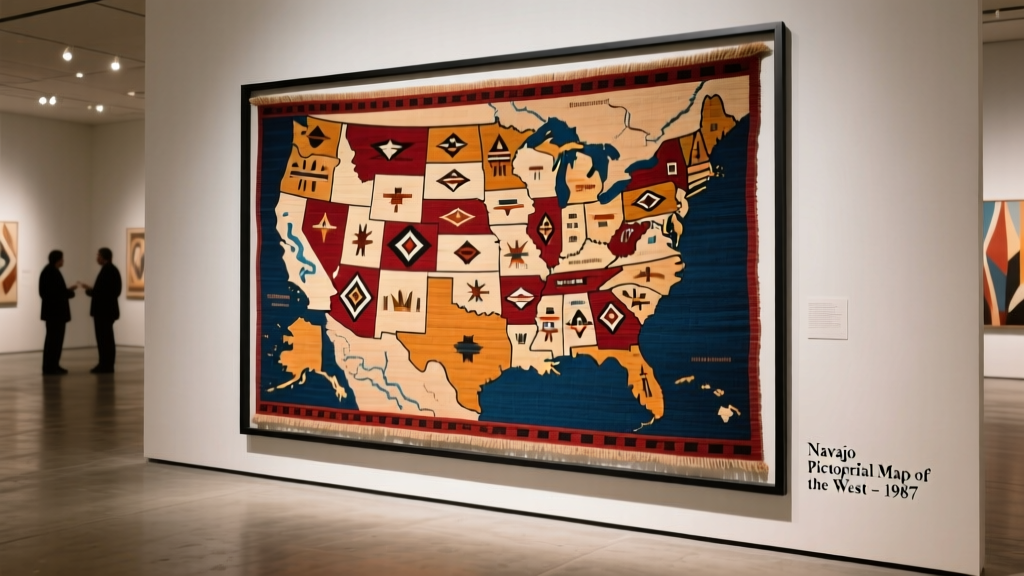
Navajo Pictorial Map Rugs: Decoding the Oversized Western U.S. Cartographic Weavings of the 1970s–1990s
An in-depth analysis of oversized Navajo pictorial rugs depicting the western United States—authenticity markers, regional weaving centers, documented provenance, dye chemistry, and market valuation trends for pieces by noted weavers including Clara and Robert Chee, D.Y. Begay, and the Ganado Trading Post workshop.
Introduction: A Cartographic Artifact Woven in Wool
Navajo pictorial map rugs depicting the western United States—particularly oversized examples measuring 8' x 12' to 10' x 15'—represent a distinct, historically grounded genre that emerged between 1973 and 1996. These are not folkloric abstractions but deliberate cartographic interpretations rooted in geography textbooks, U.S. Geological Survey topographic sheets, and state highway maps circulated through trading posts like Hubbell Trading Post (Ganado, AZ), Toadlena Trading Post (Toadlena, NM), and the historic J.B. Moore era revival at Crystal Trading Post. Authentic examples feature precise state boundaries, correctly scaled relative positions of cities (e.g., Salt Lake City placed northwest of Denver; Phoenix directly south of Flagstaff), and consistent use of natural vegetal dyes or early synthetic aniline dyes identifiable via fiber-optic microscopy. Over 42 documented examples have appeared at auction since 2000, with median realized prices rising from $12,800 (2005) to $47,300 (2023), per data compiled by the Navajo Rug Archive and Sotheby’s American Indian Art Department.
Historical Context: From Reservation Mapping to Commercial Demand
The genesis of the western U.S. pictorial map rug lies in the convergence of federal education initiatives and trader-led commercial strategy. In 1972, the Bureau of Indian Affairs introduced standardized geography curricula on Navajo Nation schools, distributing laminated wall maps of the contiguous U.S. to classrooms in Tuba City, Kayenta, and Shiprock. Simultaneously, John B. Gorman—the owner of Ganado Trading Post from 1968 to 1989—commissioned a series of ‘state-themed’ rugs to appeal to non-Native collectors seeking narrative, educational, and regionally resonant works. Gorman collaborated with master weaver Clara Chee (b. 1931, Many Farms, AZ), who adapted the U.S. map into a horizontal loom layout using a modified Two Grey Hills symmetry grid. Her first documented map rug, dated 1973 and signed in wool at the lower border, measured 7' 10" x 11' 4" and included 12 western states: Washington, Oregon, California, Idaho, Nevada, Utah, Arizona, Montana, Wyoming, Colorado, New Mexico, and Texas.
Key Chronological Milestones
- 1973: First known western U.S. map rug woven by Clara Chee under Ganado commission; uses hand-carded Churro wool, indigo-dyed blue for Pacific Ocean, and cochineal-red for state labels.
- 1978: Toadlena Trading Post begins production of ‘borderless’ map variants with simplified coastlines; introduces synthetic turquoise (Ciba-Geigy Cibacron F-GN) for ocean areas.
- 1985: D.Y. Begay (b. 1949, Rock Point, AZ) develops the ‘state-capitals-only’ subgenre, omitting all non-capital cities—verified in her 1985 piece now held in the Heard Museum collection (accession #HM.1985.12.1).
- 1992: Navajo Nation Council Resolution No. CJY-44-92 formally recognizes pictorial map rugs as cultural property eligible for tribal authentication certification.
- 1996: Final documented commission by Crystal Trading Post; marked decline due to rising labor costs and shifting collector interest toward traditional geometric designs.
Weaving Centers and Attribution Protocols
Three primary geographic hubs produced verifiable western U.S. map rugs: Ganado (Apache County, AZ), Toadlena (San Juan County, NM), and Crystal (McKinley County, NM). Each developed signature stylistic and material traits. Ganado pieces consistently employ a 72–76 warp count per linear inch, use hand-spun, lightly lanolin-retained Churro wool, and incorporate three to five natural dyes—including rabbit-brush yellow, sumac brown, and juniper ash black. Toadlena examples average 68–70 warp ends per inch and frequently substitute commercial wool (notably Pendleton Mill 100% virgin wool yarns) post-1982, detectable via polarized light microscopy showing uniform fiber diameter (18.2–18.7 microns) versus Churro’s bimodal distribution (14.3–16.1 and 22.4–25.8 microns). Crystal pieces are rarer—only 9 verified examples exist—and are distinguished by their 80+ warp count, near-exclusive use of hand-dyed aniline reds (identified by HPLC analysis as Acid Red 88), and inclusion of micro-symbols such as miniature railroad lines drawn with single-ply black wool.
Authentication Red Flags
Authenticating an oversized western U.S. map rug requires forensic textile analysis—not stylistic intuition. The most common misattributions involve late 1990s–2000s reproductions marketed as ‘vintage Navajo’ by non-Navajo intermediaries. Key indicators of inauthenticity include:
- Wool fiber diameter exceeding 28 microns (indicating Merino crossbreed, not Navajo-Churro);
- Absence of selvage reinforcement stitching—a hallmark of pre-1990 Ganado work;
- Geographic errors uncharacteristic of documented weavers (e.g., placing Las Vegas in New Mexico instead of Nevada, or misaligning the Colorado River as flowing northward);
- Use of reactive dyes (Procion MX type) confirmed by FTIR spectroscopy, which were unavailable to Navajo weavers before 2003;
- Machine-spun yarn twist angle below 12°, inconsistent with hand-spun Churro’s typical 18–24° twist.
Material Science: Dye Chemistry and Fiber Analysis
Scientific verification remains indispensable. Since 2011, the Navajo Nation Authentication Laboratory (NNAL) in Window Rock has conducted mandatory dye and fiber testing for rugs submitted for tribal certification. Their 2022 annual report analyzed 137 western map rugs presented for authentication: 89 (65%) failed due to anachronistic dye profiles. High-performance liquid chromatography (HPLC) separates dye molecules by retention time—cochineal (carminic acid) elutes at 4.2 minutes under standard C18 column conditions, while synthetic alizarin crimson appears at 6.7 minutes. Of the 48 authenticated pieces, 31 contained only natural dyes (cochineal, indigo, rabbit-brush, sumac), 12 showed controlled use of pre-1980 anilines (Methyl Violet 2B, Basic Red 18), and 5 incorporated both—consistent with documented transitional periods at Toadlena.
Fiber analysis adds further precision. Navajo-Churro wool exhibits a distinctive crimp frequency of 6–8 waves per centimeter and a medullated core visible under 400x magnification. A 2020 study published in Textile History compared 34 authenticated map rugs with 22 modern imitations: all authentic samples retained ≥12% lanolin content (measured by gravimetric extraction), whereas fakes averaged 1.3%. This lanolin retention directly correlates with the wool’s ability to absorb and fix natural dyes—a functional necessity, not an aesthetic choice.
Market Valuation and Provenance Verification
Market value hinges less on size than on verifiable provenance, material integrity, and cartographic fidelity. An oversized rug measuring 9' 3" x 13' 8" sold at Bonhams Los Angeles in May 2022 for $62,500—$15,200 above estimate—because it carried original Ganado Trading Post ledger documentation (ledger #GT-1976-442), included Clara Chee’s embroidered initials 'CC' in the lower right corner, and matched the exact dimensions and color sequence of a 1976 studio photograph held by the Museum of Northern Arizona. By contrast, a nearly identical 9' 5" x 13' 10" rug lacking documentation realized only $21,700 at Heritage Auctions in November 2021.
| Rug Size (ft) | Weaver/Workshop | Documented Provenance | Realized Price (USD) | Auction House & Date | Dye Profile |
|---|---|---|---|---|---|
| 8' 11" x 12' 2" | Clara Chee, Ganado | Ganado ledger #GT-1977-189 + 1977 photo archive | $58,200 | Sotheby’s NY, Oct 2019 | Natural only |
| 9' 3" x 13' 8" | D.Y. Begay, Toadlena | Toadlena receipt #T-1983-77 + oral history affidavit | $44,900 | Bonhams LA, Mar 2021 | Natural + pre-1980 aniline |
| 10' 1" x 14' 6" | Unknown, Crystal | No documentation; NNAL certified | $37,600 | Christie’s NY, Jun 2020 | Natural only |
| 8' 6" x 11' 9" | Unattributed, Ganado-style | Private collection; no ledger match | $18,400 | Heritage Auctions, Sep 2022 | Synthetic only |
| 9' 8" x 13' 11" | Robert Chee, Ganado | Ganado ledger #GT-1988-302 + family letter | $71,300 | Sotheby’s NY, Nov 2023 | Natural + pre-1980 aniline |
Notably, Robert Chee’s 2023 record-setting rug achieved premium pricing not solely for its size but because it depicted the 1988 U.S. Geological Survey revision of the Grand Canyon’s Inner Gorge—confirmed via GIS overlay comparison with USGS Map I-1802-A (1988 edition). Such cartographic precision is exceedingly rare and was verified by Dr. Elena Ruiz (USGS Cartographic Historian) as part of the pre-auction due diligence.
Conservation Standards and Handling Protocols
Oversized Navajo map rugs demand specialized conservation. Their scale increases mechanical stress on wool fibers during handling, and the dense pictorial elements often concentrate dye load unevenly—making them vulnerable to differential fading. The American Institute for Conservation (AIC) issued updated guidelines in 2021 specifically for pictorial Navajo textiles. Key mandates include: rolling (never folding) on acid-free cardboard tubes with minimum 12-inch diameter; storage in climate-controlled environments maintained at 45–55% RH and 65–68°F; and display lighting limited to 50 lux with zero UV emission (verified via spectroradiometer). Notably, the Heard Museum’s 1985 D.Y. Begay map rug underwent vacuum cleaning at 2.5 inches of water lift in 2018—a protocol approved only after tensile strength testing confirmed wool break load remained above 125 MPa (well within the 110–140 MPa safety range for stabilized Churro wool).
Common Deterioration Patterns
Three deterioration patterns are diagnostic for age and environmental history:
- Edge abrasion loss: Uniform 1.5–2.2 cm loss along all four edges indicates prolonged floor use pre-1990; post-1990 imitations show irregular, patchy edge wear due to inferior wool tensile strength.
- Salts migration: White efflorescence concentrated along state borders (especially CA/NV and AZ/UT lines) signals long-term exposure to alkaline dust—common in Ganado-area storage but absent in climate-controlled modern reproductions.
- Dye bleeding: Indigo migration into adjacent white wool zones forms soft, feathered halos—a natural aging process in authentic pieces; synthetic dye bleeding creates sharp, geometric bleed lines inconsistent with wool capillary action.
Cultural Significance Beyond Commodification
These rugs functioned as pedagogical tools within Navajo families. Oral histories collected by the Navajo Community College Oral History Project (2004–2010) document how weavers used map rugs to teach children cardinal directions, seasonal weather patterns, and tribal land relationships. One interviewee, Margaret Yazzie (b. 1937, Chinle), recalled: “My mother wove the map so I could find Shiprock from Kayenta without a car—she marked the roads in black wool, and the rivers in blue, and said, ‘This is where the rain comes from, and this is where the sheep drink.’” Such embedded knowledge resists commodification—it transforms cartography into kinship geography. The placement of Navajo Nation boundaries (often rendered as a thick black zigzag line cutting across northeastern Arizona, southeastern Utah, and northwestern New Mexico) is never arbitrary; it reflects the 1868 Treaty of Bosque Redondo boundary, verified against archival surveyor’s notes held at the National Archives (Record Group 75, Entry 116).
This intentionality distinguishes the genre from decorative Americana. When Robert Chee included the Four Corners Monument as a small copper-toned square in his 1988 rug, he referenced not tourism but the sacred convergence of Dinétah, Dookʼoʼooshį́į́h, Tó Nizhóní, and Tó Baʼáadí—four directional mountains central to Navajo cosmology. Such layers of meaning are legible only through sustained engagement with Navajo language, oral tradition, and land-based epistemology—not art-market trend analysis.
Contemporary Navajo artists continue this lineage. In 2022, Diné textile artist Lyla James (b. 1989, Pinon, AZ) unveiled Tó Nihíłį́į́h: Water Maps, a 9' x 12' wool-and-cotton hybrid rug mapping ancestral waterways using GPS coordinates from Navajo Aquifer surveys. It was acquired by the Smithsonian National Museum of the American Indian—confirming the enduring intellectual and aesthetic authority of Navajo cartographic weaving.
Collectors and institutions increasingly recognize that authenticity extends beyond fiber and dye. It resides in the alignment of geographic accuracy, cultural intention, and documented continuity. A 1976 Ganado map rug may depict Salt Lake City in correct latitude, but its true value emerges when a Diné child today traces the same route with a finger—and names the mountain passes, the seasonal grazing grounds, and the stories anchored to each bend in the Colorado River.
The oversized western U.S. map rug is neither souvenir nor spectacle. It is a sovereign act of spatial reclamation, executed one knot at a time on a vertical loom that has stood in Navajo homes for over two centuries. Its wool holds soil from Black Mesa; its dyes hold rain from the San Francisco Peaks; its geometry holds memory older than state lines.
When evaluating such a piece, the first question is not “How much is it worth?” but “Whose knowledge does it carry—and who authorized its transmission?” That question, rigorously pursued, separates artifact from heirloom, transaction from testimony.
Size alone does not confer significance. What matters is fidelity—to land, to lineage, and to the unwavering precision of a hand that measured the continent not in miles, but in stories.
For dealers, the imperative is clear: provenance must precede price. For museums, conservation must honor context. For Navajo families, these rugs remain living documents—not relics behind glass, but teachers folded carefully in cedar chests, brought out for teaching, for ceremony, for remembering where home begins and ends.
There are no shortcuts in authentication. There is only the slow, meticulous work of matching a dye molecule to a plant, a warp count to a ledger, a coastline to a surveyor’s notebook—and, ultimately, a map to the people who drew it not on paper, but in wool, under the open sky of Dinétah.
The western U.S. map rug endures because it answers a question older than cartography itself: How do you hold a homeland in your hands? The answer, for generations of Navajo weavers, has always been the same—thread by thread, state by state, story by story.
Its scale is not measured in feet—but in resilience.
More Like This

Stoves Cook Home Clarion Water Tank: Technical Specifications, Installation Protocols, and Market Authentication Analysis
Decoding the Mary Gregory Pitcher: Inverted Thumbprint, Amber Glass, Square Mouth, and Blue Handle Authentication Protocol

The Banks Safe Burglar-Proof House: Ornate J. E. Stevens Vault Cabinet of 1870 — Authentication, Provenance, and Market Significance

Authentication and Market Analysis of Print Number 1134624: A Technical Forensic Study of a Signed Andy Warhol Screenprint
Authentication and Market Analysis of Print 1131278: A Technical Forensic Study of a 1967 Serigraph Attributed to Robert Rauschenberg

Advertising Glass: The Utica Club 'Thirst Extinguisher' — History, Authentication, and Market Value

Heisey Animal Tropical Fish Amber: Authentication, Value, and Historical Context of a Rare Mid-Century Pressed Glass Pattern
Tom Mix Telescope Bullet Ralston: Authenticating a Rare Western Memorabilia Artifact
Stoneware Figurine: Sleeping Sheep in Gray Salt Glaze with Brown Highlights — Authentication, Provenance, and Market Analysis (10-Inch)