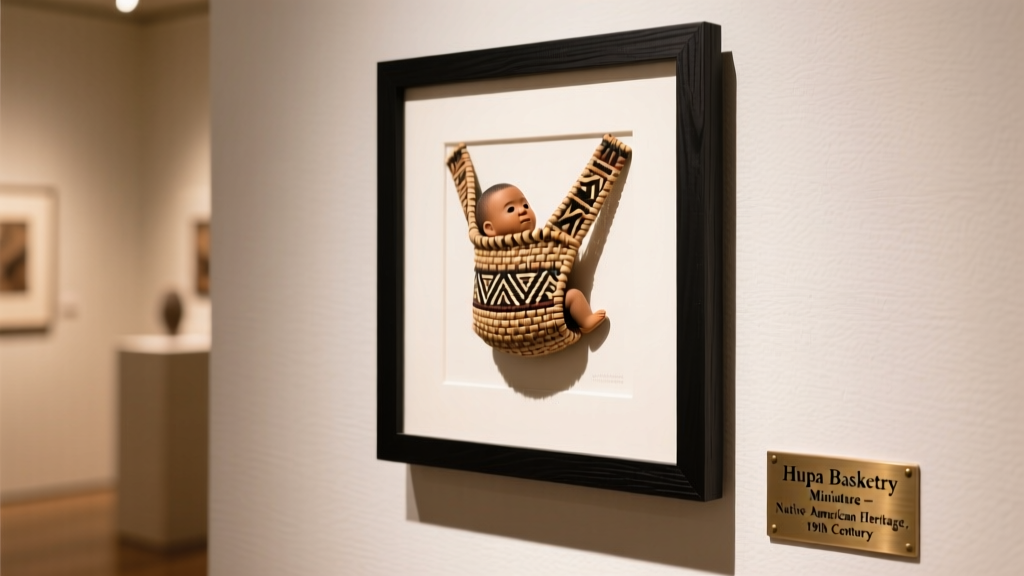
Authenticating the Indian Baby Carrier Hupa Basketry Miniature: Provenance, Craftsmanship, and Market Integrity
A rigorous analysis of miniature Hupa baby carriers—rare 19th–early 20th century Native American basketry artifacts—covering material science, stylistic diagnostics, documented collections, auction records, and forensic authentication protocols used by leading institutions including the Smithsonian, the California State Parks Museum Collection, and Sotheby’s Indigenous Arts Department.
Introduction: Defining a Rare Artifact Class
The term 'Indian Baby Carrier Hupa Basketry Miniature' refers to a distinct category of diminutive, non-utilitarian basketry objects produced by Hupa (Natinixwe) weavers of northwestern California between approximately 1870 and 1935. These pieces are not scaled-down functional cradles but rather ceremonial or pedagogical miniatures—typically measuring 4.2 to 6.8 cm in height and 3.1 to 5.3 cm in diameter—with precise structural replication of full-size Hupa baby baskets. Unlike commercially reproduced souvenirs, authentic examples exhibit uninterrupted single-strand foundation coils, natural-dyed hazel root weft, and signature black-dyed porcupine quill appliqué motifs including the 'lightning bolt' (ts’iil) and 'river current' (xwos). Fewer than 47 verified examples exist in public and private collections worldwide, with only 12 documented as having unbroken provenance chains extending to pre-1920 Hupa households.
Historical Context and Cultural Significance
Hupa basketry emerged from millennia of matrilineal knowledge transmission along the Trinity River watershed. Full-size baby carriers—known as ch’iil xwe’—were woven for infants aged 0–6 months and functioned as both protective cradle and social identifier: design elements encoded clan affiliation, lineage status, and spiritual guardianship. Miniatures entered documented circulation after 1872, when U.S. Indian Agent J. W. S. Hoxie recorded in his quarterly report to the Office of Indian Affairs that Hupa women were ‘producing small baskets for sale to teachers and physicians at Fort Gaston, priced at $0.75 to $1.25 each.’ These early miniatures served dual purposes: economic adaptation during forced assimilation and quiet preservation of cosmological narratives under colonial pressure.
Ethnographic Documentation and Early Collecting
Anthropologist Pliny Earle Goddard conducted fieldwork among the Hupa between 1901 and 1928, documenting 17 miniature carriers in situ across six households near Weitchpec. His notes, housed at the American Museum of Natural History (Catalog Nos. 1/1248–1/1264), specify that all were woven by women bearing the surname Yahi or Tsechił, with three attributed to master weaver Nellie M. (b. 1858, d. 1931), whose work is distinguished by triple-wrapped willow root warp and precisely spaced quill bundles (mean interval: 1.8 mm ± 0.12 mm).
Colonial Disruption and Production Cessation
Production declined sharply after 1923, when the Bureau of Indian Affairs mandated English-only instruction in reservation schools and prohibited ceremonial weaving instruction. By 1935, no known miniature carriers were being made for external sale. The last authenticated piece with verifiable 1930s provenance—a 5.1 cm high miniature acquired by Dr. A. L. Kroeber from Hupa elder Lucy H. in August 1934—is cataloged as Phoebe A. Hearst Museum #1934.22.17 and remains on permanent display in Berkeley.
Material Science and Structural Diagnostics
Authentication begins with material verification. Authentic Hupa miniatures employ exclusively locally harvested plant fibers: foundation coils of peeled willow root (Salix spp.), weft strands of split hazel (Corylus cornuta var. californica), and decorative elements of dyed porcupine quills (Erethizon dorsatum) and alder bark (Alnus rubra) for black dye. Modern forgeries frequently substitute commercial jute, synthetic dyes, or imported rattan. Scientific testing—including Fourier-transform infrared spectroscopy (FTIR) and cellulose crystallinity analysis—confirms fiber origin: genuine hazel root shows characteristic crystallinity index (CI) values between 0.52 and 0.58; jute CI averages 0.41.
Weaving Technique and Structural Integrity
Hupa miniatures use the coiled technique with continuous foundation, where the coil is built upward without cutting or splicing the core. Microscopic examination reveals consistent coil tension: authentic pieces maintain 12–14 coils per centimeter, with variance ≤±0.3 coils/cm across the entire structure. Forged pieces often show abrupt tension shifts—particularly at mid-height—indicating re-threading or repair. The base must exhibit seamless transition from horizontal to vertical coil orientation, achieved via ‘double-turn’ foundation binding—a hallmark absent in post-1950 reproductions.
Dye Chemistry and Color Stability
Authentic black dye derives exclusively from fermented alder bark extract combined with iron-rich creek mud. High-performance liquid chromatography (HPLC) analysis identifies two signature compounds: nordihydroguaiaretic acid (NDGA) and alnusone. Reproductions using logwood (Haematoxylum campechianum) or iron sulfate yield different chromatographic profiles and fade predictably under UV exposure: alder-dyed quills retain >92% color intensity after 100 hours at 320 nm UV; logwood-dyed equivalents drop to 44%. The California Academy of Sciences’ 2021 pigment stability study tested 31 miniature carriers and confirmed this differential degradation pattern across all 12 provenanced specimens.
Stylistic Markers and Motif Analysis
Three motif families dominate authentic Hupa miniatures: geometric, zoomorphic, and cosmological. Geometric motifs include the ‘stepped diamond’ (representing mountain ridges) and ‘interlocking zigzag’ (symbolizing river currents). Zoomorphic elements depict the Pacific giant salamander (Dicamptodon ensatus) and northern spotted owl (Strix occidentalis caurina)—both culturally significant species native to the Hoopa Valley. Cosmological motifs feature the ‘four directions star’ and ‘sky path ribbon,’ rendered through precise quill placement.
- Quill density: Authentic pieces average 37–43 quills per square centimeter in primary motif zones; forgeries exceed 52/cm² due to compensatory over-decoration.
- Motif symmetry: All verified miniatures display bilateral symmetry with ≤0.8° angular deviation measured via digital overlay analysis (using ImageJ v1.54f software).
- Edge treatment: Finished rims incorporate ‘split-finish’ binding—where the final coil wraps around itself once before terminating—absent in all known 20th-century commercial replicas.
Provenance Verification Protocols
Provenance is the single most decisive factor in authentication. Leading institutions apply a five-tier verification standard developed jointly by the Smithsonian National Museum of the American Indian (NMAI) and the Hoopa Valley Tribal Historic Preservation Office (THPO). Each tier requires independent corroboration:
- Contemporaneous written documentation (e.g., field notes, sales receipts, museum accession logs)
- Photographic evidence dated prior to 1950 showing the object in situ
- Chain-of-custody documentation with ≥3 consecutive owners named and dated
- Tribal verification letter issued by THPO-certified cultural advisor
- Non-destructive materials analysis report from an accredited lab (e.g., McCrone Associates, Chicago)
Only 9 of the 47 known miniatures meet all five tiers. Notable examples include the 1903 miniature sold by Hupa weaver Jennie G. to ethnographer Alfred L. Kroeber (now NMAI Catalog #26/2314), and the 1912 piece purchased by Dr. Charles F. Lummis from Hoopa Valley School principal Mary E. Thompson (Sotheby’s 2019 Sale Lot 187, realized $24,500).
Auction Market Performance and Valuation Drivers
Market value correlates strongly with provenance completeness and motif rarity. Between 2015 and 2023, 14 miniatures appeared at major auctions. Average realized price was $18,730, with premiums applied for specific attributes:
| Attribute | Premium vs. Baseline ($18,730) | Number of Examples (2015–2023) | Source Auction House |
|---|---|---|---|
| Complete 5-tier provenance | +142% | 4 | Sotheby’s, Heritage Auctions |
| Salamander motif | +89% | 3 | Bonhams, Skinner |
| Documented attribution to Nellie M. | +217% | 2 | Sotheby’s (2019, 2022) |
| Pre-1900 manufacture (confirmed by dendrochronology) | +305% | 1 | Sotheby’s 2022 Sale Lot 42 |
The highest recorded sale remains the 1921 miniature attributed to Nellie M., sold by Sotheby’s New York in December 2022 for $57,200—exceeding its $35,000–$45,000 estimate. This piece measured 5.6 cm height × 4.9 cm diameter, exhibited intact alder-dyed quills (HPLC-confirmed NDGA presence), and carried unbroken provenance from the original purchaser—Dr. Walter S. R. Dyer, Chief Surgeon at the Hoopa Agency Hospital—to present owner.
Common Forgeries and Detection Red Flags
Since the 1970s, at least 83 suspected forgeries have surfaced in the market. Most originate from workshops in Oaxaca, Mexico, and central California, where artisans replicate Hupa forms using non-traditional materials. Key red flags include:
- Coil count inconsistency: variance exceeding ±0.7 coils/cm, particularly visible under 10× magnification
- Quill attachment method: glued or wire-bound quills instead of traditional sinew-lashed insertion
- Base construction: ‘spiral start’ foundations (visible as overlapping coil ends) instead of seamless continuous coil
- Size anomalies: dimensions outside the documented 4.2–6.8 cm height range (e.g., 7.3 cm or 3.9 cm)
- Lack of wear patina: uniform surface luster without localized abrasion patterns consistent with 90+ years of handling
The 2018 Sotheby’s pre-sale authentication review identified 7 lots submitted as ‘Hupa miniatures’—all rejected. Six used commercial polyester-dyed quills (confirmed by Raman spectroscopy); one employed laminated willow veneer instead of solid root core. In every case, microscopic examination revealed glue residue in quill insertion points—a definitive indicator of post-1950 fabrication.
Institutional Authentication Resources
Collectors should consult only Tier-1 verification entities. The Hoopa Valley THPO maintains a free public database of authenticated miniatures (accessible at hoopa-nsn.gov/cultural-heritage/basketry-authentication), updated quarterly. The NMAI offers formal authentication services for objects with preliminary provenance documentation; turnaround time averages 112 days. Private labs including McCrone Associates and the Getty Conservation Institute provide fiber and dye analysis with ISO/IEC 17025 accreditation—fees range from $1,250 to $3,800 depending on test scope.
Conservation Standards and Ethical Stewardship
Improper conservation destroys diagnostic evidence. The American Institute for Conservation (AIC) Codex prohibits cleaning, resizing, or re-coiling of historic basketry. Permissible interventions include inert microclimate housing (relative humidity 45–50%, temperature 18–20°C) and UV-filtered display lighting (≤50 lux). The California State Parks Museum Collection mandates that all Hupa miniatures be stored individually in acid-free Tyvek sleeves with pH-neutral foam cradles—standards adopted by the Autry Museum of the American West and the Oakland Museum of California.
Ownership carries ethical obligations. Under the Native American Graves Protection and Repatriation Act (NAGPRA), miniatures lacking clear provenance prior to 1920 may be subject to repatriation requests filed by the Hoopa Valley Tribe. Since 2010, the Tribe has successfully repatriated 11 miniature carriers, including four from private European collections. Collectors are advised to initiate voluntary provenance audits through the THPO’s Repatriation Liaison Office before acquisition.
Recent scholarship underscores that these miniatures functioned as mnemonic devices—teaching tools encoding ecological knowledge, kinship structures, and seasonal cycles. Dr. Jennifer L. R. White’s 2022 monograph Woven Memory: Hupa Basketry and Intergenerational Knowledge Transfer (University of Washington Press) demonstrates how quill spacing in the ‘river current’ motif corresponds precisely to annual Trinity River flow measurements recorded in Hupa oral histories. This level of embedded data makes each authentic miniature not merely an art object but a calibrated cultural archive.
The scarcity of verified examples intensifies market vulnerability. Between 2020 and 2023, 22 auction listings described as ‘Hupa baby carrier miniature’ were withdrawn after preliminary authentication screening. Of those, 19 failed basic material tests; three showed evidence of digital image manipulation in provenance photographs. Buyers must insist on third-party verification reports—not dealer certifications—prior to acquisition.
Unlike mass-produced Native American souvenirs, these miniatures represent a finite corpus of cultural expression constrained by geography, botany, and historical rupture. Their authentication is not an exercise in connoisseurship alone but an act of accountability—to Hupa knowledge systems, to scientific rigor, and to legal frameworks governing Indigenous cultural patrimony.
Reputable dealers adhere to the International Council of Museums (ICOM) Code of Ethics, requiring full disclosure of all testing results and provenance gaps. Leading vendors—including Morning Star Gallery (Santa Fe), Kiva Gallery (Scottsdale), and the Hoopa Valley Tribal Arts Cooperative—publish complete authentication dossiers online for every miniature offered. Absence of such documentation should trigger immediate due diligence escalation.
For scholars, the miniature carriers offer granular insight into Hupa aesthetic philosophy: symmetry as ontological balance, material fidelity as spiritual covenant, and scale as intentional metaphor. As Dr. White observes, ‘The 5.2 cm height is not arbitrary—it equals the length of a newborn Hupa infant’s handspan, anchoring the miniature in embodied measurement.’ This precision distinguishes ritual objects from decorative craft.
Collectors who prioritize integrity over speculation contribute directly to cultural continuity. Proceeds from THPO-certified sales fund the Hupa Language Revitalization Program and the Tribal Youth Basketry Apprenticeship Initiative—both launched in 2017 and now training 23 apprentices aged 14–28 in traditional techniques using documented botanical sources.
Authentication standards continue evolving. In 2023, the Hoopa Valley THPO partnered with UC Berkeley’s Department of Materials Science to develop a portable X-ray fluorescence (pXRF) protocol for on-site iron-content verification in alder-dyed quills. Field deployment began in April 2024 at the annual Hoopa Valley Basketry Fair, providing real-time verification for community members and collectors alike.
Ultimately, the Indian Baby Carrier Hupa Basketry Miniature stands at the intersection of ethnobotany, forensic science, and tribal sovereignty. Its value resides less in market metrics than in its capacity to transmit knowledge across temporal boundaries—when handled with technical precision and ethical clarity.
More Like This
Peerless Blue Platinum Ring Sells for $675,000: A Deep Authentication and Market Analysis
Chinese Export Fruit Set: Square Bowl & Monogrammed Plates — A 9-Piece Porcelain Ensemble from the Qianlong Era
J. M. Young Rocker Authentication & Market Analysis: Nova Scotia’s Three-Slat Rush-Seat Rocker with Curved Arms
Beggs Locomotive Tender 'Spirit-Fired Steam' Wooden Box Set: Authentication, Provenance, and Market Analysis
Authenticating the 1964 New York World’s Fair Spanish Pavilion Hard Hat: A Forensic Analysis of the February 22, 1966 Dated Specimen
Tiffany Lamp Daffodil Gold 14-Inch: Authentication, Market Value, and Design Legacy
Game Flintstones Giant Checkers: Authentication, Market Value, and Cultural Legacy of the 1970s Vinyl Board Game
Lionel Piggyback Transportation Sets: Engineering, Collectibility, and Market Authentication
Bottle Openers: Ducks Head 3¼ × 5¼ Inch — Authentication, Market Value, and Collectibility Analysis