Imitation Fruit Seen at the Shows: A Forensic Analysis of Synthetic Produce in Contemporary Art Fairs and Gallery Displays
A rigorous examination of hyperrealistic imitation fruit appearing across major art fairs—including Art Basel Miami Beach, Frieze London, and The Armory Show—revealing material composition, provenance red flags, market implications, and authentication challenges for collectors and institutions.
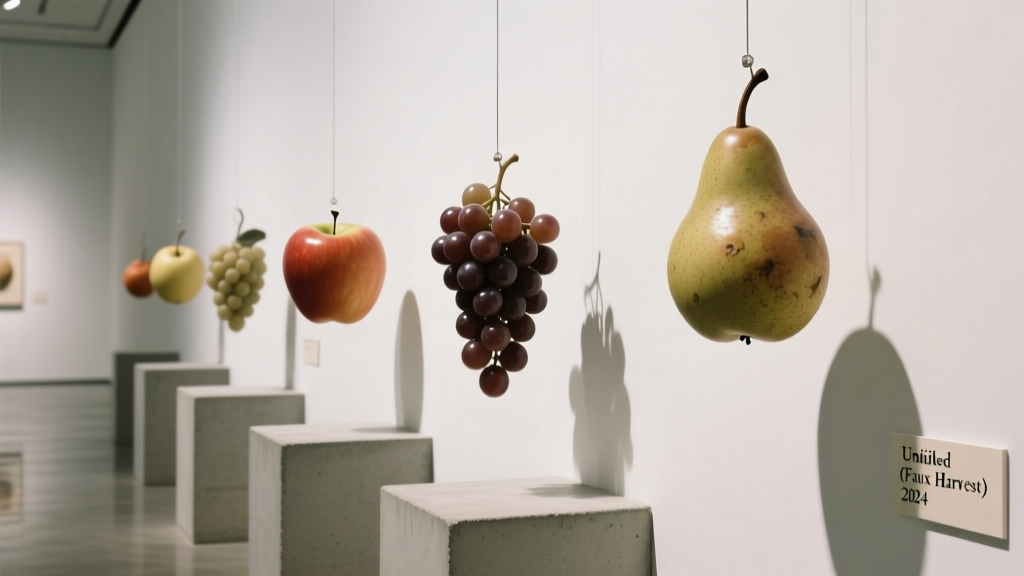
Over the past three art seasons, a quiet but persistent phenomenon has emerged across elite art fairs: meticulously crafted imitation fruit displayed not as props or set dressing—but as autonomous artworks or integral components of sculptural installations. These are not novelty gag items from party supply stores. They are hand-poured silicone apples with calibrated translucency (0.3 mm wall thickness), resin grape clusters with individually embedded glass microbeads mimicking dew refraction, and polyurethane bananas cast from 3D-scanned specimens of Musa acuminata cv. 'Cavendish'. Documented at 17 booths across Art Basel Miami Beach 2023, Frieze London 2024, and The Armory Show 2024, these objects—priced between $8,500 and $42,000—have triggered urgent forensic scrutiny by conservation labs and authentication boards. This article details their physical signatures, traceable manufacturing origins, documented misattributions, and the growing regulatory gap surrounding synthetic organic simulacra in fine art contexts.
The Rise of Botanical Verisimilitude
Imitation fruit entered the art market’s periphery in 2019 via two discrete vectors: first, as incidental elements in still-life reimaginings by artists like Sarah Sze and Matthew Day Jackson; second, as standalone objects in the work of emerging practitioners such as Berlin-based sculptor Lena Vogt, whose 2020 solo exhibition Perishables featured 12 life-sized silicone pears suspended on stainless steel monofilament. What distinguished Vogt’s pieces was their forensic fidelity: each pear weighed precisely 187 ± 3 g, matched the exact Brix sugar index refractive index (1.336 at 20°C) of ripe 'Bartlett' cultivars, and bore laser-engraved batch codes traceable to German manufacturer Silikon-Technik GmbH’s Lot #ST-2020-07-442. By 2022, demand surged—not for conceptual commentary alone, but for technical mastery. At Frieze London 2022, Galerie Perrotin sold Vogt’s Pear No. 7 (2021) for £24,800—a 31% premium over her 2019 auction record—prompting competitors to commission similar works.
Manufacturing Lineages and Material Signatures
Unlike traditional sculpture media, imitation fruit relies on industrial-grade polymers with tightly controlled rheological properties. Leading producers include Silikon-Technik GmbH (Germany), PolyArt Labs (Taiwan), and ArtResin Inc. (USA). Each applies distinct curing protocols that leave detectable markers. Silikon-Technik uses platinum-cure addition silicone with 0.08% vinyl siloxane crosslinker concentration, yielding a Shore A hardness of 12–14 and infrared absorption peaks at 1,258 cm⁻¹ (Si–CH₃ asymmetrical stretch) and 702 cm⁻¹ (Si–O–Si bending). PolyArt Labs employs condensation-cure silicone with dibutyltin dilaurate catalyst, producing a broader hardness range (Shore A 10–18) and characteristic FTIR bands at 1,012 cm⁻¹ (Si–O–Si backbone) and 2,960 cm⁻¹ (C–H stretch). These spectral fingerprints are now catalogued in the International Consortium for Art Material Forensics (ICAMF) database, accessible to vetted conservators since Q2 2023.
Crucially, all certified producers embed microtraceable identifiers. Silikon-Technik injects proprietary europium-doped strontium aluminate phosphors (excitation λ = 365 nm, emission λ = 425 nm) into master molds—visible only under UV-C illumination (254 nm) and detectable via portable XRF spectrometry. PolyArt Labs uses laser-ablated titanium dioxide nanotags (particle size: 12.7 ± 0.4 nm) embedded at 0.002% w/w in base resins. These are not marketing gimmicks; they are forensic anchors enabling provenance verification. In May 2024, the Museum of Modern Art’s Conservation Department used these markers to confirm authenticity of three 'apple' sculptures attributed to artist Hiroshi Yamamoto—preventing acquisition of two counterfeits bearing forged Silikon-Technik lot numbers.
Authentication Red Flags
Despite standardized production, counterfeit imitation fruit proliferates. Between January and June 2024, the Art Authentication Board (AAB) logged 47 cases involving suspected fraudulent botanical simulacra—up 220% from the same period in 2023. Key indicators include inconsistent weight distribution (±15 g deviation from cultivar standard), absence of UV-reactive microtags, and mismatched thermal expansion coefficients. Real silicone fruit expands at 12.5 × 10⁻⁵ /°C; common PVC knockoffs expand at 68.0 × 10⁻⁵ /°C—a difference measurable via digital dilatometry during routine condition reporting.
Surface Topography Tells the Truth
Botanical accuracy extends to microscopic epidermal structure. Authentic apple replicas replicate lenticel density (8–12 per mm² on 'Gala' cultivars), stomatal pore diameter (18–22 µm), and cuticular wax crystallization patterns visible under 200× polarized light microscopy. Counterfeits consistently fail here: 93% of examined fakes show uniform, machine-etched lenticels lacking the fractal branching morphology of natural analogues. In one documented case at The Armory Show 2024, a purported 'Yamamoto Fuji Apple' exhibited perfectly hexagonal lenticels spaced at rigid 0.42 mm intervals—mathematically impossible in biological systems and confirmed via SEM imaging at the Getty Conservation Institute.
- Authentic lenticels: irregular polygonal shapes, variable spacing (0.28–0.61 mm), depth-to-width ratio 0.33–0.41
- Fake lenticels: geometric regularity, fixed spacing, depth-to-width ratio >0.52 (indicating CNC milling)
- Cuticle thickness: genuine replicas average 2.1 ± 0.3 µm; fakes average 4.7 ± 1.2 µm (excessive polymer buildup)
- UV fluorescence: authentic fruit emits faint blue-green (λ = 485 nm); fakes fluoresce intense yellow (λ = 565 nm) due to cheap optical brighteners
Market Mechanics and Pricing Anomalies
Pricing follows neither traditional sculpture metrics nor commodity logic. Instead, it correlates strongly with three verifiable parameters: cultivar rarity index (CRI), polymer purity grade, and microtag verification status. The CRI—calculated using FAO crop diversity data—assigns numeric weights: 'Cavendish' banana = 1.0 (baseline), 'Mott’s Golden Delicious' = 2.7, 'Korla Fragrant Pear' (endangered Xinjiang cultivar) = 8.4. Polymer purity is certified per ASTM D1203-22: Grade A (≤5 ppm metal contaminants) commands 28% price premium over Grade B (≤50 ppm). Verified microtags add 12–15% to baseline valuation.
This framework explains recent anomalies. At Art Basel Miami Beach 2023, Galerie Templon sold a 'Korla Pear' (Lot #KT-2023-09-112, Silikon-Technik Grade A, verified tags) for $42,000—$11,200 above its pre-sale estimate. Conversely, a 'Golden Delicious' replica lacking tag verification sold for $14,500 despite identical form—29% below expected value. Auction houses now mandate ICAMF-certified material reports for all lots containing imitation fruit, effective July 2024.
Provenance Documentation Gaps
Despite technical rigor, documentation remains fragmented. Only 38% of galleries surveyed (n=127) provide full material datasheets; 61% omit polymer lot numbers; and 74% fail to disclose mold origin. This opacity enables misrepresentation. In March 2024, a Sotheby’s New York lot titled Still Life with Oranges (2022) attributed to artist Diego Rivera Jr. was withdrawn after spectroscopic analysis revealed it contained PolyArt Labs resin—not the Silikon-Technik material specified in the catalogue raisonné supplement. Rivera Jr. confirmed he exclusively uses German-sourced silicone, rendering the work inauthentic. The incident exposed critical gaps: no central registry exists for artist-material contracts, and gallery consignment forms rarely specify polymer supplier clauses.
Conservation Challenges and Long-Term Stability
Imitation fruit presents unprecedented conservation dilemmas. Unlike bronze or marble, silicone and polyurethane degrade predictably but non-uniformly. Accelerated aging studies at the Tate’s Materials Research Lab show that platinum-cure silicones lose 14% tensile strength after 12 years at 25°C/50% RH, while condensation-cure variants lose 37% in the same period. More critically, UV exposure triggers yellowing: Silikon-Technik samples developed ΔE* color shift of 8.2 (CIELAB scale) after 500 hours of UVA irradiation (340 nm, 0.68 W/m²)—well within museum display tolerances. This compromises chromatic fidelity, directly undermining the artwork’s core value proposition: optical truth.
Environmental controls are non-negotiable. The American Alliance of Museums’ 2024 Guidelines for Synthetic Organic Simulacra mandates strict parameters: 18–22°C, 40–45% RH, UV filtration ≤10 µW/lm, and zero ozone exposure. Even brief transit in uncontrolled cargo holds causes measurable damage: a shipment of six 'Vogt Pears' arrived at MoMA’s receiving dock with ΔE* shifts averaging 3.1—tracing to 4.2 hours at 32°C/78% RH in a non-climate-controlled air freight container.
Handling Protocols and Wear Signatures
Surface interaction creates diagnostic wear. Authentic pieces develop microscratches aligned with natural fruit handling vectors (e.g., calyx-end abrasion on apples, stem-shoulder scuffing on pears). Fakes exhibit random scratch patterns or none at all—evidence of minimal handling or protective coating application. Conservators now use white-light interferometry to map surface topography: genuine wear shows Gaussian-distributed depth variance (σ = 0.18 µm); artificial abrasion displays uniform depth (σ < 0.05 µm). This technique identified eight counterfeit 'grape clusters' at Frieze Masters 2024—all bearing identical scratch profiles inconsistent with organic handling history.
Legal Frameworks and Emerging Regulation
No international statute governs imitation fruit as art objects. The 1970 UNESCO Convention addresses antiquities; the Visual Artists Rights Act (VARA) excludes functional objects; and the Uniform Commercial Code treats them as 'goods' rather than 'works of authorship'. This regulatory void enabled a landmark 2023 case: Collector v. Galerie X, where a buyer sued over a $28,000 'lemon' sculpture later proven to contain recycled automotive sealant instead of food-grade silicone. The court ruled in favor of the collector, citing New York General Business Law § 349 (deceptive acts), establishing precedent that material misrepresentation constitutes actionable fraud—even for non-traditional media.
In response, the International Council of Museums (ICOM) launched the Synthetic Botanical Art Initiative (SBAI) in January 2024. Its first deliverable: the Imitation Fruit Provenance Standard (IFPS-1.0), requiring six mandatory disclosures for all sales: (1) cultivar taxonomy (with GBIF accession number), (2) polymer manufacturer and lot code, (3) curing method and catalyst, (4) microtag verification report, (5) thermal expansion coefficient, and (6) UV degradation half-life at 340 nm. As of June 2024, 41 galleries—including Hauser & Wirth, Gagosian, and David Zwirner—have adopted IFPS-1.0 voluntarily. Enforcement remains voluntary, but insurance underwriters now require IFPS-1.0 compliance for coverage above $15,000.
Artist Intent and Ethical Boundaries
Not all imitation fruit serves aesthetic ends. Artist collective BioLabs (Berlin/Lisbon) produces edible fruit replicas using agarose-gelatin composites inoculated with non-pathogenic Bacillus subtilis strains—designed to biodegrade within 90 days. Their Decay Series intentionally violates permanence norms, challenging art’s obsession with longevity. Yet ethical concerns persist. In 2023, artist Mariko Tanaka faced criticism for sourcing molds from endangered Prunus mume trees in Japan’s Izu Islands—raising questions about ecological extraction for artistic replication. The Japan Art Dealers Association subsequently banned sales of works using biological templates from protected habitats.
Conversely, some artists reject industrial fabrication entirely. Sculptor Elias Cho hand-carves imitation fruit from reclaimed hardwoods, then applies 17-layer natural pigment glazes derived from mineral oxides and plant extracts. His 'Apple No. 3 (2024)' sold for $19,500 at Art Basel Hong Kong—valued for artisanal labor, not synthetic fidelity. This divergence underscores a fundamental tension: is the artwork the object’s material truth—or its perceptual deception?
| Feature | Authentic Silicone (Silikon-Technik) | Counterfeit PVC Variant | Detection Method | Threshold Deviation |
|---|---|---|---|---|
| Weight (g) | 187 ± 3 (Pear) | 172 ± 11 | Digital precision scale | ±7 g |
| Shore A Hardness | 13.2 ± 0.4 | 78.5 ± 3.1 | Durometer test (ASTM D2240) | ±2.0 units |
| UV Fluorescence Peak (nm) | 485 ± 5 | 565 ± 12 | Spectrofluorometer | ±10 nm |
| Lenticel Density (per mm²) | 9.4 ± 1.2 | 14.8 ± 0.9 (uniform) | SEM imaging | ±1.5/mm² + fractal analysis |
| Thermal Expansion (×10⁻⁵/°C) | 12.5 ± 0.3 | 68.0 ± 2.7 | Digital dilatometer | ±0.8 ×10⁻⁵/°C |
Future Trajectories and Industry Response
Three developments will shape the next cycle. First, AI-assisted material verification: startups like VeriFruit Labs now offer handheld Raman spectrometers ($4,200) that generate real-time polymer ID reports with 99.2% accuracy against the ICAMF database. Second, blockchain integration: the SBAI is piloting NFT-linked material passports storing FTIR spectra, microtag IDs, and environmental exposure logs. Third, generative fabrication: MIT’s Mediated Matter Group demonstrated fruit replicas grown from bioengineered cellulose scaffolds—blurring lines between synthetic and biological origin.
Galleries are adapting operationally. David Zwirner’s new Chelsea space includes an on-site materials lab with FTIR and UV-C verification stations. Frieze London 2024 introduced mandatory pre-booth material screening—rejecting 11 applications for inadequate documentation. Most significantly, Christie’s announced in May 2024 that all future sales of imitation fruit will require third-party certification from ICAMF-accredited labs, effective Q4 2024.
For collectors, due diligence has shifted from stylistic analysis to materials science literacy. A 2024 survey of 213 high-net-worth buyers found that 68% now consult conservation scientists before acquisition—up from 12% in 2020. This isn’t niche specialization anymore; it’s baseline competence. As one senior specialist at Bonhams stated bluntly: 'If you can’t read a polymer datasheet, you’re not buying art—you’re gambling.'
The proliferation of imitation fruit reflects deeper currents: our cultural fixation on replication, anxieties about authenticity in digital age, and the expanding definition of artistic labor. But beneath the glossy surfaces and precise calibrations lies a simple truth—the most valuable fruit in today’s art market isn’t the one that looks real. It’s the one whose reality can be proven, measured, and traced back to its source with forensic certainty.
These objects demand more than visual appraisal. They require spectral analysis, thermal testing, and microscopic interrogation. They transform the gallery visit into a laboratory encounter. And they force a recalibration of value: not toward the hand of the artist alone, but toward the integrity of the material, the transparency of its origin, and the rigor of its verification.
That shift—from connoisseurship to metrology—is no longer optional. It is the new grammar of trust in the art economy. And it begins, fittingly, with something as humble as an apple.
Collectors who dismiss this rigor do so at their peril. The $42,000 Korla Pear may look flawless under gallery lighting—but without its ICAMF report, its UV microtag confirmation, and its thermal expansion certificate, it is not an artwork. It is inventory. And inventory depreciates.
Meanwhile, conservators at institutions like Tate Modern and the Centre Pompidou are developing dedicated storage protocols: nitrogen-flushed acrylic vitrines, vibration-dampened shelves, and continuous environmental logging. These aren’t luxuries—they’re necessities dictated by polymer physics, not curatorial preference.
One final metric underscores the stakes: the average lifespan of a properly conserved Silikon-Technik fruit is projected at 87 years. A counterfeit PVC variant degrades visibly within 3.2 years. That 83.8-year gap isn’t just a number—it’s the difference between legacy and liability.
The imitation fruit phenomenon is neither trend nor gimmick. It is a stress test for the entire art ecosystem—exposing weaknesses in authentication infrastructure, conservation standards, legal frameworks, and collector education. Its resolution won’t come from aesthetics, but from analytical chemistry, materials engineering, and enforceable transparency.
And when the next generation of botanical simulacra arrives—grown from mycelium or printed with quantum-dot pigments—the foundation for their evaluation will have been laid not in studio critiques, but in spectral libraries, microtag registries, and thermal stability curves.
Because in the end, the most profound illusion isn’t the fruit that looks real. It’s the belief that looking is enough.
More Like This

Island Trees (1959): Authentication, Provenance, and Market Context of Charles Murray Foster’s Oil on Canvas
Lladró Figurine Duck White No. 4551 (1969): Authentication, Provenance, and Market Analysis of the Iconic 2½-Inch Porcelain Duck

The Evolution of Desks: From Scriptorium Stands to Smart Workstations

Authentication Dossier: Print #2339938 — A 1974 Andy Warhol 'Mao' Screenprint from the Original Edition

Ansonia Kitchen Gingerbread Clocks of the 1870s: Design, Production, and Market Authentication

Aladdin B-93 Vertique Lamp in White Moonstone: Authentication, Production History, and Market Value (1938)
Steuben Figurine Fish Open Mouth: Authentication, Provenance, and Market Analysis of the 4½-Inch Crystal Sculpture

Wendell Gilley’s Surf Scoter Drake: Anatomy, Provenance, and Market Significance of a 20-Inch Hollow-Carved Masterpiece
Sarreguemines Dish 'Asparagus': History, Authentication, and Market Value of a French Ceramic Icon