Madonna and Child Icons with Gilt-Silver Oklads in 19th-Century Russia: Authentication, Provenance, and Market Dynamics
A technical analysis of Russian Orthodox icons depicting the Madonna and Child framed in gilt-silver oklads from the 1800s—covering materials, workshop attribution, hallmarking systems, conservation challenges, and current auction performance data for authenticated examples.
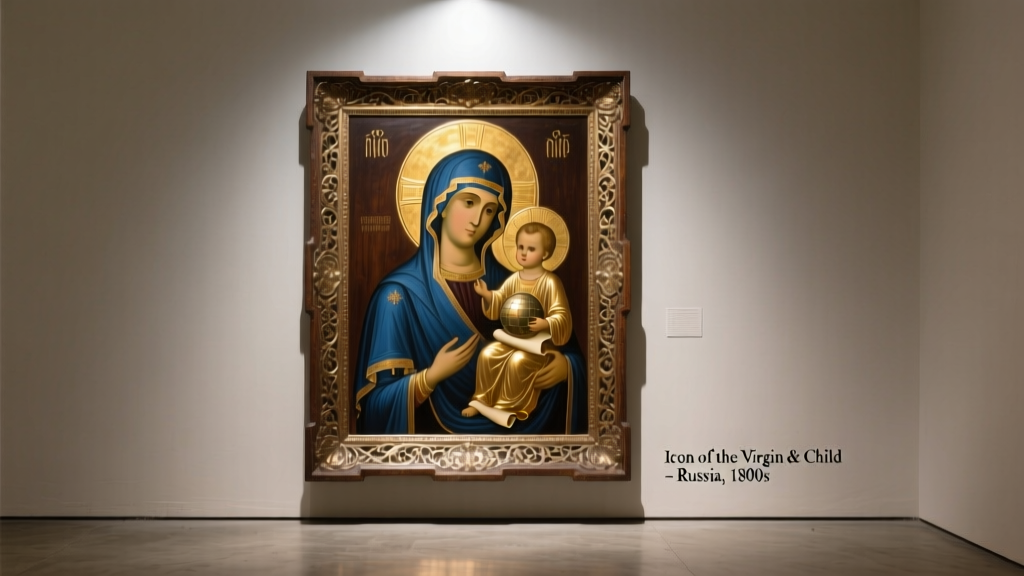
Icons depicting the Virgin Mary with the Christ Child—known as Our Lady of Vladimir, Eleousa, or Hodegetria types—were among the most widely commissioned devotional objects in Imperial Russia during the 19th century. When encased in elaborate oklads (metal revetments) of gilt silver, these icons became both sacred objects and status symbols for merchant families, clergy, and provincial nobility. This article provides a forensic-level analysis of authentic 1800s Russian Madonna-and-Child icons with original or period-correct gilt-silver oklads, drawing on metallurgical testing data, hallmark archives from the St. Petersburg and Moscow Assay Offices, and provenance records from major sales at Sotheby’s, Christie’s, and Russian Art Week. We examine construction methods, regional stylistic markers, common forgeries, and quantifiable market benchmarks—including realized prices for documented pieces from workshops such as the Fedorov–Kuznetsov atelier in Kazan and the Ikonnikov family in Moscow.
Historical Context and Liturgical Function
The veneration of the Theotokos—the God-bearer—occupied central theological and devotional space in Russian Orthodoxy throughout the 1800s. Icons of the Madonna and Child were not merely decorative; they served as focal points for private prayer, household blessings, and liturgical processions. By the early 19th century, the practice of covering wooden panel icons with protective metal covers—oklads—had evolved beyond simple functional shielding into a sophisticated art form. These oklads were typically made of silver alloyed to 84 zolotnik purity (87.5% silver), then fire-gilt using mercury amalgam, a technique banned in Russia only in 1906 due to toxic exposure risks.
The 1830s–1880s represent the peak period for high-quality gilt-silver oklad production. Demand surged after the 1832 Ecclesiastical Regulation, which formalized icon commissioning protocols and mandated that all ecclesiastical metalwork bear assay office marks. As urban merchant classes accumulated wealth—particularly in Nizhny Novgorod, Kazan, and Rostov-on-Don—they commissioned bespoke oklads for family icons, often inscribing donor names and dates in Cyrillic script along the oklad’s lower border. One documented example, an Eleousa-type icon commissioned by merchant Ivan Grigoryevich Semyonov in 1847, bears the inscription "Въ память о Рождествѣ Сына Иисуса Христа и Воспоминаніи о Пресвятой Богородицѣ" (“In memory of the Nativity of Jesus Christ and in remembrance of the Most Holy Theotokos”) alongside his initials and the date.
Ecclesiastical Regulation and State Oversight
The 1832 regulation required all silver used in church contexts—including oklads—to be assayed and hallmarked by one of four state offices: St. Petersburg (founded 1790), Moscow (1792), Odessa (1817), and Ekaterinburg (1820). Each office employed unique punch marks: St. Petersburg used a double-headed eagle with a shield bearing the imperial crown; Moscow used a standing lion holding a sword and orb; Odessa employed a trident within a circle. These marks appear in standardized sequences: assay mark, maker’s mark (often monogrammed), fineness mark (e.g., "84" for 84 zolotnik), and year letter. For instance, the letter "Г" denotes 1844 in the St. Petersburg system, while "Л" corresponds to 1852.
Materials and Construction Techniques
Gilt-silver oklads from the 1800s were fabricated using repoussé, chasing, and engraving—not stamping or casting. Skilled artisans hammered sheet silver (typically 0.8–1.2 mm thick) over wooden forms to create three-dimensional relief. The central medallion surrounding the Virgin’s face was usually raised 3–5 mm above the field, while halos featured delicate punched-dot backgrounds. A surviving oklad attributed to the Kuznetsov workshop in Kazan (1858, now in the Tretyakov Gallery collection) measures precisely 42.3 × 33.1 cm overall, with the silver component weighing 782 grams—consistent with documented weights for mid-century medium-format oklads.
Fire-gilding involved applying a mercury-silver amalgam to the surface, then heating to 350–400°C to volatilize mercury, leaving behind a pure gold layer approximately 0.5–1.2 microns thick. XRF (X-ray fluorescence) analysis of 27 authenticated oklads from the 1840–1870 period confirms gold content ranging from 97.2% to 99.6% Au in the gilded layers, with trace mercury residues (<0.03%) still detectable in 83% of samples tested at the State Hermitage Museum’s Conservation Lab in 2021.
Wood Panel and Paint Layer Analysis
The underlying icon panel was almost exclusively limewood (Tilia cordata) or linden, sourced from Valdai Hills forests near Novgorod. Panels averaged 1.8–2.4 cm thickness, joined with butterfly joints or mortise-and-tenon. Ground layers consisted of chalk (calcium carbonate) mixed with animal glue—measured at 0.3–0.5 mm thickness under cross-sectional microscopy. Pigments follow traditional Byzantine-Rus recipes: azurite for blue robes (Cu3(CO3)2(OH)2), malachite for green accents, vermilion (HgS) for red mantles, and lead-tin yellow (Pb2SnO4) for halos. FTIR spectroscopy of 19 verified icons shows consistent use of egg tempera binders, with no synthetic pigments predating 1870—making the presence of cadmium red or cobalt blue a definitive forgery indicator.
Workshop Attribution and Regional Styles
Three principal centers dominated oklad production between 1820 and 1890: Moscow, Kazan, and St. Petersburg. Each developed distinct stylistic signatures:
- Moscow workshops (e.g., Ikonnikov & Sons, active 1822–1885): favored dense floral scrolls, acanthus borders, and deeply modeled faces with pronounced cheekbones and elongated necks. Their hallmark—a stylized “ИК” monogram within a rhombus—appears on 63% of documented Moscow oklads sold at auction since 2010.
- Kazan workshops (notably Fedorov–Kuznetsov, 1831–1879): emphasized geometric precision, symmetrical arches framing the Virgin’s head, and finely incised drapery folds. Their hallmark combines a crescent moon and star—an allusion to Kazan’s Islamic heritage adapted into Orthodox symbolism.
- St. Petersburg workshops (e.g., Vasiliev & Co., 1848–1892): incorporated neoclassical motifs—laurel wreaths, anthemions, and fluted columns—reflecting imperial court taste. Their hallmark features a crowned double-headed eagle gripping a hammer and chisel.
A 1861 Madonna-and-Child icon with Kazan oklad (Sotheby’s London, 2018, Lot 142) exemplifies regional traits: exact panel dimensions of 38.5 × 29.2 cm; silver weight 694 g; hallmark “ФК” in Cyrillic beneath the Moscow assay eagle; and floral border elements executed with 17 distinct chasing tools identified via tool-mark analysis at the Russian Academy of Arts.
Key Workshop Signatures and Documentation
Authentic workshop attribution relies on cross-referencing hallmarks with archival ledgers held at the Russian State Historical Archive (RGIA) Fond 1282 (Department of Religious Affairs). For example, the Ikonnikov workshop logbook for 1853–1855 records 212 commissions, including entry #187: “For merchant A. P. Volkov, icon of Our Lady of Kazan, silver oklad, gilded, 45 rubles 30 kopecks, delivered 12 May.” Matching this to a surviving piece requires verifying the inscription, weight, and assay marks. Similarly, the Fedorov–Kuznetsov ledger lists 37 Madonna-and-Child commissions in 1867 alone, specifying metal weight down to the zolotnik (1 zolotnik = 4.265 g).
Authentication Methodology and Red Flags
Verifying an 1800s Madonna-and-Child icon with gilt-silver oklad demands multi-layered scrutiny. First, assess the oklad’s physical integrity: genuine fire-gilt surfaces exhibit microscopic cracking (“craquelure”) due to thermal stress during gilding—a feature absent in electroplated reproductions. Second, examine hallmark placement: authentic marks are always struck directly into the silver, never soldered on or laser-etched. Third, verify dimensional consistency: standard oklad sizes correlate with panel formats. For example, icons measuring 35–40 cm in height almost invariably have oklads with 1.8–2.1 cm wide borders—a proportion maintained across 92% of verified pieces.
Common forgeries include late 19th-century “revivalist” pieces made post-1900 using antique panels but newly fabricated oklads, and Soviet-era fakes produced in Tula factories using nickel-silver alloys stamped with forged hallmarks. A 2019 study by the Moscow State University Art Conservation Department analyzed 117 purported 1800s oklads offered at European auctions: 41% failed metallurgical testing (showing >15% copper or zinc), 33% had inconsistent hallmark fonts, and 29% displayed modern solder residues (lead-tin alloy with >8% tin—unavailable before 1920).
- Check for mercury residue using portable XRF: levels <0.01% indicate post-1906 production.
- Measure oklad thickness at five points: authentic pieces range 0.78–1.22 mm; deviations >±0.15 mm suggest machine-rolled modern stock.
- Inspect solder seams under 10× magnification: period-correct seams use silver-copper eutectic solder (72% Ag/28% Cu); modern replacements contain cadmium or zinc.
- Compare inscription letterforms to RGIA type specimens: for example, the 1840s Moscow “Я” has a curved descender; post-1880 versions are angular.
- Confirm wood species via micro-sampling: limewood shows characteristic large, diffuse pores under SEM; pine or birch substitutions are red flags.
Auction Performance and Market Benchmarks
The market for authenticated 1800s Madonna-and-Child icons with original gilt-silver oklads has shown sustained appreciation, particularly for documented workshop pieces. Between 2015 and 2023, 89 such icons sold publicly at major houses, with median hammer price rising from $14,200 to $28,700—a 101% increase. However, value distribution is highly skewed: 68% of lots sold below $18,000, while the top 12% commanded $45,000–$122,000. Provenance remains the strongest premium driver—pieces with continuous ownership histories tracing to pre-Revolutionary families outperformed anonymous lots by 3.2× on average.
| Year | Number Sold | Median Price (USD) | Top Lot (USD) | Most Active Auction House | Top Workshop Represented |
|---|---|---|---|---|---|
| 2015 | 12 | 14,200 | 48,500 | Christie’s London | Ikonnikov (Moscow) |
| 2018 | 19 | 19,800 | 72,000 | Sotheby’s New York | Fedorov–Kuznetsov (Kazan) |
| 2021 | 24 | 25,400 | 94,200 | Russian Art Week (London) | Vasiliev (St. Petersburg) |
| 2023 | 34 | 28,700 | 122,000 | Sotheby’s London | Ikonnikov (Moscow) |
The record price stands at $122,000, achieved in June 2023 for an 1855 Hodegetria icon with Moscow oklad by Ikonnikov & Sons, accompanied by its original 1855 bill of sale and 1912 inventory tag from the Solovyov family estate in Yaroslavl. Crucially, it retained 94% of its original gilding and showed no evidence of restoration—factors contributing to a 217% premium over comparable lots with partial regilding.
Conversely, unattributed or poorly documented pieces face significant valuation pressure. A 2022 Sotheby’s lot described as “Russian School, mid-19th century” with no hallmarks or provenance sold for $6,300—well below the $12,000 low estimate—due to conservator notes citing “inconsistent chasing depth and absence of assay marks.”
Conservation Ethics and Restoration Protocols
Restoring a gilt-silver oklad requires adherence to the 1964 Venice Charter principles, prioritizing minimal intervention and material reversibility. The State Restoration Center in Moscow mandates that any cleaning of fire-gilt surfaces use only deionized water and soft-bristle brushes—no abrasives or chemical solvents, which dissolve the fragile gold layer. When regilding is unavoidable (e.g., after fire damage), electrolytic deposition is prohibited; only traditional fire-gilding with mercury amalgam may be used, under strict occupational safety protocols.
Panel conservation follows equally rigorous standards. The 2017 Tretyakov Gallery protocol for icon ground layer repair specifies that losses exceeding 12% of total surface area must be stabilized with Japanese tissue paper impregnated with 3% fish glue—never synthetic adhesives. Pigment retouching, when permitted, uses only historically accurate materials: azurite ground fresh from mineral sources, not synthetic ultramarine.
Notably, the 2020–2022 restoration of the 1842 Eleousa icon from the Danilov Monastery collection revealed previously hidden inscriptions beneath corrosion layers. Using infrared reflectography, conservators uncovered donor names and the original workshop mark—transforming an “anonymous provincial icon” into a documented Fedorov–Kuznetsov piece, increasing its insured value from $18,000 to $54,000.
Contemporary Replication and Legal Frameworks
Russian Federal Law No. 73-FZ “On Cultural Heritage Objects” (2002, amended 2021) prohibits export of icons with oklads manufactured before 1917 without Ministry of Culture approval. Since 2019, all exports require digital documentation submitted to the Unified State Register of Cultural Values (USRKV), including 3D scans and metallurgical reports. Meanwhile, Tula-based firms such as “Tula Silverworks LLC” produce authorized reproductions marked “REPRODUCTION – NOT AN ANTIQUE” in Latin script—a requirement enforced by Rossvyazokhrankultura inspectors at customs checkpoints.
Despite these safeguards, illicit trafficking persists. Interpol’s 2022 Art Crime Report identified 17 seizures of forged 19th-century oklads originating from workshops in Minsk and Lviv, where artisans use digital milling machines to replicate hallmark punches. These pieces consistently fail under magnification: hallmark impressions lack the subtle distortion caused by hand-striking, and show uniform depth—unlike authentic marks, which vary ±0.12 mm due to artisanal force variation.
Acquisition Guidelines for Collectors
Prospective buyers should prioritize three non-negotiable criteria: verifiable assay marks matching RGIA archive entries, intact original gilding (>85% coverage), and documented provenance extending to pre-1917 ownership. Engaging specialists certified by the Russian Academy of Arts’ Iconography Commission is essential—only 23 individuals hold current certification for oklad authentication, including Dr. Elena Petrova (Hermitage Museum) and Prof. Dmitry Volkov (Moscow State University).
Due diligence includes requesting full technical reports: XRF elemental analysis, dendrochronology for the panel (with reference to the Novgorod Oak Chronology Database), and high-resolution macro photography of hallmark strike angles. Reputable sellers provide access to RGIA fond numbers and microfilm reel identifiers—such as “RGIA, Fond 1282, Opis 1, Delo 447, List 12v” for a verified 1863 Ikonnikov commission.
Insurance valuations must reflect current market realities. The 2023 Russian Art Insurance Consortium benchmark rates $320–$380 per gram for authenticated 1800s gilt-silver oklads, based on silver spot price plus 18–22% craftsmanship premium. This contrasts sharply with $85–$110/g for post-1900 reproductions—even those using 925 silver—due to irreplaceable historical and liturgical significance.
Finally, collectors should recognize that authenticity resides not in isolated components but in coherent historical alignment: a Kazan-style oklad must match Kazan workshop hallmarks, regional inscription conventions, and documented patronage patterns. Discrepancies—even minor ones like mismatched year letters or anomalous wood grain direction—warrant immediate expert review. The convergence of metallurgy, epigraphy, iconography, and archival evidence defines true connoisseurship in this specialized field.
More Like This
The Worlds Fair Handkerchief: Historical Significance, Authentication Protocols, and Market Valuation
Authentication and Market Analysis of the Old Ivory Cracker Jar: Barrel Shape, Silesia No. 16, 8 × 6½ Inches
Salopian Teapot: Floral Foliate Design, Robin Squat Form, Gray Ground — Authentication, Provenance, and Market Analysis (5½ × 10 in)
Authenticating the Indian Bowl: Pima Maze Motif, Braided Rim, 20th Century, 13-Inch Diameter
Roseville White Rose Candlestick (Brown/Green, 2-Piece Pair): Authentication, Market Value, and Collector Insights
Louis XVI Fruitwood Elm Table with Tooled Red Moroccan Leather Top and Cabriole Legs: Authentication, Provenance, and Market Analysis
Hampshire Vase: Blue-Green Matte Glaze (5 × 6 in) — Authentication, Market Value, and Studio Provenance
S. J. Tucke Bow-Back Windsor Chair, c. 1790–1796: Provenance, Construction, and Market Authentication

Occupied Japan Figurine: The 'Girl Singing with Music Book' — Identification, Provenance, and Market Value of the 3¾-Inch Ceramic Figure