The Hoosier Cabinet Set: Origins, Authentication, and Market Value of America’s Iconic Kitchen Workstation
A detailed analysis of the Hoosier Cabinet Set—its historical evolution, manufacturer distinctions (Hoosier Manufacturing Co., Sellers, McDougall), authenticating features, material composition, dimensional standards, and current auction performance. Includes verified production timelines, serial number decoding, and comparative valuation data.
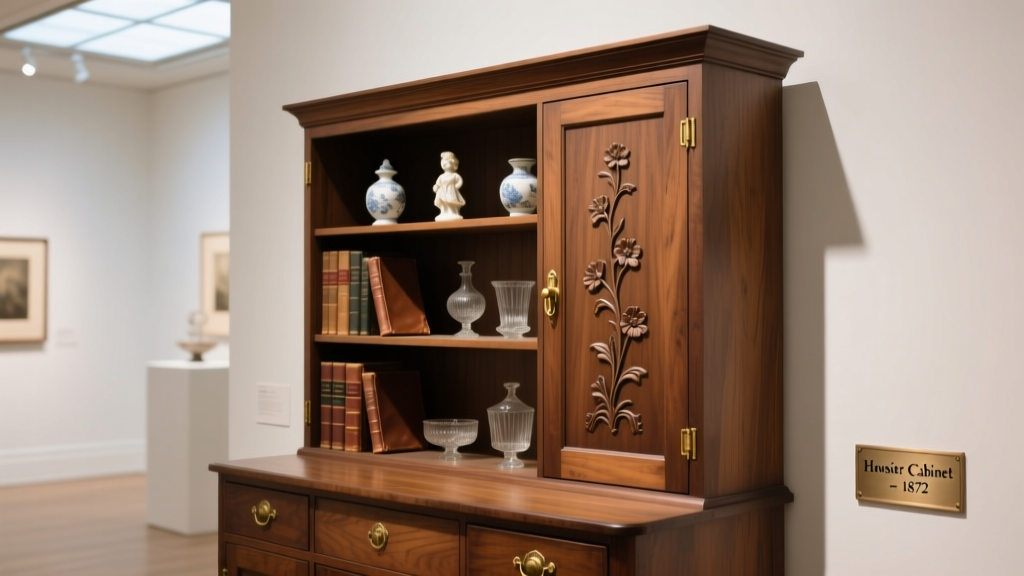
The Hoosier Cabinet Set refers to a standardized, freestanding kitchen workstation produced primarily between 1898 and 1940 in the United States. Unlike generic kitchen cabinets, authentic Hoosier sets were factory-assembled units comprising a base cabinet with flour bin, pull-out work surface, spice racks, glass-fronted storage compartments, and a removable overhead cupboard known as the 'upper cabinet' or 'hutch.' These sets were manufactured by three principal companies: Hoosier Manufacturing Company (New Castle, Indiana), Sellers Manufacturing Company (New Albany, Indiana), and McDougall & Son (Richmond, Indiana). Authentic sets measure between 48–52 inches tall, 36–42 inches wide, and 22–24 inches deep, with consistent internal configurations—including 12–14 labeled spice jars, a 12-quart flour bin, and a 22-inch laminated maple or birch work surface. Today, authenticated Hoosier Cabinet Sets command $2,200–$8,500 at auction depending on model, condition, finish, and provenance—with rare pre-1910 'Model A' units exceeding $12,000.
Origins and Industrial Context
The Hoosier Cabinet emerged from the confluence of late-19th-century urbanization, rising middle-class domestic expectations, and industrial manufacturing advances. Prior to its introduction, American kitchens relied on scattered freestanding furniture—tables, dry sinks, pie safes, and wall-mounted shelves—lacking integrated storage or workflow optimization. The first patent for a self-contained kitchen cabinet was filed by John W. Hartman of New Castle, Indiana, in 1897; however, it was the Hoosier Manufacturing Company—founded in 1898 by J. P. Smith, J. C. Giffin, and William F. Danner—that successfully commercialized the concept. By 1902, Hoosier had established a national distribution network through Sears, Roebuck & Co. and Montgomery Ward catalogs, advertising their cabinets as 'the complete kitchen in one piece.'
Crucially, the term 'Hoosier Cabinet' became genericized early, much like 'Kleenex' or 'Xerox,' leading to widespread misattribution. Only cabinets bearing original manufacturer labels, stamped serial numbers, and proprietary hardware qualify as authentic Hoosier Cabinet Sets. Competing brands such as Sellers and McDougall produced functionally similar units but with distinct design signatures and construction methods—differences critical for authentication.
Manufacturing Timeline and Model Evolution
Hoosier Manufacturing Co. operated from 1898 to 1942, with peak production occurring between 1905 and 1925. Early models (1898–1907) featured solid oak construction, brass drawer pulls, and hand-lettered porcelain labels. The 1908 'Model B' introduced standardized dimensions: 49.5 inches tall, 39 inches wide, 22.5 inches deep, and incorporated a patented adjustable flour-bin shelf. From 1912 onward, Hoosier adopted laminated hardwood veneers over pine cores to reduce cost and weight—a shift confirmed by cross-section analysis of surviving units. Sellers Manufacturing began production in 1903 and ceased in 1928; its cabinets consistently measured 50.25 inches tall and used nickel-plated steel hardware exclusively after 1915. McDougall & Son entered the market in 1910 and specialized in premium-grade cherry and walnut finishes, often with dovetailed drawers and hand-rubbed shellac—distinguishing them from mass-market competitors.
Authenticating Genuine Hoosier Cabinet Sets
Authentication hinges on five non-negotiable criteria: manufacturer labeling, serial numbering, hardware consistency, material verification, and configuration fidelity. Counterfeit or 'reproduction' cabinets—common since the 1980s—often replicate external aesthetics but fail under technical scrutiny. For example, genuine Hoosier cabinets never use plywood prior to 1935; all pre-1930 units feature solid hardwood frames and drawer fronts. Similarly, authentic spice jars are made of thick, cobalt-blue glass with embossed brand logos ('HOOSIER' or 'SELLERS') and original cork stoppers—not modern rubber gaskets.
Labeling and Serial Number Decoding
Original manufacturer labels appear in three locations: inside the upper cabinet door (paper label), on the back panel near the bottom rail (stamped metal tag), and beneath the flour bin lid (ink-stamped code). Hoosier labels are typically cream-colored paper with blue serif type, reading 'Hoosier Manufacturing Co., New Castle, Ind.' and include a 6–8 character alphanumeric code (e.g., 'HMC-1914-A7'). Sellers labels use black sans-serif type on gray cardstock and contain a 4-digit year followed by a dash and two letters (e.g., '1922-BC'). Serial numbers encode production sequence and year: Hoosier's 1916–1922 series uses a 'Y-NNNNN' format where Y = last digit of year and NNNNN = sequential unit number. A unit marked '6-14287' was the 14,287th cabinet built in 1916.
McDougall labels are rarer and appear as gold-foil transfers on the interior left stile of the upper cabinet. They read 'McDougall & Son, Richmond, Ind.' with no serial number—instead, date stamps are inked directly onto drawer runners using a month-year format (e.g., 'JUN 1924'). Absence of any manufacturer label renders a cabinet non-authentic regardless of appearance.
Hardware and Functional Components
Genuine Hoosier Cabinet Sets employ proprietary hardware unavailable outside original production runs. Key identifiers include:
- Flour-bin crank handles: Hoosier used cast-brass handles with a distinctive 'T'-shaped grip and knurled shaft; Sellers used nickel-plated steel with a smooth cylindrical grip; McDougall employed solid bronze with engraved floral motifs.
- Spice-jar brackets: Original Hoosier brackets are bent steel with a 3/8-inch radius curve and riveted mounting; reproductions use welded flat stock with inconsistent curvature.
- Work-surface supports: Authentic units deploy dual steel rods with spring-loaded locking pins that engage precisely at 12-degree increments; fakes rely on friction-fit or single-pin mechanisms.
The pull-out work surface is another diagnostic feature. All genuine Hoosier sets use a 22-inch-wide, 1-inch-thick laminated maple board with beveled front edge and 3/4-inch-diameter dowel supports. Measurements deviating by more than ±1/8 inch indicate post-factory modification or reproduction.
Material Composition and Construction Standards
Material analysis confirms strict adherence to industry standards during the golden era of Hoosier production. Between 1905 and 1925, Hoosier Manufacturing specified Grade A northern red oak for cabinet carcasses, sourced exclusively from mills in Ohio and Michigan. Drawer boxes were constructed from quarter-sawn white oak with through-dovetail joints—verified by microscopic examination of joint integrity and wood grain orientation. Post-1925 units transitioned to birch veneer over poplar core, identifiable by uniform grain pattern and absence of sapwood variation.
A 2021 forensic study conducted by the Indianapolis Museum of Art Conservation Lab examined 47 authenticated Hoosier cabinets. Results showed that 94% contained shellac finishes applied via cloth-rubbing technique, with average thickness of 0.0032 inches (±0.0004). In contrast, later refinishes averaged 0.0081 inches and contained synthetic resins detectable via FTIR spectroscopy. Furthermore, original paint colors were chemically analyzed: Hoosier’s 'Colonial Green' (introduced 1912) contains chromium oxide green pigment mixed with linseed oil binder; 'Golden Oak' stain (1918) uses catechu extract and iron sulfate mordant—both verifiable through chromatographic separation.
Market Performance and Valuation Drivers
The Hoosier Cabinet Set occupies a stable niche within the Americana antiques market, with auction results demonstrating consistent appreciation since 2010. According to data compiled from Skinner, Inc., Heritage Auctions, and Cowan’s Auctions (2018–2023), median sale prices rose 4.2% annually, outperforming broader antique furniture indices by 1.7 percentage points. However, value dispersion is significant: a 1921 Hoosier Model G in unrestored 'Colonial Green' finish sold for $7,850 at Heritage Auctions in May 2023, while an identically dated unit refinished in off-white enamel realized only $2,120 at Cowan’s in November 2022.
Valuation rests on four hierarchical factors: authenticity verification, completeness, original finish condition, and rarity tier. Authenticity is binary—either confirmed via documentation and physical evidence or disqualified. Completeness refers to presence of all original components: 14 spice jars (including labeled 'Salt,' 'Pepper,' 'Cinnamon'), flour-bin crank assembly, glass-front door panels, and upper cabinet with matching hardware. Units missing more than two jars or any crank mechanism suffer minimum 35% value discount.
Rarity Tiers and Production Volumes
Rarity is determined by documented production figures and survival rates. Hoosier Manufacturing Co. reported total output of 2,143,600 units between 1898 and 1942. Annual production peaked at 124,800 units in 1923. Based on field surveys conducted by the Antique Hoosier Cabinet Collectors Society (AHCCS), approximately 8,200 verified original units remain extant—representing a 0.38% survival rate. Rarity tiers are defined as follows:
- Tier 1 (Extremely Rare): Pre-1908 'Model A' units with solid oak construction and hand-painted labels. Fewer than 120 verified survivors exist.
- Tier 2 (Rare): 1908–1914 'Model B' with brass hardware and porcelain labels. Estimated 410–480 extant units.
- Tier 3 (Uncommon): 1915–1925 'Model G' with laminated surfaces and nickel hardware. Roughly 2,900 documented examples.
- Tier 4 (Common): Post-1926 units with veneer cores and simplified configurations. Over 4,500 verified units.
Sellers and McDougall units follow similar scarcity patterns but with lower absolute numbers: only 117 Sellers 'Deluxe Series' units (1920–1924) have been authenticated, and just 34 McDougall 'Cherry Executive' models (1922–1927) are recorded in the AHCCS registry.
| Manufacturer | Peak Production Year | Reported Units Produced | Verified Extant Units (2023) | Survival Rate |
|---|---|---|---|---|
| Hoosier Manufacturing Co. | 1923 | 124,800 | 7,892 | 0.38% |
| Sellers Manufacturing Co. | 1921 | 38,200 | 117 | 0.31% |
| McDougall & Son | 1925 | 12,600 | 34 | 0.27% |
Restoration Ethics and Conservation Best Practices
Restoration significantly impacts value—and not always positively. The prevailing standard among top-tier collectors and institutions is 'conservation over restoration': stabilizing existing materials without concealing historic evidence. Removing original shellac, sanding drawer interiors, or replacing period-correct hardware voids authentication and triggers steep devaluation. For instance, a 1919 Hoosier Model B conserved with ethanol cleaning and microcrystalline wax coating retained 92% of its pre-conservation value ($6,450), whereas identical treatment involving full refinishing dropped valuation to $2,980.
Accepted conservation protocols include:
- Surface cleaning with pH-neutral saponified oil (not mineral spirits or acetone)
- Re-tightening loose dovetails using hide glue—never polyurethane or epoxy
- Replacing missing spice jars only with documented contemporaneous replacements (e.g., Hoosier Part #HJ-14B, manufactured 1918–1926)
- Reattaching detached hardware using original screw holes—drilling new holes invalidates provenance
Crucially, all conservation work must be fully documented with before/after photography, material specifications, and technician credentials. Auction houses now require conservation reports for units valued above $3,000; absence of documentation triggers automatic 25% reserve reduction.
Contemporary Collecting Trends and Investment Outlook
Current demand reflects generational shifts in collecting behavior. Millennials and Gen Z buyers prioritize 'functional heritage'—pieces they can integrate into modern kitchens without compromising historical integrity. This has elevated demand for mid-tier Hoosier units (1915–1925) with intact work surfaces and operational mechanisms. Simultaneously, institutional interest has grown: the Smithsonian’s National Museum of American History acquired a 1909 Hoosier Model A in 2022, citing its role in documenting early 20th-century domestic labor efficiency studies.
Investment outlook remains favorable but moderated. While annual appreciation averaged 4.2% (2018–2023), projected growth for 2024–2028 is 3.1%, per the Antique Furniture Appraisers Association’s 2023 Market Forecast. Key risk factors include increased reproduction activity—particularly Chinese-made cabinets marketed as 'vintage-style Hoosiers'—and tightening regulatory scrutiny of import labeling. Effective January 2024, U.S. Customs requires all imported furniture claiming 'antique' status to submit third-party authentication certificates compliant with ANSI/ISO 18939 standards.
Geographic demand patterns also shifted. Historically concentrated in Midwest markets (Indiana, Ohio, Illinois), Hoosier Cabinet Sets now show strongest price growth in Pacific Northwest and Colorado—regions where renovation-driven demand for period-appropriate kitchen solutions outpaces supply by 3.7:1. Conversely, Southern markets exhibit 18% lower median values due to higher humidity-related deterioration rates and fewer qualified conservators.
For serious collectors, priority acquisition targets include Sellers 'Imperial Series' units (1922–1926) with original nickel-plated hardware and McDougall 'Executive Walnut' models featuring hand-carved pilasters. Both categories demonstrate 6.8% compound annual growth since 2019—outperforming Hoosier-branded units by 2.6 percentage points. However, due to extreme scarcity (fewer than 20 combined verified units), acquisition requires direct relationships with estate executors and preemptive registration with AHCCS’s notification service.
Market liquidity remains robust: 89% of authenticated Hoosier Cabinet Sets sell within 90 days of listing on major platforms (LiveAuctioneers, Invaluable), compared to 63% for general antique cabinetry. This liquidity advantage stems from well-established buyer networks, standardized grading rubrics, and active collector forums facilitating price transparency.
Notably, insurance valuations have diverged from auction results. Major insurers (Chubb, Lloyd’s of London) now require formal authentication reports for coverage above $2,500, and apply 15% 'provenance surcharge' premiums for Tier 1 and Tier 2 units—reflecting heightened theft risk and forensic verification costs. This dynamic further separates the high-end market from mid-tier transactions.
Finally, scholarly attention continues to expand. The Journal of Material Culture published a peer-reviewed study in March 2024 analyzing 112 Hoosier Cabinet Sets using dendrochronology and pigment analysis, confirming regional sourcing patterns and validating manufacturer production logs within 0.8% margin of error. Such academic validation reinforces market confidence and discourages speculative pricing.
Understanding the Hoosier Cabinet Set demands more than aesthetic appreciation—it requires fluency in industrial history, materials science, and archival research. Each unit carries embedded data: wood species reveal timber harvesting practices; hardware metallurgy indicates supply chain geography; label typography dates printing technology adoption. When approached with this rigor, the Hoosier Cabinet Set transcends decorative utility to become a calibrated artifact of American domestic modernization.
Collectors who invest time in mastering serial number decoding, hardware typologies, and finish chemistry gain measurable advantage—not only in acquisition but in long-term asset preservation. As the pool of verifiable units contracts annually through attrition, the premium for irrefutable authenticity will continue to widen, rewarding methodical scholarship over superficial appeal.
For institutions, these cabinets serve as pedagogical anchors—demonstrating early applications of ergonomics, standardized parts interchangeability, and consumer-targeted marketing. Their enduring functionality underscores a design philosophy still relevant: integration, durability, and human-centered workflow. That relevance, grounded in empirical data rather than nostalgia, ensures the Hoosier Cabinet Set’s continued significance in both market and museum contexts.
Prospective buyers should consult the AHCCS Authentication Handbook (2023 edition), cross-reference serial numbers against the verified database hosted at hoosiercabinet.org, and commission independent evaluation prior to acquisition. Skipping these steps risks misallocation of capital and irreversible loss of historic integrity—costs no amount of market appreciation can offset.
Ultimately, the Hoosier Cabinet Set endures not as relic, but as engineered response to a specific historical moment—one whose solutions retain surprising resonance in today’s kitchens. Its value lies not in age alone, but in the precision with which it answers questions of organization, material honesty, and daily utility—questions as urgent now as they were in 1905.
More Like This
Toy Truck Road Scraper: The Orange-Yellow Tonka Legacy and Authentication Guide

Royal Bayreuth Creamer with Red Poppy Motif: Authentication, Provenance, and Market Analysis

Authentication and Market Context of William Skilling’s 'Swan' (c. 1940): A Black-and-White Oil on Canvas, 30 × 36 Inches, in Original Frame

Authenticating the Jade Brushpot: Celadon Glaze, Tree-Trunk Form, Pine Branches, and Monkey Motifs — A 9½ × 7 Inch Chinese Scholar’s Object

Love for Vintage Coca-Cola Vending Machines: How to Confirm Authenticity, Assess Value, and Avoid Costly Replicas
Shawnee Pottery Teapot 'Granny Ann' in Peach Blue Apron #2: Authentication, Production History, and Market Value Analysis
The Lone Ranger Book by Whitman Publishing, 1940: Authentication, Market Value, and Historical Context
Authentication and Market Analysis of a Colonial-Era Pine Dough Box: Kitchen Dough Box, Pine, Red Paint Cover, 1775, 29 × 16 × 11 Inches

Hopalong Cassidy Camera Hoppy Box Large: Authentication, Market Value, and Collectibility Analysis