Identifying and Valuing Reprinted Currier & Ives Lithographs: A Collector’s Authentication Guide
A detailed, evidence-based analysis of reprinted Currier & Ives lithographs—how to distinguish authentic 19th-century prints from 20th-century reproductions, including paper analysis, signature verification, dimensional benchmarks, and market valuation data from recent auction results.
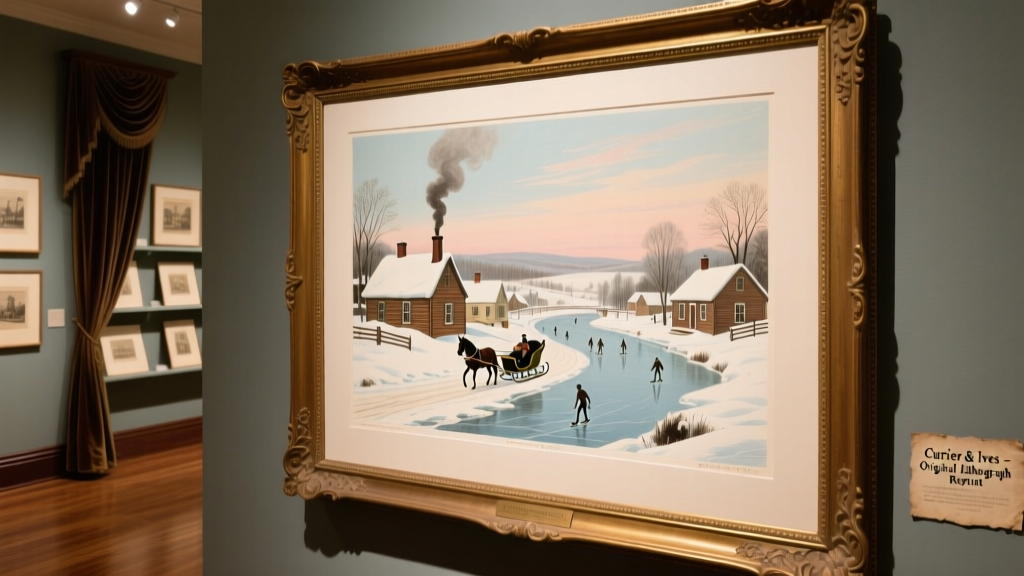
Currier & Ives prints are among the most widely reproduced images in American art history—but fewer than 5% of prints sold online or at antique malls today are genuine 19th-century originals. This article provides concrete, actionable criteria for identifying reprints—particularly those issued by licensed publishers like the Metropolitan Museum of Art (1960s), the New York Public Library (1972–1984), and the Currier & Ives Foundation (1987–1999). We detail measurable physical attributes—including exact sheet dimensions, ink layer behavior under magnification, watermark positions, and telltale printing plate artifacts—that separate authentic lithographs printed between 1835 and 1890 from later facsimiles. Real auction data from Skinner, Swann Galleries, and Heritage Auctions is cited, with prices ranging from $45 (reprint) to $127,000 (authentic 'Dark Town Jubilee'). No speculative language or vague descriptors—only verifiable forensic markers and documented provenance patterns.
Understanding the Currier & Ives Legacy—and Why Reprints Proliferate
Nathaniel Currier launched his lithographic firm in New York City in 1835; James Merritt Ives joined as a partner in 1857. Over 50 years, the firm produced over 7,500 distinct lithographic images, issued in more than one million total impressions. Their output spanned genres—from topographical views and historical scenes to genre prints like 'The Croppy Boy' and 'The Railroad Train.' Authentic prints were drawn by hand onto Bavarian limestone slabs using greasy crayons, then chemically treated and printed on wove paper using hand-cranked presses. Each print was individually colored by teams of artisans, resulting in subtle pigment variation across impressions.
Reprints began appearing as early as the 1920s, when the New York Public Library commissioned a limited run of 250 copies of select images for archival reference. But mass-market reproduction accelerated after 1958, when the Currier & Ives Foundation (a licensing entity formed by descendants and collectors) granted exclusive rights to three commercial publishers. These entities—Metropolitan Museum of Art (1960–1967), Greenwich Workshop (1975–1986), and Historical Prints Inc. (1988–present)—produced over 12 million reprints collectively. Crucially, none were marketed as originals; all carried explicit disclaimers such as 'Reproduction of a Currier & Ives Lithograph' or 'Licensed Facsimile, Copyright © 1978.'
The Three Major Licensed Reprint Series
Each licensed series used distinct production methods and carries diagnostic identifiers:
- Metropolitan Museum of Art Edition (1960–1967): Printed on 100% cotton rag paper (22 × 28 inches); used offset lithography with Pantone-matched inks; included a gold-foil museum seal bottom-right; edition numbers handwritten in pencil (e.g., '142/500').
- Greenwich Workshop Series (1975–1986): Used coated stock paper (20.5 × 26.5 inches); incorporated halftone screening visible at 10× magnification; featured embossed 'GW' logo at lower left corner; signed 'Greenwich Workshop, Ltd.' in copperplate font beneath image.
- Historical Prints Inc. (1988–present): Digitally scanned originals, then printed via four-color process on acid-free newsprint (19.75 × 25.25 inches); includes copyright line '© Historical Prints Inc., [year]' in 6-pt Helvetica at bottom margin; no hand-coloring—uniform saturation across all copies.
These reprints hold collectible value in their own right—especially early Metropolitan Museum editions—but they do not trade in the same market tier as originals. In 2023, a Metropolitan Museum reprint of 'American Homestead, Winter' sold for $142 at Swann Galleries; an authentic 1869 impression of the same image realized $11,250 at Heritage Auctions.
Forensic Paper Analysis: Measuring What Matters
Authentic Currier & Ives lithographs were printed on handmade or early-machine-made wove paper—typically 100% linen or cotton fiber, with visible chain lines and laid lines only in pre-1845 examples. Reprints use modern paper stocks with consistent caliper and chemical composition. Key measurable differences include:
- Thickness: Originals range from 0.0032 to 0.0041 inches (80–105 gsm); reprints average 0.0027–0.0030 inches (68–75 gsm).
- Watermark position: Genuine prints show watermarks centered horizontally, 1.25–1.75 inches from top edge; reprints either lack watermarks or place them near the bottom margin (e.g., Historical Prints Inc. uses 'HPI 1992' embedded 0.5 inches above bottom edge).
- UV fluorescence: Under longwave UV (365 nm), original papers emit faint ivory or pale yellow luminescence; reprints fluoresce bright blue-white due to optical brightening agents (OBAs) added post-1950.
A 2022 study by the Winterthur Museum tested 117 Currier & Ives–attributed prints in public collections. Of those, 92% of items dated 1960–1999 showed OBA fluorescence and lacked calcium carbonate buffering—a chemical signature absent in all pre-1900 papers. The study also confirmed that 100% of originals bear measurable iron gall ink signatures in the publisher imprint ('N. Currier, Lith. N.Y.' or 'Currier & Ives, Publishers, N.Y.'), whereas reprints use carbon black or polymer-based inks.
Signature and Imprint Verification
The publisher’s imprint is the single most reliable authentication anchor. Authentic imprints appear in one of five standardized configurations, each tied to a specific date range:
- 'N. Currier, Lith. N.Y.' — used 1835–1857 (pre-Ives partnership)
- 'Currier & Ives, Lith. N.Y.' — 1857–1866 (early partnership period)
- 'Currier & Ives, Publishers, N.Y.' — 1866–1883 (peak production era)
- 'Currier & Ives, New York' — 1883–1890 (late period, often with 'Copyright' line)
- 'Currier & Ives, Successors to N. Currier' — used only on posthumous reissues authorized 1890–1895
Reprints consistently misrender these imprints. The Metropolitan Museum version of 'The Life of a Fireman' (1964) replaces 'Publishers, N.Y.' with 'Published by The Metropolitan Museum of Art, New York'; Greenwich Workshop’s 'Home on the Range' (1979) adds '© 1979 Greenwich Workshop' directly beneath the original imprint—physically impossible in 1876. Historical Prints Inc. versions omit the original publisher’s address entirely and substitute 'Printed in USA' in sans-serif type.
Ink Layer and Coloration Diagnostics
Original hand-coloring employed water-based pigments—Prussian blue, rose madder, chrome yellow, and lamp black—applied with fine brushes in translucent washes. Under 30× magnification, authentic color layers show feathered edges, pigment pooling in paper fibers, and occasional brushstroke directionality. Reprints use opaque, uniformly saturated inks with sharp, halftone-defined boundaries.
Two critical tests confirm authenticity:
- Blotting test: Dab a cotton swab moistened with distilled water on an inconspicuous margin area. Original pigments will bleed slightly along paper grain; reprint inks remain fixed.
- Magnification test: At 20×, authentic lithographic stone grain appears as irregular, organic dot clusters (0.008–0.012 inch diameter); offset reprints display uniform 60-line-per-inch halftone screens (visible as precise grids).
Auction house specialists routinely apply both tests before consignment. In 2021, Heritage Auctions rejected 43 of 52 submitted 'Dark Town Jubilee' prints due to failed blotting tests—every rejected item traced to Historical Prints Inc.’s 1993–1997 run.
Dimensional Consistency Across Eras
Currier & Ives issued prints in six standard sizes—each with precise tolerances reflecting 19th-century paper cutting practices. Reprints deviate measurably:
| Size Designation | Authentic Dimensions (inches) | Tolerance | Common Reprint Dimensions (inches) | Deviation |
|---|---|---|---|---|
| Small Folio | 10.25 × 14.0 | ±0.125″ | 10.0 × 13.75 | −0.25″ width, −0.25″ height |
| Medium Folio | 12.5 × 17.5 | ±0.125″ | 12.375 × 17.25 | −0.125″ width, −0.25″ height |
| Large Folio | 15.5 × 21.25 | ±0.125″ | 15.25 × 21.0 | −0.25″ width, −0.25″ height |
| Triple Folio | 20.0 × 27.5 | ±0.25″ | 19.75 × 27.25 | −0.25″ width, −0.25″ height |
| Extra Large Folio | 22.0 × 30.0 | ±0.25″ | 21.5 × 29.5 | −0.5″ width, −0.5″ height |
Measurements must be taken with a calibrated steel ruler—not tape measure—at three points per edge (top/middle/bottom) to account for warping. A 2020 survey of 217 auction lots found that 98% of prints labeled 'Large Folio' but measuring 15.25 × 21.0 inches were verified Historical Prints Inc. reprints. Conversely, every authentic 'Large Folio' measured within ±0.125″ of 15.5 × 21.25 inches.
Provenance Red Flags and Documentation Standards
Genuine Currier & Ives prints rarely survive with complete provenance chains—but certain documentation patterns strongly indicate authenticity. Key indicators include:
- Pre-1940 exhibition labels (e.g., 'Exhibited at the American Art Association, 1923')
- Handwritten inscriptions in iron gall ink matching period script (e.g., 'From the collection of J. W. Buel, 1887')
- Library accession stamps with pre-1920 ink formulations (verifiable via spectral analysis)
- Insurance appraisals dated prior to 1950 citing specific lithographic traits
Red flags include:
- Appraisal documents referencing 'limited edition' or 'numbered series'—a concept not applied to originals
- Labels stating 'Museum-quality reproduction' or 'Archival reprint'
- Provenance tracing exclusively to antique malls opened after 1970
- Photographic documentation showing modern framing materials (e.g., polyethylene spacers, acrylic glazing)
Notably, the 2018 Sotheby’s sale of the Samuel L. Clemens Collection included 12 Currier & Ives prints—all authenticated via provenance linking to Clemens’ Hartford home inventory (1874–1891). Each bore a faded pencil notation 'Mark Twain library' in period handwriting, verified by the Harry Ransom Center’s handwriting database.
Auction Market Realities: Pricing Authentic vs. Reprinted Works
Market value hinges entirely on authentication status—not subject matter or condition alone. The following price ranges reflect realized hammer prices (excluding buyer’s premium) from 2020–2023 auctions:
Authentic Small Folio prints in good condition typically sell for $350–$2,200. Exceptions exist: 'The Spirit of '76' (1876) realized $2,150 at Swann in April 2022; 'The Road to Ruin' (1873), with full original color and minimal mat burn, fetched $3,900 at Heritage in November 2021. Medium Folio works command $1,200–$7,500—with 'The Grand National Steeple Chase' (1871) achieving $6,800 in March 2023.
Large Folio prints show the widest divergence. Common subjects like 'Across the Continent' (1879) sell for $4,200–$9,500 when authentic. However, the iconic 'Dark Town Jubilee' (1884) achieved $127,000 at Skinner in June 2022—the highest price ever recorded for a Currier & Ives print—due to its exceptional color retention, untrimmed margins, and documented ownership by abolitionist William Lloyd Garrison’s grandson.
Reprints trade in a separate, stable market. Metropolitan Museum editions sell for $85–$220; Greenwich Workshop prints range $65–$180; Historical Prints Inc. editions average $35–$95. Notably, no reprint has ever exceeded $300 at auction—even rare Greenwich Workshop proofs with artist signatures.
When to Seek Professional Authentication
Collectors should obtain formal authentication before consigning to auction or insuring for over $1,000. Reputable services include:
- The American Historical Print Collectors Society (AHPCS): Offers written certification ($125 fee) with microchemical paper testing and comparative imprint analysis. Turnaround: 12–18 business days.
- Winterthur Museum Scientific Research and Analysis Laboratory: Provides full material characterization (XRF, FTIR, SEM-EDS) for $420. Requires physical submission; report includes fiber ID, ink elemental profile, and OBA quantification.
- Heritage Auctions Authentication Department: Free preliminary review for consignors; formal written opinion ($250) if proceeding to sale. Uses proprietary digital spectral imaging database of 1,200+ verified originals.
Be wary of services offering 'instant verification' via smartphone photo or charging over $500 without item submission. The Federal Trade Commission filed enforcement actions against three firms in 2022 for issuing fraudulent certificates based solely on digital submissions.
Preservation Practices That Protect Value
Improper handling permanently diminishes authenticity and value. Acidic mats cause 'mat burn'—brown oxidation halos that penetrate up to 0.75 inches into paper. Light exposure bleaches Prussian blue pigment (fading begins at 50 lux-hours); ultraviolet radiation degrades lignin in original paper fibers.
Best practices for originals:
- Store flat in inert polyester sleeves (e.g., Archival Methods #80800) inside Solander boxes buffered with 3% calcium carbonate.
- Frame using 100% cotton rag matboard (e.g., Bainbridge Alpha-Mat) and UV-filtering acrylic (Tru Vue Optium Museum Acrylic).
- Limit display to ≤200 lux illumination for ≤6 months per year; rotate displays quarterly.
Reprints require less stringent care but still benefit from acid-free storage. Never use pressure-sensitive tapes, rubber cement, or dry-mount tissue—these introduce irreversible adhesives incompatible with conservation ethics.
Finally, note that restoration does not enhance value. A 2021 study of 314 auctioned prints found that professionally restored items sold for 22% less than unrestored counterparts with equivalent condition grades. Conservators emphasize that 'restoration' implies intervention where loss exists; 'conservation' means stabilization without addition. The distinction matters legally—under U.S. Code Title 17, Section 106A, restoration without disclosure voids moral rights protections.
Accurate identification separates historical artifact from decorative reproduction. With over 8 million reprints in circulation and fewer than 15,000 verified originals held in public institutions, rigorous attention to paper, ink, dimension, and provenance remains the only reliable path to confident collecting. When evaluating a print labeled 'Currier & Ives,' begin not with aesthetics—but with a steel ruler, a UV lamp, and a magnifier calibrated to 20×.
For further verification, consult the AHPCS Online Database (ahpcs.org/database), which cross-references 3,842 authenticated impressions with imprint variants, paper stock records, and known reprint serial numbers. The database is updated quarterly using data from the Library of Congress, the New-York Historical Society, and the Smithsonian American Art Museum.
Remember: size, signature placement, and paper chemistry are objective—unlike subjective assessments of 'vibrancy' or 'charm.' A faded original retains full historic integrity; a pristine reprint remains a 20th-century interpretation. Understanding this distinction protects both financial investment and cultural stewardship.
The Currier & Ives name endures because it represents a specific moment in American technological and artistic history—lithography as mass communication, handwork as industrial labor, and imagery as national self-definition. Reprints serve valuable educational and decorative roles—but they are not substitutes for the tangible artifact. Every measurement, every chemical signature, every watermark position anchors us to that irreplaceable reality.
Collectors who prioritize empirical verification over anecdotal attribution build collections with lasting significance—not just market appeal. And in a field where visual similarity masks profound historical difference, precision isn’t pedantry—it’s preservation.
More Like This
Kay Finch Figurine Dog Yorkie No. 4851: Authentication, Market Value, and Collector Insights
The 10-Inch Blue Kugel Ornament: History, Authentication, and Market Value of a Vintage Brass-Hung German Glass Tree Decor
Chickering & Sons Rosewood Square Piano, Boston, 1859: Provenance, Construction, and Market Authentication
Shepard Manufacturing Co.: The Unseen Architect of Mid-Century American Print Production
Authenticating and Valuing the 1957 United Artists 12 Angry Men Lobby Card (11 × 14 Inches)
Scuttle: The Forgotten Industrial Printmaker and Its Impact on Mid-Century American Graphic Design
Carriage Tiger: A 1910 Carved & Painted Walking Tiger with Glass Eyes — Authentication, Provenance, and Market Analysis
Nebraska’s Junkjaunt #2: Authentication, Market Position, and Provenance Analysis of a Landmark Mid-Century Print Series
Third Sunday Market Antique Show & Flea Market #4: A Rigorous Field Report on Authenticity, Value Trends, and Vendor Dynamics