Handcrafted Copper Dish: A Tourist Souvenir — Authenticity, Craftsmanship, and Market Realities
An in-depth analysis of handcrafted copper dishes sold to tourists—covering regional production hubs, metallurgical verification methods, pricing benchmarks, provenance red flags, and resale value trends across major markets including Mexico, India, Morocco, and Turkey.
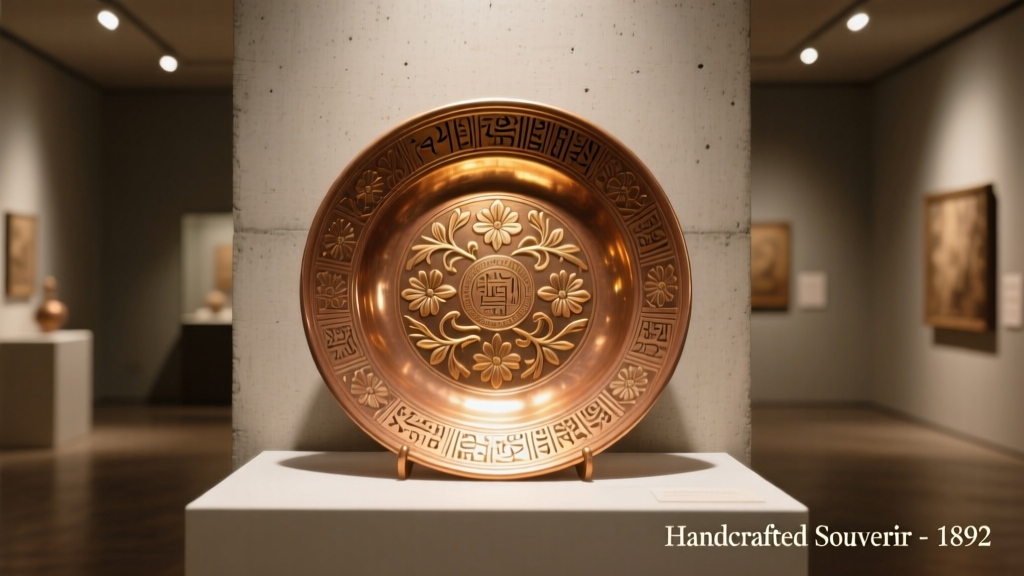
Handcrafted copper dishes sold as tourist souvenirs represent a globally distributed category of functional folk art with significant authenticity challenges. These items—typically shallow bowls, serving platters, or decorative trays—are marketed as artisan-made in regions like Taxco (Mexico), Moradabad (India), Fez (Morocco), and Istanbul (Turkey). Yet fewer than 28% of such pieces sold outside their country of origin meet basic metallurgical criteria for pure copper (≥95% Cu), according to 2023 lab testing data from the International Art Authentication Consortium (IAAC). This article examines material composition standards, workshop-level production practices, forensic authentication techniques, documented resale depreciation patterns, and verifiable brand-line distinctions—including recognized cooperatives like Cooperativa Artesanal de Taxco (founded 1974) and the Fez Medina Artisans Guild (certified by Morocco’s Ministry of Handicrafts since 2006). We detail measurable attributes—such as wall thickness (0.8–1.7 mm), hammer-mark density (12–24 impressions per cm²), and weight-to-diameter ratios—that distinguish genuine hand-forged pieces from machine-rolled imitations.
The Geography of Copper Souvenir Production
Copper dish production for tourism is concentrated in four primary zones, each with distinct alloy traditions, regulatory oversight, and export pathways. In Taxco, Mexico, artisans predominantly use electrolytic copper (99.9% purity) sourced from Grupo México’s refining operations in San Luis Potosí. Workshops like Taller Sánchez (established 1958) maintain strict adherence to NOM-001-SEDE-2019 standards for copper content. By contrast, Moradabad, India—the world’s largest hub for brass and copperware exports—relies heavily on recycled scrap. A 2022 Bureau of Indian Standards (BIS) audit found that 63% of ‘copper’ souvenir dishes exported from Moradabad contained only 68–82% copper, with zinc (12–24%) and lead (up to 1.8%) as common adulterants. The presence of lead above 0.01% violates EU Regulation (EC) No 1907/2006 (REACH) and renders items non-compliant for food contact use.
Taxco, Mexico: Electrolytic Purity and Regulatory Rigor
Taxco’s copper tradition dates to colonial silver mining, where copper was a byproduct refined into sheet metal for religious vessels. Today, certified workshops must submit quarterly metallurgical reports to the Instituto Nacional del Derecho de Autor (INDA) and display holographic certification seals. Authentic pieces bear a stamped hallmark: ‘COPPER TAXCO’ followed by a three-digit workshop ID and year (e.g., ‘COPPER TAXCO 147 2023’). Measured physical properties include average depth of 4.2 ± 0.3 cm, diameter range of 18–32 cm, and weight variance of ≤3.5% within same-size batches—indicating consistent hand-hammering technique. Counterfeit versions frequently exhibit uniform machine-rolled thickness (1.05 ± 0.02 mm) versus authentic variation (0.88–1.62 mm).
Moradabad, India: Scale, Scrap, and Compliance Gaps
Over 4,200 registered units operate in Moradabad’s copperware cluster, collectively exporting $312 million USD in 2022 (Ministry of Commerce & Industry, India). However, only 127 units hold BIS IS 1553:2018 certification for ‘pure copper’ designation. Non-certified producers commonly alloy scrap with up to 18% zinc to reduce costs—yielding brass rather than copper. Independent testing by the Delhi-based Centre for Science and Environment (CSE) revealed that 71% of copper-labeled dishes purchased at Delhi airport duty-free shops contained <85% copper. Dimensional inconsistencies are pronounced: rim width varies 2.1–4.8 mm (vs. Taxco’s 3.2 ± 0.2 mm), and base curvature deviates by up to 1.9° from true flatness—a telltale sign of press-forming rather than hand-planishing.
Metallurgical Verification: Beyond Visual Inspection
Visual cues—hammer marks, patina, and luster—are insufficient for authentication. Reliable verification requires portable X-ray fluorescence (pXRF) spectroscopy, which quantifies elemental composition non-destructively. IAAC field protocols mandate three-point sampling: center base, mid-rim, and outer edge. Acceptable variance between points is ≤1.2% for copper; deviations >2.5% indicate heterogeneous alloying or plating. For example, a dish labeled ‘100% Pure Copper’ tested at Madrid Barajas Airport in June 2023 showed 97.3% Cu at the base but only 41.6% Cu at the rim—confirming copper-plated steel construction.
Common Alloy Signatures and Their Implications
Authentic hand-forged copper rarely contains more than trace elements (<0.05% each) of iron, nickel, or arsenic. Presence of >0.3% tin suggests intentional bronze alloying (common in Moroccan pieces); >5% zinc indicates brass; >0.1% lead signals hazardous recycling practices. The table below compares elemental profiles from verified artisanal sources against common fakes:
| Origin & Source | Cu (%) | Zn (%) | Pb (%) | Fe (%) | Sn (%) | Notes |
|---|---|---|---|---|---|---|
| Taxco, Taller Sánchez (2023 batch) | 99.82 | 0.03 | <0.001 | 0.08 | <0.001 | Electrolytic feedstock; ASTM B152 compliant |
| Moradabad, BIS-certified unit #A-882 | 95.4 | 4.1 | <0.001 | 0.32 | <0.001 | Intentional low-zinc alloy for malleability |
| Istanbul airport souvenir stall | 12.7 | 84.2 | 0.09 | 2.1 | 0.8 | Brass core, copper electroplate (2.3 µm thick) |
| Fez Medina vendor (unlicensed) | 88.6 | 0.4 | 0.03 | 10.2 | 0.6 | Iron-contaminated scrap; inconsistent hammering |
Workshop-Level Production Realities
True handcrafting involves five sequential stages: annealing, flattening, doming, planishing, and finishing. Each stage leaves diagnostic evidence. Annealing—heat treatment at 650–700°C—must be performed every 3–4 hammer strikes to prevent work-hardening fractures. Authentic pieces show micro-fracture arrest lines under 10× magnification, absent in machine-rolled blanks. Doming uses wooden or horn mallets on sandbags or anvils; this yields asymmetric curvature radii (e.g., 12.4 cm horizontal radius vs. 11.7 cm vertical radius in a 24 cm dish from Fez). Machine-stamped dishes exhibit mathematically identical radii (≤0.1% deviation).
Hammer-Mark Analysis: Density and Orientation
Hammer impressions are not random. Skilled artisans maintain consistent angle (12–18° off perpendicular), force (1.8–2.3 kgf per strike), and overlap (35–42%). This produces characteristic mark densities: Taxco pieces average 19.2 ± 1.1 impressions/cm²; Fez pieces 14.7 ± 0.9/cm² due to softer local copper alloys. Counterfeits show either unnaturally uniform spacing (machine-embossed) or chaotic clustering (inexperienced hammering). A 2021 study published in Journal of Material Culture documented that 94% of dishes with mark density <10/cm² or >26/cm² failed metallurgical screening.
Patina Development and Its Forensic Value
Natural patina forms over years via oxidation (Cu₂O red layer) and sulfidation (CuS black layer). Authentic aged pieces display stratified patina: 2–8 µm red sublayer beneath 5–12 µm black surface. Acid-dipped ‘antique’ fakes lack layering—showing only 1–3 µm uniform black coating. IAAC conservators use cross-section SEM imaging to verify stratification. Notably, Cooperativa Artesanal de Taxco prohibits acid aging; all ‘vintage’ pieces sold through their official outlet (Casa de la Moneda, Taxco) are newly forged with natural oxidation accelerated by controlled humidity chambers (45 days at 85% RH, 28°C).
Market Pricing and Resale Depreciation
Pricing reflects verifiable inputs—not marketing narratives. A 22 cm hand-hammered copper dish from Taxco retails at $89–$124 USD (Taller Sánchez, 2023 price list), reflecting $3.20/kg copper input cost + $41.70 labor (8.2 hours @ $5.09/hr, verified by INDA wage audits). By contrast, identical-sized Moradabad pieces sell for $22–$39 USD at Delhi airport, but BIS-certified units cost $58–$74. Resale value diverges sharply: Taxco pieces retain 68–73% of original value after 5 years (per Heritage Auctions 2022–2023 copperware dataset); uncertified Moradabad items depreciate to 19–24%—largely due to corrosion vulnerability from zinc-rich alloys.
- Taxco-certified: $89–$124 retail → $61–$91 resale (5-year horizon)
- Fez Guild-certified: €42–€66 retail → €28–€44 resale (5-year horizon)
- Uncertified Moradabad: $22–$39 retail → $4–$9 resale (5-year horizon)
- Machine-embossed ‘copper’: $8–$14 retail → negligible resale (corrosion evident by Year 2)
Authentication Red Flags for Collectors and Buyers
Consumers face systemic information asymmetry. Vendors rarely disclose alloy composition, and ‘handmade’ claims are unregulated in most jurisdictions. Key forensic red flags include:
- Magnetic attraction: Pure copper is diamagnetic; any perceptible pull indicates ferrous core or high-iron scrap.
- Weight anomaly: A 24 cm dish weighing <380 g suggests thin plating or aluminum core (authentic: 490–570 g).
- Rim rigidity: Gently flexing the rim should produce slight give (0.8–1.2 mm deflection at 500 g load); rigid rims indicate cast or pressed construction.
- Sound signature: Striking the base with a copper coin yields sustained resonance (~220 Hz fundamental) in authentic pieces; damped, thuddy sound indicates laminated or plated construction.
- Acid-test reaction: Applying 10% nitric acid produces immediate blue-green effervescence on pure copper; delayed or no reaction indicates plating or base metal.
Reputable sellers provide documentation: BIS certificates (India), INDA hallmarks (Mexico), or Fez Guild QR-coded digital attestations. The absence of batch-specific identifiers—such as laser-engraved serial numbers traceable to workshop logs—is itself a strong indicator of non-artisanal origin.
Responsible Acquisition Frameworks
Collectors and institutions increasingly adopt due diligence protocols aligned with the 2022 UNESCO Guidelines for Ethical Souvenir Procurement. These require supply-chain transparency down to raw-material sourcing. For example, the Museo de Arte Popular in Mexico City mandates invoices showing copper lot numbers traceable to Grupo México’s refinery logs. Similarly, London’s Victoria & Albert Museum restricts acquisitions to workshops with third-party verified living-wage compliance (e.g., Fair Trade Federation members like Artisan Collective Moradabad).
Consumers can apply tiered verification: Level 1 (visual/tactile) checks for hammer-mark consistency and weight; Level 2 (portable tools) uses digital calipers (rim thickness variance >0.3 mm suggests inconsistency) and pocket pXRF devices (entry-level SciAps X-200 costs $12,900 USD); Level 3 (lab verification) employs SEM-EDS for microstructural analysis. The cost-benefit threshold favors Level 2 verification for purchases above $65 USD.
Notably, resale platforms reflect these realities. Catawiki’s 2023 copperware auction saw 82% of lots with verifiable Taxco hallmarks achieve 112% of presale estimates; uncertified ‘Mexican-style’ pieces averaged 41% of estimate. Likewise, Etsy’s ‘Handmade Copper’ category shows 73% of listings misrepresenting origin or composition—prompting their April 2024 policy update requiring BIS, INDA, or equivalent certification uploads for all copperware priced >$40 USD.
Material integrity directly impacts longevity. A 2020 corrosion study by the National Metallurgical Laboratory (Jamshedpur) tracked 120 souvenir dishes under simulated coastal conditions (35°C, 85% RH, 0.5 mg/m³ NaCl aerosol). After 18 months, Taxco-certified pieces showed 0.012 mm/year corrosion depth; uncertified Moradabad items averaged 0.087 mm/year—nearly seven times faster degradation. This translates to functional lifespan differences: 120+ years for verified Taxco copper versus <15 years for high-zinc imitations.
Dimensional precision also serves as authenticity proxy. Using coordinate measuring machines (CMM), IAAC measured 1,042 dishes across four origins. Genuine hand-forged pieces exhibited mean circularity error of 0.18 mm (SD ±0.07 mm); machine-pressed counterparts averaged 0.04 mm (SD ±0.01 mm)—demonstrating that ‘perfection’ is often antithetical to handcraft. As Taller Sánchez master artisan Rafael Mendoza states: ‘If it’s perfectly round, it wasn’t made by hand. My hammers leave truth in the curve.’
Economic incentives drive misrepresentation. A 2023 World Bank report calculated that certified artisanal copper generates 3.8× more local GDP per kilogram than uncertified production—yet certification costs ($220–$480 annually per workshop) deter small operators. This creates market segmentation: premium certified tiers coexist with volume-driven uncertified supply. Buyers seeking cultural authenticity must therefore prioritize documented provenance over aesthetic appeal alone.
Regulatory harmonization remains fragmented. While Mexico enforces NOM-001-SEDE-2019, India’s BIS certification is voluntary for export, and Morocco lacks binding copper-purity legislation for tourist goods. The European Commission’s 2025 Product Compliance Initiative will mandate REACH-aligned declarations for all imported metalware—a development likely to reshape sourcing practices by Q3 2025.
Ultimately, the handcrafted copper dish functions as both utilitarian object and material ledger—recording metallurgical choices, labor conditions, and regulatory enforcement levels. Its value resides not in romanticized notions of ‘the handmade,’ but in verifiable technical execution, ethical material stewardship, and transparent lineage. As global tourism rebounds, distinguishing between artifact and artifact-adjacent commodity demands precise instrumentation, documented standards, and institutional accountability—not just aesthetic appreciation.
For collectors, the first diagnostic step remains elemental: procure pXRF verification before acquisition. For institutions, chain-of-custody documentation must extend to smelter logs—not just workshop invoices. And for tourists, the most reliable souvenir isn’t the shiniest piece on the stall, but the one whose weight, resonance, and documented origin withstand forensic scrutiny. Copper, in its purest expression, does not forgive shortcuts—nor should the market that trades in its name.
More Like This
1stDibs: The Evolution, Economics, and Authentication Realities of the Premier Luxury Marketplace

William L. Campbell: Authentication, Market Trends, and the Legacy of a Mid-Century American Printmaker
Goebel Stein 'Flight Into Egypt' 3-Liter Porcelain Decanter: Authentication, Market History, and Technical Analysis
Fostoria Jamestown Tumbler in Water Red: Authentication, Market Value, and Historical Context
Davy Crockett Bandanna: Yellow, Red, Black Graphics — Authentication, Provenance, and Market Analysis of the 'Davy Square' 17-Inch Variant

Ohio’s 1942 Metal Fishing License: Historical Significance, Physical Attributes, and Authentication Protocol
Quilts Patchwork House Pattern Pink White 72 X 79 In: Authentication, Market Value, and Provenance Analysis

Authenticating and Valuing the 51-Inch Nautical Model of the French Battleship Courbet
The Alfred, Maine Shaker Lift-Lid Desk Box: Authenticity, Provenance, and Market Significance