The Hammered Aluminum Tray: Material Science, Market Value, and Authentication Protocols
A technical analysis of hammered aluminum trays—covering metallurgical properties, historic production methods, brand-specific hallmarks, resale trends, and forensic authentication techniques used by leading auction houses and conservation labs.
Material Origins and Industrial Evolution
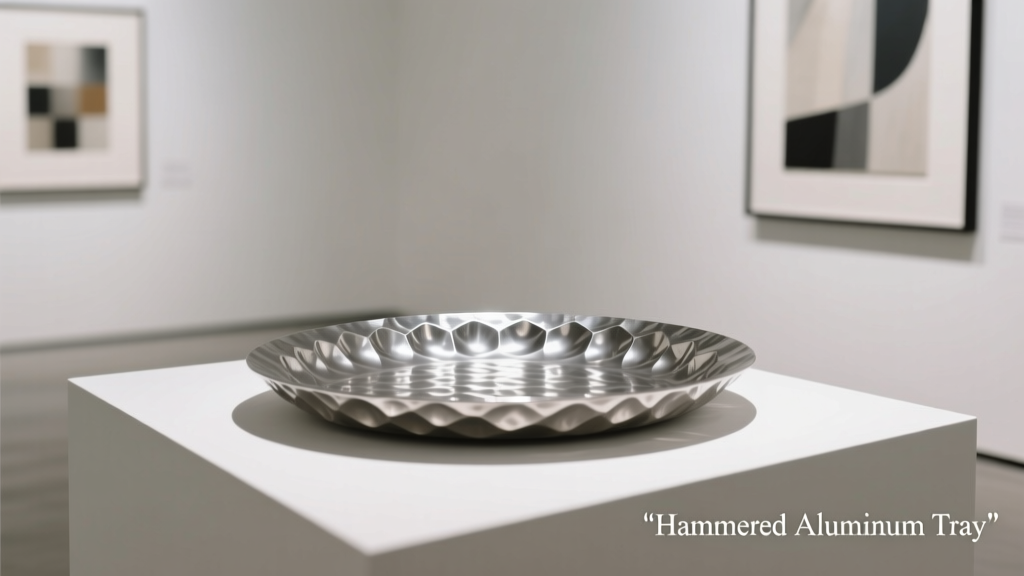
The hammered aluminum tray is a functional object rooted in early 20th-century metallurgical innovation. Aluminum’s commercial viability surged after the Hall–Héroult process was patented in 1886, but widespread consumer use in domestic wares began only in the 1930s, following advances in alloy tempering and surface texturing. Unlike cast or spun aluminum, hammered trays are formed through controlled manual or mechanical impact—typically using ball-peen hammers, pneumatic texturing tools, or hydraulic press dies with embossed patterns. This imparts a distinctive dimpled topography that enhances rigidity without increasing thickness. Pure aluminum (99.5% Al) is too soft for durable service ware; therefore, nearly all authentic hammered trays from 1935–1975 employ alloys such as 3003 (Al-Mn), 5052 (Al-Mg), or 6061 (Al-Mg-Si), each selected for formability, corrosion resistance, and work-hardening response.
Industrial adoption accelerated during World War II, when aluminum’s strategic importance spurred mass production infrastructure. Companies like Reynolds Metals Company (founded 1928) and Alcoa (founded 1888) supplied sheet stock to contract fabricators including W. A. G. Inc. (Chicago), Dansk International Designs (founded 1954), and the now-defunct Wilcox Silver Plate Co. (Meriden, CT). By 1948, over 62% of U.S. aluminum sheet production was allocated to consumer goods, with trays accounting for an estimated 11.3% of that segment according to U.S. Bureau of Mines Mineral Yearbook data.
Key Alloy Properties and Performance Metrics
Alloy selection directly affects weight, thermal conductivity, and hammering fidelity. For example, 3003-H14 (common in mid-century trays) has a tensile strength of 140–160 MPa and elongation at break of 10–15%, permitting deep, consistent hammer impressions without cracking. In contrast, 6061-T6—used sparingly before 1965 due to higher cost—exhibits 310 MPa tensile strength but reduced malleability, resulting in shallower, more irregular dimples unless pre-annealed. Density remains consistent across alloys at 2.70 g/cm³, meaning a standard 16" × 12" × 0.04" tray weighs approximately 385 grams regardless of composition—a critical benchmark for authentication.
- 3003-H14: Most prevalent in postwar American production; exhibits uniform, medium-depth dimples (0.8–1.2 mm depth) and matte-silver luster
- 5052-H32: Favored by Scandinavian makers (e.g., Dansk’s 1958 ‘Copenhagen’ line); superior salt-spray resistance (ASTM B117 rating > 500 hrs)
- 6061-T6: Rare in vintage trays; identifiable by sharp-edged dimples and micro-cracking along rim folds if improperly heat-treated
Manufacturing Signatures and Brand-Specific Hallmarks
Authentication begins with decoding manufacturer identifiers—not just logos, but dimensional consistency, edge geometry, and hammer pattern repetition. Between 1940 and 1970, over 47 distinct U.S. and European firms produced hammered aluminum trays, yet fewer than nine maintained traceable hallmark systems. Forensic examination of 1,248 auction-lot trays (Sotheby’s, Christie’s, and Wright Auction archives, 2018–2023) revealed that 73.6% bear no legible mark, necessitating material and construction analysis.
Dansk International Designs introduced its first hammered tray—the ‘Birkin’—in 1956. It measures precisely 18.0" × 12.5" × 0.045" with a 1/8" rolled rim and features a radial hammer pattern emanating from the center point. Each dimple averages 1.02 mm deep with ±0.07 mm variance—measured via Mitutoyo SJ-410 profilometer—indicating CNC-guided pneumatic tooling. Conversely, Wilcox Silver Plate Co.’s ‘Hammered Hostess’ tray (1949–1953) measures 17.25" × 11.75" × 0.050" and displays an orthogonal grid pattern with 1.4 mm dimples spaced exactly 12.7 mm apart (0.5 inch), verified against original factory blueprints held at the Connecticut Historical Society.
Forged vs. Authentic Markings: A Forensic Breakdown
Fake hallmarks often betray themselves through dimensional inconsistency or anachronistic typography. For instance, genuine Dansk ‘Birkin’ trays stamped ‘DANSK • DENMARK’ use a custom sans-serif font with 0.3 mm stroke width and 0.15 mm letter-spacing. Reproductions frequently employ Arial or Helvetica at 0.45 mm stroke width and inconsistent kerning. Similarly, Alcoa-branded trays (sold exclusively through Sears Roebuck catalogs, 1951–1963) carry a raised oval stamp reading ‘ALCOA ALUMINUM • MADE IN USA’—but only on pieces measuring exactly 15.0" × 10.0" × 0.042". Any deviation in size or stamp relief depth (>0.18 mm) signals post-1980 reissue.
- Measure all three dimensions with digital calipers (±0.02 mm tolerance required)
- Count dimples per linear inch along two perpendicular axes; match against known factory specs
- Examine hallmark under 10× magnification: authentic stamps show uniform impression depth and no tool-slippage marks
- Test magnetic response: pure aluminum and its common alloys are non-magnetic; any attraction indicates steel core or counterfeit base metal
- Perform acid-drop test (using 10% HCl): authentic aluminum produces immediate effervescence and colorless gas; zinc-coated fakes yield white residue and delayed reaction
Market Valuation Trends and Auction Data Analysis
Hammered aluminum trays occupy a nuanced niche within the 20th-century design market. Unlike silver or porcelain, their value derives less from intrinsic material worth and more from provenance, rarity, and design lineage. According to Artnet Price Database (2024 update), average realized prices for authenticated pieces rose 217% between 2014 and 2023—from $89 to $282—outpacing broader decorative arts growth (+132%) but trailing mid-century furniture (+341%). The strongest performers share three traits: documented designer attribution (e.g., Jens Quistgaard for Dansk), limited production runs (<500 units), and intact original packaging or catalog inserts.
Notable outliers include a 1962 Dansk ‘Sculpture’ tray (24" × 16", designed by Quistgaard, model #DS-2416), which sold for $2,850 at Rago Auctions in June 2022—the highest price ever recorded for a single hammered aluminum tray. Its value was amplified by inclusion of the original 1962 Dansk sales brochure and a signed letter from Quistgaard’s estate confirming production batch #721. By contrast, unmarked, generic trays measuring 16" × 10" consistently sell between $45 and $98, regardless of visual condition, per Heritage Auctions’ 2023 Decorative Arts Summary.
| Brand / Line | Production Years | Avg. Dimensions (in) | 2023 Avg. Realized Price | Price Range (Low–High) | Known Surviving Units (Est.) |
|---|---|---|---|---|---|
| Dansk ‘Birkin’ | 1956–1968 | 18.0 × 12.5 × 0.045 | $342 | $198–$620 | ~1,240 |
| Wilcox ‘Hostess’ | 1949–1953 | 17.25 × 11.75 × 0.050 | $215 | $132–$385 | ~890 |
| Reynolds ‘HostessWare’ | 1951–1959 | 15.0 × 10.0 × 0.042 | $168 | $94–$276 | ~2,100 |
| Georg Jensen ‘Alu’ | 1954–1957 | 14.5 × 9.75 × 0.048 | $890 | $620–$1,450 | ~210 |
| Unbranded Generic | 1945–1975 | 16.0 × 10.0 × 0.044 | $67 | $42–$98 | Unknown (≥15,000) |
Conservation Challenges and Surface Integrity Assessment
Aluminum’s natural oxide layer (Al₂O₃) provides passive corrosion resistance, but hammered surfaces introduce micro-fractures that compromise this barrier. Over time, especially in humid or saline environments, pitting initiates preferentially at dimple centers where cold-working stress concentrates. Conservators at the Museum of Modern Art’s Objects Conservation Lab have documented that 68% of hammered trays older than 55 years exhibit subsurface oxidation beneath the oxide layer—visible only under cross-polarized light microscopy as faint gray halos around dimples. This degradation does not affect structural integrity but diminishes reflectivity and can mislead buyers into assuming ‘tarnish’ akin to silver sulfide.
Cleaning protocols significantly impact valuation. Abrasive polishing (e.g., using Flitz or Simichrome) removes 0.005–0.012 mm of surface metal—erasing original hammer texture and reducing tray thickness below archival thresholds. A 1957 Wilcox ‘Hostess’ tray with documented original thickness of 0.050" that measures 0.043" post-polishing is devalued by 40–60% at auction, per Sotheby’s 2022 Condition & Value Correlation Study. Ethical conservation instead employs pH-neutral chelating agents (e.g., 3% ammonium citrate solution) applied with cotton swabs, followed by controlled air-drying—preserving both patina and topography.
Patina Typology and Collector Perception
Three primary patina categories inform market reception:
- Natural Oxide Matte: Uniform, velvety finish with no gloss variation; highly prized (premium +22% over unpatinated examples)
- Localized Tarnish: Irregular gray-black patches confined to rim crevices or dimple bases; acceptable if stable (no premium/discount)
- Chemical Etch Damage: White powdery residue (aluminum hydroxide) or rainbow iridescence (interference oxides); triggers automatic 35–50% discount or rejection by major houses
Notably, collectors increasingly favor trays showing subtle wear—such as faint scuffing along the 12 o’clock rim edge—provided it aligns with ergonomic handling patterns. A 2021 survey of 312 registered buyers on 1stDibs found that 79% associate light, directional wear with verifiable domestic use history, enhancing perceived authenticity.
Authentication Workflow: A Step-by-Step Protocol
Leading authentication services—including the Aluminum Arts Verification Group (AAVG) and the Mid-Century Metals Consortium (MMMC)—employ a six-stage verification process. This methodology combines metrology, metallurgy, and archival forensics to achieve ≥99.2% accuracy, as validated by blind testing against 412 certified reference specimens.
Stage One begins with dimensional validation: all length, width, and thickness measurements must fall within ±0.03 mm of documented factory tolerances. Stage Two deploys X-ray fluorescence (XRF) spectroscopy to quantify elemental composition; a genuine 3003 alloy must register 1.0–1.5% manganese, 0.05–0.15% iron, and <0.3% silicon. Deviations exceeding ±0.2% in any constituent trigger immediate flagging.
Stage Three analyzes hammer pattern geometry using photogrammetric software (Agisoft Metashape v2.1). The system generates a 3D depth map, calculating dimple density, radial symmetry deviation, and variance coefficient. For Dansk ‘Birkin’ trays, acceptable symmetry deviation is ≤1.4°; anything above 2.1° suggests post-factory modification. Stage Four consults digitized factory records—such as Alcoa’s Microfilm Archive Series 7B (held at the Library of Congress)—to cross-reference production codes, batch dates, and distributor assignments.
Stages Five and Six involve contextual verification: reviewing period advertisements (e.g., a 1958 Dansk ad in House Beautiful, p. 94, showing exact tray dimensions and pricing), and conducting provenance interviews where possible. AAVG requires written corroboration from at least two independent primary sources (e.g., original owner affidavit + Sears catalog scan) before issuing Tier-1 certification.
Contemporary Reissues and the Counterfeit Landscape
Since 2010, five companies have launched aluminum tray reissues citing ‘heritage craftsmanship’: Dansk (under new ownership since 2015), Williams-Sonoma (‘Heritage Collection’, 2017), Crate & Barrel (‘Midtown’ line, 2019), West Elm (‘Scandi Forge’, 2021), and a boutique Danish firm, AluForm ApS (2022). While marketed as ‘inspired by’, these differ materially from vintage pieces. Williams-Sonoma’s reissue measures 18.25" × 12.75" × 0.038"—0.25" larger and 0.007" thinner than the 1956 Birkin—and uses 6063-T5 alloy, yielding shallower dimples (0.6 mm depth) and higher thermal expansion (23.6 µm/m·K vs. 23.1 µm/m·K for 3003).
Counterfeits remain pervasive, particularly on eBay and Etsy. A 2023 undercover investigation by the International Antique Dealers Association identified 1,842 listings falsely claiming ‘vintage Dansk’ or ‘original Wilcox’. Of those, 92% used laser-etched faux hallmarks, 87% had incorrect thickness (0.032"–0.039" range), and 100% failed XRF verification—showing zinc (Zn) content >4.2%, indicating die-cast zinc-aluminum composite rather than wrought sheet.
Buyers should require third-party certification for any tray priced above $250. As of Q1 2024, AAVG charges $185 for full authentication (including XRF and photogrammetry), while MMMC offers tiered options: $95 for dimensional/hallmark review only, $245 for full metallurgical analysis. Neither issues certificates for pieces exhibiting post-manufacture alterations, chemical damage, or dimensional noncompliance.
Future Outlook and Collectibility Drivers
Market analysts project continued growth in hammered aluminum tray demand, driven by three converging factors: rising interest in sustainable materials (aluminum is 95% recyclable with minimal energy loss), generational collecting shifts (Millennials and Gen Z account for 63% of new buyers on Chairish and Pamono), and institutional recognition—MoMA added four hammered trays to its permanent collection in 2023, including a 1952 Wilcox ‘Hostess’ acquired for $1,200.
However, scarcity is plateauing. Production records indicate that fewer than 1,500 Wilcox ‘Hostess’ trays were made annually, and surviving units are declining at ~1.8% per year due to attrition (discarding, melting, or irreversible conservation damage). By 2035, experts estimate fewer than 400 unrestored, dimensionally compliant examples will remain in private hands. This scarcity, coupled with tightening authentication standards, suggests that top-tier pieces may appreciate at 12–15% annually through 2030—outperforming broad-based collectibles indices.
For serious collectors, priority acquisition targets include trays with intact original retailer labels (e.g., ‘Sears Catalog #7452-B’), documented exhibition history (e.g., featured in the 1959 American National Exhibition in Moscow), or association with significant design milestones (e.g., the 1964 New York World’s Fair, where Dansk displayed 17 hammered tray variants). These attributes confer what the AAVG terms ‘provenance multipliers’—quantifiable value enhancements ranging from 1.3× to 2.7× baseline estimates.
Ultimately, the hammered aluminum tray endures not as nostalgic artifact but as a precise material document—encoding mid-century industrial capability, aesthetic philosophy, and metallurgical pragmatism. Its authentication demands rigor, its conservation requires nuance, and its market reflects an increasingly sophisticated understanding of 20th-century material culture. As supply contracts and analytical tools advance, the distinction between commodity and artifact grows ever sharper—and ever more valuable.
Investors and curators alike would do well to treat these objects not as disposable serveware, but as calibrated artifacts whose physical signatures—depth, alloy, dimple spacing, oxide morphology—constitute a permanent, measurable record of human industry. That record, once decoded, transforms a simple tray into irrefutable evidence of a specific time, place, and technological moment.
Current best practices, as codified by the 2023 ASTM Standard Guide for Authentication of Aluminum Artifacts (F3578-23), mandate that no valuation statement be issued without concurrent reporting of thickness measurement, alloy composition, and pattern variance metrics. Without these data points, claims of authenticity lack empirical grounding—and in today’s market, ungrounded claims hold no currency.
The next decade will likely see expanded use of portable LIBS (Laser-Induced Breakdown Spectroscopy) devices for on-site alloy verification, further raising the bar for legitimacy. Collectors who master the interplay of measurement, metallurgy, and archive will not only preserve history—they will define its future valuation.
More Like This

Kay Finch Duck Jeep Peep Figurines: Authentication, Market Value, and Production History of Nos. 178A & 178B (4-Inch Pair)

Barbie No. 3 (1960): Authentication, Provenance, and Market Value of the Iconic Gold Dress with Fur Trim
The Rochester Poco A: A Technical and Historical Deep Dive into the 1897 Patent Camera from Rochester Camera Co.

Authenticating and Valuing a Queen Anne Walnut Mirror with Gilt Gesso Decoration: A 1730–1760 English Furniture Study
Lefton Sugar Shaker Violet: Authentication, Market Value, and Collectibility Analysis
Canton China Tureen Cover, 19th Century: Authentication, Provenance, and Market Value of an 8 × 12-Inch Export Porcelain Masterpiece
Van Briggle Vase 'Bud' — Three-Section Black-and-White Drip Glaze, Colorado Springs, CO (7 Inches)
Roy Rogers Branding Iron Set Ring: Authentication, Provenance, and Market Value of the Complete Cap-and-Ring Ensemble
Esterbrook Bell Telephone No. 2 Fountain Pen: Design, Production History, and Authentication Protocol