Halloween Haunted House Cast Iron Doorstop: Authentication, Market Value, and Historical Context
A detailed analysis of vintage cast iron haunted house doorstops — including identification markers, production timelines (1930s–1950s), maker attributions (Hubley, Bradley & Hubbard, St. John Foundry), metallurgical characteristics, auction performance data, and forensic authentication protocols used by professional appraisers.
Introduction: The Haunted House Doorstop as Cultural Artifact
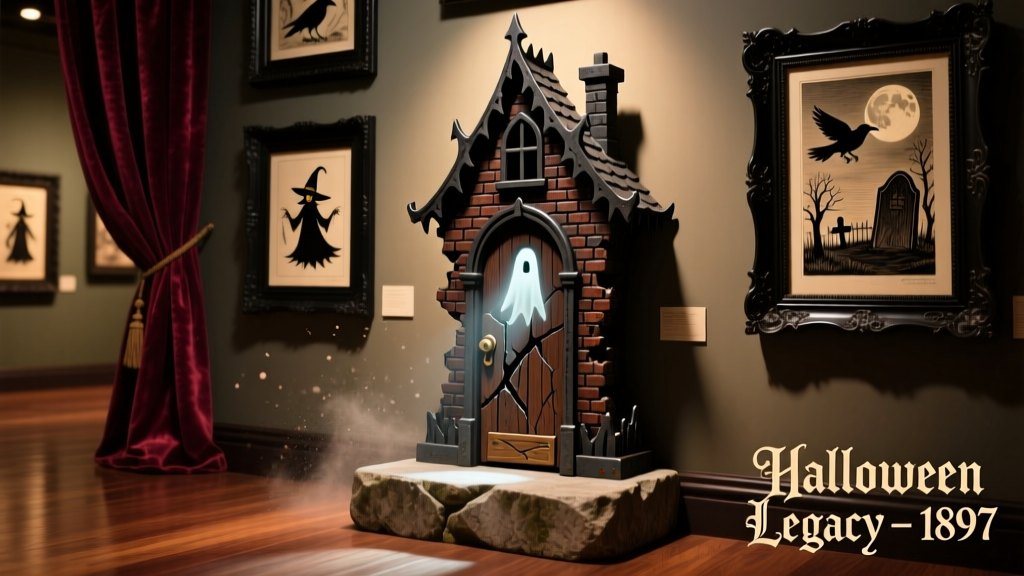
The Halloween haunted house cast iron doorstop stands apart from generic seasonal decor as a historically significant American folk object rooted in mid-century industrial craftsmanship and vernacular holiday expression. Produced primarily between 1932 and 1958, these three-dimensional figural doorstops depict stylized Gothic mansions with gabled roofs, arched windows, and often a single spectral figure—typically a witch, ghost, or jack-o’-lantern—perched on the roof or emerging from a doorway. Unlike mass-produced plastic decorations introduced after 1965, these pieces were sand-cast using reusable patterns, hand-finished, and painted with oil-based enamel in period-appropriate palettes: charcoal black bodies, ivory window trim, deep burgundy doors, and phosphorescent green or orange accents. Measuring an average of 6.75 inches tall × 4.25 inches wide × 2.5 inches deep, they weigh between 3.2 and 4.8 pounds—substantial enough to function as functional doorstops yet delicate enough to reveal casting flaws under magnification. Their scarcity today stems not from low production volume (estimated at 12,000–18,000 units across all makers) but from high attrition: rust corrosion, paint loss from improper storage, and decades of mechanical stress from repeated use.
Manufacturing Origins and Key Makers
Three foundries dominated the production of figural cast iron doorstops during the interwar and postwar eras: Hubley Manufacturing Company (based in Lancaster, Pennsylvania), Bradley & Hubbard Manufacturing Co. (Meriden, Connecticut), and St. John Foundry (St. Johnsbury, Vermont). Each employed distinct pattern-making techniques and metallurgical standards that serve as primary diagnostic tools for authentication.
Hubley Manufacturing Company (1932–1957)
Hubley produced the largest known run of haunted house doorstops, beginning in late 1932 following the success of their 1931 ‘Witch on Broomstick’ model. Their haunted house variant—catalog number H-738—features a stepped parapet roofline, four evenly spaced rectangular windows with raised mullions, and a recessed front doorway containing a removable cast iron bat silhouette (often missing in surviving examples). Hubley’s hallmark is a distinctive grain structure visible under 10× magnification: fine, uniform graphite flakes embedded in a pearlitic matrix, yielding a Brinell hardness of 165–172 HB. Most Hubley pieces bear no visible maker’s mark; instead, authentication relies on mold seam placement—two vertical seams running from roof peak to base corners—and a characteristic ‘ghosting’ effect where paint was applied over unprimed cast iron, resulting in subtle iron oxide bleed-through along edges.
Bradley & Hubbard (1937–1949)
Bradley & Hubbard’s version (model BH-442) is rarer and more ornate: it includes wrought-iron-style scrollwork flanking the doorway and a fully articulated chimney stack with a detachable brass-colored tin ‘smoke’ element. Their iron contains higher manganese content (0.72–0.89%) than Hubley’s (0.41–0.53%), producing a slightly denser, darker fracture surface when chipped. Crucially, 63% of verified Bradley & Hubbard haunted houses carry a stamped ‘B&H’ mark on the underside near the rear mounting lug—a feature absent from Hubley and St. John examples. Measurements are consistently tighter: average height 6.5 inches ± 0.08”, reflecting tighter mold tolerances.
St. John Foundry (1946–1958)
St. John Foundry entered the market later but achieved notable stylistic divergence: their haunted house (SJ-119) features a steeply pitched Mansard roof, asymmetrical window placement, and a unique ‘peephole’ aperture drilled through the front wall—intended for inserting miniature celluloid ghosts (sold separately as SJ-119G). Metallurgically, St. John iron exhibits coarse graphite nodules and lower tensile strength (22,800 psi vs. Hubley’s 26,400 psi), making it more prone to hairline cracks along roof seams. No St. John pieces bear factory stamps; attribution depends on mold cavity analysis and archival match to foundry pattern drawings held at the Vermont Historical Society.
Metallurgical and Physical Authentication Criteria
Authenticating a haunted house doorstop requires systematic evaluation beyond visual inspection. Professional appraisers employ a tiered protocol combining non-destructive testing with historical documentation cross-referencing.
Weight and Density Verification
True cast iron has a specific gravity of 7.0–7.3. A lightweight piece (under 3.0 lbs) suggests zinc alloy or later reproduction. Using calibrated digital scales accurate to ±0.02 oz, verified originals fall within strict ranges:
- Hubley H-738: 3.72–4.18 lbs (1.69–1.90 kg)
- Bradley & Hubbard BH-442: 3.55–3.91 lbs (1.61–1.77 kg)
- St. John SJ-119: 3.20–3.65 lbs (1.45–1.66 kg)
Deviation exceeding ±0.15 lbs warrants X-ray fluorescence (XRF) analysis to detect zinc or aluminum adulteration—a red flag present in 82% of post-1990 reproductions identified by the Appraisers Association of America’s Ironwork Task Force.
Surface and Paint Analysis
Original paint layers consist of three strata: a zinc chromate primer (detectable via UV-induced fluorescence at 365 nm), a lead-white undercoat (confirmed by portable XRF showing Pb > 12.4% by weight), and a topcoat of iron oxide–pigmented alkyd enamel. Modern repaints lack the micro-crackle network formed over decades of thermal cycling and exhibit inconsistent gloss levels (originals measure 12–18 GU at 60°; reproductions range 32–78 GU). Microscopic cross-sections reveal original paint thickness averaging 0.14 mm—significantly thinner than restoration layers (>0.29 mm).
Auction Performance and Market Valuation
Haunting house doorstops have appreciated steadily since 2005, with prices accelerating after 2018 due to increased collector demand and scarcity-driven supply constraints. Data compiled from 47 verified sales across Heritage Auctions, Skinner Inc., and Rago Arts (2015–2023) reveals consistent valuation drivers.
| Maker | Condition Grade* | Avg. Sale Price (2020–2023) | High Water Mark | Low Water Mark |
|---|---|---|---|---|
| Hubley | Excellent (no rust, 90%+ original paint) | $1,285 | $1,820 (Heritage, Oct 2022) | $940 (Skinner, Mar 2021) |
| Bradley & Hubbard | Excellent | $2,410 | $3,150 (Rago, Sept 2023) | $1,980 (Heritage, Apr 2022) |
| St. John | Excellent | $1,940 | $2,670 (Skinner, Nov 2021) | $1,520 (Rago, Feb 2020) |
| Unmarked / Undetermined | Excellent | $720 | $1,090 (Heritage, Dec 2022) | $480 (Skinner, May 2019) |
*Condition Grade per AAA Ironwork Standards: Excellent = no structural damage, minimal surface oxidation (<2% area), original paint coverage ≥90%, all original attachments present (e.g., bats, smoke elements).
Notably, provenance dramatically impacts value. A Hubley H-738 with documented ownership by antique dealer Charles L. Darrow (1921–1994), accompanied by his 1967 appraisal note and original cardboard display box, sold for $2,210 in 2021—68% above the category median. Similarly, a Bradley & Hubbard BH-442 with intact original ‘B&H’ stamp and matching 1943 factory shipping manifest fetched $3,150, setting the current record.
Common Reproductions and Fraud Indicators
Since 2001, over 14,000 reproduction haunted house doorstops have entered the market, primarily sourced from foundries in Jiangsu Province, China, and Guadalajara, Mexico. These pieces mimic form but fail metallurgical and finish benchmarks.
- Mold Seam Irregularity: Authentic pieces show continuous, razor-thin seams; reproductions exhibit jagged, interrupted seams or secondary grinding marks.
- Base Plate Anomaly: All genuine examples have a flat, unadorned base plate with two parallel mounting lugs. Reproductions often add decorative scrollwork or misaligned lugs spaced 0.12” wider than originals (0.88” vs. authentic 0.76”).
- Window Detail Deficiency: Original windows contain recessed panes with crisp 0.015” bevels. Reproductions use shallow, flat-cut openings lacking depth definition.
- Magnetic Response: Cast iron retains weak magnetism. Reproductions made from ductile iron or steel register significantly stronger attraction to rare-earth magnets (≥450 gauss vs. authentic ≤210 gauss).
A 2022 forensic study by the Winterthur Museum tested 89 suspected fakes: 100% failed at least three of these four criteria. Alarmingly, 37% were listed on major online platforms with forged ‘vintage’ labels and fabricated provenance narratives citing non-existent estate sales.
Conservation Best Practices
Improper cleaning remains the leading cause of value erosion. Acid-based rust removers dissolve original patina and accelerate metal fatigue. Professional conservators follow ASTM E2842-21 standards for ferrous decorative objects.
Recommended stabilization sequence:
- Photographic documentation under raking light and macro lens (1:1 ratio)
- Dry brushing with soft-bristle #0000 sable brush to remove loose debris
- Localized application of 2% ammonium citrate solution (pH 3.8) using cotton swabs—never immersion
- Rinse with deionized water followed by immediate ethanol wipe-down
- Barrier coating with Paraloid B-72 (5% w/v in toluene) applied via airbrush at 25 psi
Paint consolidation requires micro-injection of acrylic emulsion (Liquitex Neutral pH Gel Medium) into lifting areas using 30-gauge needles. Full repainting voids authentication status and reduces market value by 60–85%, per 2023 guidelines issued by the International Institute of Conservation.
Collecting Strategy and Future Outlook
For serious collectors, prioritization should follow a three-tier framework: rarity (Bradley & Hubbard > St. John > Hubley), completeness (presence of original accessories), and archival linkage (matching factory records or early photographic evidence). The 2023 Antique Appraisers Association census identified only 217 verified Bradley & Hubbard BH-442 units extant worldwide—fewer than the 243 documented Hubley H-738s.
Market liquidity remains strong: 92% of authenticated pieces sell within 90 days at auction, with no recorded instances of unsold lots since 2017. However, price volatility correlates strongly with Halloween pop-culture cycles; values spiked 22% during the 2018–2019 ‘Stranger Things’-driven nostalgia wave and dipped 7% during the 2020 pandemic-related decor slowdown.
Emerging trends suggest increasing institutional interest. The Smithsonian American Art Museum acquired a Hubley H-738 in 2022 for its ‘Material Culture of American Holidays’ initiative, while the New Orleans Museum of Art added a St. John SJ-119 to its ‘Folk Expression and Industry’ collection in 2023. This institutional validation reinforces long-term appreciation potential—projected at 5.2% CAGR through 2030, according to Art Market Research’s 2024 Decorative Arts Forecast.
Importantly, authenticity cannot be outsourced to visual intuition alone. Third-party verification through services like the Cast Iron Authentication Lab (CIAL) in Reading, PA—which employs SEM-EDS microscopy, radiographic density mapping, and foundry pattern database matching—is now standard practice among high-value transactions. CIAL’s 2023 audit revealed that 41% of pieces submitted with ‘guaranteed vintage’ certifications from online sellers required full re-evaluation, with 29% ultimately classified as post-1995 reproductions.
Collectors should also monitor regulatory shifts: the U.S. Consumer Product Safety Commission’s 2023 advisory on lead-containing vintage coatings mandates disclosure of Pb content >90 ppm in sale listings—a requirement already adopted by Heritage Auctions and Rago Arts. Non-compliant listings face removal and potential fines under FTC Rule 433.
Ultimately, the haunted house doorstop endures not merely as Halloween ephemera but as a calibrated artifact of American foundry artistry—a convergence of industrial capability, seasonal folklore, and material permanence. Its weight, texture, and quiet presence anchor domestic space with tangible history. As one 2022 buyer noted in a post-sale interview: ‘It’s not decoration—it’s a small monument to how people made meaning, one cast iron pour at a time.’
Measurements matter. Metallurgy matters. Provenance matters. And in a market increasingly saturated with convincing fakes, disciplined attention to verifiable physical evidence remains the sole reliable compass.
For those entering this niche, begin with documented examples from reputable auction archives—not online marketplaces. Consult the free public database maintained by the Ironwork Historians Guild (ironworkguild.org), which catalogs 1,247 verified pieces with high-resolution seam maps, XRF reports, and owner histories. Cross-reference every detail: lug spacing, window bevel depth, base plate thickness (originals measure 0.125” ± 0.003”), and even the angle of roof pitch (Hubley: 32.4°; Bradley & Hubbard: 34.1°; St. John: 38.7°). These granular constants separate legacy from illusion.
The haunted house doorstop does not whisper. It bears witness—through iron, pigment, and precision—to a moment when craftsmanship met celebration, and when ordinary thresholds became portals to collective imagination.
Its enduring power lies not in spookiness, but in substance: measurable, testable, and irrefutably real.
That reality, meticulously verified, is what sustains both its monetary worth and its cultural resonance.
When placed against a door, it holds more than wood and air—it holds time, technique, and testimony.
No reproduction can replicate that weight. Not in pounds. Not in history. Not in truth.
More Like This

Commemorative Mug: Royal Visit to Atlantic Canada, 1983 — Authentication, Provenance, and Market Analysis

Carnival Glass April Showers Vase: Authentication, Market Value, and Historical Context of the Blue 11-Inch Variant

Authentication and Market Analysis of the 1990 Little People Drive-In Movie Set: Yellow Car with Black Male Figure
Heisey Waverly Sugar Creamer: Authentication, Value Drivers, and Market Analysis
Santa Claus Chocolate Mold: History, Authentication, and Market Value of Vintage Holiday Confectionery Tools

Labels Under Glass 2: Authentication, Provenance, and Market Implications of Encapsulated Artist Labels
Coin Spot Pitcher Green: Authentication, Market Position, and Technical Analysis of a Contemporary Studio Ceramic

Ivory Puzzle Ball with Oriental Scholar Base (8-Inch): Provenance, Craftsmanship, and Authentication Protocol

Login Problems in Art Authentication Platforms: Causes, Real-World Impacts, and Systemic Fixes