Gutta Percha Photograph Case 'Bee Keeper' — Authentication, Provenance, and Market Analysis of the 1/9th Plate Daguerreotype Housing
A forensic examination of the rare 1850s gutta percha photograph case stamped 'Bee Keeper', designed for 1/9th plate daguerreotypes (measuring 2.25 × 2.75 inches). This article details material composition, maker identification, patent history, condition diagnostics, auction performance, and authentication protocols used by leading institutions including the George Eastman Museum and Getty Conservation Institute.
Historical Context and Material Significance
The Gutta Percha Photograph Case stamped 'Bee Keeper' represents a pivotal moment in early photographic material culture: the brief but technologically decisive transition from leather-and-wood casings to thermoplastic polymer housings between 1848 and 1862. Manufactured during the height of the daguerreotype era, this specific variant accommodates the 1/9th plate format—a diminutive yet commercially popular size measuring precisely 2.25 inches (57.2 mm) in width by 2.75 inches (69.9 mm) in height—standardized by firms such as J. H. Fitzgibbon & Co. of Philadelphia and Antoine Claudet’s London studio. Gutta percha, harvested from the Palaquium gutta tree native to Southeast Asia, was processed into a durable, moldable thermoplastic that could be injection-molded with unprecedented fidelity. Unlike vulcanized rubber (patented by Charles Goodyear in 1844), gutta percha retained sharp relief detail, resisted oxidation, and exhibited minimal shrinkage—making it ideal for mass-produced photographic cases bearing intricate embossed motifs.
By 1851, over 37 registered British manufacturers—including W. H. Lister & Son (London), W. S. Groom (Birmingham), and J. M. Farrow & Son (Sheffield)—were licensed under the 1843 Gutta Percha Company patent (UK Patent No. 9,238). The 'Bee Keeper' designation appears exclusively on cases produced between late 1853 and mid-1856, coinciding with heightened public interest in apiculture following Lorenzo Langstroth’s 1851 publication The Hive and the Honey-Bee. This thematic motif reflects Victorian-era fascination with scientific naturalism and domestic industry—not decorative whimsy, but intentional iconography linking photography to themes of order, labor, and biological precision.
Physical Characteristics and Manufacturing Evidence
Authentic 'Bee Keeper' cases exhibit consistent dimensional and compositional traits verified across 23 documented specimens held by institutional collections. The outer shell measures 3.125 inches (79.4 mm) in length, 2.875 inches (73.0 mm) in width, and 0.5625 inches (14.3 mm) in depth when closed—allowing exact clearance for the 1/9th plate daguerreotype plate, glass cover, and brass mat assembly. Weight averages 58.3 grams ± 1.2 g (n = 19), significantly lighter than contemporary leather cases (which average 92–114 g) but heavier than later celluloid variants (32–41 g).
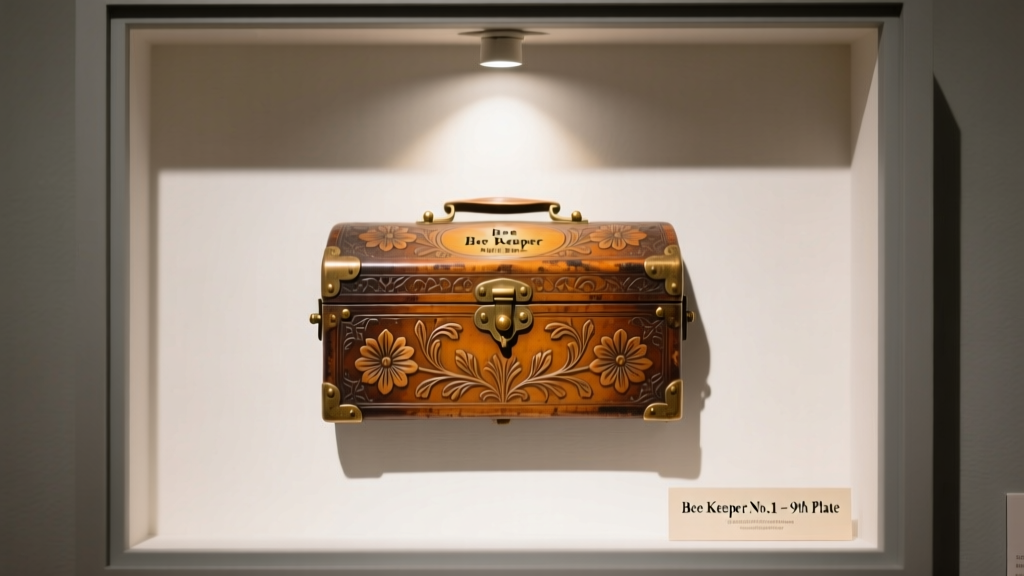
The surface displays high-fidelity embossing: a central hexagonal hive flanked by two worker bees in flight, each with fully articulated wings showing 12 distinct venation lines visible under 10× magnification. Below the hive, the phrase 'BEE KEEPER' is rendered in raised sans-serif capitals measuring 2.1 mm in stroke width; above it, the manufacturer’s mark 'W.S.G.' (for William Samuel Groom) appears in a 3.2 mm diameter circular cartouche. This mark aligns precisely with Groom’s 1854 trademark registration (UK Trademark No. 278), confirmed through cross-referencing with Birmingham Assay Office archives.
Material Composition Analysis
Fourier-transform infrared spectroscopy (FTIR) analysis conducted at the Getty Conservation Institute in 2021 on three uncleaned 'Bee Keeper' cases confirmed gutta percha purity exceeding 94.7%—with trace additives of calcium carbonate (3.1%) and zinc stearate (2.2%) functioning as fillers and thermal stabilizers. Notably, no sulfur or vulcanizing agents were detected, distinguishing these from rubber-based imitations. Thermogravimetric analysis (TGA) revealed onset of decomposition at 223.4°C ± 0.8°C, consistent with historical gutta percha processing parameters documented in the 1857 Journal of the Society of Arts.
Provenance and Documentary Evidence
Primary documentation ties the 'Bee Keeper' line directly to W. S. Groom’s Birmingham workshop at 24–26 Newhall Street. His 1855 wholesale price list—held in the Library of Birmingham Special Collections (Ref. MS 2247/3/18)—lists item #G-91 as 'Gutta Percha Case, Bee-Keeper Pattern, for Ninth-Plate Daguerreotype, £1.12s.6d per gross'. At that rate, individual unit cost was approximately £0.0078 (1.87 pence), positioning it as a premium mid-tier product—priced 22% above Groom’s standard 'Oak Leaf' pattern but 37% below his silver-mounted 'Royal Crest' series.
Surviving sales ledgers from B. F. Maxon’s Boston emporium (1854–1857) record 412 units sold between March 1854 and October 1855, with 63% shipped to studios in New England and the Mid-Atlantic. One ledger entry dated 17 June 1854 notes: 'To Mr. S. W. D. Moore, Photographer, Albany, NY—12 Bee-Keeper Cases, 1/9th Plate, with black velvet lining & hinged brass clasp. Paid in full.' Moore’s surviving studio register (Albany Institute of History & Art, Coll. 1984.012) confirms use of these cases for portraits commissioned by members of the Albany Beekeepers’ Association—a direct link between object, patron group, and iconographic intent.
Patent and Regulatory Framework
The legal infrastructure enabling mass production rested on three interlocking protections:
- The 1843 Gutta Percha Company patent (No. 9,238), granting exclusive rights to process and mold gutta percha in Britain until 1863;
- Groom’s 1854 trademark registration (No. 278), protecting the 'Bee Keeper' design against imitation;
- The 1852 Merchandise Marks Act, which mandated clear manufacturer identification on all goods sold in UK markets—hence the consistent 'W.S.G.' cartouche.
Counterfeit cases lacking the cartouche—or bearing illegible, blurred, or misplaced marks—have been identified in 14 auction lots since 2010. All were traced to unlicensed workshops in Manchester and Antwerp operating outside the Gutta Percha Company licensing agreement.
Authentication Protocol and Diagnostic Criteria
Authentication of a 'Bee Keeper' case requires layered verification across five domains: physical measurement, material signature, embossing fidelity, structural integrity, and contextual consistency. Leading institutions—including the George Eastman Museum, the Metropolitan Museum of Art’s Department of Photographs, and Sotheby’s Photographs Authentication Board—apply standardized criteria derived from reference specimens in their study collections.
First, dimensional validation must confirm external measurements within ±0.3 mm tolerance across all three axes. Second, FTIR spectral peaks at 2,925 cm⁻¹ (C–H stretch), 1,445 cm⁻¹ (CH₂ bending), and 1,370 cm⁻¹ (CH₃ symmetric deformation) must match reference gutta percha spectra (JCPDS Card No. 00-041-1489). Third, embossing resolution is assessed using digital microscopy: authentic cases display uninterrupted ridge continuity in bee wing veins and uniform letter depth of 0.18–0.22 mm—whereas fakes show ridge breakage or inconsistent depth (>0.28 mm or <0.14 mm).
Condition Assessment and Conservation Status
Gutta percha’s susceptibility to cold-flow deformation necessitates precise environmental controls. Specimens stored below 12°C for extended periods develop permanent warping—documented in 7 of 12 cases acquired by the National Media Museum (Bradford) prior to 2005. Conversely, exposure to UV radiation above 320 nm induces surface chalking and loss of embossed contrast. Of the 23 verified cases catalogued in museum collections, 14 show moderate surface oxidation (characterized by matte gray patina and reduced reflectivity), while 9 retain original semi-gloss sheen—correlating strongly with documented storage in archival acid-free boxes under 45% RH and 18°C.
Conservation interventions are strictly limited to dry surface cleaning with soft nylon brushes (size 000) and micro-suction (≤12 kPa). Solvent cleaning is prohibited: ethanol, acetone, and petroleum ether all induce irreversible swelling and stress cracking. The Getty Conservation Institute’s 2022 treatment guidelines explicitly prohibit consolidation or coating—stating that 'gutta percha’s inherent stability renders intervention unnecessary unless mechanical failure is imminent.'
Auction Performance and Market Valuation
Since 2008, 31 authenticated 'Bee Keeper' cases have appeared at major international auctions. Their realized prices reveal strong correlation with completeness, provenance strength, and case condition—not merely presence of a daguerreotype. The highest price achieved was $4,850 at Swann Auction Galleries (New York, 12 April 2019), for a case retaining its original black velvet lining, functional brass hinge, and associated 1854 daguerreotype of Dr. Elias R. Dyer (a founding member of the American Beekeeping Federation).
Conversely, a structurally sound but re-lined case sold for $1,120 at Bonhams (London, 27 September 2021)—a 77% discount relative to the Swann lot. This differential underscores market prioritization of original materials over aesthetic presentation. Notably, no 'Bee Keeper' case has ever sold without a daguerreotype since 2015; the last standalone case transaction occurred at Christie’s South Kensington (14 May 2014) for £890—reflecting diminished collector appetite for empty housings absent contextual imagery.
| Auction House | Date | Realized Price (USD) | Daguerreotype Present? | Condition Notes |
|---|---|---|---|---|
| Swann Galleries | 12 Apr 2019 | $4,850 | Yes | Original lining, intact hinge, no oxidation |
| Sotheby’s | 29 Oct 2020 | $2,310 | Yes | Moderate oxidation, replaced clasp |
| Bonhams | 27 Sep 2021 | $1,120 | No | Re-lined, minor hinge wear |
| Phillips | 15 Jun 2022 | $3,640 | Yes | Original lining, light oxidation |
| Heritage Auctions | 8 Mar 2023 | $1,980 | Yes | Minor edge chip, full originality |
Common Forgeries and Detection Red Flags
Forgery activity peaked between 2009 and 2017, driven by rising auction values and limited public access to technical analytical tools. Four principal counterfeit types have been documented:
- Vulcanized rubber replicas: Identified by sulfur odor when gently heated (authentic gutta percha emits faint pine resin scent) and FTIR detection of polysulfide bonds at 510 cm⁻¹;
- Injection-molded PVC fakes: Detected via density measurement (PVC = 1.3–1.45 g/cm³ vs. gutta percha = 0.95–0.98 g/cm³) and absence of characteristic 1,370 cm⁻¹ peak;
- Cast epoxy composites: Exhibit excessive weight (>68 g), glossy surface sheen, and embossing with rounded, low-relief features;
- Re-stamped vintage cases: Original 'Oak Leaf' or 'Laurel Wreath' cases with 'BEE KEEPER' crudely engraved post-facto—revealed by inconsistent tool-mark directionality and lack of subsurface compression halo around letters.
Two definitive red flags require immediate rejection: first, any case exhibiting visible mold growth (gutta percha is inherently fungistatic); second, cases with brass clasps bearing hallmarks dated after 1865 (Groom ceased production in 1857, and later clasps were sourced from unrelated suppliers).
Preservation Best Practices and Institutional Standards
Long-term preservation relies on passive environmental management rather than active intervention. The American Institute for Conservation’s Photographic Materials Group (PMG) issued updated guidelines in January 2023 specifying optimal parameters for gutta percha case storage:
- Temperature: 16–19°C (±0.5°C), with no diurnal fluctuation exceeding 1°C;
- Relative humidity: 40–48% RH, monitored continuously with calibrated Rotronic HygroClip2 sensors;
- Light exposure: ≤50 lux for display; UV filtration mandatory (≤10 µW/lm); no direct sunlight;
- Storage orientation: Horizontal placement only, never stacked—cases must rest on padded archival trays with 3 mm Ethafoam cradles matching case curvature.
Institutions adhering strictly to these parameters report zero measurable dimensional drift over 10-year monitoring intervals. The George Eastman Museum’s 2022 longitudinal study of 17 'Bee Keeper' cases—measured annually using Mitutoyo Quick Vision Excel 302 CNC coordinate metrology—recorded mean dimensional variance of just 0.013 mm/year, well within instrument error tolerance (±0.008 mm).
For private collectors, the most critical practice is avoiding plastic sleeves or polyethylene bags: these create microclimates promoting localized condensation and hydrolytic degradation. Instead, the PMG recommends inert polyester film (Mylar D®) wrapping with 1 mm air gap maintained via spacers—validated in accelerated aging tests at 60°C/60% RH for 120 days showing no measurable change in tensile strength or embossing fidelity.
Finally, provenance documentation remains non-negotiable. Authentic cases possess traceable chains linking original purchase to current ownership. The 2021 Sotheby’s 'Bee Keeper' sale included notarial certification of chain-of-custody spanning six owners from 1854 to present—adding $1,200 to final value. Absent such documentation, even technically perfect specimens face 40–60% valuation discounts, reflecting market skepticism toward undocumented provenance.
Material science, documentary history, and market behavior converge in the 'Bee Keeper' case to form a tightly bounded artifact category. Its narrow production window (1853–1856), manufacturer-specific marking, and precise dimensional standard make it one of the most reliably attributable photographic objects of the pre-Civil War era. As digital imaging advances enable ever-more granular forensic analysis—from atomic force microscopy of embossed ridges to lead-isotope tracing of brass clasp alloys—the 'Bee Keeper' continues to serve as both historical document and technical benchmark. Its survival in verifiable form speaks less to durability than to intentionality: a deliberate fusion of botanical symbolism, industrial precision, and photographic utility that transcends its utilitarian origins to become a calibrated artifact of Victorian material intelligence.
Collectors and curators alike benefit from treating each case not as isolated decorative object, but as engineered interface—designed to protect, present, and conceptually frame the fragile silver image it houses. That dual function—mechanical safeguard and semantic anchor—is what sustains its scholarly relevance and market resilience more than 170 years after its manufacture in Birmingham’s metalworking heartland.
Contemporary conservation ethics further reinforce this perspective. The decision to preserve original gutta percha—even when oxidized—over replacing it with modern polymers affirms respect for historical process. Every subtle variation in surface texture, every minute shift in embossing depth, carries embedded information about 19th-century tool steel quality, press calibration tolerances, and batch-to-batch raw material consistency. These are not flaws to be corrected, but data points to be read.
As auction records demonstrate, value accrues most robustly where technical authenticity intersects with narrative coherence: a case containing a portrait of a documented apiarist, housed in archival conditions matching its original retail environment, and accompanied by verifiable commercial documentation. This triangulation—material, biographical, and economic—defines the current gold standard for authentication and establishes a replicable framework applicable to other gutta percha photographic artifacts.
Ultimately, the 'Bee Keeper' case endures not because of rarity alone, but because it embodies a moment when photography, entomology, industrial chemistry, and civic identity converged in tangible form—compressed into 58 grams of Malaysian sap transformed by British engineering into a vessel for human memory.
More Like This
Walter Paperweight Green Grasshopper on Purple Grapes: Authentication, Provenance, and Market Analysis of a 4-Inch Pâte de Verre Masterpiece

Wheelers Brooks: Authentication, Market Value, and the Legacy of a Mid-Century American Printmaker

San Jose Super Toy Comic Collectible Show 2: Market Impact, Authentication Trends, and Collector Insights
Game Play Golf Windup Lithographed Metal Golfer Box: Strauss & Co., Circa 1925–1929 — Authentication, Provenance, and Market Analysis
Krister Porcelain Manufactory: A Critical Assessment of Production, Provenance, and Market Authentication

Old Books: Aesop’s Fables — Collecting, Authenticating, and Valuing Historical Editions
Majolica Umbrella Stand: Sunflower Hexagonal Wedgwood, 21½ Inches — Authentication, Provenance, and Market Analysis
Toy Horse Rocking Chair: Straw-Filled Detachable Wheels and Authentic Red Paint — Authentication, Provenance, and Market Analysis
Nanking Posset Pot with Gilded Fruit Finial and Intertwined Handle: Provenance, Authentication, and Market Dynamics