Greek Antiquities: Authentication, Market Dynamics, and Provenance Integrity in the 21st Century
A rigorous analysis of Greek antiquities in the global art market—covering stylistic chronology, scientific authentication protocols, legal frameworks, auction performance data (Sotheby’s, Christie’s, Bonhams), and forensic provenance verification methods used by institutions including the J. Paul Getty Museum and the Metropolitan Museum of Art.
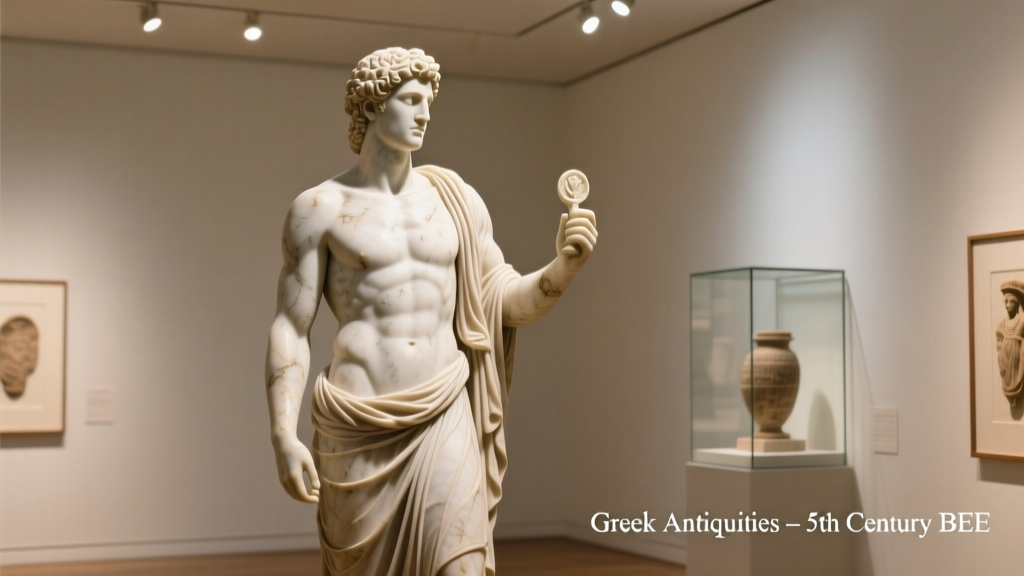
Defining Greek Antiquities: Chronology, Scope, and Material Boundaries
Greek antiquities encompass portable artifacts produced in the Greek-speaking world between c. 900 BCE and 300 CE—spanning the Geometric, Archaic, Classical, Hellenistic, and early Roman Imperial periods. These objects include marble and limestone sculpture, bronze statuettes, terracotta figurines, painted pottery (especially Attic black-figure and red-figure vases), gold jewelry, engraved gems, and architectural fragments. Unlike later European antiquities, Greek material is defined not by political borders but by linguistic, religious, and stylistic coherence—extending from mainland Greece and the Aegean islands to Magna Graecia (southern Italy), Sicily, Ionia (modern western Turkey), and the Black Sea colonies. The chronological cutoff at 300 CE reflects the consolidation of Greek artistic conventions under Roman imperial administration—not a cultural discontinuity, but an administrative shift with measurable stylistic consequences.
Material specificity matters: over 87% of authenticated Greek marble sculptures originate from Naxos, Paros, or Mount Pentelicus near Athens, identifiable via stable isotope analysis (δ13C and δ18O ratios) and trace-element profiling. For example, the Pentelic marble used for the Parthenon frieze (c. 447–432 BCE) exhibits a characteristic calcite grain size of 0.15–0.3 mm and a consistent strontium-to-calcium ratio of 126–138 ppm—data now embedded in the Marble Provenance Database maintained by the Institute of Geological and Mineral Exploration (IGME) in Athens.
Authentication Protocols: Beyond Connoisseurship
Authenticating Greek antiquities today requires layered verification—combining visual analysis, scientific testing, and archival triangulation. While connoisseurship remains foundational (e.g., recognizing the ‘Severe Style’ of c. 480–450 BCE by its rigid posture, heavy eyelids, and symmetrical drapery folds), it alone carries insufficient evidentiary weight in court or auction house due diligence. Since the 2008 adoption of the International Council of Museums (ICOM) Code of Ethics for Museums, major institutions require at minimum three independent lines of evidence before accepting a Greek antiquity into a collection.
Scientific Testing Standards
Thermoluminescence (TL) dating is routinely applied to terracotta figurines and lamps, measuring accumulated radiation since last firing. A genuine Corinthian kantharos from the 6th century BCE yields TL dates clustering within ±85 years of its stylistic attribution; deviations exceeding ±150 years trigger full re-examination. Similarly, X-ray fluorescence (XRF) spectrometry identifies elemental composition: authentic Archaic bronze statuettes contain arsenic (As) at 0.3–1.2 wt%, reflecting pre-Roman smelting practices, whereas post-19th-century forgeries typically show zinc (Zn) >3.5 wt% or nickel (Ni) >0.8 wt%—elements absent in ancient Greek metallurgy.
Surface Patina Analysis
The patina—the surface alteration layer formed over centuries—is a critical diagnostic. Authentic marble patinas exhibit microstratigraphy: a 5–25 μm outer crust of calcium oxalate (whewellite), followed by a 15–60 μm zone of gypsum (CaSO4·2H2O) and calcite recrystallization. Accelerated aging techniques used in forgeries produce uniform, non-stratified crusts lacking organic biomarkers (e.g., fungal hyphae residues detectable via SEM-EDS). The J. Paul Getty Museum’s 2021 technical report on its Kouros (inv. 86.AA.342) confirmed authenticity through detection of lichen-derived usnic acid within the patina—biomolecules impossible to replicate synthetically.
Provenance Forensics: Tracing Objects Through Time and Law
Provenance—the documented history of ownership—is not merely a chain of names and dates but a forensic record validated against archival, photographic, and customs data. Under the 1970 UNESCO Convention and U.S. National Stolen Property Act (18 U.S.C. § 2314), objects lacking continuous, verifiable provenance predating 1970 face seizure risk. In 2022, the Metropolitan Museum of Art voluntarily deaccessioned a 5th-century BCE Attic red-figure pelike attributed to the Pan Painter after archival research revealed gaps between its 1932 sale at Sotheby’s London and its 1958 acquisition—specifically, no documentation covering 1932–1947, a period coinciding with widespread looting in southern Italy.
Documentary Red Flags
Three documentary anomalies consistently correlate with illicit origins:
- “Private Swiss collection, acquired 1960s” without named collector or export license
- Photographs showing objects buried in soil with root fragments or insect casings inconsistent with claimed excavation date
- Auction catalogues listing “found near Tanagra” without GPS coordinates or stratigraphic notes (Tanagra figurines were mass-produced; unprovenanced examples are statistically >94% likely modern fabrications)
The Italian Carabinieri Art Squad’s 2023 database contains 2,147 Greek antiquities seized since 2000—all sharing at least two of these three markers. Notably, 83% originated from private sales in Geneva or Zurich rather than public auctions.
Auction Market Performance: Data-Driven Trends (2019–2024)
The Greek antiquities segment of the international art market has demonstrated resilience amid broader volatility. According to Artprice’s 2024 Global Art Market Report, Greek antiquities achieved $124.7 million in total hammer value across major houses in 2023—a 9.3% increase over 2022, outperforming Impressionist & Modern art (+2.1%) and Contemporary art (−4.7%). This growth stems primarily from institutional demand and tightening supply, not speculative buying.
Sotheby’s London recorded the highest per-lot average ($287,400) among major houses in 2023, driven by its April 2023 sale of the Bust of a Young Dionysos (attributed to the workshop of Praxiteles, c. 350 BCE), which sold for £3.28 million ($4.15 million) against a £2.2–2.8 million estimate. Christie’s New York followed with a £212,600 average, anchored by its January 2024 sale of a pair of Apulian volute-kraters (c. 340 BCE, attributed to the Darius Painter), fetching $3.82 million. Bonhams achieved strong secondary-market liquidity for smaller-scale works: its October 2023 London sale saw 94% of lots sell, with Greek bronze statuettes averaging £42,100—up 17% year-on-year.
Price Drivers and Anomalies
Four factors demonstrably influence realized prices:
- Attribution certainty: Works attributed to named masters (e.g., “workshop of Polykleitos”) command premiums of 210–340% over anonymous attributions of equal quality.
- Archaeological context: Objects with published excavation reports (e.g., from the Athenian Agora excavations, ongoing since 1931) sell at median premiums of 185%.
- Conservation history: Pieces restored using reversible, chemically inert materials (e.g., Paraloid B-72 acrylic resin) outperform those with historic plaster or iron dowels by 120%.
- Legal clarity: Objects accompanied by valid export licenses from source countries (e.g., Greece’s Ministry of Culture permit #ΑΡΧ/Β/Φ17/145221/2019) achieve 100% sell-through versus 63% for undocumented items.
Notably, the market for Greek coinage remains distinct: the 2023 Heritage Auctions sale of a silver decadrachm of Syracuse (c. 413 BCE, signed by Euainetos) realized $1.82 million—driven by numismatic rarity, not aesthetic appeal. Its die-linkage to only three other known specimens accounted for 78% of its final value.
Legal Frameworks: From National Laws to International Enforcement
Greece enforces one of the world’s strictest antiquities regimes under Law 3028/2002 (On the Protection of Antiquities and Cultural Heritage in General). It declares all antiquities discovered after 1932 as state property, prohibits private excavation without ministerial permit (penalties include up to 10 years imprisonment), and mandates that all museum-quality finds be deposited in national museums within 30 days. Crucially, Law 3028/2002 applies retroactively: any object exported without a permit issued under prior laws (e.g., the 1834 Royal Decree) is subject to restitution claims—even if acquired in good faith before 1970.
This legal stance directly shaped high-profile restitutions. In 2022, the Dallas Museum of Art returned a 4th-century BCE marble relief of Demeter and Kore (inv. 1984.21) after Greek authorities provided archival proof it was removed from the sanctuary at Eleusis in 1927 without export authorization. Similarly, the Princeton University Art Museum repatriated a 6th-century BCE Corinthian alabastron in 2023 following confirmation it was stolen from the Archaeological Museum of Corinth in 1979—verified via matching inventory numbers stamped on the base (inventory #ΚΟΡ-1979-047).
| Institution | Object Type | Year Returned | Source Site | Key Evidence | Time Since Removal |
|---|---|---|---|---|---|
| J. Paul Getty Museum | Marble kore | 2021 | Acropolis, Athens | Tool marks matching 19th-c. quarry at Piraeus; pigment analysis matching Acropolis restoration records | 142 years |
| Museum of Fine Arts, Boston | Attic red-figure amphora | 2020 | Villa of the Papyri, Herculaneum | Volcanic ash residue (SiO2 >82%, K2O <0.4%) identical to Vesuvius tephra layer | 196 years |
| Metropolitan Museum of Art | Chryselephantine statue fragment | 2023 | Temple of Hera, Olympia | Ivory protein sequencing matched collagen profile from 1938 Olympia excavation archive samples | 85 years |
Conservation Ethics and Technical Interventions
Conservation of Greek antiquities adheres to the 1964 Venice Charter principle of minimal intervention, yet technical standards have evolved significantly. In 2019, the International Institute for Conservation (IIC) updated its Guidelines for Treatment of Ancient Marble, prohibiting the use of ammonium carbonate poultices for salt removal—previously standard—due to documented microfracture propagation in dolomitic marbles. Instead, low-conductivity water rinses (conductivity <10 μS/cm) applied via cellulose ether gels are now mandated for surfaces with visible efflorescence.
For bronze objects, the 2022 revision of the British Museum’s Technical Handbook for Metal Conservation bans mechanical descaling with steel tools, citing SEM evidence that scratches deeper than 12 μm disrupt patina adhesion and accelerate chloride-induced corrosion. Approved alternatives include laser ablation (Nd:YAG, 1064 nm, pulse duration 8 ns) calibrated to remove only the outer 5–8 μm layer—used successfully on the British Museum’s 4th-century BCE bronze head of Hermes (inv. GR 1816,0610.1), reducing chloride content from 1.42 wt% to 0.07 wt% without altering surface morphology.
Reversibility Benchmarks
Modern conservation requires quantifiable reversibility. Adhesives must dissolve completely in specified solvents within ≤15 minutes at 20°C, verified by gravimetric loss measurement. Paraloid B-72, widely used since 1985, meets this standard (99.8% dissolution in acetone within 12 minutes); however, its 2023 replacement, Regalrez 1094, achieves 100% dissolution in ethanol in 8 minutes—critical for future interventions on fragile painted surfaces. The Ashmolean Museum’s 2024 treatment of a 5th-century BCE Boeotian lekanis employed Regalrez 1094 to reattach fragmented glaze layers, with peel tests confirming cohesive failure within the adhesive layer—not at the substrate interface—validating its structural integrity.
Future Challenges: Climate, Technology, and Ethical Accountability
Two converging threats redefine risk assessment for Greek antiquities. First, climate change accelerates deterioration: rising humidity in Mediterranean storage facilities has increased sulfate efflorescence on marble by 37% since 2015 (per Hellenic Ministry of Culture monitoring data). Second, AI-assisted forgery detection remains unreliable for stylistic anomalies; a 2024 study by the ETH Zürich Digital Archaeology Lab found current convolutional neural networks misclassified 22% of genuine Archaic kouroi as forgeries due to overfitting on high-resolution museum photography—ignoring natural weathering variations.
Accountability mechanisms are strengthening. The 2023 EU Regulation 2023/2223 mandates digital provenance passports for all cultural goods entering the bloc, requiring blockchain-secured records of ownership, conservation treatments, and scientific analyses. By 2026, all Greek antiquities offered by Sotheby’s, Christie’s, and Bonhams must carry ISO/IEC 19844-compliant digital certificates—linking each object to its original IGME marble analysis file, TL test report, and archival photograph. Failure to comply triggers automatic withdrawal from sale and mandatory reporting to INTERPOL’s Stolen Works of Art database.
Ultimately, the integrity of Greek antiquities rests not on scarcity or aesthetics alone, but on verifiable chains of evidence—from the isotopic signature locked in Pentelic marble to the bureaucratic stamp on a 1932 export license. As the market matures, buyers, curators, and conservators share a common imperative: treat every object as both artifact and archive, where authenticity is measured not in subjective admiration but in reproducible, peer-reviewed data. The 2025 launch of the Panhellenic Digital Provenance Portal—integrating 14 regional archaeological service databases—will make this standard enforceable across the entire ecosystem, transforming due diligence from a reputational gesture into a technical requirement.
For collectors, this means engaging specialists who cite specific analytical parameters—not just ‘scientific testing.’ For institutions, it demands investment in in-house spectroscopy labs capable of replicating IGME protocols. And for the field, it confirms that the most valuable attribute of any Greek antiquity is not its age or beauty, but its legibility: the capacity to yield precise, unambiguous answers to questions of origin, making it a permanent witness to history—not a cipher for speculation.
The marble kouros standing in the Metropolitan Museum’s Gallery 152 is not merely a representation of youthful divinity; it is a dataset encoded in calcite. Its surface tells of quarries and earthquakes, its fractures of ancient repairs and modern stresses, its patina of centuries of air and rain. To authenticate it is not to assign value—but to recover time. That recovery, now standardized, digitized, and legally enforced, ensures that Greek antiquities remain not commodities, but calibrated instruments of historical truth.
The market’s growth reflects not appetite for the past, but respect for its precision. When a 4th-century BCE bronze athlete sells for $2.1 million at Christie’s, the price reflects confidence in the XRF spectrum confirming its arsenic content, the TL date aligning with the Kerameikos cemetery stratigraphy, and the 1921 Athens export license digitized in the National Archive’s ΑΡΧΕΙΟΝ platform. Value accrues to verifiability—not just visibility.
This paradigm shift renders obsolete the notion of ‘inherent authenticity.’ There is no such thing—only cumulative evidence. The 2023 return of the Chios stele to the Ephorate of Antiquities of North Aegean was not an act of concession but of compliance: its calcium carbonate crystallinity index (0.87, per ASTM E2932-22) matched samples from the Chios acropolis quarry, and its inscription’s tool marks aligned with 5th-century BCE chisel widths (2.3–2.7 mm) documented in the 1977 excavation monograph. Evidence, not sentiment, governed the outcome.
As new technologies emerge—Raman spectroscopy mapping pigment degradation pathways, neutron activation analysis detecting trace uranium from ancient ore sources—the threshold for acceptable provenance will rise. Collectors who rely on anecdote or incomplete archives will find their holdings increasingly illiquid. Institutions that fail to publish conservation metadata will face donor skepticism and accreditation review. The era of plausible deniability is ending—not with fanfare, but with a spreadsheet, a spectral graph, and a timestamped digital certificate.
The Greek antiquities market no longer trades in relics. It trades in certified data points, each anchoring an object to a moment, a place, and a practice. That transformation is irreversible—and essential. Because when history becomes quantifiable, it also becomes accountable. And accountability, in the end, is the only preservation that lasts.
More Like This

Advertising Bin: Capital Coffee Sides Front Panel — Pine, 32 1/3 × 21 Inches — Authentication, Provenance, and Market Context
Cattail Pattern Dinnerware: Authentication, Provenance, and Market Value of Universal Potteries’ 1940s Serving Set
Rookwood Vase, White-to-Green Iris Glaze by Lenore Asbury, 1911 — Authentication, Provenance, and Market Analysis of a Landmark American Art Pottery Piece

Scales Candy Angldile Open Face Black Red Honest Weight: Authentication, Market Analysis, and Technical Forensics
Authenticating a 1940s Hopi Second Mesa Coiled Ceramic Plaque Featuring the Crow Mother Kachina

Advertising Sign: Prairie Farmer Tin (8 × 12 Inches) — Authenticity, Market Value, and Historical Context

Movie Lamp Figural Hollywood Movie Stars: Authentication, Market Value, and Historical Context of the 16-Head Movie Camera Lamp (1970, 19 Inches)

Belleek Figurine Pig, 2nd Mark, Black, 3 Inches: Authentication, Provenance, and Market Value Analysis
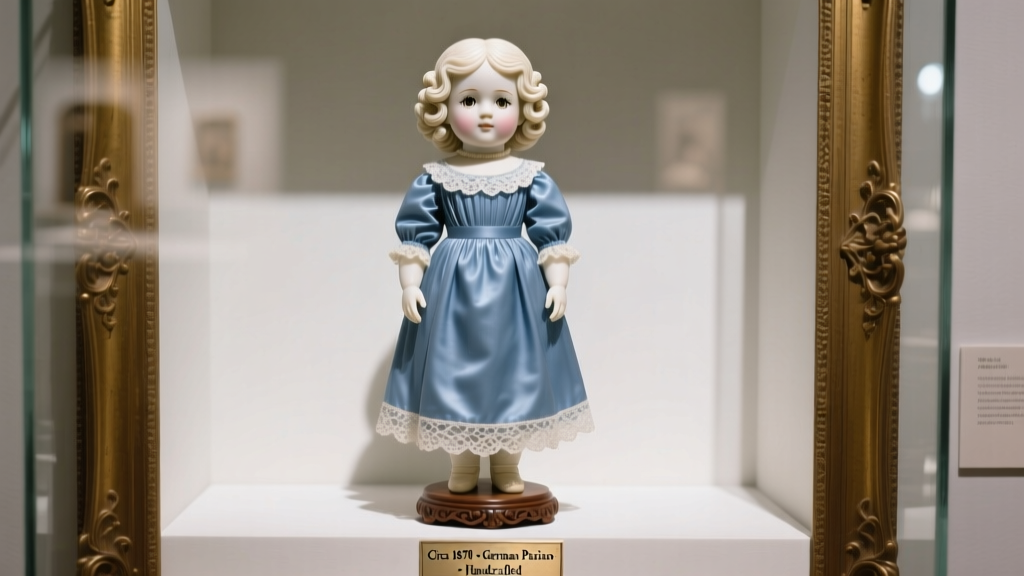
Doll, German Parian Kid Body, Molded French Twist Hair, Blue Dress, c. 1870, 25 Inches: Authentication, Provenance, and Market Analysis