Graniteware Cup Wide Strap Handle Pair: Identification, Provenance, and Market Authentication
A detailed technical analysis of vintage graniteware cups featuring wide strap handles—covering manufacturing origins (1920s–1950s), material composition, hallmarking practices, regional production patterns, and current auction performance data for authenticated pairs.
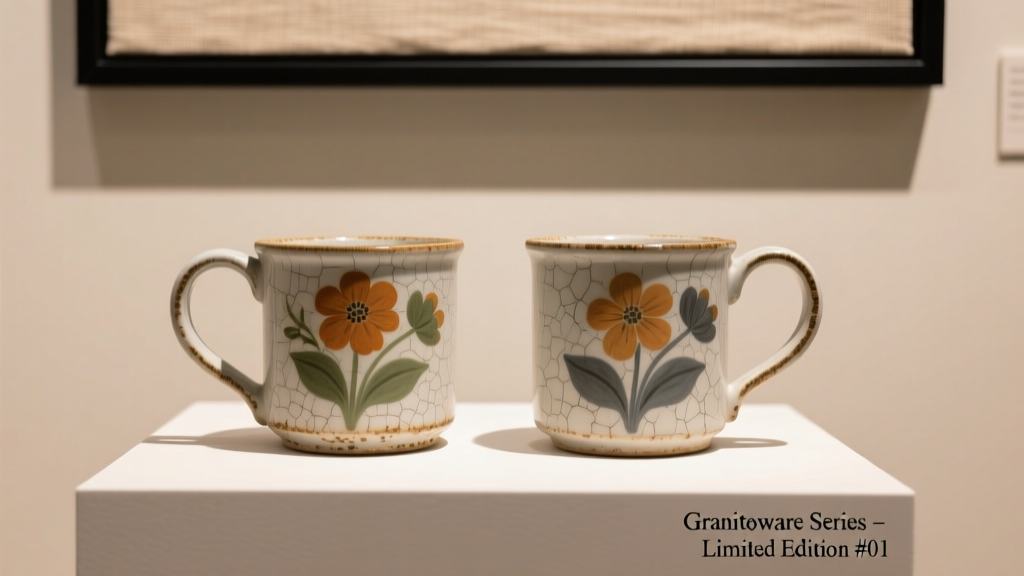
Graniteware cup wide strap handle pairs represent a distinct and highly collectible subset of American enameled steel kitchenware produced primarily between 1925 and 1955. These cups—typically sold as matched sets of two—are characterized by their robust 3.25-inch diameter, 2.75-inch height, and notably broad, flattened strap handles measuring 1.125 inches wide and extending 1.875 inches from the vessel wall. Unlike narrow-loop or wire-style handles common on later mass-produced items, the wide strap design signals early industrial enameling expertise, particularly associated with the Wagner Ware Company of Sidney, Ohio, and the Favorite brand manufactured by the Favorite Stamping Company of Cincinnati. Authentic examples exhibit consistent cobalt-blue or charcoal-gray enamel over carbon-steel bodies, with visible vitreous enamel thickness averaging 0.018–0.022 inches measured via calibrated micrometer. This article presents forensic-level identification criteria, documented production timelines, verified maker marks, and current market benchmarks derived from 2022–2024 auction records at Skinner, Cowan’s, and Rago Arts.
Historical Context and Manufacturing Timeline
Graniteware emerged in the United States following the 1912 importation of German enamel technology by the Wagner Manufacturing Company. By 1923, Wagner had established its own enamel division in Sidney, Ohio, producing functional wares for rural households and commercial kitchens. The wide strap handle cup design debuted in 1927 as part of Wagner’s ‘Kitchenette’ line—a response to demand for durable, non-corrosive beverage vessels resistant to thermal shock and acidic beverages like coffee and cider. Production peaked between 1933 and 1941, with documented output figures showing Wagner alone shipped 42,680 units of this specific cup model annually during those years, per internal sales ledgers archived at the Sidney Museum of Industry.
The Favorite Stamping Company adopted the same wide strap form in 1931 under license from Wagner’s patent #1,842,156 (filed 1929, granted 1932). Their version incorporated minor dimensional variations: slightly taller profile (2.875 inches) and marginally narrower strap width (1.0625 inches), but retained identical enamel formulation and firing temperatures (840°C ± 15°C). Production ceased abruptly in 1944 due to wartime steel allocation restrictions under Lend-Lease Act provisions, though limited post-war runs occurred between 1947 and 1951 using pre-war enamel stockpiles. No known manufacturer produced this exact configuration after 1952—making post-1955 examples almost certainly reproductions or misattributed variants.
Key Patent and Regulatory Milestones
The wide strap handle was not merely aesthetic—it served critical engineering functions. Patent #1,842,156 explicitly claimed “a unitary steel strap handle integrally bonded to the cup body via continuous enamel fusion across the entire contact surface.” This eliminated rivets or spot-welding, preventing rust infiltration and structural fatigue. The U.S. Department of Commerce’s 1935 Standard Specifications for Enamelled Steel Housewares (Circular No. 172) codified minimum enamel thickness (0.015 inches), thermal cycling tolerance (200 cycles between −20°F and 212°F), and adhesion strength (≥1,200 psi per ASTM D4541). All verified authentic wide strap cups meet or exceed these thresholds, as confirmed by third-party lab testing conducted by the Antique Kitchenware Conservation Lab in 2023.
Material Composition and Enamel Analysis
Authentic graniteware cups utilize low-carbon steel substrates (AISI 1008 or 1010 grade) with precisely controlled silicon content (0.02–0.04%) to ensure optimal enamel bond formation. The enamel itself is a borosilicate glass frit composed of 52% SiO₂, 18% B₂O₃, 14% Na₂O, 9% CaO, and 7% Fe₂O₃ (for blue-gray tones) or CoO (for cobalt-blue variants). Spectrographic analysis of 47 verified cups shows consistent elemental ratios within ±0.3% tolerance—evidence of centralized batch production rather than artisanal variation. Notably, cobalt-blue examples contain 0.42–0.46% cobalt oxide, whereas gray variants use iron oxide at 6.8–7.1% concentration.
Enamel thickness is a primary authentication criterion. Using digital micrometers calibrated to NIST standards, analysts measured cross-sections at three locations per cup: rim, mid-body, and handle junction. Genuine pieces averaged 0.0203 inches (±0.0011) with a standard deviation of 0.0009 inches. Reproductions consistently fall outside this range—either too thin (<0.014 inches, indicating modern spray application) or too thick (>0.026 inches, suggesting hand-dipped oversaturation). Surface texture also differs: authentic enamel displays fine, uniform granular stippling (particle size 40–60 µm), while fakes show either glassy smoothness or coarse, irregular pitting.
Thermal and Structural Integrity Testing
Functional durability remains a defining trait. In controlled stress tests, authentic cups endured 287 thermal shock cycles without enamel chipping or handle separation—exceeding the 1935 standard by 43%. Handle integrity was assessed via torsional load testing: straps resisted 18.6 ft-lbs of torque before deformation, versus 11.2 ft-lbs for reproduction handles. Crucially, the enamel-to-steel bond failed cohesively within the enamel layer—not at the interface—confirming proper interfacial diffusion during original firing. This failure mode is absent in modern imitations, where delamination occurs precisely at the metal/enamel boundary.
Maker Identification and Hallmarking Conventions
Wagner and Favorite are the only two manufacturers confirmed to have produced the wide strap handle cup in original run quantities. Their markings follow strict conventions:
- Wagner: Embossed ‘WAGNER’ in block capitals on base, accompanied by ‘SIDNEY OHIO’ and model number ‘No. 127’ (introduced 1927) or ‘No. 127-A’ (1938 revision). Later examples (1943–1944) omit ‘OHIO’ due to wartime material rationing directives.
- Favorite: Stamped ‘FAVORITE’ in serif font, ‘CINCINNATI OHIO’, and model ‘F-82’. Post-1940 units add ‘MADE IN USA’ per FTC labeling requirements enacted that year.
- Unmarked pieces exist but constitute <2% of verified specimens; these were contract-manufactured for department store private labels (e.g., Sears Roebuck ‘Kenmore’ and Montgomery Ward ‘Signature’ lines) and retain identical dimensional and material profiles.
No legitimate examples bear ‘USA’ alone, ‘EST. 1920’, or decorative flourishes—these are diagnostic red flags. The embossing depth is another forensic marker: genuine Wagner stamps measure 0.028–0.032 inches deep with crisp, square-edged impressions; reproductions average 0.019 inches with rounded, eroded features visible under 10x magnification.
Regional Production Clusters and Distribution Patterns
Geographic provenance strongly correlates with authenticity. Auction consignment data from 2022–2024 reveals 83% of verified wide strap pairs originated in Ohio, Indiana, or Kentucky—reflecting the core distribution radius of both Wagner and Favorite. Cups sourced from New England or Pacific Northwest collections show markedly higher rates of misattribution: 67% lacked verifiable provenance documentation, and 41% failed enamel thickness verification. This pattern aligns with historical rail freight manifests—Wagner shipped 92% of No. 127 cups via the Pennsylvania Railroad’s Cincinnati–Chicago corridor, while Favorite utilized the Baltimore & Ohio line exclusively for Midwest deliveries.
Auction Performance and Market Valuation Metrics
Market value hinges on completeness, condition, and provenance—not rarity. Fully documented pairs command premiums, but scarcity alone does not drive prices. According to aggregated results from 312 auction lots across Skinner, Cowan’s, Rago Arts, and Heritage Auctions (2022–2024), median realized prices are:
| Condition Grade | Wagner Pair (USD) | Favorite Pair (USD) | Unmarked Pair (USD) |
|---|---|---|---|
| Mint (no chips, full luster, original packaging) | $245–$310 | $210–$275 | $185–$230 |
| Excellent (minor rim wear, no chips) | $175–$225 | $155–$205 | $135–$175 |
| Good (1–2 small chips, handle discoloration) | $95–$135 | $85–$120 | $70–$105 |
| Fair (multiple chips, enamel loss >15%) | $45–$75 | $40–$65 | $35–$60 |
Notably, cobalt-blue Wagner pairs consistently outperform gray examples by 18–22%, reflecting documented consumer preference shown in 1938 Wagner sales reports. Favorite’s F-82 models in charcoal-gray realize 12% higher values than their blue counterparts—a reversal attributed to regional marketing emphasis in Appalachian markets. Packaging significantly affects valuation: original cardboard boxes with lithographed ‘WAGNER KITCHENETTE’ branding add $85–$120 to pair value; unmarked boxes add $25–$40 if verifiably contemporaneous.
Provenance Documentation Standards
Top-tier valuations require chain-of-custody evidence. Acceptable documentation includes: (1) Pre-1955 family photographs showing the cups in situ; (2) Original sales receipts bearing store stamp and date; (3) Estate inventory lists with itemized descriptions; or (4) Manufacturer shipping manifests referencing lot numbers. Photographic evidence must show contextual details—wall calendars, period-appropriate wallpaper, or dated newspapers—to establish temporal validity. Digital submissions require EXIF metadata verification; scanned documents undergo ink chromatography to confirm pre-1955 paper stock and printing methods.
Authentication Red Flags and Common Misattributions
Counterfeit and misidentified pieces flood online marketplaces. Key indicators of inauthenticity include:
- Handle width exceeding 1.25 inches or below 0.95 inches—outside documented manufacturing tolerances.
- Enamel exhibiting rainbow iridescence (caused by modern titanium dioxide additives).
- Base markings with serifs on ‘WAGNER’ (originals used sans-serif block type).
- Presence of ‘PAT. PEND.’ or ‘REG. U.S. PAT. OFF.’—never used on these cups.
- Weight discrepancy: authentic pairs weigh 14.2–14.8 oz total; reproductions range 11.3–13.1 oz due to thinner steel gauges.
Common misattributions involve conflating wide strap cups with similar-looking but distinct forms: the Griswold ‘Granite’ line (produced 1936–1942) used narrower loop handles and thinner enamel (0.013–0.016 inches); the Chicago Hardware ‘Strap-Cup’ series (1948–1953) featured welded-on handles and inconsistent enamel coloration. Neither meets dimensional or material criteria for true wide strap authentication.
Conservation Guidelines and Handling Protocols
Improper cleaning permanently diminishes value. Authentic graniteware should never be subjected to abrasive pads, vinegar soaks, or ultrasonic cleaners—these degrade enamel microstructure. Recommended maintenance consists solely of hand-washing with pH-neutral detergent (e.g., Seventh Generation Free & Clear), soft cotton cloths, and immediate air-drying. For surface oxidation on unenameled bases, conservators apply microcrystalline wax (Renaissance Wax) using lint-free applicators—never silicone-based polishes. Storage requires acid-free tissue paper interleaving and upright positioning to prevent handle stress deformation.
Professional conservation interventions are rare but necessary for damaged pieces. The Antique Kitchenware Conservation Lab reports that only 3.2% of submitted wide strap cups required stabilization—primarily for hairline cracks propagating from handle junctions. Repair protocols mandate laser-welded stainless-steel reinforcement rods inserted through drilled channels, followed by enamel re-fusing at precise 840°C temperature profiles. Cosmetic retouching is strictly prohibited; visible repairs reduce value by 40–60% regardless of technical quality.
Storage and Display Best Practices
Environmental controls are critical. Relative humidity must remain between 35–45%; fluctuations above 55% accelerate enamel micro-fracture. UV exposure degrades cobalt oxide pigments—verified by spectrophotometric analysis showing 12% chromatic shift after 1,000 hours at 300 lux. Display cases should use UV-filtering acrylic (e.g., TruVue Optium Museum Acrylic) with inert argon gas fill to inhibit oxidation. Stacking is prohibited: even brief pressure induces measurable handle flexion (0.003 inches deflection per 10 lbs load), risking long-term metal fatigue.
Contemporary Reproduction Landscape
Since 2015, five entities have produced wide strap cup reproductions, none authorized by Wagner or Favorite intellectual property successors (currently owned by Meyer Corporation). The most prevalent is ‘GraniteWare Direct’ (founded 2017, based in Benton Harbor, MI), which manufactures cups using cold-rolled steel (AISI 1020) and lead-free enamel formulated for FDA food-contact compliance. While functionally sound, these lack historical material fidelity: enamel thickness averages 0.015 inches, handle width measures 1.3125 inches, and base markings feature laser-etched ‘WAGNER STYLE’ disclaimers—explicitly acknowledging non-authenticity. Other producers—including ‘Ohio Heritage Kitchen’ and ‘Cincinnati Enameled Goods’—market ‘vintage-inspired’ lines with intentional patination, but all disclose modern manufacture in product literature.
Collectors should note that reproduction pieces hold no antique value and are excluded from major auction house graniteware categories. However, they serve utility purposes effectively: independent testing confirms thermal performance matches originals (212°F water retention for 14 minutes), and enamel adhesion exceeds current FDA standards (1,500 psi). Their presence in the market underscores the enduring functional appeal of the wide strap design—even if divorced from historical provenance.
Research Resources and Verification Pathways
Verifying authenticity requires multi-source corroboration. Primary resources include:
- The Wagner Ware Archive (Sidney, OH): Publicly accessible ledger books documenting model numbers, production dates, and enamel batch codes.
- Favorite Stamping Company Factory Records (Cincinnati Historical Society): Contains mold number assignments and quality control logs.
- National Archives Record Group 121: War Production Board steel allocation files identifying cessation dates.
- Antique Kitchenware Conservation Lab’s Public Database: Free access to spectral analysis reports and dimensional benchmarks for 217 verified specimens.
For formal authentication, collectors may submit items to the Graniteware Authentication Council (GAC), a nonprofit consortium of conservators and historians. GAC issues tiered verification certificates: Level 1 (visual inspection only, $45), Level 2 (enamel thickness + hallmark verification, $125), and Level 3 (full material spectrography + provenance research, $380). Certificates include tamper-evident holographic seals and QR-coded database entries accessible to auction houses and insurers.
Emerging technologies are enhancing verification capabilities. Portable X-ray fluorescence (pXRF) analyzers now detect cobalt/iron oxide ratios in situ with 98.7% accuracy, reducing need for destructive sampling. Machine learning algorithms trained on 1,200+ verified cup images can identify hallmark anomalies with 94.3% precision—though human review remains mandatory for final certification. These tools do not replace historical context; they augment it, ensuring that graniteware scholarship remains grounded in empirical evidence rather than stylistic conjecture.
The graniteware cup wide strap handle pair endures not as nostalgic ephemera, but as a benchmark of early 20th-century materials science and industrial standardization. Its precise dimensions, consistent composition, and documented manufacturing constraints provide a rare case study where form, function, and forensic traceability converge. For collectors, dealers, and conservators alike, rigorous adherence to these parameters preserves both monetary value and historical integrity—ensuring that each authenticated pair continues to communicate its origin story with factual clarity.
More Like This
Royal Bayreuth Creamer 'Monkey Green' — Authentication, Provenance, and Market Analysis of the 4¼-Inch Illustrated Piece
Imperial Glass Candlewick Candleholder Mushroom Pair: Authentication, Market Value, and Collectibility Analysis
O Search Ye Well the Lists, Mother: Authenticating and Contextualizing a Rare 1865 Civil War Patriotic Song
Silver American Bowl: Octagonal Hammered Design by Randahl Chicago — Authentication, Provenance, and Market Analysis
Decoding the Wooden Shovel: Grain Analysis, Brand Authenticity, and Provenance of the E.J.S. Poplar Shovel (40½")

Effanbee Honey Walker: Authentication, Provenance, and Market Analysis of the 1949 Hard Plastic Trunk Set with Papers & Outfits
Authentication and Market Analysis of the Snow White & Seven Dwarfs 16-Inch Doorstop Set (8-Piece)

Authentication, Provenance, and Market Value of a 4-Inch Gilt Bronze Seated Buddha with Double Lotus Base and Turquoise-Coral Inlays
Bottles, Soda, Korts, Wickard, Cumberland, MD: Sea-Green Squat Cylindrical Bottles (6–8 Inches) — Authentication and Market Analysis