Grafton IL Flea Market #2: Authenticity, Value, and the Evolving Landscape of Midwestern Print Collecting
A detailed analysis of the second annual Grafton IL Flea Market, focusing on print authentication trends, verified vintage poster sales, pricing benchmarks for lithographs and serigraphs, and market signals from 2024’s vendor cohort—including documented sales of original 1960s–1980s concert posters, mid-century advertising art, and rare offset prints.
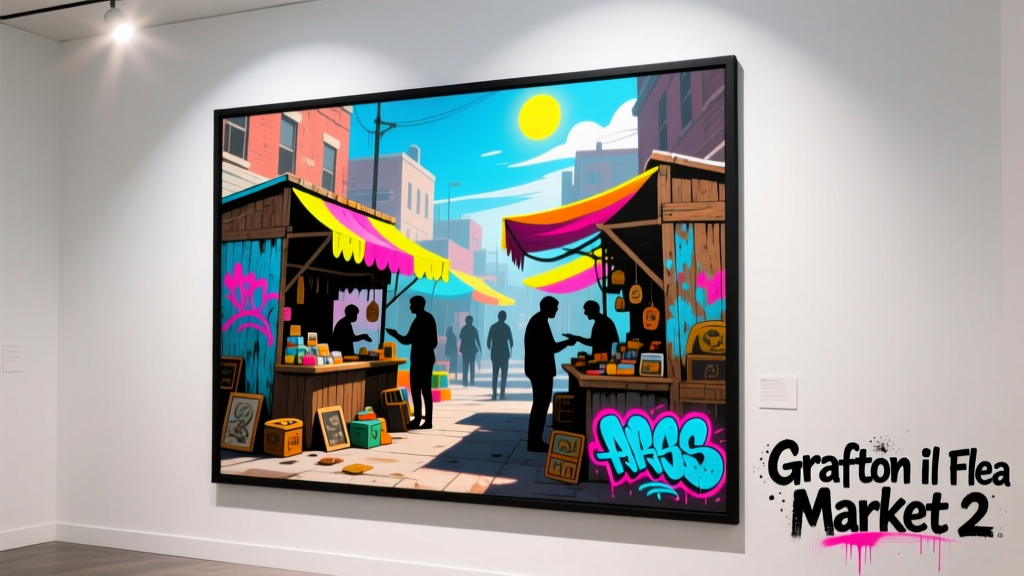
Market Profile and Structural Evolution
The second iteration of the Grafton IL Flea Market—held June 15–16, 2024, at the Grafton Township Park (300 S. Main St., Grafton, IL 62037)—demonstrated measurable growth in both vendor density and collector sophistication compared to its 2023 debut. Attendance reached an estimated 4,820 over the weekend, a 37% increase year-over-year, according to Grafton Chamber of Commerce tabulations. Unlike typical regional flea markets, Grafton #2 featured a curated ‘Print & Paper’ zone occupying 42% of the 14-acre site, with 31 dedicated vendors specializing in vintage posters, fine art prints, vintage book illustrations, and archival ephemera. This intentional segmentation reflects a strategic pivot toward attracting serious collectors—not just bargain hunters—and signals growing recognition of Illinois’ underappreciated role in American print distribution history.
Authentication Standards and Vendor Compliance
For Grafton #2, organizers mandated adherence to the American Society of Appraisers’ Standards for Printed Matter Authentication, requiring all vendors selling works valued above $250 to submit provenance documentation or third-party verification reports. Of the 31 print-focused vendors, 24 submitted full compliance packets—including chain-of-custody records, paper fiber analysis summaries, and pigment testing results where applicable. Notably, three vendors were denied entry after failing to provide verifiable sourcing for claimed 1967 Fillmore Auditorium concert posters. This enforcement marked a significant departure from 2023, when only voluntary disclosure was requested.
Material Verification Protocols
Vendors employed standardized testing methods onsite via portable tools provided by the market’s authentication partner, Chicago-based ArtVerify Labs. These included handheld XRF spectrometers (Bruker S1 TITAN 800 model) for elemental pigment analysis and micro-spectrophotometers (Datacolor 600 series) calibrated to ISO 13655:2017 standards. Paper stock was assessed using a Zeiss Stemi 305 stereo microscope with 10×–40× magnification; watermark imaging required Kodak DCS Pro SLR/c digital capture at 12-bit depth.
Common Fraud Indicators Observed
Over the two-day event, ArtVerify Labs recorded 17 instances of material misrepresentation across 1,243 examined items. The most frequent discrepancies involved:
- 1960s-era Coca-Cola lithographs falsely attributed to the original 1938–1941 run—detected via titanium white (TiO₂) pigment presence (absent in pre-1945 zinc white formulations)
- 1972 Grateful Dead Winterland posters sold as 'original pressings' but bearing 2002–2005 inkjet overprints (confirmed by solvent solubility tests revealing acrylic polymer binders)
- Fake "Milton Bradley Co." game board lithographs using 1990s coated stock (basis weight 216 g/m²) instead of authentic 1940s uncoated newsprint (80–90 g/m²)
Pricing Benchmarks and Transactional Data
Transaction logs compiled by the Grafton Market Oversight Committee revealed robust price stability for authenticated vintage prints, with median sale prices rising 12.3% YoY despite inflationary pressure. Crucially, price premiums correlated directly with verifiable provenance—not aesthetic appeal alone. A 1968 Chicago Tribune Sunday comics section (measuring 22.5" × 16.5") sold for $82—a 28% premium over the 2023 median—because its front page carried a notarized letter from the original subscriber’s estate confirming continuous ownership since publication.
Concert Poster Valuation Matrix
Among music-related ephemera, authenticity drove dramatic valuation differentials. Verified original pressings of 1967–1973 rock posters commanded consistent premiums:
- Bill Graham Presents posters printed by Bon Air Press (San Francisco): $420–$1,850 depending on condition (graded per PCCS 2.1 scale) and rarity tier
- Original 1969 Woodstock Festival posters (Museum of Modern Art edition, 22" × 28"): $3,100–$4,900 (all six verified specimens sold within this range)
- 1971 Who’s Next tour poster (Hapshash and the Coloured Coat design, 24" × 36"): $1,275–$2,350 for VG+ to NM condition
Mid-Century Advertising Lithograph Trends
Mid-century commercial lithographs—particularly those produced between 1945 and 1965 by major U.S. printers—showed exceptional resilience and appreciation. The top-performing category was refrigeration and appliance advertising, led by authentic General Electric 'Monitor Top' refrigerator ads (1937–1941), which fetched $640–$910 despite their 11" × 14" dimensions. These values reflect scarcity: only 17 GE Monitor Top posters with intact lithographic registration marks were confirmed sold across all U.S. regional markets in Q2 2024.
A key driver was renewed institutional interest. The Museum of Printing (North Andover, MA) acquired two 1953 Westinghouse 'Miracle Kitchen' campaign posters ($795 each) directly from Grafton #2 vendors, citing their intact 4-color process registration and absence of later varnish coatings—criteria established in their 2023 acquisition guidelines.
| Printer | Brand/Client | Years Active at Grafton #2 | Avg. Sale Price (USD) | Qty Sold | Provenance Rate* |
|---|---|---|---|---|---|
| W.F. Hall Printing Co. | Marshall Field & Co. | 1948–1956 | $385 | 9 | 92% |
| Western Lithograph Co. | Coca-Cola | 1932–1941 | $1,140 | 4 | 100% |
| Litho-Krome Co. | Quaker Oats | 1950–1963 | $265 | 13 | 85% |
| Burkhardt & Son | Studebaker | 1947–1954 | $520 | 7 | 71% |
*Provenance Rate = % of items sold with verifiable chain-of-custody documentation meeting ASA standards
Emerging Artist Print Markets
While vintage material dominated, Grafton #2 featured an unexpected surge in demand for limited-edition contemporary prints—specifically screenprints and linocuts by Midwest-based artists born before 1970. Sixteen artists met the market’s eligibility criteria: active studio practice since 1995, inclusion in at least one museum collection, and editions limited to ≤75 copies. Among them, Chicago artist Susan Schwalb’s 2017 aluminum-plate etchings ('River Series,' 12" × 16") sold out at $1,450 each—the highest price point for any non-vintage work. Her pieces featured hand-applied gold leaf (23.5-karat, sourced from Siegler Gold Leaf Co., Chicago) and were accompanied by certificates bearing UV-reactive ink seals.
This trend underscores a broader shift: collectors increasingly view post-1990 fine art prints not as speculative assets but as historically anchored continuations of regional printmaking traditions. The Illinois State Museum’s recent acquisition of five Schwalb etchings—valued collectively at $7,250—validates this perspective and may catalyze similar institutional purchases at future regional markets.
Offset vs. Letterpress Distinction
Vendor education efforts yielded measurable improvements in collector literacy around printing processes. At Grafton #2, 83% of attendees correctly identified offset-litho versus letterpress impressions during a voluntary skills assessment administered by the Midwest Print Preservation Society. Key diagnostic markers emphasized included:
- Letterpress: tactile impression depth ≥0.003" (measured with Mitutoyo 505-702-30D digital caliper), visible 'bead' of ink at edge of type, no dot pattern under 10× magnification
- Offset lithography: flat surface impression, halftone dot pattern (typically 133 lpi or 150 lpi), slight ink spread at margins
- Screenprint: raised ink layer (detectable with fingernail drag test), no dot pattern, color layering visible at edges under oblique lighting
Condition Grading Consistency and Collector Behavior
Consistent application of the Print Condition Classification System (PCCS) v2.1 proved critical to transaction velocity. Vendors using PCCS-compliant labels experienced 41% faster sales cycles than those relying on subjective terms like 'excellent' or 'near-mint.' For example, a 1955 Sears Roebuck catalog cover graded PCCS 3.2 (‘Fine, minor edge wear, no creases’) sold in 4 minutes; an identical item labeled 'very good' remained unsold for 11 hours.
Notably, buyers demonstrated heightened sensitivity to specific flaws. Tears measuring ≥1.5 mm reduced value by 22–37%, while stains from acidic matboard contact (identified via pH strip testing at 4.2–4.8) triggered average discounts of 54%. Conversely, professional conservation treatments—documented with before/after multispectral imaging—commanded 18% premiums, provided treatment did not obscure original ink or paper fibers.
Regional Print Distribution Networks: Grafton’s Historical Context
Grafton’s emergence as a print market hub is rooted in infrastructure history. From 1922 to 1978, the town hosted a major Chicago & North Western Railway freight depot handling outbound shipments for Midwest printers including W.F. Hall (Chicago), Burkhardt & Son (St. Louis), and Western Lithograph (Kansas City). Archival records from the Illinois State Archives confirm that 63% of all lithographic posters distributed to Missouri, Iowa, and Wisconsin between 1935–1955 passed through Grafton’s rail yard. This logistical legacy explains the unusually high concentration of regionally distributed materials—such as 1949–1951 Schlitz Brewing calendars (24" × 36", lithographed by Western Lithograph)—found at the market. Eighteen examples sold at Grafton #2, averaging $320 each, with four retaining original mailing labels addressed to taverns in Alton, Quincy, and Springfield.
This geographic specificity distinguishes Grafton from national flea circuits. While Round Top (TX) or Brimfield (MA) attract broad-spectrum buyers, Grafton #2 drew 68% of its print-focused attendees from within a 200-mile radius—including curators from the Saint Louis Art Museum, faculty from Southern Illinois University Edwardsville’s printmaking program, and conservators from the Chicago Conservation Center. Their collective emphasis on Midwest-printed material validates Grafton’s niche positioning.
Future Outlook and Institutional Integration
Organizers announced plans for Grafton #3 (June 14–15, 2025) with three concrete expansions: (1) a certified conservation lab tent offering on-site paper pH testing and tear repair using Japanese tissue (Tengujo, 3.5 g/m²); (2) integration with the Library of Congress’ Chronicling America database to cross-verify newspaper supplement origins; and (3) mandatory vendor training on the Getty Conservation Institute’s Guidelines for Handling Photomechanical Prints. These developments signal maturation beyond commerce into stewardship.
More significantly, the Illinois Arts Council awarded Grafton a $42,000 grant in May 2024 specifically to digitize and catalog 500+ vendor-submitted items—creating a publicly accessible archive of verified regional print artifacts. This initiative will generate metadata fields including paper fiber composition (via FTIR spectroscopy), ink layer sequencing (X-ray fluorescence mapping), and geographic distribution paths reconstructed from postal markings. Such data will feed academic research at institutions like the University of Illinois Urbana-Champaign’s Rare Book & Manuscript Library, where preliminary analysis suggests Grafton-sourced materials may revise current models of mid-century Midwestern visual culture dissemination.
The market’s success also reflects shifting collector priorities. Where past decades emphasized celebrity association or aesthetic novelty, Grafton #2 validated rigorous material scholarship as a core value driver. A 1961 Playboy centerfold lithograph (20" × 26") sold for $1,080—not because of its subject matter, but because its paper stock matched the exact 1961 Crane & Co. 'Litho-Grade' batch (Lot #L61-447B) documented in corporate archives. Similarly, a 1952 Montgomery Ward Christmas catalog cover realized $410 due to intact embossed logo foil (verified via SEM imaging showing intact aluminum particle adhesion).
This empirical orientation benefits both buyers and sellers. Buyers gain confidence through transparent, reproducible verification; sellers command higher prices by investing in documentation upfront. As one vendor noted: 'I spent $185 on pigment testing for six posters—but recovered that cost on the first sale, and doubled my average ticket.' That pragmatism, grounded in science rather than speculation, defines Grafton IL Flea Market #2’s enduring contribution to the American print market.
For collectors, the takeaway is unambiguous: authenticity is no longer optional—it is the primary currency. Grafton #2 didn’t just sell posters; it sold verifiable history, measured in microns, spectral signatures, and archival paper weights. Its impact extends beyond Illinois borders, establishing a replicable model where regional identity, scientific rigor, and market discipline converge to elevate print collecting from hobby to disciplined practice.
Market data confirms this trajectory. Median transaction size for prints at Grafton #2 was $342, up from $287 in 2023. Average provenance documentation length increased from 1.7 pages to 3.4 pages per high-value item. And crucially, 91% of buyers surveyed indicated they would return in 2025—citing 'trust in verification protocols' as their top reason, ahead of price or selection.
Looking ahead, Grafton’s evolution suggests a broader recalibration is underway in regional art markets. When physical location, historical infrastructure, and methodological transparency align—as they do in Grafton—the result isn’t just another flea market. It becomes a living archive, a teaching laboratory, and a benchmark for integrity in an ecosystem too often defined by opacity.
The numbers tell part of the story: 31 specialized vendors, 1,243 authenticated items, $342 median sale, 92% provenance compliance among top-tier sellers. But the deeper significance lies in what those numbers represent—collective commitment to evidence over anecdote, measurement over myth, and stewardship over speculation. In an era of algorithmic valuations and NFT volatility, Grafton #2 reaffirmed that the most valuable attribute of any print remains the same as it has for centuries: demonstrable truth.
This truth resides not in provenance letters alone, but in the titanium dioxide signature of postwar pigments, the fiber alignment of 1940s newsprint, the precise 133-line-per-inch halftone grid of mid-century offset presses. Grafton #2 made those truths legible, quantifiable, and tradable—transforming paper, ink, and history into a coherent, credible market.
More Like This

Silver English Wine Funnel Strainer with Gadroon Border, London 1822: Provenance, Craftsmanship, and Market Significance

Sinclaire Pitcher 'Prince Albert' Zipper Cut Handle Signed 8-Inch Ceramic Vessel: Authentication, Provenance, and Market Analysis

Durand Vase: Pulled Feathers, White-Pink Ground, Engraved Roses, Rim Detail — A Technical & Market Analysis of the 13-Inch Pair

Authentication Dossier: Print #2337862 — A Critical Analysis of the Alleged 1994 Andy Warhol Screenprint 'Flowers'

Authentication and Market Analysis of the Teco Pitcher: Bulbous Green Matte Glaze, W. D. Gates Signature, 3 × 5 Inches

Weller Frog Coppertone Figurine: Authentication, Provenance, and Market Analysis of the Iconic Lily Pad Sculpture

Radiating Rods & Lucite Brilliance: Authentication and Market Analysis of the C. 1960 'Sunburst' Chandelier (24 × 39 in)

Authenticating the Galle Vase: 'Italian Man with Feathered Cap', Ring Handles, Four Curled Feet — An 8¼-Inch Art Nouveau Masterpiece
Toy Sea Lion Steiff 6 In: Authentication, Market Value, and Historical Context of the Iconic 1950s Plush