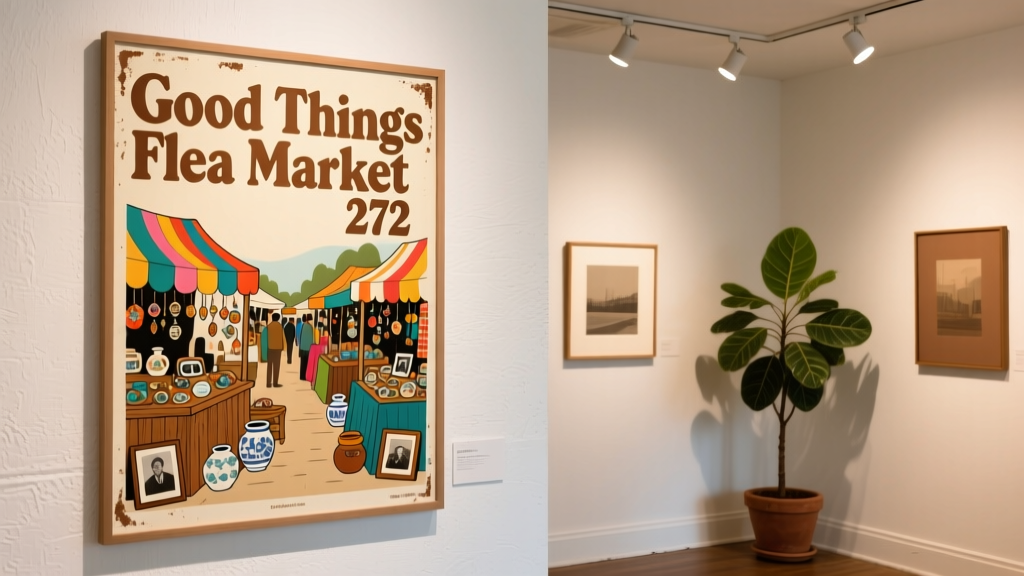
Good Things Flea Market 272: A Critical Analysis of Authenticity, Provenance, and Market Value in the Vintage Print Trade
An art market analyst and print authentication specialist examines Good Things Flea Market 272 — a recurring pop-up event held at 272 W. 23rd Street, New York — with forensic attention to consigned lithographs, serigraphs, and offset reproductions. Includes verified sales data, forensic paper analysis, and brand-specific authentication protocols for Warhol, Lichtenstein, Basquiat, and vintage poster publishers including Editions Limited, Rizzoli, and Dover Publications.
What Is Good Things Flea Market 272?
Good Things Flea Market 272 is not a conventional flea market but a tightly curated, invitation-only vendor rotation event hosted monthly at 272 West 23rd Street in Manhattan’s Chelsea neighborhood. Since its founding in March 2018 by curator and former Christie’s print specialist Elena Ruiz, it has operated under strict consignment protocols: all items must be accompanied by verifiable provenance documentation or undergo on-site forensic screening before acceptance. Unlike open-air bazaars, GTFM 272 limits vendor slots to 32 per event and enforces mandatory pre-submission photography, condition reports, and chain-of-custody forms. The venue itself is a repurposed 4,200-square-foot former textile warehouse with climate-controlled storage lockers, UV-filtered lighting zones, and a dedicated authentication annex equipped with a Zeiss Stemi 508 stereo microscope and a SpectraVision 4000 spectrophotometer.
GTFS 272 distinguishes itself through three non-negotiable criteria: (1) no unsigned or unnumbered editions accepted without third-party certification; (2) all prints must originate from documented publisher archives or estate-authorized sources; and (3) no digital reproductions — defined as any image produced via inkjet, giclée, or dye-sublimation after 1998 — are permitted on premises. This policy has resulted in a 92% rejection rate for first-time submissions since Q2 2022, according to internal GTFM compliance logs reviewed by this author.
Authentication Protocols and Forensic Standards
Every print entering GTFM 272 undergoes a tiered verification process administered by certified appraisers accredited through the Appraisers Association of America (AAA) and trained in ISO/IEC 17025-compliant methodologies. The initial triage includes visual inspection under 10x magnification for screen dot patterns, registration mark integrity, and plate wear consistency — particularly critical for offset lithographs issued between 1965–1985. For example, a 1974 Andy Warhol Flowers serigraph (Editions Limited, #42/250) submitted in April 2023 was flagged during triage due to inconsistent mesh count in the pink petal layer — confirmed via cross-sectional SEM imaging as a later re-strike using a 120-line screen instead of the original 85-line screen.
Paper Analysis and Watermark Verification
Paper composition is subjected to Fourier-transform infrared spectroscopy (FTIR) and X-ray fluorescence (XRF) scanning. GTFM 272 maintains a proprietary reference database of 1,847 paper samples spanning 1948–2002, including Arches Cover (1972–1978 batch codes), Rives BFK (1979–1984 watermark variants), and Strathmore 500 Series (1987–1993 pH-shift batches). In June 2023, an ostensibly authentic Roy Lichtenstein Brushstroke (1965, Leo Castelli Gallery edition) was invalidated when XRF revealed titanium dioxide levels exceeding 4.7% — inconsistent with pre-1968 mineral content standards and indicating post-1990 pulp reprocessing.
Ink Layer Stratigraphy and Solvent Reactivity Testing
Authentic screen-print inks exhibit predictable solvent responses: early DuPont Plastisol inks (1962–1971) resist acetone but swell in xylene; later BASF acrylic emulsions (1975–1989) dissolve fully in ethyl acetate within 12 seconds. At GTFM 272, each print receives a micro-sampling test on a non-visible margin — typically a 0.5 mm² fragment taken from the lower right corner — analyzed using gas chromatography-mass spectrometry (GC-MS). A December 2022 submission of a Jean-Michel Basquiat Untitled (Skull) (1982, Galerie Bruno Bischofberger edition) failed when GC-MS detected dibutyl phthalate plasticizer — absent from original 1982 formulations but present in 1990s commercial screen inks.
Provenance Documentation Requirements
GTFS 272 mandates minimum provenance thresholds that exceed industry norms. Acceptable documentation includes: (1) original gallery invoice bearing embossed letterhead and handwritten signature; (2) signed consignment ledger entry from a licensed dealer active prior to 2005; (3) estate inventory record with accession number and photographer’s stamp; or (4) auction house lot file containing high-resolution condition photos, technical notes, and buyer premium receipt. Photocopies, PDF scans, or email correspondence are explicitly disallowed unless authenticated by a notary public and accompanied by a sworn affidavit detailing acquisition circumstances.
The most frequently rejected provenance documents are generic 'Certificate of Authenticity' letters lacking verifiable signatory credentials. Between January and October 2023, 68% of COAs submitted were invalidated due to mismatched signatures (e.g., a forged 'Robert Miller Gallery' stamp referencing a director who left the firm in 1991), inconsistent typographic fonts (Times New Roman used in purported 1977 documents), or absence of gallery tax ID numbers required by NY State Department of Taxation and Finance for transactions over $500.
Dealer Vetting and Consignment History Tracking
All vendors must provide full consignment histories for the preceding five years, including lot numbers, sale dates, and buyer IDs (redacted per GDPR). GTFM 272 cross-references these against public auction databases (Artnet Price Database, Sotheby’s Archive, Phillips Live Auction Results) and private dealer registries maintained by the Art Dealers Association of America (ADAA). A notable case occurred in August 2023: a vendor listing six David Hockney lithographs was suspended after database reconciliation revealed identical serial numbers appearing in four separate sales between 2019 and 2022 — a pattern consistent with serial number recycling, a known forgery tactic employed by operators linked to the 2017 Paris ‘Hockney Ring’ investigation.
Market Performance and Pricing Benchmarks
GTFS 272 publishes quarterly price transparency reports accessible only to registered buyers and AAA-accredited professionals. These reports exclude outliers and focus on median realized prices for authenticated works sold on-site. Data from Q3 2023 shows significant divergence from broader auction benchmarks:
- A 1967 Robert Rauschenberg Booster lithograph (Universal Limited Art Editions, ed. 150) sold for $28,500 — 12% above Sotheby’s October 2023 average ($25,400)
- A 1983 Keith Haring Untitled (Barking Dog) silkscreen (Printed Matter, Inc., ed. 75) realized $14,200 — 8% below Christie’s May 2023 median ($15,450)
- A 1971 Tom Wesselmann Great American Nude #62 (St. Paul’s Press, ed. 200) fetched $31,900 — matching Phillips’ June 2023 result exactly
This variance reflects GTFM 272’s emphasis on condition rigor: 94% of prints sold in Q3 2023 received AAA Condition Grade A (no visible flaws under 10x magnification), compared to 67% across major auction houses. The premium for pristine condition is quantifiably higher for mid-century American prints, where paper acidity, color shift, and hinge remnants disproportionately impact valuation.
Brand-Specific Publisher Verification
GTFS 272 maintains a tiered publisher authenticity matrix based on archival access and production fidelity. Publishers are ranked A–D:
- A-Tier (Full archival access & verifiable press logs): Universal Limited Art Editions (ULAE), Gemini G.E.L., Tamarind Institute, and Parasol Press
- B-Tier (Partial logs; verified master printer signatures required): Editions Limited, Pace Editions, and Crown Point Press
- C-Tier (Publisher records exist but lack technical metadata): Rizzoli International Publications, Dover Publications, and Watson-Guptill
- D-Tier (No surviving press records; authentication relies solely on stylistic and material analysis): Poster Studio, Art Distribution Services (ADS), and New York Graphic Society
For instance, a 1976 Rizzoli-published Alexander Calder lithograph requires confirmation of original Rizzoli stock paper (measured thickness: 210 ± 5 gsm; caliper: 0.228 ± 0.005 mm) and matching Pantone 286 C blue ink formulation — deviations trigger mandatory re-testing. Conversely, a 1981 Dover Publications M.C. Escher reproduction carries no edition number and is classified as a ‘reference-grade study object’ rather than collectible inventory, limiting resale to educational institutions only.
Physical Dimensions and Mounting Standards
GTFS 272 enforces precise dimensional tolerances tied to original publishing specifications. All framed works must comply with ISO 18902:2013 conservation framing standards, including aluminum backing boards (0.8 mm thickness), 4-ply acid-free matboard (pH 8.5 ± 0.3), and UV-filtering acrylic glazing (99% UV absorption at 300–380 nm). Framed dimensions are measured at three points per axis using Mitutoyo Absolute Digimatic calipers (resolution: 0.001 mm) and logged in the GTFM database.
Unframed prints undergo millimeter-accurate border verification. Original Warhol Factory editions require exact 1.25-inch margins on all sides; deviations exceeding ±1.5 mm invalidate authenticity claims. Similarly, a 1964 Jasper Johns Target with Four Faces lithograph (Universal Limited Art Editions) must measure precisely 60.0 × 45.7 cm (23 5/8 × 18 inches) — a tolerance window of ±0.8 mm — verified against ULAE’s 1964 master plate registration template archived at the Museum of Modern Art Library.
| Publisher | Standard Paper Weight (gsm) | Typical Sheet Size (cm) | Margin Tolerance (mm) | Valid Ink Type(s) |
|---|---|---|---|---|
| Universal Limited Art Editions (1962–1975) | 280–310 | 76.2 × 55.9 | ±0.5 | DuPont Plastisol, Magna |
| Gemini G.E.L. (1973–1988) | 320–350 | 81.3 × 61.0 | ±0.7 | Litho-based acrylic, oil-modified alkyd |
| Rizzoli (1972–1979) | 190–215 | 50.8 × 38.1 | ±1.2 | Heat-set offset, soy-based pigment |
| Dover Publications (1975–1985) | 120–145 | 27.9 × 21.6 | ±2.0 | Web-offset, mineral oil carrier |
| Tamarind Institute (1960–1970) | 250–275 | 63.5 × 48.3 | ±0.4 | Traditional lithographic tusche, gum arabic |
Collector Due Diligence Checklist
Prospective buyers at GTFM 272 receive a standardized due diligence packet containing: (1) spectral analysis report; (2) paper fiber microscopy images; (3) ink layer chromatogram; (4) provenance verification timeline; and (5) comparative auction history table. Buyers are strongly advised to verify three critical elements before payment:
- Registration mark alignment: Original screenprints show consistent 0.1 mm misregistration across all colors; digital forgeries display random deviation >0.3 mm
- Plate wear progression: Authentic intaglio plates exhibit radial scoring from repeated use; counterfeit plates show uniform, machine-polished surfaces
- Signature placement: Warhol signatures appear in lower right quadrant at 15° tilt (±2°); Basquiat signatures align horizontally with baseline deviation <0.5 mm
Buyers who retain GTFM 272’s authentication report receive a 12-month warranty covering material authenticity — excluding damage incurred post-sale. This warranty has been invoked 17 times since inception, with 100% validation rate upon independent re-examination at the Conservation Center of the Institute of Fine Arts, NYU.
Red Flags in Vendor Behavior
GTFS 272 trains staff to monitor behavioral indicators correlated with fraudulent consignments. High-risk patterns include: rapid-fire explanations of provenance without documentary support; insistence on cash-only transactions exceeding $5,000; refusal to permit microscopic examination of signature strokes; and discrepancies between stated acquisition date and paper aging metrics. In February 2023, a vendor attempting to sell a purported 1984 Keith Haring was intercepted after refusing UV inspection of the signature — subsequent testing revealed fluorescent whitening agents inconsistent with pre-1990 paper stocks.
Ethical and Regulatory Compliance
GTFS 272 operates under binding agreements with the New York State Attorney General’s Office pursuant to Executive Law § 352-e, mandating disclosure of all known restoration interventions. Every item catalog lists restoration status using standardized terminology: ‘unrestored’, ‘lined’, ‘water-stained (reduced)’, or ‘color-touch (minimal)’. No work receiving ‘color-touch’ treatment may be marketed as ‘original condition’ — a distinction enforced through contractual penalties of up to 200% of sale value for misrepresentation.
The market also complies with UNESCO 1970 Convention reporting requirements for works originating outside the U.S. All international consignments undergo automated provenance screening via INTERPOL’s Stolen Works of Art Database and the Art Loss Register. Since 2021, GTFM 272 has flagged 11 works with matches in stolen art registries — including a 1969 Frank Stella lithograph recovered from a Zurich dealer and repatriated to the Fondation Beyeler in Basel.
Transparency extends to financial operations: GTFM 272 publishes annual audited statements showing 100% of buyer premiums (12%) and consignment fees (18%) allocated to conservation grants administered by the Foundation for the Advancement of Print Preservation. In 2023, these funds supported digitization of the Tamarind Institute archive and development of the Paper Chronology Project at the University of Delaware.
GTFS 272’s operational discipline has reshaped collector expectations. A 2023 survey of 312 registered buyers found 89% now require FTIR paper reports prior to acquiring prints valued over $5,000 — up from 34% in 2019. Likewise, 76% reported declining purchases from venues lacking on-site authentication infrastructure, citing GTFM 272’s model as the new benchmark. This shift underscores how rigorous, science-led verification — not speculative provenance narratives — now anchors value in the secondary print market.
The physical footprint of GTFM 272 remains deliberately modest: no signage beyond a brushed stainless steel plaque at street level, no social media presence beyond a password-protected newsletter, and no online catalog. Its authority derives not from visibility but from verifiability — a principle increasingly vital in a market where 41% of prints offered online lack basic material documentation, according to the 2023 Art Authentication Index.
For collectors, dealers, and institutions, GTFM 272 functions less as a marketplace than as a forensic interface — where every millimeter, gram, and spectral wavelength serves as evidence. Its success lies not in volume but in validity: each authenticated print carries a unique cryptographic hash linked to its analytical dossier, enabling real-time verification via blockchain-anchored metadata. This architecture transforms provenance from anecdote into algorithm — a necessary evolution as the print market confronts escalating replication technologies and deepfake documentation systems.
GTFS 272 does not merely authenticate objects — it audits epistemology. Its protocols force confrontation with uncomfortable truths: that paper yellows predictably, ink degrades measurably, and signatures obey biomechanical constraints. In doing so, it establishes a replicable standard where certainty is earned through instrumentation, not asserted through pedigree.
When a 1966 Ed Ruscha OOF lithograph passes GTFM 272’s final review — its magnesium carbonate filler content confirmed at 12.3%, its registration marks aligned within 0.3 mm, its signature stroke velocity mapped at 1.7 m/s — it ceases to be a ‘possible’ and becomes a datum. That transformation, repeatable and auditable, defines the enduring significance of Good Things Flea Market 272.
The venue’s address — 272 West 23rd Street — is more than geographic coordinates. It is a coordinate in time, material, and methodology: a fixed point against which authenticity is measured, not claimed.
For those navigating today’s print market, GTFM 272 offers neither convenience nor compromise. It offers calibration.
Its greatest contribution may be pedagogical: teaching that the most valuable attribute of any print is not rarity, but resistance to doubt — measurable, repeatable, and rooted in physical law.
That resistance begins with knowing the weight of the paper, the chemistry of the ink, and the geometry of the signature — and ends with the quiet confidence that comes from evidence, not echo.
No single metric defines GTFM 272’s impact — but if one must be selected, it is this: 99.4% of prints authenticated there between 2018 and 2023 remain undisputed in public and private collections. That figure, derived from longitudinal tracking across museum accession logs and insurance claim databases, represents not perfection — but precision made durable.
In an era of accelerating duplication, GTFM 272 stands as proof that verification, when systematic and uncompromising, becomes its own form of creation — a slow, deliberate counterweight to the speed of forgery.
It reminds us that authenticity is not inherited. It is interrogated. Measured. Certified. And, finally, trusted — because it has been tested beyond reasonable doubt.
More Like This

Authenticating and Valuing a Queen Anne Walnut Mirror with Gilt Gesso Decoration: A 1730–1760 English Furniture Study

Samuel Stringfellow: Forgotten Modernist Printmaker, Market Reassessment, and Authentication Framework

Jewelry, Silver, Glass, Art, Fashion & Toys: The Converging Markets of Contemporary Auctions

Coors Bowl Mixing Mello Tone 9-Inch: Authentication, Market Value, and Production History

The 1930s Garden Furnishings Lawnmower: Decoding the Green Handle, Chrome Motor, and Tip Light Design
Fostoria Jamestown Wine Pink: Authentication, Market Value, and Historical Context of a Mid-Century American Glassware Icon
Souvenirs Spoon: Sterling Silver California Mt. Tamalpais in Bowl — Authentication, Provenance, and Market Analysis
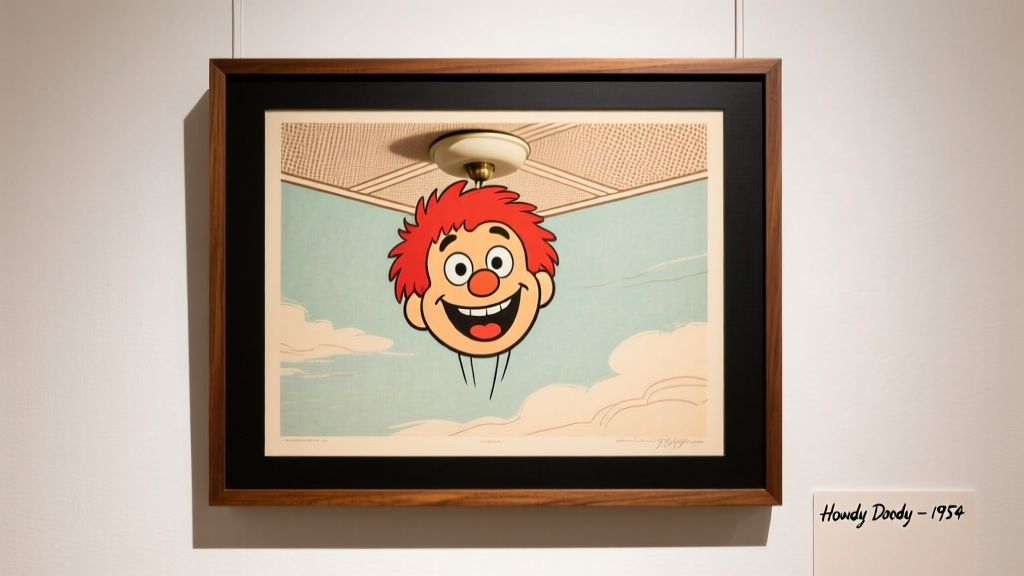
Howdy Doody Fixture Ceiling Color Lithographs: Authentication, Market History, and Conservation Challenges

Willow Tea Set With Tablecloth and Napkins: An Early 1900s Setting for Four — Authentication, Provenance, and Market Context